Influence Strategies for
Practitioners
Linda Rising
linda@lindarising.org
www.lindarising.org
Disclaimer: This provocative presentation is ideally the
beginning of a conversation. It won't take long for me
to tell you everything I know about cognitive
psychology, although I have been reading in the area
for several years now. I'm an amateur who has
sufficient interest in weird topics and a strange way of
connecting ideas that might or might not be of interest
to you. Thank you for your tolerance and understanding
of my meanderings and I hope you learn a little that
might help you in your life.
This is not an “academic” presentation, but those
interested in more information are invited to ask me for
references for any part of this talk and I will be happy
to make them available.
Persuasion
 Psychological dynamics to change people
in ways they wouldn’t if left alone.
 Manipulation, brainwashing, … have a
very different intent.
 Persuasion strategies are tools that can be
used for any purpose.
 There are always ethical considerations.
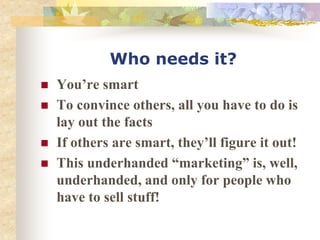
Who needs it?
 You’re smart
 To convince others, all you have to do is
lay out the facts
 If others are smart, they’ll figure it out!
 This underhanded “marketing” is, well,
underhanded, and only for people who
have to sell stuff!
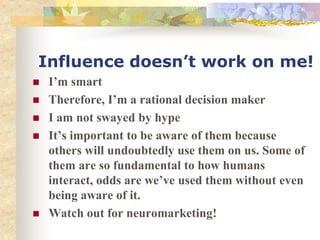
Influence doesn’t work on me!
 I’m smart
 Therefore, I’m a rational decision maker
 I am not swayed by hype
 It’s important to be aware of them because
others will undoubtedly use them on us. Some of
them are so fundamental to how humans
interact, odds are we’ve used them without even
being aware of it.
 Watch out for neuromarketing!
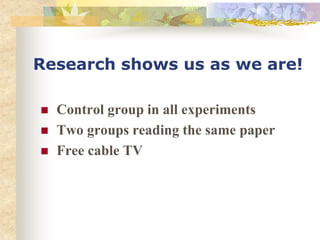
Research shows us as we are!
 Control group in all experiments
 Two groups reading the same paper
 Free cable TV
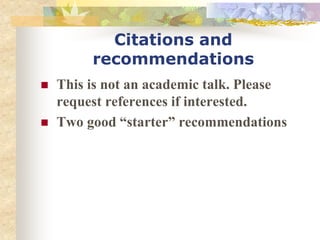
Citations and
recommendations
 This is not an academic talk. Please
request references if interested.
 Two good “starter” recommendations
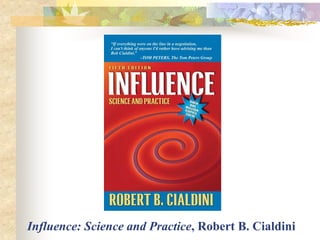
Influence: Science and Practice, Robert B. Cialdini
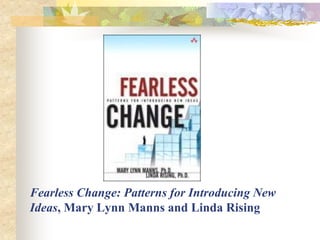
Fearless Change: Patterns for Introducing New
Ideas, Mary Lynn Manns and Linda Rising
Cialdini’s Six Strategies
Liking: We like attractive people and those who are
like us
Reciprocity: We repay in kind
Social proof: We follow the lead of similar or
superior others
Commitment/Consistency: We align with previous
commitments
Authority: We defer to authority or expertise
Scarcity/Exclusivity: We want more when access is
restricted—enhanced by exclusivity
1- Liking: We like attractive
people and those who are like us
 Attractive often equals height—
experiments with college lecturers
 Judicial system, elections, hiring/raises
 We like familiar things – names of
products, easier typeface
What can you do?
In pairs or triads think of some things you
can do on Monday morning to use
“Liking”
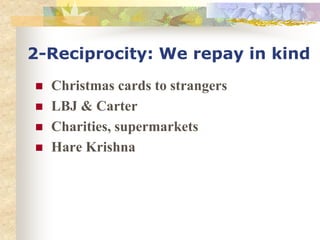
2-Reciprocity: We repay in kind
 Christmas cards to strangers
 LBJ & Carter
 Charities, supermarkets
 Hare Krishna
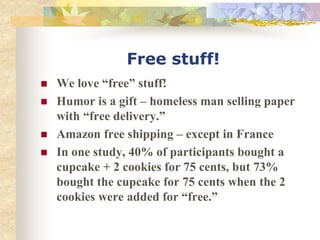
Free stuff!
 We love “free” stuff!
 Humor is a gift – homeless man selling paper
with “free delivery.”
 Amazon free shipping – except in France
 In one study, 40% of participants bought a
cupcake + 2 cookies for 75 cents, but 73%
bought the cupcake for 75 cents when the 2
cookies were added for “free.”
What can you do?
In pairs or triads think of some things you
can do on Monday morning to use
“Reciprocity”
3-Social proof: We follow the
lead of similar or superior others
 Canned laughter, fancy dinner party
 Energy use study: (1) environment, (2)
socially responsible, (3) saved money, (4)
neighbors were doing it
 Shills, street corner joke
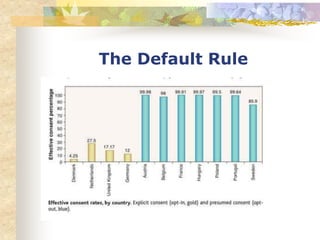
The Default Rule
What can you do?
In pairs or triads think of some things you
can do on Monday morning to use
“Social Proof”
4-Commitment/Consistency: We
align with previous commitments
 After placing bet, after voting, after buying
lottery ticket, after making any kind of
decision (especially public), we are more
certain that it was right
 Experiment with energy conservation --
providing information, asking for a change in
habits didn’t work but asking for permission to
“publish names” – even greater effect when no
names were published!
What can you do?
In pairs or triads think of some things you
can do on Monday morning to use
“Commitment or Consistency”
5-Authority: We defer to
authority or expertise
 Stanley Milgram’s grisly experiments
 Nurse’s drug story
What can you do?
In pairs or triads think of some things you
can do on Monday morning to use
“Authority”
6-Scarcity/Exclusivity: We want
more when access is restricted—
enhanced by exclusivity, cost
 18th century French reformer,
economist, and statesman Turgot
 Banned material
 Jury told to disregard information
 Wine and beer lovers are easily fooled
What can you do?
In pairs or triads think of some things you
can do on Monday morning to use
“Scarcity”
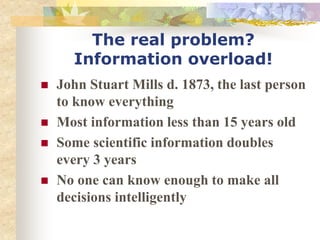
The real problem?
Information overload!
 John Stuart Mills d. 1873, the last person
to know everything
 Most information less than 15 years old
 Some scientific information doubles
every 3 years
 No one can know enough to make all
decisions intelligently
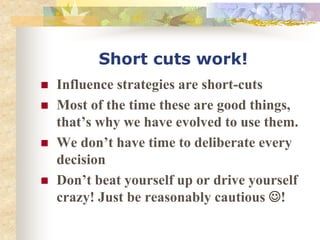
Short cuts work!
 Influence strategies are short-cuts
 Most of the time these are good things,
that’s why we have evolved to use them.
 We don’t have time to deliberate every
decision
 Don’t beat yourself up or drive yourself
crazy! Just be reasonably cautious !
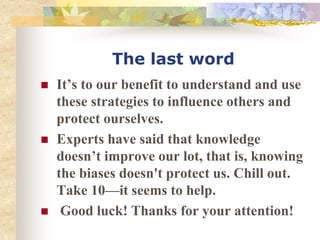
The last word
 It’s to our benefit to understand and use
these strategies to influence others and
protect ourselves.
 Experts have said that knowledge
doesn’t improve our lot, that is, knowing
the biases doesn't protect us. Chill out.
Take 10—it seems to help.
 Good luck! Thanks for your attention!

Influence strategies for practitioners - Linda Rising

  • 1.
    Influence Strategies for Practitioners LindaRising linda@lindarising.org www.lindarising.org
  • 2.
    Disclaimer: This provocativepresentation is ideally the beginning of a conversation. It won't take long for me to tell you everything I know about cognitive psychology, although I have been reading in the area for several years now. I'm an amateur who has sufficient interest in weird topics and a strange way of connecting ideas that might or might not be of interest to you. Thank you for your tolerance and understanding of my meanderings and I hope you learn a little that might help you in your life. This is not an “academic” presentation, but those interested in more information are invited to ask me for references for any part of this talk and I will be happy to make them available.
  • 3.
    Persuasion  Psychological dynamicsto change people in ways they wouldn’t if left alone.  Manipulation, brainwashing, … have a very different intent.  Persuasion strategies are tools that can be used for any purpose.  There are always ethical considerations.
  • 4.
    Who needs it? You’re smart  To convince others, all you have to do is lay out the facts  If others are smart, they’ll figure it out!  This underhanded “marketing” is, well, underhanded, and only for people who have to sell stuff!
  • 5.
    Influence doesn’t workon me!  I’m smart  Therefore, I’m a rational decision maker  I am not swayed by hype  It’s important to be aware of them because others will undoubtedly use them on us. Some of them are so fundamental to how humans interact, odds are we’ve used them without even being aware of it.  Watch out for neuromarketing!
  • 6.
    Research shows usas we are!  Control group in all experiments  Two groups reading the same paper  Free cable TV
  • 7.
    Citations and recommendations  Thisis not an academic talk. Please request references if interested.  Two good “starter” recommendations
  • 8.
    Influence: Science andPractice, Robert B. Cialdini
  • 9.
    Fearless Change: Patternsfor Introducing New Ideas, Mary Lynn Manns and Linda Rising
  • 10.
    Cialdini’s Six Strategies Liking:We like attractive people and those who are like us Reciprocity: We repay in kind Social proof: We follow the lead of similar or superior others Commitment/Consistency: We align with previous commitments Authority: We defer to authority or expertise Scarcity/Exclusivity: We want more when access is restricted—enhanced by exclusivity
  • 11.
    1- Liking: Welike attractive people and those who are like us  Attractive often equals height— experiments with college lecturers  Judicial system, elections, hiring/raises  We like familiar things – names of products, easier typeface
  • 12.
    What can youdo? In pairs or triads think of some things you can do on Monday morning to use “Liking”
  • 13.
    2-Reciprocity: We repayin kind  Christmas cards to strangers  LBJ & Carter  Charities, supermarkets  Hare Krishna
  • 14.
    Free stuff!  Welove “free” stuff!  Humor is a gift – homeless man selling paper with “free delivery.”  Amazon free shipping – except in France  In one study, 40% of participants bought a cupcake + 2 cookies for 75 cents, but 73% bought the cupcake for 75 cents when the 2 cookies were added for “free.”
  • 15.
    What can youdo? In pairs or triads think of some things you can do on Monday morning to use “Reciprocity”
  • 16.
    3-Social proof: Wefollow the lead of similar or superior others  Canned laughter, fancy dinner party  Energy use study: (1) environment, (2) socially responsible, (3) saved money, (4) neighbors were doing it  Shills, street corner joke
  • 17.
  • 18.
    What can youdo? In pairs or triads think of some things you can do on Monday morning to use “Social Proof”
  • 19.
    4-Commitment/Consistency: We align withprevious commitments  After placing bet, after voting, after buying lottery ticket, after making any kind of decision (especially public), we are more certain that it was right  Experiment with energy conservation -- providing information, asking for a change in habits didn’t work but asking for permission to “publish names” – even greater effect when no names were published!
  • 20.
    What can youdo? In pairs or triads think of some things you can do on Monday morning to use “Commitment or Consistency”
  • 21.
    5-Authority: We deferto authority or expertise  Stanley Milgram’s grisly experiments  Nurse’s drug story
  • 22.
    What can youdo? In pairs or triads think of some things you can do on Monday morning to use “Authority”
  • 23.
    6-Scarcity/Exclusivity: We want morewhen access is restricted— enhanced by exclusivity, cost  18th century French reformer, economist, and statesman Turgot  Banned material  Jury told to disregard information  Wine and beer lovers are easily fooled
  • 24.
    What can youdo? In pairs or triads think of some things you can do on Monday morning to use “Scarcity”
  • 25.
    The real problem? Informationoverload!  John Stuart Mills d. 1873, the last person to know everything  Most information less than 15 years old  Some scientific information doubles every 3 years  No one can know enough to make all decisions intelligently
  • 26.
    Short cuts work! Influence strategies are short-cuts  Most of the time these are good things, that’s why we have evolved to use them.  We don’t have time to deliberate every decision  Don’t beat yourself up or drive yourself crazy! Just be reasonably cautious !
  • 27.
    The last word It’s to our benefit to understand and use these strategies to influence others and protect ourselves.  Experts have said that knowledge doesn’t improve our lot, that is, knowing the biases doesn't protect us. Chill out. Take 10—it seems to help.  Good luck! Thanks for your attention!