“Fundraising? 
Use these words, 
not those” 
October 8, 2014 
Host: NonProfit Times 
Conducted by: Herschell Gordon Lewis 
Interlocutor: Paul Clolery
Fund raising folklore: 
Ours is a dignified world, 
existing peacefully outside 
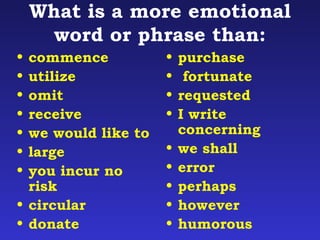
the roiling seas of 
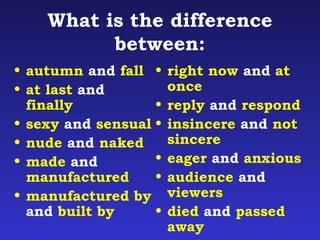
commerce. 
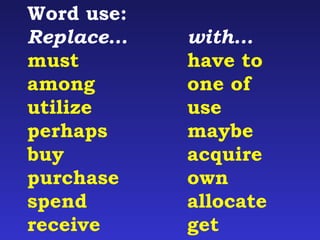
Fund raising reality: 
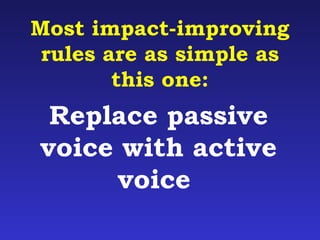
Ours is a business whose 
very nature makes it at 
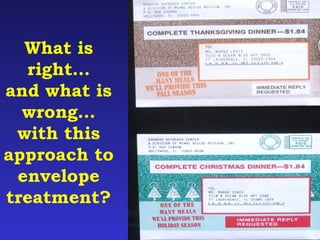
least as competitive as 
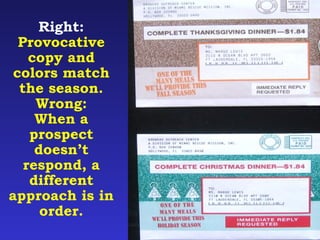
commerce … and very 
probably more so.
If you’re a professional 
writer who wants to 
increase effectiveness 
and impact, don’t look 
for big differences. Look 
for hidden sources of 
power drainage or 
apparently minor touches 
such as…
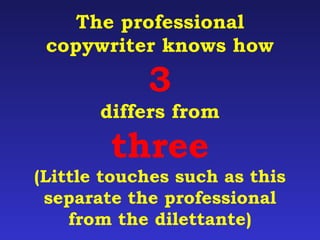
The professional 
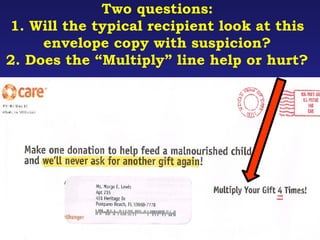
copywriter knows how 
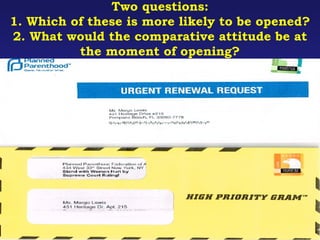
3 
differs from 
three 
(Little touches such as this 
separate the professional 
from the dilettante)
One element should drive 
every professional 
communication you create, 
from this moment forward: 
THE 
CLARITY 
COMMANDMENT
The Clarity 
Commandment: 
When you choose words and 
phrases for 
force-communication, 
clarity is paramount. 
Don’t let any other component 
of the communications mix 
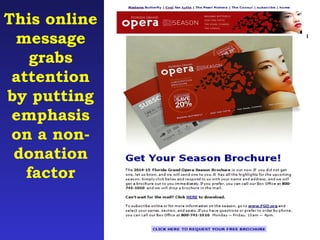
interfere with it.
Sorry, you won’t hear them 
during this diatribe: 
• Paradigm 
• Proactive 
• Win-win 
• Game plan 
• 24/7 
• Fast track 
• Customer-centric 
• At the end of the 
day 
• Core competency 
• Think outside the 
box 
• Knowledge-based 
• On the same page
Avoid these words in 
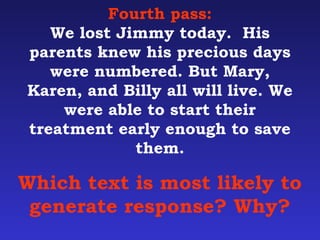
force-communication 
messages: 
• quality 
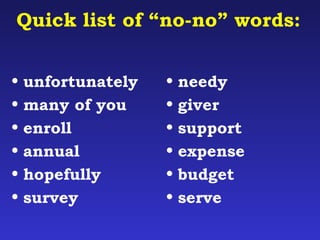
• service 
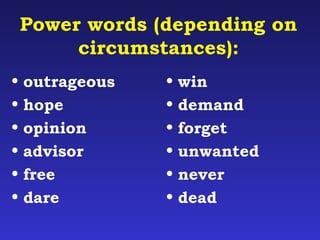
• value 
• needs (as 
noun) 
• “Remember,” 
• What’s more 
• Your partner 
in… 
•When it 
comes to…
What is a more emotional 
word or phrase than: 
• commence 
• purchase 
• utilize 
• fortunate 
• omit 
• requested 
• receive 
• I write 
• we would like to 
concerning 
• large 
• we shall 
• you incur no 
• error 
risk 
• perhaps 
• circular 
• however 
• donate 
• humorous
What is the difference 
between: 
• autumn and fall 
• at last and 
finally 
• sexy and sensual 
• nude and naked 
• made and 
manufactured 
• manufactured by 
and built by 
• right now and at 
once 
• reply and respond 
• insincere and not 
sincere 
• eager and anxious 
• audience and 
viewers 
• died and passed 
away
Word use: 
Replace… with… 
must have to 
among one of 
utilize use 
perhaps maybe 
buy acquire 
purchase own 
spend allocate 
receive get
Most impact-improving 
rules are as simple as 
this one: 
Replace passive 
voice with active 
voice
Are you establishing a 
relationship as you ask for 
funds? Passive voice adds 
distance for no beneficial 
reason: 
“A reply from you would 
be appreciated.” 
“We really do want your 
reaction.”
What is 
right… 
and what is 
wrong… 
with this 
approach to 
envelope 
treatment?
Right: 
Provocative 
copy and 
colors match 
the season. 
Wrong: 
When a 
prospect 
doesn’t 
respond, a 
different 
approach is in 
order.
If you’re a professional 
writer who wants to 
increase effectiveness 
and impact, you know 
that synonyms aren’t 
identical. For example, 
you know the difference 
between “Can you…” and 
“Will you…”:
Which has the most impact? 
► Can you help us? 
► Will you help us? 
► Will you help these kids? 
► Help me. 
► Help me, PLEASE. 
Or is it none of the above? 
The answer will make sense 
to you in about 30 minutes.
Would you ask people to… 
•give 
•donate 
•contribute 
•bestow 
•bequeath
YOU are in command of the 
reaction to your words: 
“Attention, seniors: We 
are conducting a clinical 
trial for…” 
“Attention, seniors: A 
research organization is 
conducting a clinical trial 
for…”
YOU are in command of the 
reaction to your words: 
“In the event of your 
death...” 
“If you should die....”
YOU are in command of the 
reaction to your words: 
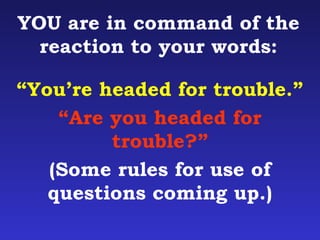
“You’re headed for trouble.” 
“Are you headed for 
trouble?” 
(Some rules for use of 
questions coming up.)
YOU are in command of the 
reaction to your words: 
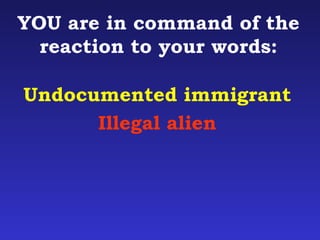
Undocumented immigrant 
Illegal alien
Which of these should 
produce better results? 
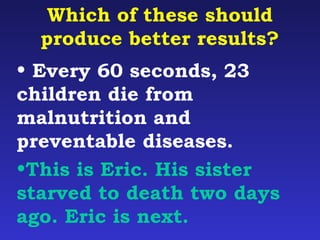
• Every 60 seconds, 23 
children die from 
malnutrition and 
preventable diseases. 
•This is Eric. His sister 
starved to death two days 
ago. Eric is next.
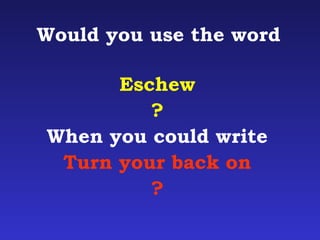
Would you use the word 
Eschew 
? 
When you could write 
Turn your back on 
?
WARNING: 
The typical recipient of your 
message, whether mail or 
online or print or broadcast, 
doesn’t share your knowledge 
of the “in-talk” that may be 
common inside your office. 
Write within the recipient’s 
experiential background, not 
yours.
A quick look at 
some of the 
weapons in our 
arsenal:
The carrier envelope has 
just one purpose 
(other than preventing 
the contents from falling 
out into the street): 
to get itself opened.
Two questions: 
1. Which of these is more likely to be opened? 
2. What would the comparative attitude be at 
the moment of opening?
Two questions: 
1. Will the typical recipient look at this 
envelope copy with suspicion? 
2. Does the “Multiply” line help or hurt?
Saying too much 
on the envelope 
can damage response.
A quick look at 
the key selling 
element of direct 
mail – the letter:
Some logical 
and ridiculously 
simple rules 
for 
effective letter-writing 
(and much email):
Keep your 
first sentence 
short.
No paragraphs 
longer than 
seven lines.
Single space 
the letter. 
Double space 
between paragraphs.
In a letter longer than 
one page, 
don’t 
end a paragraph at the 
bottom of any page 
except the last. 
(Why?)
Don’t 
sneak up 
on the reader. 
Fire 
your biggest gun 
first. 
(Imperative for e-mail.)
Tired of “Dear Friend”? 
Try one of these: 
• Good morning! 
• Hi. 
• Dear Colleague, 
• Dear Tennis Nut, 
• Dear Fellow Tennis Nut, 
• This will be a good day, [NAME]! 
• If you’re like I am, [NAME]… 
(When should you use 
only the first name?)
How does 
Hi. 
Differ from 
Hi! 
?
The p.s. should reinforce 
one of the key selling 
motivators 
or mention an extra 
benefit --- 
one which doesn't require 
explanation.
A quick look at 
online 
fundraising:
An absolute rule of 
online fundraising: 
Make response 
no-brainer 
easy.
In general, 
local 
not-for-profit organizations 
do considerably better with 
e-mail solicitations than 
national 
not-for-profit organizations. 
Why?
Two reasons: 
1. The message can be “from” a 
known individual. 
2. You have far less guesswork 
in predetermining the best 
demographic, both proved and 
unproved.
Did you know… 
•Adding the recipient’s name to 
the “Subject” line usually 
increases response. 
•Whether a produced message or 
straight text pulls best depends 
on individual and specific 
circumstances. 
•There is no point in sending 
“teaser” e-mail.
Astute fund raisers report 
success when e-mailing 
existing donors with 
“Emergency!” messages. 
E-mailing cold lists with 
the wrong words can be 
frustrating, unprofitable, 
and the cause of hate-mail.
Can (and should) you use e-mail 
either to tell a potential donor 
a direct mail appeal is coming… 
and/or… 
to remind a potential donor 
after sending a direct mail 
appeal?
Can (and should) you use e-mail 
either to tell a potential donor 
a direct mail appeal is coming… 
and/or… 
to remind a potential donor 
after sending a direct mail 
appeal? 
YES to both.
This online 
message 
grabs 
attention 
by putting 
emphasis 
on a non-donation 
factor
A quick look at 
print as possible 
fundraising 
media:
In print media, 
you have 
one to three seconds 
to grab and hold 
the reader’s 
attention. 
Don’t waste that time.
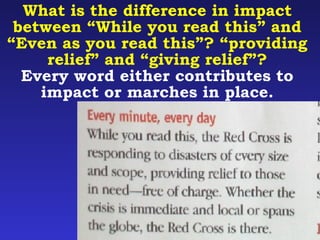
What is the difference in impact 
between “While you read this” and 
“Even as you read this”? “providing 
relief” and “giving relief”? 
Every word either contributes to 
impact or marches in place.
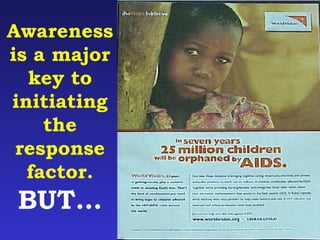
Awareness 
is a major 
key to 
initiating 
the 
response 
factor. 
BUT…
Would you regard this as 
the optimum way to 
generate response?
You have time today to 
analyze fundraising 
messages you’re working 
on now and waiting for 
your fingertips to 
produce improvement… 
and a lifetime for your 
fingertips to use what 
you’re picking up today.
Pick up and use this -- 
Information optimizing: 
Directing or changing the 
reader’s or viewer’s or 
listener’s perception 
without changing the 
facts.
Information optimizing… 
When should you use 
asterisks 
(*) 
in fund raising copy?
Information optimizing… 
When should you use 
asterisks 
(*) 
in fund raising copy? 
Never.
Information optimizing: 
Questions are 
automatically 
reader-involving.
Note the difference: 
You won’t stand by and 
let it happen. 
Will you stand by and 
let it happen? 
(Note, too: The choice is 
NOT automatic.)
A fund raising example: 
— Why I am sending you 
this message: 
— Why am I sending you 
this message? 
The psychological impact 
of the headings is in no way 
parallel, even though the 
words are identical.
Information optimizing: 
Transforming a command 
into a question not only 
dissipates latent 
antagonism but promotes 
rapport.
Requests for donations 
should be described in 
terms of the potential 
donor’s capability… 
NOT 
the organization’s 
financial goals.
An absolute truism of 
force-communication: 
Specifics 
outpull 
generalizations.
Please do agree: 
21st century fund raising 
demands more than the 
classic true but worn 
“We need help” 
approach. 
And examples are more 
involving than statistics.
The superiority of 
examples over statistics: 
Statistics = cold-blooded, 
no involvement. 
Examples = warm-blooded, 
involvement.
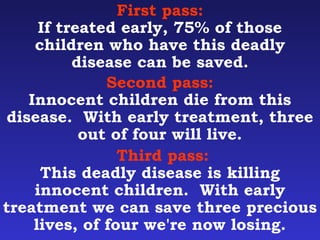
First pass: 
If treated early, 75% of those 
children who have this deadly 
disease can be saved. 
Second pass: 
Innocent children die from this 
disease. With early treatment, three 
out of four will live. 
Third pass: 
This deadly disease is killing 
innocent children. With early 
treatment we can save three precious 
lives, of four we're now losing.
Fourth pass: 
We lost Jimmy today. His 
parents knew his precious days 
were numbered. But Mary, 
Karen, and Billy all will live. We 
were able to start their 
treatment early enough to save 
them. 
Which text is most likely to 
generate response? Why?
And as 
we end, 
some more 
words…
Quick list of “no-no” words: 
• unfortunately 
• many of you 
• enroll 
• annual 
• hopefully 
• survey 
• needy 
• giver 
• support 
• expense 
• budget 
• serve
Power words (depending on 
circumstances): 
• outrageous 
• hope 
• opinion 
• advisor 
• free 
• dare 
• win 
• demand 
• forget 
• unwanted 
• never 
• dead
A few words that can bring 
serendipitous response: 
• relief 
• reward 
• support 
• culture 
• benefit/ 
• pain 
beneficial 
• pleasure 
• celebrate 
• expand/ 
• hero 
expansion
Let’s use two of those 
serendipitous words for 
this get-together: 
•It’s a pleasure 
to wrap this up. 
•It’s a relief 
to wrap this up.
???????????????????????? 
???????????????????????? 
???????????????????????? 
???????????????????????? 
Questions 
???????????????????????? 
???????????????????????? 
???????????????????????? 
????????????????????????

Np twebinar2014

  • 1.
    “Fundraising? Use thesewords, not those” October 8, 2014 Host: NonProfit Times Conducted by: Herschell Gordon Lewis Interlocutor: Paul Clolery
  • 3.
    Fund raising folklore: Ours is a dignified world, existing peacefully outside the roiling seas of commerce. Fund raising reality: Ours is a business whose very nature makes it at least as competitive as commerce … and very probably more so.
  • 4.
    If you’re aprofessional writer who wants to increase effectiveness and impact, don’t look for big differences. Look for hidden sources of power drainage or apparently minor touches such as…
  • 5.
    The professional copywriterknows how 3 differs from three (Little touches such as this separate the professional from the dilettante)
  • 6.
    One element shoulddrive every professional communication you create, from this moment forward: THE CLARITY COMMANDMENT
  • 7.
    The Clarity Commandment: When you choose words and phrases for force-communication, clarity is paramount. Don’t let any other component of the communications mix interfere with it.
  • 8.
    Sorry, you won’thear them during this diatribe: • Paradigm • Proactive • Win-win • Game plan • 24/7 • Fast track • Customer-centric • At the end of the day • Core competency • Think outside the box • Knowledge-based • On the same page
  • 9.
    Avoid these wordsin force-communication messages: • quality • service • value • needs (as noun) • “Remember,” • What’s more • Your partner in… •When it comes to…
  • 10.
    What is amore emotional word or phrase than: • commence • purchase • utilize • fortunate • omit • requested • receive • I write • we would like to concerning • large • we shall • you incur no • error risk • perhaps • circular • however • donate • humorous
  • 11.
    What is thedifference between: • autumn and fall • at last and finally • sexy and sensual • nude and naked • made and manufactured • manufactured by and built by • right now and at once • reply and respond • insincere and not sincere • eager and anxious • audience and viewers • died and passed away
  • 12.
    Word use: Replace…with… must have to among one of utilize use perhaps maybe buy acquire purchase own spend allocate receive get
  • 13.
    Most impact-improving rulesare as simple as this one: Replace passive voice with active voice
  • 14.
    Are you establishinga relationship as you ask for funds? Passive voice adds distance for no beneficial reason: “A reply from you would be appreciated.” “We really do want your reaction.”
  • 15.
    What is right… and what is wrong… with this approach to envelope treatment?
  • 16.
    Right: Provocative copyand colors match the season. Wrong: When a prospect doesn’t respond, a different approach is in order.
  • 17.
    If you’re aprofessional writer who wants to increase effectiveness and impact, you know that synonyms aren’t identical. For example, you know the difference between “Can you…” and “Will you…”:
  • 18.
    Which has themost impact? ► Can you help us? ► Will you help us? ► Will you help these kids? ► Help me. ► Help me, PLEASE. Or is it none of the above? The answer will make sense to you in about 30 minutes.
  • 19.
    Would you askpeople to… •give •donate •contribute •bestow •bequeath
  • 20.
    YOU are incommand of the reaction to your words: “Attention, seniors: We are conducting a clinical trial for…” “Attention, seniors: A research organization is conducting a clinical trial for…”
  • 21.
    YOU are incommand of the reaction to your words: “In the event of your death...” “If you should die....”
  • 22.
    YOU are incommand of the reaction to your words: “You’re headed for trouble.” “Are you headed for trouble?” (Some rules for use of questions coming up.)
  • 23.
    YOU are incommand of the reaction to your words: Undocumented immigrant Illegal alien
  • 24.
    Which of theseshould produce better results? • Every 60 seconds, 23 children die from malnutrition and preventable diseases. •This is Eric. His sister starved to death two days ago. Eric is next.
  • 25.
    Would you usethe word Eschew ? When you could write Turn your back on ?
  • 26.
    WARNING: The typicalrecipient of your message, whether mail or online or print or broadcast, doesn’t share your knowledge of the “in-talk” that may be common inside your office. Write within the recipient’s experiential background, not yours.
  • 27.
    A quick lookat some of the weapons in our arsenal:
  • 28.
    The carrier envelopehas just one purpose (other than preventing the contents from falling out into the street): to get itself opened.
  • 29.
    Two questions: 1.Which of these is more likely to be opened? 2. What would the comparative attitude be at the moment of opening?
  • 30.
    Two questions: 1.Will the typical recipient look at this envelope copy with suspicion? 2. Does the “Multiply” line help or hurt?
  • 31.
    Saying too much on the envelope can damage response.
  • 32.
    A quick lookat the key selling element of direct mail – the letter:
  • 33.
    Some logical andridiculously simple rules for effective letter-writing (and much email):
  • 34.
    Keep your firstsentence short.
  • 35.
    No paragraphs longerthan seven lines.
  • 36.
    Single space theletter. Double space between paragraphs.
  • 37.
    In a letterlonger than one page, don’t end a paragraph at the bottom of any page except the last. (Why?)
  • 38.
    Don’t sneak up on the reader. Fire your biggest gun first. (Imperative for e-mail.)
  • 39.
    Tired of “DearFriend”? Try one of these: • Good morning! • Hi. • Dear Colleague, • Dear Tennis Nut, • Dear Fellow Tennis Nut, • This will be a good day, [NAME]! • If you’re like I am, [NAME]… (When should you use only the first name?)
  • 40.
    How does Hi. Differ from Hi! ?
  • 41.
    The p.s. shouldreinforce one of the key selling motivators or mention an extra benefit --- one which doesn't require explanation.
  • 42.
    A quick lookat online fundraising:
  • 43.
    An absolute ruleof online fundraising: Make response no-brainer easy.
  • 44.
    In general, local not-for-profit organizations do considerably better with e-mail solicitations than national not-for-profit organizations. Why?
  • 45.
    Two reasons: 1.The message can be “from” a known individual. 2. You have far less guesswork in predetermining the best demographic, both proved and unproved.
  • 46.
    Did you know… •Adding the recipient’s name to the “Subject” line usually increases response. •Whether a produced message or straight text pulls best depends on individual and specific circumstances. •There is no point in sending “teaser” e-mail.
  • 47.
    Astute fund raisersreport success when e-mailing existing donors with “Emergency!” messages. E-mailing cold lists with the wrong words can be frustrating, unprofitable, and the cause of hate-mail.
  • 48.
    Can (and should)you use e-mail either to tell a potential donor a direct mail appeal is coming… and/or… to remind a potential donor after sending a direct mail appeal?
  • 49.
    Can (and should)you use e-mail either to tell a potential donor a direct mail appeal is coming… and/or… to remind a potential donor after sending a direct mail appeal? YES to both.
  • 50.
    This online message grabs attention by putting emphasis on a non-donation factor
  • 51.
    A quick lookat print as possible fundraising media:
  • 52.
    In print media, you have one to three seconds to grab and hold the reader’s attention. Don’t waste that time.
  • 53.
    What is thedifference in impact between “While you read this” and “Even as you read this”? “providing relief” and “giving relief”? Every word either contributes to impact or marches in place.
  • 54.
    Awareness is amajor key to initiating the response factor. BUT…
  • 55.
    Would you regardthis as the optimum way to generate response?
  • 56.
    You have timetoday to analyze fundraising messages you’re working on now and waiting for your fingertips to produce improvement… and a lifetime for your fingertips to use what you’re picking up today.
  • 57.
    Pick up anduse this -- Information optimizing: Directing or changing the reader’s or viewer’s or listener’s perception without changing the facts.
  • 58.
    Information optimizing… Whenshould you use asterisks (*) in fund raising copy?
  • 59.
    Information optimizing… Whenshould you use asterisks (*) in fund raising copy? Never.
  • 60.
    Information optimizing: Questionsare automatically reader-involving.
  • 61.
    Note the difference: You won’t stand by and let it happen. Will you stand by and let it happen? (Note, too: The choice is NOT automatic.)
  • 62.
    A fund raisingexample: — Why I am sending you this message: — Why am I sending you this message? The psychological impact of the headings is in no way parallel, even though the words are identical.
  • 63.
    Information optimizing: Transforminga command into a question not only dissipates latent antagonism but promotes rapport.
  • 64.
    Requests for donations should be described in terms of the potential donor’s capability… NOT the organization’s financial goals.
  • 65.
    An absolute truismof force-communication: Specifics outpull generalizations.
  • 66.
    Please do agree: 21st century fund raising demands more than the classic true but worn “We need help” approach. And examples are more involving than statistics.
  • 67.
    The superiority of examples over statistics: Statistics = cold-blooded, no involvement. Examples = warm-blooded, involvement.
  • 68.
    First pass: Iftreated early, 75% of those children who have this deadly disease can be saved. Second pass: Innocent children die from this disease. With early treatment, three out of four will live. Third pass: This deadly disease is killing innocent children. With early treatment we can save three precious lives, of four we're now losing.
  • 69.
    Fourth pass: Welost Jimmy today. His parents knew his precious days were numbered. But Mary, Karen, and Billy all will live. We were able to start their treatment early enough to save them. Which text is most likely to generate response? Why?
  • 70.
    And as weend, some more words…
  • 71.
    Quick list of“no-no” words: • unfortunately • many of you • enroll • annual • hopefully • survey • needy • giver • support • expense • budget • serve
  • 72.
    Power words (dependingon circumstances): • outrageous • hope • opinion • advisor • free • dare • win • demand • forget • unwanted • never • dead
  • 73.
    A few wordsthat can bring serendipitous response: • relief • reward • support • culture • benefit/ • pain beneficial • pleasure • celebrate • expand/ • hero expansion
  • 74.
    Let’s use twoof those serendipitous words for this get-together: •It’s a pleasure to wrap this up. •It’s a relief to wrap this up.
  • 76.
    ???????????????????????? ???????????????????????? ???????????????????????? ???????????????????????? Questions ???????????????????????? ???????????????????????? ???????????????????????? ????????????????????????