Toy Compiler
Toy compiler
Front end :
It performs lexical , syntax and semantic Involved functions…
1.Determining validity of a source statement from the view point
of analysis.
2.Determine the “content” of source statement.
3.Construct a suitable representation of the source statement for
being used by subsequent analysis function (or)the synthesis
phase of the language processor.
FrontEnd…
•Lexical analysis=Content in lexical class.
•Syntax analysis=syntactic structure of source
statement.
•Semantic analysis=In meaning of statement
_ For a declaration statement
_ It is set of attributes of a declared variable
Example: Type, length and dimensionality
FrontEnd…
Output of Front end:
1.Tables of information.
2.An intermediate code which is the
description of the source program.
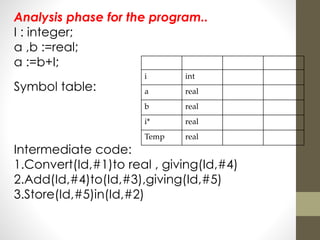
Analysis phase for the program..
I : integer;
a ,b :=real;
a :=b+I;
Symbol table:
Intermediate code:
1.Convert(Id,#1)to real , giving(Id,#4)
2.Add(Id,#4)to(Id,#3),giving(Id,#5)
3.Store(Id,#5)in(Id,#2)
Symbol type length address
i int
a real
b real
i* real
Temp real
Lexical analysis(scanning):
Identifies lexical units in source statement.Its
Classifies units into different lexical classes.
Eg: id’s,constants,reserved id’s etc.
Eg:the statement a := b+i represented as string
of tokens.
Id#2 Op#5 Id#3 OP#3 Id#1 Op#10
Syntax Analysis:
Syntax analysis processes the string of tokens
built by lexical analysis to determine the
statement classes.
Eg: assignment statement,if statement ,etc..
real :=
a b a +
b i
•Semantic Analysis:
:= := :=
a,real + a,real + a,real temp,real
b,real i,int b,real i*,real
Back End:
• Involves Two phases
• Memory Allocation
• Code Generation
Memory Allocation
• It is a simple task given the presence of the
symbol table.
• The memory requirement of an identifier is
computed from its type,length,dimensionality
and memory is allocated
• For example
Symbol Type Length Address
1 i int 2000
2 a real 2001
3 a real 2002
Code Generation
• It uses knowledge of the target architectue i.e.. Knowledge of
instructions and addressing modes
• Issues
• 1.Detremine the places where the intermediate results to be
kept (either on memory locations or in machine registers)
• 2.Determine which instruction should be used for type
conversion
• 3.determine which addressing mode to be used while
accessing variables.
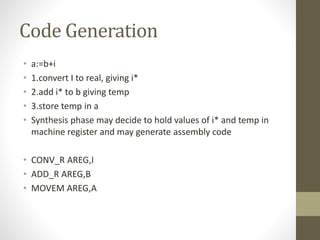
Code Generation
• a:=b+i
• 1.convert I to real, giving i*
• 2.add i* to b giving temp
• 3.store temp in a
• Synthesis phase may decide to hold values of i* and temp in
machine register and may generate assembly code
• CONV_R AREG,I
• ADD_R AREG,B
• MOVEM AREG,A

Toy compiler

  • 1.
  • 2.
    Toy compiler Front end: It performs lexical , syntax and semantic Involved functions… 1.Determining validity of a source statement from the view point of analysis. 2.Determine the “content” of source statement. 3.Construct a suitable representation of the source statement for being used by subsequent analysis function (or)the synthesis phase of the language processor.
  • 3.
    FrontEnd… •Lexical analysis=Content inlexical class. •Syntax analysis=syntactic structure of source statement. •Semantic analysis=In meaning of statement _ For a declaration statement _ It is set of attributes of a declared variable Example: Type, length and dimensionality
  • 4.
    FrontEnd… Output of Frontend: 1.Tables of information. 2.An intermediate code which is the description of the source program.
  • 5.
    Analysis phase forthe program.. I : integer; a ,b :=real; a :=b+I; Symbol table: Intermediate code: 1.Convert(Id,#1)to real , giving(Id,#4) 2.Add(Id,#4)to(Id,#3),giving(Id,#5) 3.Store(Id,#5)in(Id,#2) Symbol type length address i int a real b real i* real Temp real
  • 6.
    Lexical analysis(scanning): Identifies lexicalunits in source statement.Its Classifies units into different lexical classes. Eg: id’s,constants,reserved id’s etc. Eg:the statement a := b+i represented as string of tokens. Id#2 Op#5 Id#3 OP#3 Id#1 Op#10
  • 7.
    Syntax Analysis: Syntax analysisprocesses the string of tokens built by lexical analysis to determine the statement classes. Eg: assignment statement,if statement ,etc.. real := a b a + b i
  • 8.
    •Semantic Analysis: := :=:= a,real + a,real + a,real temp,real b,real i,int b,real i*,real
  • 9.
    Back End: • InvolvesTwo phases • Memory Allocation • Code Generation
  • 10.
    Memory Allocation • Itis a simple task given the presence of the symbol table. • The memory requirement of an identifier is computed from its type,length,dimensionality and memory is allocated • For example Symbol Type Length Address 1 i int 2000 2 a real 2001 3 a real 2002
  • 11.
    Code Generation • Ituses knowledge of the target architectue i.e.. Knowledge of instructions and addressing modes • Issues • 1.Detremine the places where the intermediate results to be kept (either on memory locations or in machine registers) • 2.Determine which instruction should be used for type conversion • 3.determine which addressing mode to be used while accessing variables.
  • 12.
    Code Generation • a:=b+i •1.convert I to real, giving i* • 2.add i* to b giving temp • 3.store temp in a • Synthesis phase may decide to hold values of i* and temp in machine register and may generate assembly code • CONV_R AREG,I • ADD_R AREG,B • MOVEM AREG,A