The study of the adverse effects
of a toxin on living organisms
• Adverse effects
– any change from an organism’s normal state
– dependent upon the concentration of toxin at the target
site for a sufficient time
• Toxin (Poison)
– any agent capable of producing a deleterious response
in a biological system
• Living organism
– a sac of water with target sites, storage depots and
enzymes
What is a Poison?
All substances are poisons;
there is none that is not a poison.
The right dose
differentiates a poison and a remedy.
Paracelsus (1493-1541)
What is a Dose?
The amount of chemical entering the body
This is usually given as
mg of chemical/kg of body weight = mg/kg
The dose is dependent upon
* The environmental concentration
* The properties of the toxin
* The frequency of exposure
* The length of exposure
* The exposure pathway
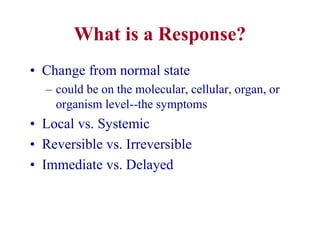
What is a Response?
• Change from normal state
– could be on the molecular, cellular, organ, or
organism level--the symptoms
• Local vs. Systemic
• Reversible vs. Irreversible
• Immediate vs. Delayed
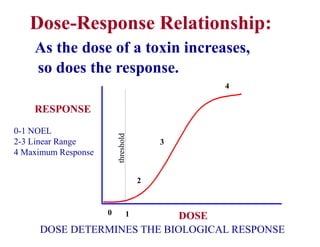
Dose-Response Relationship:
As the dose of a toxin increases,
so does the response.
2
3
4
0 1 DOSE
RESPONSE
0-1 NOEL
2-3 Linear Range
4 Maximum Response
DOSE DETERMINES THE BIOLOGICAL RESPONSE
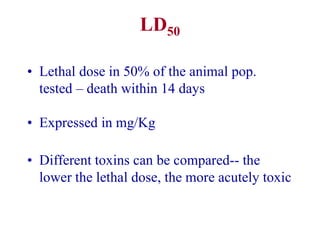
LD50
• Lethal dose in 50% of the animal pop.
tested – death within 14 days
• Expressed in mg/Kg
• Different toxins can be compared-- the
lower the lethal dose, the more acutely toxic
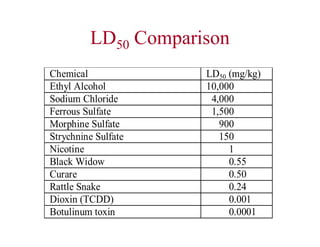
LD50 Comparison
Chemical LD50 (mg/kg)
Ethyl Alcohol 10,000
Sodium Chloride 4,000
Ferrous Sulfate 1,500
Morphine Sulfate 900
Strychnine Sulfate 150
Nicotine 1
Black Widow 0.55
Curare 0.50
Rattle Snake 0.24
Dioxin (TCDD) 0.001
Botulinum toxin 0.0001
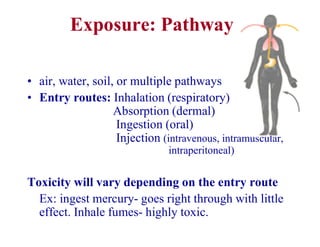
Exposure: Pathway
• air, water, soil, or multiple pathways
• Entry routes: Inhalation (respiratory)
Absorption (dermal)
Ingestion (oral)
Injection (intravenous, intramuscular,
intraperitoneal)
Toxicity will vary depending on the entry route
Ex: ingest mercury- goes right through with little
effect. Inhale fumes- highly toxic.
Exposure: Duration
Acute < 24hr usually 1 exposure
Subacute 1 month repeated doses
Subchronic 1-3mo repeated doses
Chronic > 3mo repeated doses
Over time, the amount of chemical in the body can
build up, it can redistribute, or it can overwhelm
repair and removal mechanisms
Susceptibility
• Varies by species
– Close taxonomy cannot predict similarity in
susceptibility
• Varies between individuals due to:
– genetics
– age
– health status
– gender
– nutrients
– hormonal status
– synergistic and antagonistic effects
Individual Susceptibility
--there can be 10-30 fold difference in
response to a toxicant in a population
• Genetics-species, strain variation, individual
variations (yet still can extrapolate between
mammals--similar biological mechanisms)
• Gender (gasoline nephrotox in male mice only)
• Age--young
– underdeveloped excretory mechanisms
– underdeveloped biotransformation enzymes
– underdeveloped blood-brain barrier
Individual Susceptibility
• Age--old
– changes in excretion and metabolism rates,
body fat
• Nutritional status
• Health conditions
• Previous or Concurrent Exposures
– additive --antagonistic
– synergistic
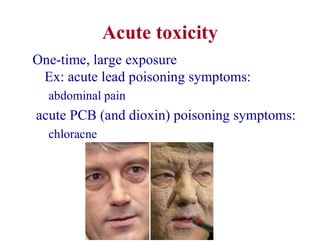
Acute toxicity
One-time, large exposure
Ex: acute lead poisoning symptoms:
abdominal pain
acute PCB (and dioxin) poisoning symptoms:
chloracne
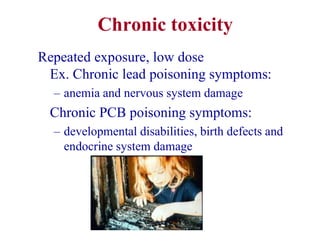
Chronic toxicity
Repeated exposure, low dose
Ex. Chronic lead poisoning symptoms:
– anemia and nervous system damage
Chronic PCB poisoning symptoms:
– developmental disabilities, birth defects and
endocrine system damage
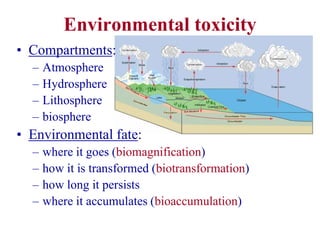
Environmental toxicity
• Compartments:
– Atmosphere
– Hydrosphere
– Lithosphere
– biosphere
• Environmental fate:
– where it goes (biomagnification)
– how it is transformed (biotransformation)
– how long it persists
– where it accumulates (bioaccumulation)
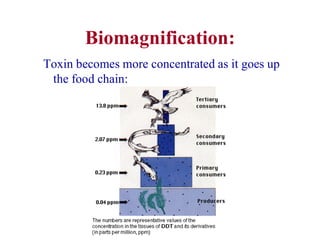
Biomagnification:
Toxin becomes more concentrated as it goes up
the food chain:
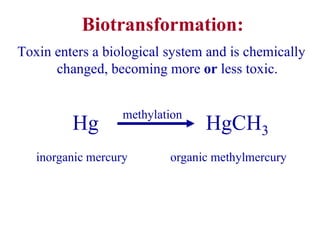
Biotransformation:
Toxin enters a biological system and is chemically
changed, becoming more or less toxic.
inorganic mercury organic methylmercury
Hg HgCH3
methylation
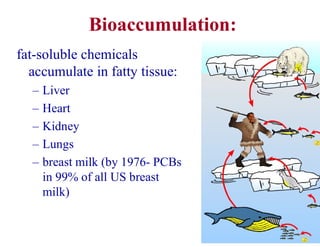
Bioaccumulation:
fat-soluble chemicals
accumulate in fatty tissue:
– Liver
– Heart
– Kidney
– Lungs
– breast milk (by 1976- PCBs
in 99% of all US breast
milk)
Toxic exposure is not new
• Hippocrates described lead poisoning
in 370 BC
• Mercury fumes killed Roman slaves
and prisoners in Spanish mercury
mines
• Turkish peasants lived in houses built
with asbestos died of lung disease
What is new?
We are ALL exposed to toxic
compounds every day
• 1000 new synthetic compounds/yr.
• Many persist though wastewater
treatment and go into waterways,
affecting fish and wildlife
• 70, 000 chemicals in common use in
US, many petroleum distillation
products
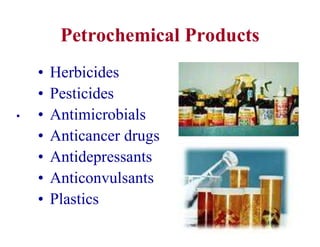
Petrochemical Products
• Herbicides
• Pesticides
• Antimicrobials
• Anticancer drugs
• Antidepressants
• Anticonvulsants
• Plastics
•
•
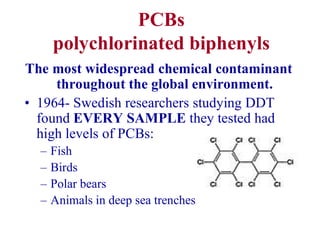
PCBs
polychlorinated biphenyls
The most widespread chemical contaminant
throughout the global environment.
• 1964- Swedish researchers studying DDT
found EVERY SAMPLE they tested had
high levels of PCBs:
– Fish
– Birds
– Polar bears
– Animals in deep sea trenches
History of PCBs:
• 1929-1973: 1.4 billion pounds produced in US
• 1930: began to be sold by Monsanto as “Arachlor”
• 1973: FDA established tolerance levels in food
• 1976: TSCA banned production, sale, distribution
or use in open systems
• 1977: Monsanto terminated production
Properties of PCBs:
• High boiling point
• Heat resistant
• Hydrophobic
– Soluble in oil
– Insoluble in water
• Nonconductor
Ways PCBs Escape into the
Environment
1. Discharges into waterways
– GE, Outboard Manufacturing
2. Vapor from paint or landfills
3. Fire
– 1981 Binghampton, NY- took years to clean up and cost $37M
4. Leaks in industrial equipment
– 1979, Billings, Montana- millions of lbs. of contam. chicken feed
5. Accidental spills and illegal dumping
– 1978, NC- 210 miles of back roads, 31,000 gallons discharged
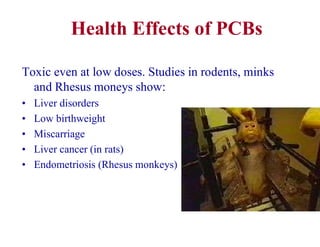
Health Effects of PCBs
Toxic even at low doses. Studies in rodents, minks
and Rhesus moneys show:
• Liver disorders
• Low birthweight
• Miscarriage
• Liver cancer (in rats)
• Endometriosis (Rhesus monkeys)
Mothers who ate fish from Lake
Michigan during pregnancy had
children with:
• Smaller head circumference
• low birth weight
• Less cooperative behavior
• Poor memories
• Lower IQ
Michigan Maternal Infant Cohort Study
1984-1990
PCBs are Endocrine Disruptors
along with at least 50 other chemicals including:
• Heavy metals (lead and mercury)
• Many synthetic petroleum based chemicals
including DDT and dioxin
• Plastics containing phthlates (a plastic softening
agent)
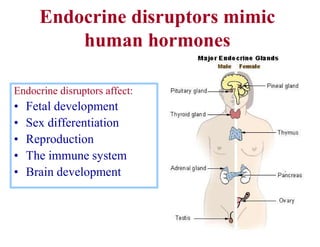
Endocrine disruptors mimic
human hormones
Endocrine disruptors affect:
• Fetal development
• Sex differentiation
• Reproduction
• The immune system
• Brain development

Toxicology

  • 2.
    The study ofthe adverse effects of a toxin on living organisms • Adverse effects – any change from an organism’s normal state – dependent upon the concentration of toxin at the target site for a sufficient time • Toxin (Poison) – any agent capable of producing a deleterious response in a biological system • Living organism – a sac of water with target sites, storage depots and enzymes
  • 3.
    What is aPoison? All substances are poisons; there is none that is not a poison. The right dose differentiates a poison and a remedy. Paracelsus (1493-1541)
  • 4.
    What is aDose? The amount of chemical entering the body This is usually given as mg of chemical/kg of body weight = mg/kg The dose is dependent upon * The environmental concentration * The properties of the toxin * The frequency of exposure * The length of exposure * The exposure pathway
  • 5.
    What is aResponse? • Change from normal state – could be on the molecular, cellular, organ, or organism level--the symptoms • Local vs. Systemic • Reversible vs. Irreversible • Immediate vs. Delayed
  • 6.
    Dose-Response Relationship: As thedose of a toxin increases, so does the response. 2 3 4 0 1 DOSE RESPONSE 0-1 NOEL 2-3 Linear Range 4 Maximum Response DOSE DETERMINES THE BIOLOGICAL RESPONSE
  • 7.
    LD50 • Lethal dosein 50% of the animal pop. tested – death within 14 days • Expressed in mg/Kg • Different toxins can be compared-- the lower the lethal dose, the more acutely toxic
  • 8.
    LD50 Comparison Chemical LD50(mg/kg) Ethyl Alcohol 10,000 Sodium Chloride 4,000 Ferrous Sulfate 1,500 Morphine Sulfate 900 Strychnine Sulfate 150 Nicotine 1 Black Widow 0.55 Curare 0.50 Rattle Snake 0.24 Dioxin (TCDD) 0.001 Botulinum toxin 0.0001
  • 9.
    Exposure: Pathway • air,water, soil, or multiple pathways • Entry routes: Inhalation (respiratory) Absorption (dermal) Ingestion (oral) Injection (intravenous, intramuscular, intraperitoneal) Toxicity will vary depending on the entry route Ex: ingest mercury- goes right through with little effect. Inhale fumes- highly toxic.
  • 10.
    Exposure: Duration Acute <24hr usually 1 exposure Subacute 1 month repeated doses Subchronic 1-3mo repeated doses Chronic > 3mo repeated doses Over time, the amount of chemical in the body can build up, it can redistribute, or it can overwhelm repair and removal mechanisms
  • 11.
    Susceptibility • Varies byspecies – Close taxonomy cannot predict similarity in susceptibility • Varies between individuals due to: – genetics – age – health status – gender – nutrients – hormonal status – synergistic and antagonistic effects
  • 12.
    Individual Susceptibility --there canbe 10-30 fold difference in response to a toxicant in a population • Genetics-species, strain variation, individual variations (yet still can extrapolate between mammals--similar biological mechanisms) • Gender (gasoline nephrotox in male mice only) • Age--young – underdeveloped excretory mechanisms – underdeveloped biotransformation enzymes – underdeveloped blood-brain barrier
  • 13.
    Individual Susceptibility • Age--old –changes in excretion and metabolism rates, body fat • Nutritional status • Health conditions • Previous or Concurrent Exposures – additive --antagonistic – synergistic
  • 14.
    Acute toxicity One-time, largeexposure Ex: acute lead poisoning symptoms: abdominal pain acute PCB (and dioxin) poisoning symptoms: chloracne
  • 15.
    Chronic toxicity Repeated exposure,low dose Ex. Chronic lead poisoning symptoms: – anemia and nervous system damage Chronic PCB poisoning symptoms: – developmental disabilities, birth defects and endocrine system damage
  • 16.
    Environmental toxicity • Compartments: –Atmosphere – Hydrosphere – Lithosphere – biosphere • Environmental fate: – where it goes (biomagnification) – how it is transformed (biotransformation) – how long it persists – where it accumulates (bioaccumulation)
  • 17.
    Biomagnification: Toxin becomes moreconcentrated as it goes up the food chain:
  • 18.
    Biotransformation: Toxin enters abiological system and is chemically changed, becoming more or less toxic. inorganic mercury organic methylmercury Hg HgCH3 methylation
  • 19.
    Bioaccumulation: fat-soluble chemicals accumulate infatty tissue: – Liver – Heart – Kidney – Lungs – breast milk (by 1976- PCBs in 99% of all US breast milk)
  • 20.
    Toxic exposure isnot new • Hippocrates described lead poisoning in 370 BC • Mercury fumes killed Roman slaves and prisoners in Spanish mercury mines • Turkish peasants lived in houses built with asbestos died of lung disease What is new?
  • 21.
    We are ALLexposed to toxic compounds every day • 1000 new synthetic compounds/yr. • Many persist though wastewater treatment and go into waterways, affecting fish and wildlife • 70, 000 chemicals in common use in US, many petroleum distillation products
  • 22.
    Petrochemical Products • Herbicides •Pesticides • Antimicrobials • Anticancer drugs • Antidepressants • Anticonvulsants • Plastics • •
  • 23.
    PCBs polychlorinated biphenyls The mostwidespread chemical contaminant throughout the global environment. • 1964- Swedish researchers studying DDT found EVERY SAMPLE they tested had high levels of PCBs: – Fish – Birds – Polar bears – Animals in deep sea trenches
  • 24.
    History of PCBs: •1929-1973: 1.4 billion pounds produced in US • 1930: began to be sold by Monsanto as “Arachlor” • 1973: FDA established tolerance levels in food • 1976: TSCA banned production, sale, distribution or use in open systems • 1977: Monsanto terminated production
  • 25.
    Properties of PCBs: •High boiling point • Heat resistant • Hydrophobic – Soluble in oil – Insoluble in water • Nonconductor
  • 26.
    Ways PCBs Escapeinto the Environment 1. Discharges into waterways – GE, Outboard Manufacturing 2. Vapor from paint or landfills 3. Fire – 1981 Binghampton, NY- took years to clean up and cost $37M 4. Leaks in industrial equipment – 1979, Billings, Montana- millions of lbs. of contam. chicken feed 5. Accidental spills and illegal dumping – 1978, NC- 210 miles of back roads, 31,000 gallons discharged
  • 27.
    Health Effects ofPCBs Toxic even at low doses. Studies in rodents, minks and Rhesus moneys show: • Liver disorders • Low birthweight • Miscarriage • Liver cancer (in rats) • Endometriosis (Rhesus monkeys)
  • 28.
    Mothers who atefish from Lake Michigan during pregnancy had children with: • Smaller head circumference • low birth weight • Less cooperative behavior • Poor memories • Lower IQ Michigan Maternal Infant Cohort Study 1984-1990
  • 29.
    PCBs are EndocrineDisruptors along with at least 50 other chemicals including: • Heavy metals (lead and mercury) • Many synthetic petroleum based chemicals including DDT and dioxin • Plastics containing phthlates (a plastic softening agent)
  • 30.
    Endocrine disruptors mimic humanhormones Endocrine disruptors affect: • Fetal development • Sex differentiation • Reproduction • The immune system • Brain development