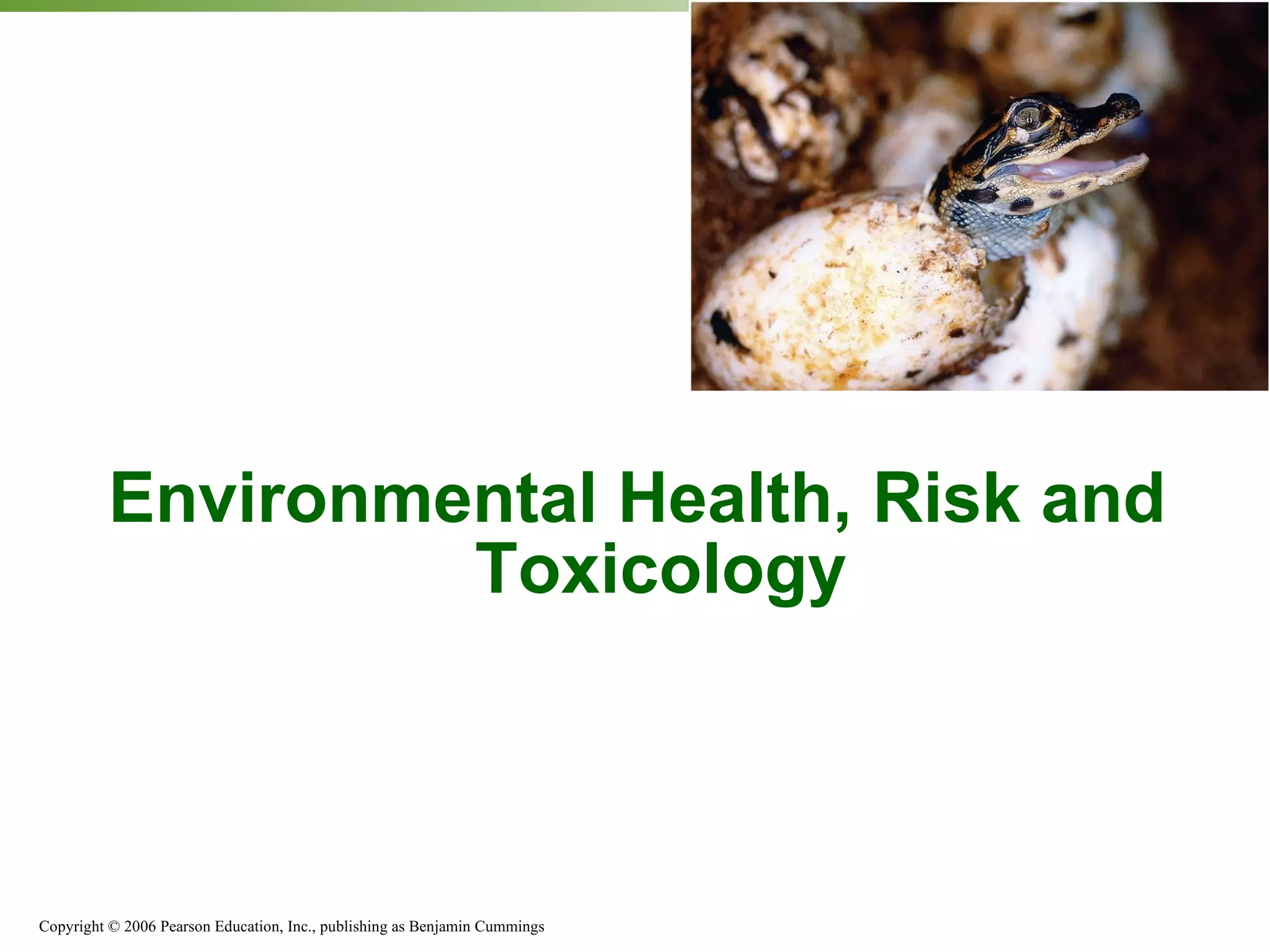
Environmental Health, Risk and Toxicology
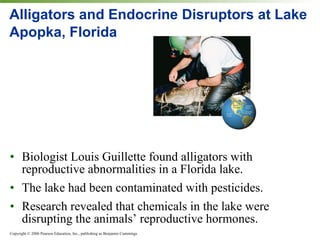
Alligators and Endocrine Disruptors at Lake Apopka, Florida Biologist Louis Guillette found alligators with reproductive abnormalities in a Florida lake. The lake had been contaminated with pesticides. Research revealed that chemicals in the lake were disrupting the animals’ reproductive hormones.
Environmental health Environmental health: Assesses environmental factors that influence human health and quality of life. Seeks to prevent adverse effects on human health and ecological systems. Contains environmental toxicology within its scope.
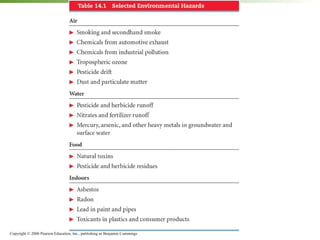
Environmental health hazards Synthetic and natural toxicants are only one type of environmental health threat.  Others are: • Physical hazards  (floods, blizzards, landslides, radon, UV exposure) • Chemical hazards  (disinfectants, pesticides) • Biological hazards  (viruses, bacterial infections) • Cultural or lifestyle hazards  (drinking, smoking, bad diet, crime in neighborhood)
 
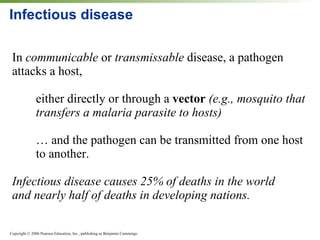
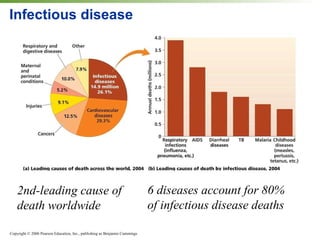
Infectious disease In  communicable  or  transmissable  disease, a pathogen attacks a host, either directly or through a  vector   (e.g., mosquito that transfers a malaria parasite to hosts) …  and the pathogen can be transmitted from one host to another. Infectious disease causes 25% of deaths in the world and nearly half of deaths in developing nations.
Infectious disease 2nd-leading cause of death worldwide 6 diseases account for 80% of infectious disease deaths
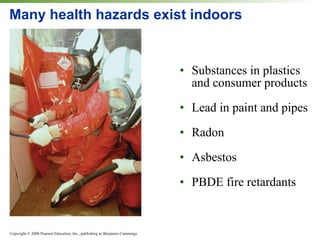
Many health hazards exist indoors Substances in plastics and consumer products Lead in paint and pipes  Radon Asbestos PBDE fire retardants
Toxicology The study of poisonous substances and their effects on humans and other organisms Toxicologists assess and compare toxic agents, or  toxicants , for their  toxicity , the degree of harm a substance can inflict. Analagous to a  pathogenicity  or  virulence  of the biological hazards that spread infectious disease. Environmental toxicology  focuses on effects of chemical poisons released into the environment.
Environmental toxicology Studies toxicants that come from or are discharged into the environment, and: Health effects on humans Effects on animals Effects on ecosystems Animals are studied: For their own welfare As “canaries in a coal mine” to warn of effects  on humans
Synthetic chemicals are everywhere in our environment Many thousands have been produced and released. Some persist for long time periods or travel great distances. 2002 USGS study:  80% of U.S. streams contain up to 82 wastewater contaminants, include antibiotics, perfumes, detergents, drugs, steroids, disinfectants, etc.
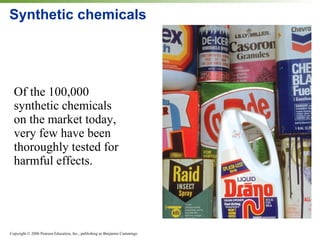
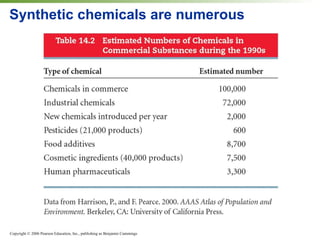
Synthetic chemicals Of the 100,000 synthetic chemicals on the market today, very few have been thoroughly tested for harmful effects.
Synthetic chemicals are numerous
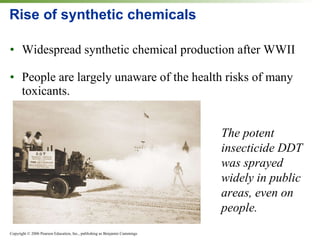
Rise of synthetic chemicals Widespread synthetic chemical production after WWII People are largely unaware of the health risks of many toxicants. The potent insecticide DDT was sprayed widely in public areas, even on people.
Silent Spring  and Rachel Carson Carson’s 1962 book alerted the public that DDT and other pesticides could be toxic to animals and people. Further research led the EPA to ban DDT in 1973. These developments were central to the modern environmental movement.
Types of toxicants Carcinogens : cause cancer Mutagens:  cause mutations in DNA Teratogens:  cause birth defects Allergens:  cause unnecessary immune response Neurotoxins:  damage nervous system Endocrine disruptors:  interfere with hormones
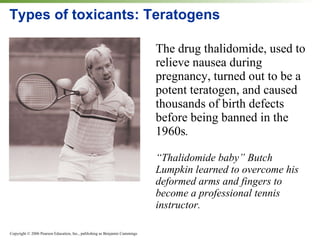
Types of toxicants: Teratogens The drug thalidomide, used to relieve nausea during pregnancy, turned out to be a potent teratogen, and caused thousands of birth defects before being banned in the 1960s .  “ Thalidomide baby” Butch Lumpkin learned to overcome his deformed arms and fingers to become a professional tennis instructor.
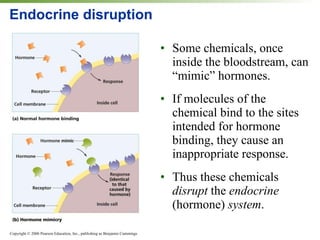
Endocrine disruption Some chemicals, once inside the bloodstream, can “mimic” hormones. If molecules of the chemical bind to the sites intended for hormone binding, they cause an inappropriate response. Thus these chemicals  disrupt  the  endocrine  (hormone)  system .
Endocrine disruption The hormone system is geared to working with tiny concentrations of hormones … … so, it can respond to tiny concentrations of environmental contaminants. Have chemicals in the environment acted as endocrine disruptors in humans?
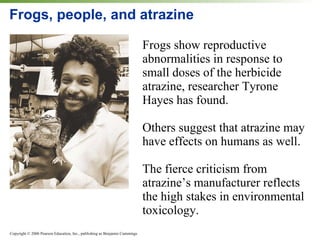
Frogs, people, and atrazine Frogs show reproductive abnormalities in response to small doses of the herbicide atrazine, researcher Tyrone Hayes has found. Others suggest that atrazine may have effects on humans as well. The fierce criticism from atrazine’s manufacturer reflects the high stakes in environmental toxicology.
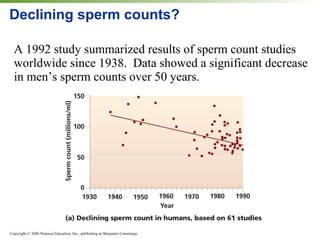
Declining sperm counts? A 1992 study summarized results of sperm count studies worldwide since 1938.  Data showed a significant decrease in men’s sperm counts over 50 years.
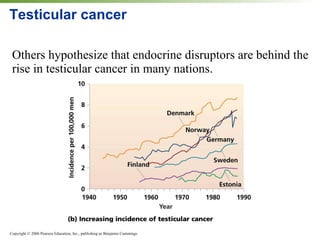
Testicular cancer Others hypothesize that endocrine disruptors are behind the rise in testicular cancer in many nations.
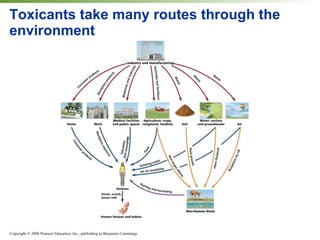
Toxicants take many routes through the environment
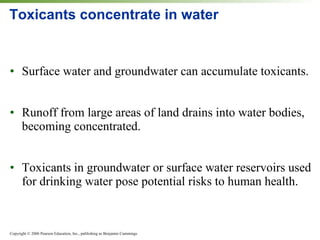
Toxicants concentrate in water Surface water and groundwater can accumulate toxicants. Runoff from large areas of land drains into water bodies, becoming concentrated. Toxicants in groundwater or surface water reservoirs used for drinking water pose potential risks to human health.
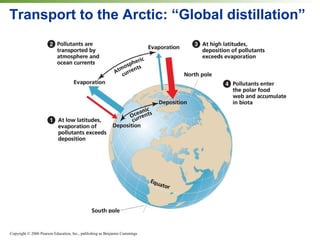
Airborne toxicants Volatile chemicals can travel long distances on atmospheric currents. PCBs are carried thousands of miles from developed nations of the temperate zone up to the Arctic, where they are found in tissues of polar bears and seals.
Transport to the Arctic: “Global distillation”
Persistence Some chemicals are more stable than others, persisting for longer in the environment. DDT and PCBs are persistent. Bt toxin in GM crops is not persistent. Temperature, moisture, sun exposure, etc., affect rate of degradation. Most toxicants degrade into simpler  breakdown products .  Some of these are also toxic.  (DDT breaks down to DDE, also toxic.)
Poisons accumulate in tissues The body may excrete, degrade, or store toxicants. Fat-soluble ones are stored. DDT is persistent and fat soluble, …  so builds up in tissues:  bioaccumulation . Bioaccumulated chemicals may be passed on to animals that eat the organism—up the food chain…
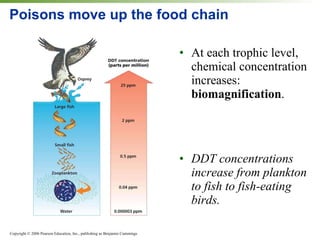
Poisons move up the food chain At each trophic level, chemical concentration increases:  biomagnification . DDT concentrations increase from plankton to fish to fish-eating birds.
All toxicants are not synthetic Although toxicology tends to focus on man-made chemicals, it’s important to keep in mind that there are plenty of natural toxicants. Many are toxins produced by animals or plants for protection against predators and pathogens.
Studying effects of hazards Toxicologists study effects in several major ways: •  Wildlife toxicology studies •  Human epidemiological studies •  Dose-response studies in the lab
Wildlife toxicology Determine causes of mortality in die-off events (e.g.,  toxoplasma) or Test animals in the lab for response to toxicants or Correlate chemical presence and animal presence in the field
Human epidemiology Human studies rely on: Case history  = observation and analysis of individual patients Epidemiological studies  = long-term, large-scale comparisons of different groups of people Animal testing
Human epidemiology Advantages:   Realistic   All real-life factors included Disadvantages:   Statistically correlational only;    does not prove causation   Takes many years to get results
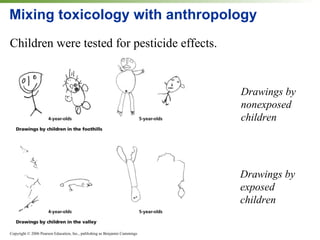
Mixing toxicology with anthropology Children were tested for pesticide effects. Drawings by nonexposed children Drawings by exposed children
Dose-response analysis Method of determining toxicity of a substance by measuring response to different doses Lab animals are used. Mice and rats breed quickly, and give data relevant to humans because they share mammal physiology with us. Responses to doses are plotted on a  dose-response curve .
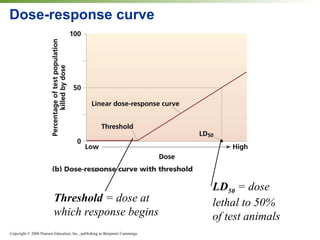
Dose-response curve LD 50  = dose lethal to 50% of test animals Threshold  = dose at which response begins
Dose-response curve Dose-response curves allow us to predict effects of higher doses. By extrapolating the curve out to higher values, we can predict how toxic a substance may be to humans at various concentrations. In most curves, response increases with dose. But this is not always the case;    the increase may not be linear. With endocrine disruption, it may  decrease .
Factors affecting toxicity Not all people are equal.  Sensitivity to toxicant can vary with sex, age, weight, etc. Babies, older people, or those in poor health are more sensitive. Type of exposure: acute  = high exposure in short period of time chronic  = lower amounts over long period of time
Mixtures of toxicants Substances may interact when combined together. Mixes of toxicants may cause effects greater than the sum of their individual effects. These are called  synergistic   effects . A challenging problem for toxicology:  There is no way to test all possible combinations! (And the environment contains complex mixtures of many toxicants.)
Policy on toxicants Key agencies and products they regulate: Food and Drug Administration (FDA) food, additives, cosmetics, drugs, medical devices Environmental Protection Agency (EPA) pesticides, industrial chemicals, and any synthetic  chemicals not covered by other agencies Occupational Health and Safety Administration (OSHA) workplace hazards
Risk Risk  = the mathematical probability that some harmful outcome will result from a given action, event, or substance Probability   = a quantitative description of the likelihood of a certain outcome Harmful outcome  could be defined as injury, death, environmental damage, economic loss, etc.
Perceiving Risk Most individuals evaluate the relative risk they face based on: Degree of control. Fear of unknown. Whether we voluntarily take the risk. Whether risk is catastrophic. Unfair distribution of risk. Sometimes misleading information, denial, and irrational fears can cloud judgment.
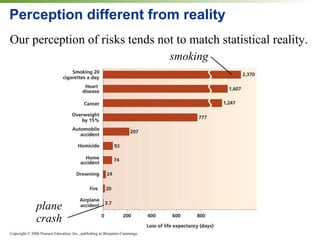
Perception different from reality Our perception of risks tends not to match statistical reality.  smoking plane crash
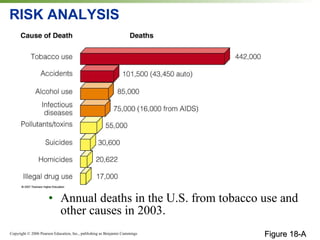
RISK ANALYSIS Annual deaths in the U.S. from tobacco use and other causes in 2003. Figure 18-A
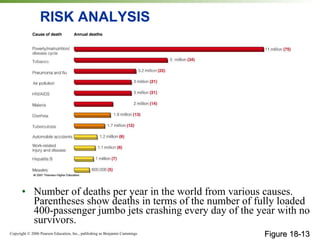
RISK ANALYSIS Number of deaths per year in the world from various causes. Parentheses show deaths in terms of the number of fully loaded 400-passenger jumbo jets crashing every day of the year with no survivors. Figure 18-13
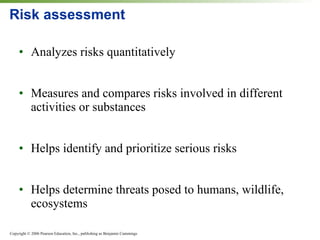
Risk assessment Analyzes risks quantitatively Measures and compares risks involved in different activities or substances Helps identify and prioritize serious risks Helps determine threats posed to humans, wildlife, ecosystems
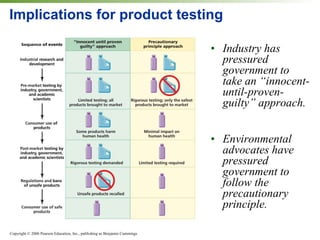
Implications for product testing “ Innocent until proven guilty”: Industry can introduce any products it wants. Government bears the burden of proof to show if  products are dangerous. Precautionary principle: Industry cannot introduce a product until it is very  thoroughly tested and shown convincingly to be  harmless.
Implications for product testing Industry has pressured government to take an “innocent-until-proven-guilty” approach. Environmental advocates have pressured government to follow the precautionary principle.
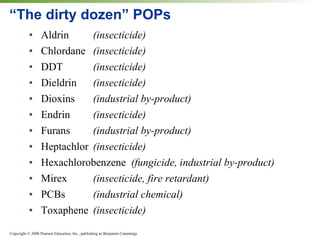
“ The dirty dozen” POPs Aldrin (insecticide) Chlordane (insecticide) DDT (insecticide) Dieldrin (insecticide) Dioxins (industrial by-product) Endrin (insecticide) Furans (industrial by-product) Heptachlor (insecticide) Hexachlorobenzene  (fungicide, industrial by-product) Mirex (insecticide, fire retardant) PCBs (industrial chemical) Toxaphene (insecticide)
Conclusion International agreements are a hopeful sign that governments will prevent environmental hazards. But solutions can come more easily when they do not arise from government regulation alone. Consumer choice can influence industry if consumers have scientific information. But we will never attain complete knowledge of risks. A safer future depends on knowing risks, phasing out harmful substances, and replacing them with safer ones.

Toxicology & risk

  • 1.
  • 2.
    Alligators and EndocrineDisruptors at Lake Apopka, Florida Biologist Louis Guillette found alligators with reproductive abnormalities in a Florida lake. The lake had been contaminated with pesticides. Research revealed that chemicals in the lake were disrupting the animals’ reproductive hormones.
  • 3.
    Environmental health Environmentalhealth: Assesses environmental factors that influence human health and quality of life. Seeks to prevent adverse effects on human health and ecological systems. Contains environmental toxicology within its scope.
  • 4.
    Environmental health hazardsSynthetic and natural toxicants are only one type of environmental health threat. Others are: • Physical hazards (floods, blizzards, landslides, radon, UV exposure) • Chemical hazards (disinfectants, pesticides) • Biological hazards (viruses, bacterial infections) • Cultural or lifestyle hazards (drinking, smoking, bad diet, crime in neighborhood)
  • 5.
  • 6.
    Infectious disease In communicable or transmissable disease, a pathogen attacks a host, either directly or through a vector (e.g., mosquito that transfers a malaria parasite to hosts) … and the pathogen can be transmitted from one host to another. Infectious disease causes 25% of deaths in the world and nearly half of deaths in developing nations.
  • 7.
    Infectious disease 2nd-leadingcause of death worldwide 6 diseases account for 80% of infectious disease deaths
  • 8.
    Many health hazardsexist indoors Substances in plastics and consumer products Lead in paint and pipes Radon Asbestos PBDE fire retardants
  • 9.
    Toxicology The studyof poisonous substances and their effects on humans and other organisms Toxicologists assess and compare toxic agents, or toxicants , for their toxicity , the degree of harm a substance can inflict. Analagous to a pathogenicity or virulence of the biological hazards that spread infectious disease. Environmental toxicology focuses on effects of chemical poisons released into the environment.
  • 10.
    Environmental toxicology Studiestoxicants that come from or are discharged into the environment, and: Health effects on humans Effects on animals Effects on ecosystems Animals are studied: For their own welfare As “canaries in a coal mine” to warn of effects on humans
  • 11.
    Synthetic chemicals areeverywhere in our environment Many thousands have been produced and released. Some persist for long time periods or travel great distances. 2002 USGS study: 80% of U.S. streams contain up to 82 wastewater contaminants, include antibiotics, perfumes, detergents, drugs, steroids, disinfectants, etc.
  • 12.
    Synthetic chemicals Ofthe 100,000 synthetic chemicals on the market today, very few have been thoroughly tested for harmful effects.
  • 13.
  • 14.
    Rise of syntheticchemicals Widespread synthetic chemical production after WWII People are largely unaware of the health risks of many toxicants. The potent insecticide DDT was sprayed widely in public areas, even on people.
  • 15.
    Silent Spring and Rachel Carson Carson’s 1962 book alerted the public that DDT and other pesticides could be toxic to animals and people. Further research led the EPA to ban DDT in 1973. These developments were central to the modern environmental movement.
  • 16.
    Types of toxicantsCarcinogens : cause cancer Mutagens: cause mutations in DNA Teratogens: cause birth defects Allergens: cause unnecessary immune response Neurotoxins: damage nervous system Endocrine disruptors: interfere with hormones
  • 17.
    Types of toxicants:Teratogens The drug thalidomide, used to relieve nausea during pregnancy, turned out to be a potent teratogen, and caused thousands of birth defects before being banned in the 1960s . “ Thalidomide baby” Butch Lumpkin learned to overcome his deformed arms and fingers to become a professional tennis instructor.
  • 18.
    Endocrine disruption Somechemicals, once inside the bloodstream, can “mimic” hormones. If molecules of the chemical bind to the sites intended for hormone binding, they cause an inappropriate response. Thus these chemicals disrupt the endocrine (hormone) system .
  • 19.
    Endocrine disruption Thehormone system is geared to working with tiny concentrations of hormones … … so, it can respond to tiny concentrations of environmental contaminants. Have chemicals in the environment acted as endocrine disruptors in humans?
  • 20.
    Frogs, people, andatrazine Frogs show reproductive abnormalities in response to small doses of the herbicide atrazine, researcher Tyrone Hayes has found. Others suggest that atrazine may have effects on humans as well. The fierce criticism from atrazine’s manufacturer reflects the high stakes in environmental toxicology.
  • 21.
    Declining sperm counts?A 1992 study summarized results of sperm count studies worldwide since 1938. Data showed a significant decrease in men’s sperm counts over 50 years.
  • 22.
    Testicular cancer Othershypothesize that endocrine disruptors are behind the rise in testicular cancer in many nations.
  • 23.
    Toxicants take manyroutes through the environment
  • 24.
    Toxicants concentrate inwater Surface water and groundwater can accumulate toxicants. Runoff from large areas of land drains into water bodies, becoming concentrated. Toxicants in groundwater or surface water reservoirs used for drinking water pose potential risks to human health.
  • 25.
    Airborne toxicants Volatilechemicals can travel long distances on atmospheric currents. PCBs are carried thousands of miles from developed nations of the temperate zone up to the Arctic, where they are found in tissues of polar bears and seals.
  • 26.
    Transport to theArctic: “Global distillation”
  • 27.
    Persistence Some chemicalsare more stable than others, persisting for longer in the environment. DDT and PCBs are persistent. Bt toxin in GM crops is not persistent. Temperature, moisture, sun exposure, etc., affect rate of degradation. Most toxicants degrade into simpler breakdown products . Some of these are also toxic. (DDT breaks down to DDE, also toxic.)
  • 28.
    Poisons accumulate intissues The body may excrete, degrade, or store toxicants. Fat-soluble ones are stored. DDT is persistent and fat soluble, … so builds up in tissues: bioaccumulation . Bioaccumulated chemicals may be passed on to animals that eat the organism—up the food chain…
  • 29.
    Poisons move upthe food chain At each trophic level, chemical concentration increases: biomagnification . DDT concentrations increase from plankton to fish to fish-eating birds.
  • 30.
    All toxicants arenot synthetic Although toxicology tends to focus on man-made chemicals, it’s important to keep in mind that there are plenty of natural toxicants. Many are toxins produced by animals or plants for protection against predators and pathogens.
  • 31.
    Studying effects ofhazards Toxicologists study effects in several major ways: • Wildlife toxicology studies • Human epidemiological studies • Dose-response studies in the lab
  • 32.
    Wildlife toxicology Determinecauses of mortality in die-off events (e.g., toxoplasma) or Test animals in the lab for response to toxicants or Correlate chemical presence and animal presence in the field
  • 33.
    Human epidemiology Humanstudies rely on: Case history = observation and analysis of individual patients Epidemiological studies = long-term, large-scale comparisons of different groups of people Animal testing
  • 34.
    Human epidemiology Advantages: Realistic All real-life factors included Disadvantages: Statistically correlational only; does not prove causation Takes many years to get results
  • 35.
    Mixing toxicology withanthropology Children were tested for pesticide effects. Drawings by nonexposed children Drawings by exposed children
  • 36.
    Dose-response analysis Methodof determining toxicity of a substance by measuring response to different doses Lab animals are used. Mice and rats breed quickly, and give data relevant to humans because they share mammal physiology with us. Responses to doses are plotted on a dose-response curve .
  • 37.
    Dose-response curve LD50 = dose lethal to 50% of test animals Threshold = dose at which response begins
  • 38.
    Dose-response curve Dose-responsecurves allow us to predict effects of higher doses. By extrapolating the curve out to higher values, we can predict how toxic a substance may be to humans at various concentrations. In most curves, response increases with dose. But this is not always the case; the increase may not be linear. With endocrine disruption, it may decrease .
  • 39.
    Factors affecting toxicityNot all people are equal. Sensitivity to toxicant can vary with sex, age, weight, etc. Babies, older people, or those in poor health are more sensitive. Type of exposure: acute = high exposure in short period of time chronic = lower amounts over long period of time
  • 40.
    Mixtures of toxicantsSubstances may interact when combined together. Mixes of toxicants may cause effects greater than the sum of their individual effects. These are called synergistic effects . A challenging problem for toxicology: There is no way to test all possible combinations! (And the environment contains complex mixtures of many toxicants.)
  • 41.
    Policy on toxicantsKey agencies and products they regulate: Food and Drug Administration (FDA) food, additives, cosmetics, drugs, medical devices Environmental Protection Agency (EPA) pesticides, industrial chemicals, and any synthetic chemicals not covered by other agencies Occupational Health and Safety Administration (OSHA) workplace hazards
  • 42.
    Risk Risk = the mathematical probability that some harmful outcome will result from a given action, event, or substance Probability = a quantitative description of the likelihood of a certain outcome Harmful outcome could be defined as injury, death, environmental damage, economic loss, etc.
  • 43.
    Perceiving Risk Mostindividuals evaluate the relative risk they face based on: Degree of control. Fear of unknown. Whether we voluntarily take the risk. Whether risk is catastrophic. Unfair distribution of risk. Sometimes misleading information, denial, and irrational fears can cloud judgment.
  • 44.
    Perception different fromreality Our perception of risks tends not to match statistical reality. smoking plane crash
  • 45.
    RISK ANALYSIS Annualdeaths in the U.S. from tobacco use and other causes in 2003. Figure 18-A
  • 46.
    RISK ANALYSIS Numberof deaths per year in the world from various causes. Parentheses show deaths in terms of the number of fully loaded 400-passenger jumbo jets crashing every day of the year with no survivors. Figure 18-13
  • 47.
    Risk assessment Analyzesrisks quantitatively Measures and compares risks involved in different activities or substances Helps identify and prioritize serious risks Helps determine threats posed to humans, wildlife, ecosystems
  • 48.
    Implications for producttesting “ Innocent until proven guilty”: Industry can introduce any products it wants. Government bears the burden of proof to show if products are dangerous. Precautionary principle: Industry cannot introduce a product until it is very thoroughly tested and shown convincingly to be harmless.
  • 49.
    Implications for producttesting Industry has pressured government to take an “innocent-until-proven-guilty” approach. Environmental advocates have pressured government to follow the precautionary principle.
  • 50.
    “ The dirtydozen” POPs Aldrin (insecticide) Chlordane (insecticide) DDT (insecticide) Dieldrin (insecticide) Dioxins (industrial by-product) Endrin (insecticide) Furans (industrial by-product) Heptachlor (insecticide) Hexachlorobenzene (fungicide, industrial by-product) Mirex (insecticide, fire retardant) PCBs (industrial chemical) Toxaphene (insecticide)
  • 51.
    Conclusion International agreementsare a hopeful sign that governments will prevent environmental hazards. But solutions can come more easily when they do not arise from government regulation alone. Consumer choice can influence industry if consumers have scientific information. But we will never attain complete knowledge of risks. A safer future depends on knowing risks, phasing out harmful substances, and replacing them with safer ones.