International Journal of Trend in Scientific Research and Development (IJTSRD)
Volume: 3 | Issue: 4 | May-Jun 2019 Available Online: www.ijtsrd.com e-ISSN: 2456 - 6470
@ IJTSRD | Unique Paper ID - IJTSRD23464 | Volume – 3 | Issue – 4 | May-Jun 2019 Page: 24
Toxic Comment Classification
Pallam Ravi, Hari Narayana Batta, Greeshma S, Shaik Yaseen
Anurag Group of Institutions, Telangana, India
How to cite this paper: Pallam Ravi |
Hari Narayana Batta | Greeshma S |
Shaik Yaseen "Toxic Comment
Classification" Published in
International Journal of Trend in
Scientific Research and Development
(ijtsrd), ISSN: 2456-
6470, Volume-3 |
Issue-4, June 2019,
pp.24-27, URL:
https://www.ijtsrd.c
om/papers/ijtsrd23
464.pdf
Copyright © 2019 by author(s) and
International Journal of Trend in
Scientific Research and Development
Journal. This is an Open Access article
distributed under
the terms of the
CreativeCommons
Attribution License (CC BY 4.0)
(http://creativecommons.org/licenses/
by/4.0)
ABSTRACT
Building a multi-headed model that's capable of detecting different types of
toxicity like threats, obscenity, insult and identity-based hate. Discussing things
you care about can be difficult. The threatof abuseandharassmentonline means
that many people stop expressing themselves and give up on seeking different
opinions. Platforms struggle to efficiently facilitate conversations, leadingmany
communities to limit or completely shut down user comments. So far we have a
range of publicly available models served through the perspective APIs,
including toxicity. But the current models still make errors, and they don't allow
users to select which type of toxicity they're interested in finding.
Keywords: toxic comment classification
1. INTRODUCTION
Discussing things you care about can be difficult. The threat
of abuse and harassment online means that many people
stop expressing themselves and give up on seeking different
opinions. Platforms struggle to evidently facilitate
conversations, leading many communities to limit or
completely shut down user comments.
2. MOTIVATION
So far we have a range of publicly available models served
through the Perspective API, including toxicity. But the
current models still make errors, and they don't allow users
to select which type of toxicity they're interested in finding.
(E.g. some platforms may be ne with profanity, but not with
other types of toxic content)
3. PROBLEM STATEMENT
Building a multi-headed model that's capable of detecting
different types of toxicity like threats, obscenity, insult and
identity-based hate.
4. DATASET
The dataset used was Wikipedia corpus dataset which was
rated by human raters for toxicity. The corpus contains
comments from discussions relating to use pages and
articles dating from 2004-2015. The dataset was hosted on
Kaggle.
5. DATA OVERVIEW
The dataset used was Wikipedia corpus dataset which was
rated by human raters for toxicity. The corpus contains
comments from discussions relating to use pages and
articles dating from 2004-2015. The dataset was hosted on
Kaggle.
The comments were manually classified into following
categories:
Toxic
Severe toxic
Obscene
Threat
Insult
Identity hate
6. APPROACH
6.1 HOW PROBABILITY WAS CALCULATED?
Though there many multi class classifiers, we do not have a
suitable multi label classier which was able to give
probability with which target belongs to a label.
So, we used scikit-learn OneVsRestClassier with various
estimators, with the help of predict_proba, we predicted the
probability with which a comment belongs to a particular
label.
IJTSRD23464
International Journal of Trend in Scientific Research and Development (IJTSRD) @ www.ijtsrd.com eISSN: 2456-6470
@ IJTSRD | Unique Paper ID - IJTSRD23464 | Volume – 3 | Issue – 4 | May-Jun 2019 Page: 25
7. ANALYSIS OF DATASET
7.1 VISUALIZATION
7.1.1 COUNT THE NUMBER OF COMMENTS IN EACH
CLASS
Three major labels are:
toxic
obscene
insult
7.1.2 Pie chart of Label Distribution over comments
(without “none” category).
7.1.3 COUNT FOR EACH LABEL COMBINATION
Now, let's take a look at number of comment for each label
combination. This helps us in finding correlation between
categories.
Following can be inferred from above table:
The table shows that number of comments with only none
label are high.
Toxic which is the label high after none is present in all top 6
combinations.
Among the top combinations, obscene and insult comes 4
times in 6.
As the combinations increase the count drops very fast.
7.1.4 CORRELATION MATRIX
Following can be inferred from above matrix:
Toxic is highly correlated with obscene and insult.
Insult and obscene have highest correlation factor of 0.74
Interesting things to be observed:
Though, a severe toxic comment is also aToxiccomment,the
correlation between them is only 0.31.
8. FEATURE ENGINEERING
8.1 CLEANING THE COMMENTS
Since, the comments in the dataset were collected
from the internet they may contain 'HTML' elements in
them. So, we removed the
HTML
We then converted each comment into lower case and then
split it into individual words.
There were some words in the dataset which had length >
100, since there are no words in the English language whose
length > 100, we remove such words.
First, we tried building the features removing stop words
and then trained some models thinking that it may help the
model in learning the semantics of toxicity, but wefoundout
that the model learns better if there are stop words in the
comment.
Possible reason is, generally a hate/toxic comment is used
towards a person, seeing the data we found out that those
persons are generally referred by pronouns, which are
nothing but stop words.
8.2 STEMMERS AND LEMMATIZERS
1. Definitions:
Stemming usually refers to a crude heuristic process that
chops o the ends of words in the hope of achieving this goal
correctly most of the time, and often includes removal of
derivational affixes.
Lemmatization usually refers to doing things properly with
the use of a vocabulary and morphologicalanalysisof words,
normally aiming to remove endings only and to return the
base or dictionary form of a word, which is known as the
lemma.
International Journal of Trend in Scientific Research and Development (IJTSRD) @ www.ijtsrd.com eISSN: 2456-6470
@ IJTSRD | Unique Paper ID - IJTSRD23464 | Volume – 3 | Issue – 4 | May-Jun 2019 Page: 26
2. Reasons to use:
We used both snowball stemmer, porter stemmer and
WordNet lemmatizer.
For grammatical reasons, documents are going to use
different forms of a word, such as organizes, organize
and organizing. But they all represent thesame semantics.
So, using stemmer/Lemmatizerforthosethreewordsgivesa
single word, which helps algorithm learn better.
3. Results:
On public dataset:
Snowball > WordNet > Porter
On private dataset:
WordNet > Snowball > Porter
Decreasing order of accuracy.
8.3 VECTORIZATION
Python's scikit-learn deals with numeric data only. To
convert the text data into numerical form, tf-idf vectorizeris
used. TF-IDF vectorizer converts a collection of raw
documents to a matrix of Tf-idf features.
We set the predictor variable on the dataset with tf-idf
vectorizer, in two different ways. First, by setting the
parameter analyzer as 'word'(select words) and the second
by setting it to 'char'(select characters). Using 'char' was
important because the data had many 'foreign languages'
and they were di cult to deal with by considering only the
'word' analyzer.
We set the parameter n-gram range (an n-gram is a
continuous sequence of n-items from a given sample of text
or speech). After trying various values, we set the n-gram as
(1, 1) for 'word' analyzer and (1, 4) for 'char' analyzer. We
also set the max_features as 30000 for both word and char
analyzer after many trails.
We then combined the word and character features and
transformed the dataset into two sparse matrixes for train
and test sets, respectively using tf-idf vectorizer.
8.4 ADDING DATA RELATED FEATURES
We tried adding features to the dataset that are computed
from the data itself. Those features are:
Length of comments
Number of exclamation marks - Data showed severe toxic
comments with multiple exclamation marks.
Number of question marks
Number of punctuation symbols - Assumption is that angry
people might not use punctuation symbols.
Number of symbols - there are some comments with words
like f**k,
$#*t etc.
Number of words
Number of unique words - Data showed that angry
comments are some- times repeated many times.
Proportion of unique words
Conclusion: All the above features had correlation of <0.06
with all labels. So, we decided that adding these features
does not benefit the model.
9. MODEL BUILDING
Our basic pipeline consisted of count vectorizer or a tf-idf
vectorizer and a classifier. We used OneVsRest Classifier
model. We trained the model with Logistic Regression (LR),
Random Forest (RF) and Gradient Boosting (GB) classifiers.
Among them LR gave good probabilities with default
parameters. So, we then improved theLRmodelbychanging
its parameters.
10. TRAINING, VALIDATION AND TEST METRICS
10.1 TRAINING AND VALIDATION SPLIT
To know whether was generalizable or not, we divided the
into train and validation sets in 80:20 ratio. We then trained
various models on the training data, then we ran the models
on validation data and we checked whether the model is
generalizable or not.
Also, we trained different models on trainingdata andtested
those on validation data, then we arrived at our best model.
10.2 TEST METRIC
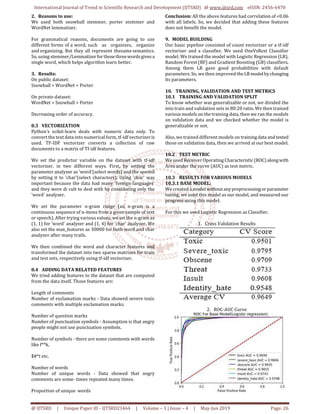
We used Receiver Operating Characteristic(ROC)alongwith
Area under the curve (AUC) as test metric.
10.3 RESULTS FOR VARIOUS MODELS
10.3.1 BASE MODEL:
We created a model withoutanypreprocessingorparameter
tuning, we used this model as our model, and measured our
progress using this model.
For this we used Logistic Regression as Classifier.
1. Cross Validation Results
2. ROC-AUC Curve
International Journal of Trend in Scientific Research and Development (IJTSRD) @ www.ijtsrd.com eISSN: 2456-6470
@ IJTSRD | Unique Paper ID - IJTSRD23464 | Volume – 3 | Issue – 4 | May-Jun 2019 Page: 27
10.3.2 Random Forest:
Next, we created our model using Random Forest. We used
n_estimators = 10 and random_state = 1 as parameters.
We observed the following results:
1. Cross Validation Results
2. ROC – AUC Curve
From the Cross Validation results table and ROC-AUC Curve,
it is clear that Random Forest performs poorly compared to
our base model itself, so we proceeded to tune parameters
for Logistic Regression for better accuracy.
10.3.3 LOGISTIC REGRESSION
I. We created one model using C = 4 as parameter. The
following results were observed.
1. Cross Validation Results
2. ROC –AUC Curve
II. We created another Logistic Regression by selecting the
best parameters by cross - validating the following
parameters.
3. Cross Validation Results
4. ROC – AUC Curve
Though, (i) gave better score compared to (ii) on validation
set, with difference in order of 0.0001. When run on the
actual data (ii) was found to better than (i).
11. CONCLUSION
After checking the kaggle discussion board of the actual
competition, standard Machine Learning approaches yield a
maximum score of 0.9792, irrespective of any approach. In
order to get a large margin over this score one has to employ
Deep Learning (DL) techniques.
12. REFERENCES
[1] https://blog.citizennet.com/blog/2
012/11/10/random-forests-ensembles-and-performa
[2] https://www.data-to-viz.com/
[3] https://www.kaggle.com/jagangupt a/stop-the-s-toxic-
comments-eda

Toxic Comment Classification

  • 1.
    International Journal ofTrend in Scientific Research and Development (IJTSRD) Volume: 3 | Issue: 4 | May-Jun 2019 Available Online: www.ijtsrd.com e-ISSN: 2456 - 6470 @ IJTSRD | Unique Paper ID - IJTSRD23464 | Volume – 3 | Issue – 4 | May-Jun 2019 Page: 24 Toxic Comment Classification Pallam Ravi, Hari Narayana Batta, Greeshma S, Shaik Yaseen Anurag Group of Institutions, Telangana, India How to cite this paper: Pallam Ravi | Hari Narayana Batta | Greeshma S | Shaik Yaseen "Toxic Comment Classification" Published in International Journal of Trend in Scientific Research and Development (ijtsrd), ISSN: 2456- 6470, Volume-3 | Issue-4, June 2019, pp.24-27, URL: https://www.ijtsrd.c om/papers/ijtsrd23 464.pdf Copyright © 2019 by author(s) and International Journal of Trend in Scientific Research and Development Journal. This is an Open Access article distributed under the terms of the CreativeCommons Attribution License (CC BY 4.0) (http://creativecommons.org/licenses/ by/4.0) ABSTRACT Building a multi-headed model that's capable of detecting different types of toxicity like threats, obscenity, insult and identity-based hate. Discussing things you care about can be difficult. The threatof abuseandharassmentonline means that many people stop expressing themselves and give up on seeking different opinions. Platforms struggle to efficiently facilitate conversations, leadingmany communities to limit or completely shut down user comments. So far we have a range of publicly available models served through the perspective APIs, including toxicity. But the current models still make errors, and they don't allow users to select which type of toxicity they're interested in finding. Keywords: toxic comment classification 1. INTRODUCTION Discussing things you care about can be difficult. The threat of abuse and harassment online means that many people stop expressing themselves and give up on seeking different opinions. Platforms struggle to evidently facilitate conversations, leading many communities to limit or completely shut down user comments. 2. MOTIVATION So far we have a range of publicly available models served through the Perspective API, including toxicity. But the current models still make errors, and they don't allow users to select which type of toxicity they're interested in finding. (E.g. some platforms may be ne with profanity, but not with other types of toxic content) 3. PROBLEM STATEMENT Building a multi-headed model that's capable of detecting different types of toxicity like threats, obscenity, insult and identity-based hate. 4. DATASET The dataset used was Wikipedia corpus dataset which was rated by human raters for toxicity. The corpus contains comments from discussions relating to use pages and articles dating from 2004-2015. The dataset was hosted on Kaggle. 5. DATA OVERVIEW The dataset used was Wikipedia corpus dataset which was rated by human raters for toxicity. The corpus contains comments from discussions relating to use pages and articles dating from 2004-2015. The dataset was hosted on Kaggle. The comments were manually classified into following categories: Toxic Severe toxic Obscene Threat Insult Identity hate 6. APPROACH 6.1 HOW PROBABILITY WAS CALCULATED? Though there many multi class classifiers, we do not have a suitable multi label classier which was able to give probability with which target belongs to a label. So, we used scikit-learn OneVsRestClassier with various estimators, with the help of predict_proba, we predicted the probability with which a comment belongs to a particular label. IJTSRD23464
  • 2.
    International Journal ofTrend in Scientific Research and Development (IJTSRD) @ www.ijtsrd.com eISSN: 2456-6470 @ IJTSRD | Unique Paper ID - IJTSRD23464 | Volume – 3 | Issue – 4 | May-Jun 2019 Page: 25 7. ANALYSIS OF DATASET 7.1 VISUALIZATION 7.1.1 COUNT THE NUMBER OF COMMENTS IN EACH CLASS Three major labels are: toxic obscene insult 7.1.2 Pie chart of Label Distribution over comments (without “none” category). 7.1.3 COUNT FOR EACH LABEL COMBINATION Now, let's take a look at number of comment for each label combination. This helps us in finding correlation between categories. Following can be inferred from above table: The table shows that number of comments with only none label are high. Toxic which is the label high after none is present in all top 6 combinations. Among the top combinations, obscene and insult comes 4 times in 6. As the combinations increase the count drops very fast. 7.1.4 CORRELATION MATRIX Following can be inferred from above matrix: Toxic is highly correlated with obscene and insult. Insult and obscene have highest correlation factor of 0.74 Interesting things to be observed: Though, a severe toxic comment is also aToxiccomment,the correlation between them is only 0.31. 8. FEATURE ENGINEERING 8.1 CLEANING THE COMMENTS Since, the comments in the dataset were collected from the internet they may contain 'HTML' elements in them. So, we removed the HTML We then converted each comment into lower case and then split it into individual words. There were some words in the dataset which had length > 100, since there are no words in the English language whose length > 100, we remove such words. First, we tried building the features removing stop words and then trained some models thinking that it may help the model in learning the semantics of toxicity, but wefoundout that the model learns better if there are stop words in the comment. Possible reason is, generally a hate/toxic comment is used towards a person, seeing the data we found out that those persons are generally referred by pronouns, which are nothing but stop words. 8.2 STEMMERS AND LEMMATIZERS 1. Definitions: Stemming usually refers to a crude heuristic process that chops o the ends of words in the hope of achieving this goal correctly most of the time, and often includes removal of derivational affixes. Lemmatization usually refers to doing things properly with the use of a vocabulary and morphologicalanalysisof words, normally aiming to remove endings only and to return the base or dictionary form of a word, which is known as the lemma.
  • 3.
    International Journal ofTrend in Scientific Research and Development (IJTSRD) @ www.ijtsrd.com eISSN: 2456-6470 @ IJTSRD | Unique Paper ID - IJTSRD23464 | Volume – 3 | Issue – 4 | May-Jun 2019 Page: 26 2. Reasons to use: We used both snowball stemmer, porter stemmer and WordNet lemmatizer. For grammatical reasons, documents are going to use different forms of a word, such as organizes, organize and organizing. But they all represent thesame semantics. So, using stemmer/Lemmatizerforthosethreewordsgivesa single word, which helps algorithm learn better. 3. Results: On public dataset: Snowball > WordNet > Porter On private dataset: WordNet > Snowball > Porter Decreasing order of accuracy. 8.3 VECTORIZATION Python's scikit-learn deals with numeric data only. To convert the text data into numerical form, tf-idf vectorizeris used. TF-IDF vectorizer converts a collection of raw documents to a matrix of Tf-idf features. We set the predictor variable on the dataset with tf-idf vectorizer, in two different ways. First, by setting the parameter analyzer as 'word'(select words) and the second by setting it to 'char'(select characters). Using 'char' was important because the data had many 'foreign languages' and they were di cult to deal with by considering only the 'word' analyzer. We set the parameter n-gram range (an n-gram is a continuous sequence of n-items from a given sample of text or speech). After trying various values, we set the n-gram as (1, 1) for 'word' analyzer and (1, 4) for 'char' analyzer. We also set the max_features as 30000 for both word and char analyzer after many trails. We then combined the word and character features and transformed the dataset into two sparse matrixes for train and test sets, respectively using tf-idf vectorizer. 8.4 ADDING DATA RELATED FEATURES We tried adding features to the dataset that are computed from the data itself. Those features are: Length of comments Number of exclamation marks - Data showed severe toxic comments with multiple exclamation marks. Number of question marks Number of punctuation symbols - Assumption is that angry people might not use punctuation symbols. Number of symbols - there are some comments with words like f**k, $#*t etc. Number of words Number of unique words - Data showed that angry comments are some- times repeated many times. Proportion of unique words Conclusion: All the above features had correlation of <0.06 with all labels. So, we decided that adding these features does not benefit the model. 9. MODEL BUILDING Our basic pipeline consisted of count vectorizer or a tf-idf vectorizer and a classifier. We used OneVsRest Classifier model. We trained the model with Logistic Regression (LR), Random Forest (RF) and Gradient Boosting (GB) classifiers. Among them LR gave good probabilities with default parameters. So, we then improved theLRmodelbychanging its parameters. 10. TRAINING, VALIDATION AND TEST METRICS 10.1 TRAINING AND VALIDATION SPLIT To know whether was generalizable or not, we divided the into train and validation sets in 80:20 ratio. We then trained various models on the training data, then we ran the models on validation data and we checked whether the model is generalizable or not. Also, we trained different models on trainingdata andtested those on validation data, then we arrived at our best model. 10.2 TEST METRIC We used Receiver Operating Characteristic(ROC)alongwith Area under the curve (AUC) as test metric. 10.3 RESULTS FOR VARIOUS MODELS 10.3.1 BASE MODEL: We created a model withoutanypreprocessingorparameter tuning, we used this model as our model, and measured our progress using this model. For this we used Logistic Regression as Classifier. 1. Cross Validation Results 2. ROC-AUC Curve
  • 4.
    International Journal ofTrend in Scientific Research and Development (IJTSRD) @ www.ijtsrd.com eISSN: 2456-6470 @ IJTSRD | Unique Paper ID - IJTSRD23464 | Volume – 3 | Issue – 4 | May-Jun 2019 Page: 27 10.3.2 Random Forest: Next, we created our model using Random Forest. We used n_estimators = 10 and random_state = 1 as parameters. We observed the following results: 1. Cross Validation Results 2. ROC – AUC Curve From the Cross Validation results table and ROC-AUC Curve, it is clear that Random Forest performs poorly compared to our base model itself, so we proceeded to tune parameters for Logistic Regression for better accuracy. 10.3.3 LOGISTIC REGRESSION I. We created one model using C = 4 as parameter. The following results were observed. 1. Cross Validation Results 2. ROC –AUC Curve II. We created another Logistic Regression by selecting the best parameters by cross - validating the following parameters. 3. Cross Validation Results 4. ROC – AUC Curve Though, (i) gave better score compared to (ii) on validation set, with difference in order of 0.0001. When run on the actual data (ii) was found to better than (i). 11. CONCLUSION After checking the kaggle discussion board of the actual competition, standard Machine Learning approaches yield a maximum score of 0.9792, irrespective of any approach. In order to get a large margin over this score one has to employ Deep Learning (DL) techniques. 12. REFERENCES [1] https://blog.citizennet.com/blog/2 012/11/10/random-forests-ensembles-and-performa [2] https://www.data-to-viz.com/ [3] https://www.kaggle.com/jagangupt a/stop-the-s-toxic- comments-eda