“Used Car E-Commerce Stats
for Buyers, Sellers & Advertisers”
Prepared by,
Rohit G. Vaze
rvaze@hawk.iit.edu
Group number: 175
Introduction
• High increase in used (2nd hand) car sales in recent years
• Used cars: Fairly good condition, low cost
• E-commerce websites have triggered used car sales
• Popular E-commerce website for selling used cars: eBay
• Which are the popular brands in the used car market?
• Which are the popular vehicle types in the used car market?
• The selling price (ad price) of a used car depends on what factors?
• How will the used car prices be in the future?
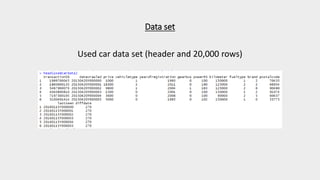
Data set
Used car data set (header and 20,000 rows)
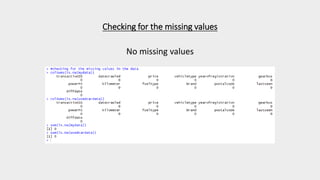
Checking for the missing values
No missing values
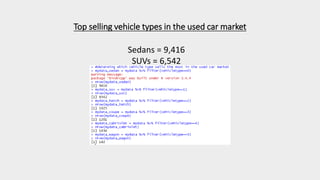
Top selling vehicle types in the used car market
Sedans = 9,416
SUVs = 6,542
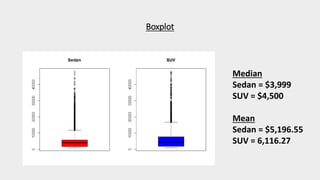
Boxplot
Median
Sedan = $3,999
SUV = $4,500
Mean
Sedan = $5,196.55
SUV = 6,116.27
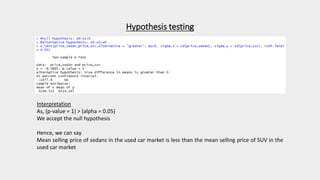
Hypothesis testing
Interpretation
As, (p-value = 1) > (alpha = 0.05)
We accept the null hypothesis
Hence, we can say
Mean selling price of sedans in the used car market is less than the mean selling price of SUV in the
used car market
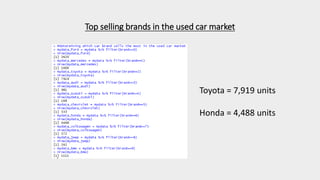
Top selling brands in the used car market
Toyota = 7,919 units
Honda = 4,488 units
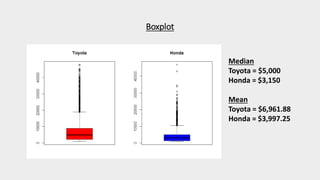
Boxplot
Median
Toyota = $5,000
Honda = $3,150
Mean
Toyota = $6,961.88
Honda = $3,997.25
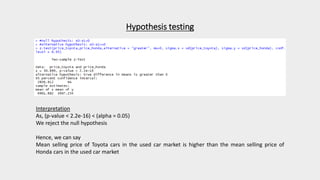
Hypothesis testing
Interpretation
As, (p-value < 2.2e-16) < (alpha = 0.05)
We reject the null hypothesis
Hence, we can say
Mean selling price of Toyota cars in the used car market is higher than the mean selling price of
Honda cars in the used car market
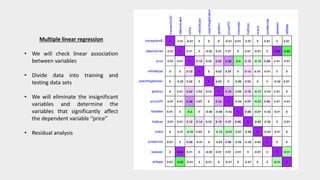
Multiple linear regression
• We will check linear association
between variables
• Divide data into training and
testing data sets
• We will eliminate the insignificant
variables and determine the
variables that significantly affect
the dependent variable “price”
• Residual analysis
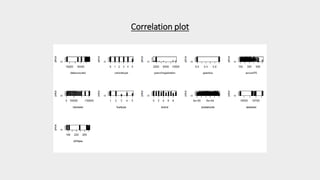
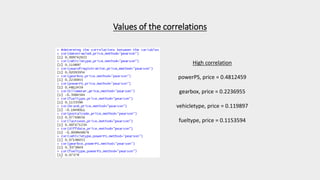
Correlation plot
Values of the correlations
High correlation
powerPS, price = 0.4812459
gearbox, price = 0.2236955
vehicletype, price = 0.119897
fueltype, price = 0.1153594
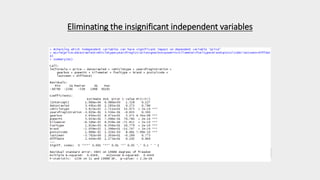
Eliminating the insignificant independent variables
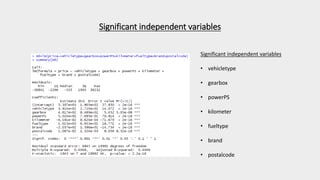
Significant independent variables
• vehicletype
• gearbox
• powerPS
• kilometer
• fueltype
• brand
• postalcode
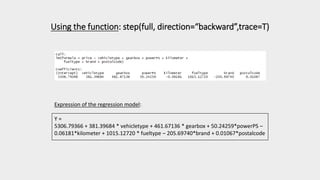
Using the function: step(full, direction=“backward”,trace=T)
Expression of the regression model:
Y =
5306.79366 + 381.39684 * vehicletype + 461.67136 * gearbox + 50.24259*powerPS –
0.06181*kilometer + 1015.12720 * fueltype – 205.69740*brand + 0.01067*postalcode
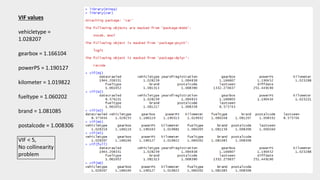
VIF values
vehicletype =
1.028207
gearbox = 1.166104
powerPS = 1.190127
kilometer = 1.019822
fueltype = 1.060202
brand = 1.081085
postalcode = 1.008306
VIF < 5,
No collinearity
problem
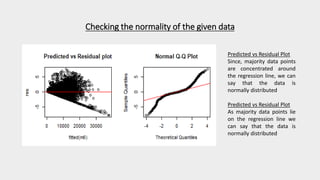
Checking the normality of the given data
Predicted vs Residual Plot
Since, majority data points
are concentrated around
the regression line, we can
say that the data is
normally distributed
Predicted vs Residual Plot
As majority data points lie
on the regression line we
can say that the data is
normally distributed
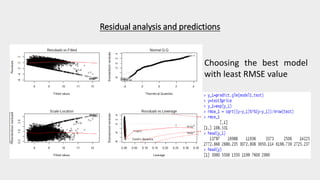
Residual analysis and predictions
Choosing the best model
with least RMSE value
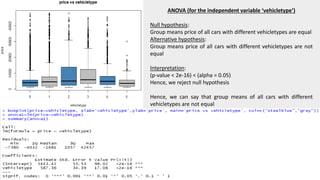
ANOVA (for the independent variable ‘vehicletype’)
Null hypothesis:
Group means price of all cars with different vehicletypes are equal
Alternative hypothesis:
Group means price of all cars with different vehicletypes are not
equal
Interpretation:
(p-value < 2e-16) < (alpha = 0.05)
Hence, we reject null hypothesis
Hence, we can say that group means of all cars with different
vehicletypes are not equal
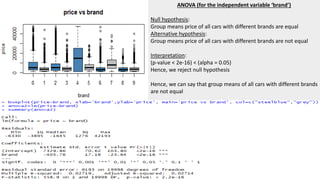
ANOVA (for the independent variable ‘brand’)
Null hypothesis:
Group means price of all cars with different brands are equal
Alternative hypothesis:
Group means price of all cars with different brands are not equal
Interpretation:
(p-value < 2e-16) < (alpha = 0.05)
Hence, we reject null hypothesis
Hence, we can say that group means of all cars with different brands
are not equal
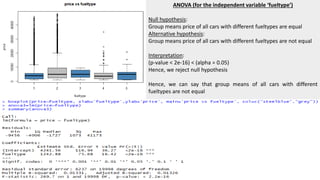
ANOVA (for the independent variable ‘fueltype’)
Null hypothesis:
Group means price of all cars with different fueltypes are equal
Alternative hypothesis:
Group means price of all cars with different fueltypes are not equal
Interpretation:
(p-value < 2e-16) < (alpha = 0.05)
Hence, we reject null hypothesis
Hence, we can say that group means of all cars with different
fueltypes are not equal
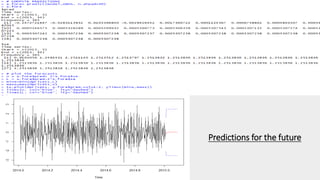
Time series analysis and forecasting
• Loading the data set and required libraries
• Normality test: Histogram, QQ plot, Jarque-Bera test
• Ljung box test, ACF plots, PACF plots
• Differencing
• Build different models AR, MA, ARMA, ARIMA
• Future predictions
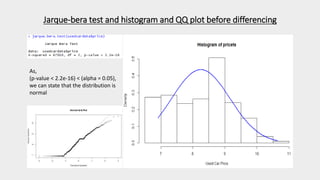
Jarque-bera test and histogram and QQ plot before differencing
As,
(p-value < 2.2e-16) < (alpha = 0.05),
we can state that the distribution is
normal
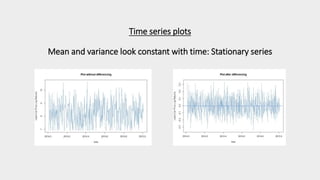
Time series plots
Mean and variance look constant with time: Stationary series
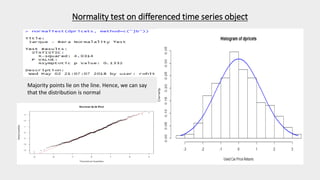
Normality test on differenced time series object
Majority points lie on the line. Hence, we can say
that the distribution is normal
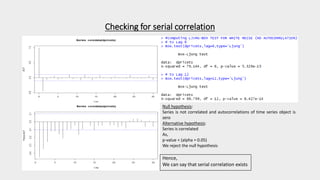
Checking for serial correlation
Null hypothesis:
Series is not correlated and autocorrelations of time series object is
zero
Alternative hypothesis:
Series is correlated
As,
p-value < (alpha = 0.05)
We reject the null hypothesis
Hence,
We can say that serial correlation exists
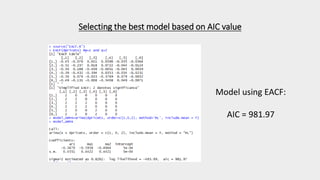
Selecting the best model based on AIC value
Model using EACF:
AIC = 981.97
Selecting the best model based on AIC value
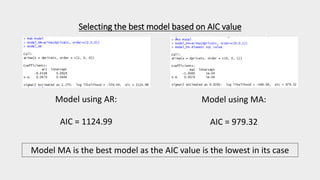
Model using AR:
AIC = 1124.99
Model using MA:
AIC = 979.32
Model MA is the best model as the AIC value is the lowest in its case
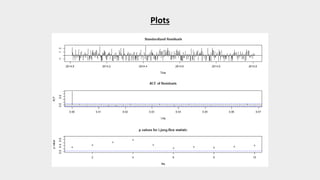
Plots
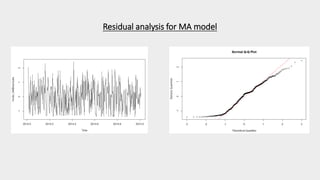
Residual analysis for MA model
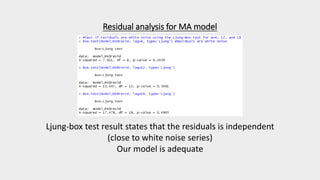
Ljung-box test result states that the residuals is independent
(close to white noise series)
Our model is adequate
Predictions for the future
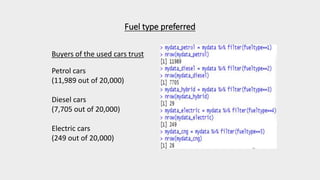
Fuel type preferred
Buyers of the used cars trust
Petrol cars
(11,989 out of 20,000)
Diesel cars
(7,705 out of 20,000)
Electric cars
(249 out of 20,000)
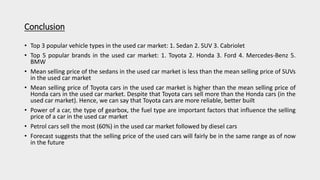
Conclusion
• Top 3 popular vehicle types in the used car market: 1. Sedan 2. SUV 3. Cabriolet
• Top 5 popular brands in the used car market: 1. Toyota 2. Honda 3. Ford 4. Mercedes-Benz 5.
BMW
• Mean selling price of the sedans in the used car market is less than the mean selling price of SUVs
in the used car market
• Mean selling price of Toyota cars in the used car market is higher than the mean selling price of
Honda cars in the used car market. Despite that Toyota cars sell more than the Honda cars (in the
used car market). Hence, we can say that Toyota cars are more reliable, better built
• Power of a car, the type of gearbox, the fuel type are important factors that influence the selling
price of a car in the used car market
• Petrol cars sell the most (60%) in the used car market followed by diesel cars
• Forecast suggests that the selling price of the used cars will fairly be in the same range as of now
in the future
THANK YOU

Data Analytics Project Presentation

  • 1.
    “Used Car E-CommerceStats for Buyers, Sellers & Advertisers” Prepared by, Rohit G. Vaze rvaze@hawk.iit.edu Group number: 175
  • 2.
    Introduction • High increasein used (2nd hand) car sales in recent years • Used cars: Fairly good condition, low cost • E-commerce websites have triggered used car sales • Popular E-commerce website for selling used cars: eBay • Which are the popular brands in the used car market? • Which are the popular vehicle types in the used car market? • The selling price (ad price) of a used car depends on what factors? • How will the used car prices be in the future?
  • 3.
    Data set Used cardata set (header and 20,000 rows)
  • 4.
    Checking for themissing values No missing values
  • 5.
    Top selling vehicletypes in the used car market Sedans = 9,416 SUVs = 6,542
  • 6.
    Boxplot Median Sedan = $3,999 SUV= $4,500 Mean Sedan = $5,196.55 SUV = 6,116.27
  • 7.
    Hypothesis testing Interpretation As, (p-value= 1) > (alpha = 0.05) We accept the null hypothesis Hence, we can say Mean selling price of sedans in the used car market is less than the mean selling price of SUV in the used car market
  • 8.
    Top selling brandsin the used car market Toyota = 7,919 units Honda = 4,488 units
  • 9.
    Boxplot Median Toyota = $5,000 Honda= $3,150 Mean Toyota = $6,961.88 Honda = $3,997.25
  • 10.
    Hypothesis testing Interpretation As, (p-value< 2.2e-16) < (alpha = 0.05) We reject the null hypothesis Hence, we can say Mean selling price of Toyota cars in the used car market is higher than the mean selling price of Honda cars in the used car market
  • 11.
    Multiple linear regression •We will check linear association between variables • Divide data into training and testing data sets • We will eliminate the insignificant variables and determine the variables that significantly affect the dependent variable “price” • Residual analysis
  • 12.
  • 13.
    Values of thecorrelations High correlation powerPS, price = 0.4812459 gearbox, price = 0.2236955 vehicletype, price = 0.119897 fueltype, price = 0.1153594
  • 14.
    Eliminating the insignificantindependent variables
  • 15.
    Significant independent variables Significantindependent variables • vehicletype • gearbox • powerPS • kilometer • fueltype • brand • postalcode
  • 16.
    Using the function:step(full, direction=“backward”,trace=T) Expression of the regression model: Y = 5306.79366 + 381.39684 * vehicletype + 461.67136 * gearbox + 50.24259*powerPS – 0.06181*kilometer + 1015.12720 * fueltype – 205.69740*brand + 0.01067*postalcode
  • 17.
    VIF values vehicletype = 1.028207 gearbox= 1.166104 powerPS = 1.190127 kilometer = 1.019822 fueltype = 1.060202 brand = 1.081085 postalcode = 1.008306 VIF < 5, No collinearity problem
  • 18.
    Checking the normalityof the given data Predicted vs Residual Plot Since, majority data points are concentrated around the regression line, we can say that the data is normally distributed Predicted vs Residual Plot As majority data points lie on the regression line we can say that the data is normally distributed
  • 19.
    Residual analysis andpredictions Choosing the best model with least RMSE value
  • 20.
    ANOVA (for theindependent variable ‘vehicletype’) Null hypothesis: Group means price of all cars with different vehicletypes are equal Alternative hypothesis: Group means price of all cars with different vehicletypes are not equal Interpretation: (p-value < 2e-16) < (alpha = 0.05) Hence, we reject null hypothesis Hence, we can say that group means of all cars with different vehicletypes are not equal
  • 21.
    ANOVA (for theindependent variable ‘brand’) Null hypothesis: Group means price of all cars with different brands are equal Alternative hypothesis: Group means price of all cars with different brands are not equal Interpretation: (p-value < 2e-16) < (alpha = 0.05) Hence, we reject null hypothesis Hence, we can say that group means of all cars with different brands are not equal
  • 22.
    ANOVA (for theindependent variable ‘fueltype’) Null hypothesis: Group means price of all cars with different fueltypes are equal Alternative hypothesis: Group means price of all cars with different fueltypes are not equal Interpretation: (p-value < 2e-16) < (alpha = 0.05) Hence, we reject null hypothesis Hence, we can say that group means of all cars with different fueltypes are not equal
  • 23.
    Time series analysisand forecasting • Loading the data set and required libraries • Normality test: Histogram, QQ plot, Jarque-Bera test • Ljung box test, ACF plots, PACF plots • Differencing • Build different models AR, MA, ARMA, ARIMA • Future predictions
  • 24.
    Jarque-bera test andhistogram and QQ plot before differencing As, (p-value < 2.2e-16) < (alpha = 0.05), we can state that the distribution is normal
  • 25.
    Time series plots Meanand variance look constant with time: Stationary series
  • 26.
    Normality test ondifferenced time series object Majority points lie on the line. Hence, we can say that the distribution is normal
  • 27.
    Checking for serialcorrelation Null hypothesis: Series is not correlated and autocorrelations of time series object is zero Alternative hypothesis: Series is correlated As, p-value < (alpha = 0.05) We reject the null hypothesis Hence, We can say that serial correlation exists
  • 28.
    Selecting the bestmodel based on AIC value Model using EACF: AIC = 981.97
  • 29.
    Selecting the bestmodel based on AIC value Model using AR: AIC = 1124.99 Model using MA: AIC = 979.32 Model MA is the best model as the AIC value is the lowest in its case
  • 30.
  • 31.
  • 32.
    Residual analysis forMA model Ljung-box test result states that the residuals is independent (close to white noise series) Our model is adequate
  • 33.
  • 34.
    Fuel type preferred Buyersof the used cars trust Petrol cars (11,989 out of 20,000) Diesel cars (7,705 out of 20,000) Electric cars (249 out of 20,000)
  • 35.
    Conclusion • Top 3popular vehicle types in the used car market: 1. Sedan 2. SUV 3. Cabriolet • Top 5 popular brands in the used car market: 1. Toyota 2. Honda 3. Ford 4. Mercedes-Benz 5. BMW • Mean selling price of the sedans in the used car market is less than the mean selling price of SUVs in the used car market • Mean selling price of Toyota cars in the used car market is higher than the mean selling price of Honda cars in the used car market. Despite that Toyota cars sell more than the Honda cars (in the used car market). Hence, we can say that Toyota cars are more reliable, better built • Power of a car, the type of gearbox, the fuel type are important factors that influence the selling price of a car in the used car market • Petrol cars sell the most (60%) in the used car market followed by diesel cars • Forecast suggests that the selling price of the used cars will fairly be in the same range as of now in the future
  • 36.