OpenAI’s GPT-3 Language
Model
Steve Omohundro, Ph.D.
Possibility Research
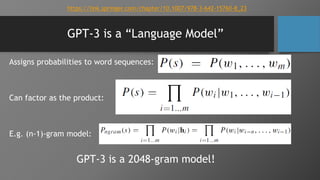
GPT-3 is a “Language Model”
Assigns probabilities to word sequences:
Can factor as the product:
E.g. (n-1)-gram model:
GPT-3 is a 2048-gram model!
https://link.springer.com/chapter/10.1007/978-3-642-15760-8_23
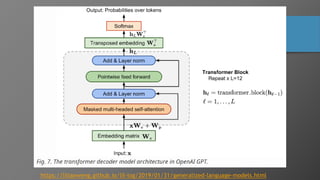
https://lilianweng.github.io/lil-log/2019/01/31/generalized-language-models.html
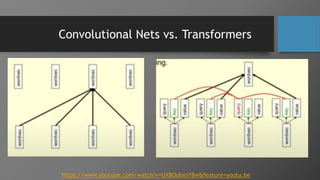
https://www.youtube.com/watch?v=UX8OubxsY8w&feature=youtu.be
Convolutional Nets vs. Transformers
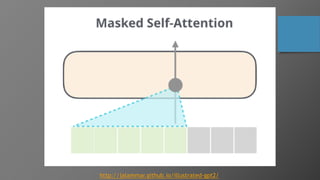
http://jalammar.github.io/illustrated-gpt2/
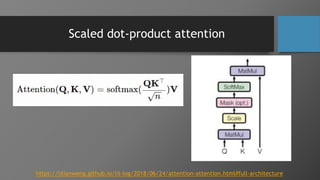
Scaled dot-product attention
https://lilianweng.github.io/lil-log/2018/06/24/attention-attention.html#full-architecture
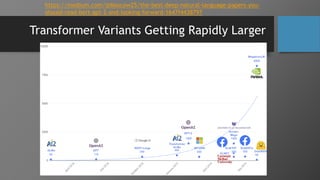
Transformer Variants Getting Rapidly Larger
https://medium.com/@Moscow25/the-best-deep-natural-language-papers-you-
should-read-bert-gpt-2-and-looking-forward-1647f4438797
GPT-3 175B Model Architecture
• Input reversibly encoded as tokens with “Byte Pair Encoding” of
UTF-8 bytes
• Context window of 2,048 tokens
• 96 transformer layers
• 96 self-attention heads, each 128 dimensional
• 12,288 units in bottleneck layer, 49,152 in feed forward layer
• Batch size of 3.2M samples
• Learning rate .6*10^-4
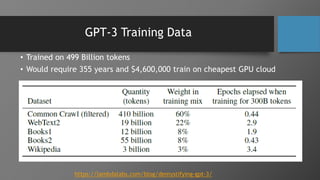
GPT-3 Training Data
• Trained on 499 Billion tokens
• Would require 355 years and $4,600,000 train on cheapest GPU cloud
https://lambdalabs.com/blog/demystifying-gpt-3/
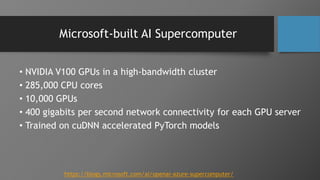
Microsoft-built AI Supercomputer
• NVIDIA V100 GPUs in a high-bandwidth cluster
• 285,000 CPU cores
• 10,000 GPUs
• 400 gigabits per second network connectivity for each GPU server
• Trained on cuDNN accelerated PyTorch models
https://blogs.microsoft.com/ai/openai-azure-supercomputer/
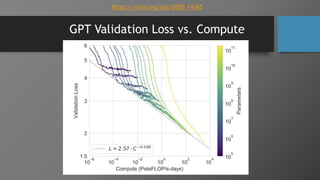
GPT Validation Loss vs. Compute
https://arxiv.org/abs/2005.14165
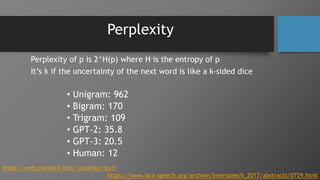
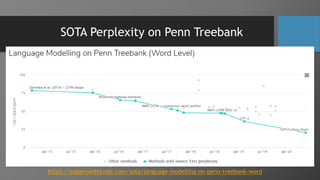
Perplexity
Perplexity of p is 2^H(p) where H is the entropy of p
It’s k if the uncertainty of the next word is like a k-sided dice
• Unigram: 962
• Bigram: 170
• Trigram: 109
• GPT-2: 35.8
• GPT-3: 20.5
• Human: 12
https://web.stanford.edu/~jurafsky/slp3/
https://www.isca-speech.org/archive/Interspeech_2017/abstracts/0729.html
https://paperswithcode.com/sota/language-modelling-on-penn-treebank-word
SOTA Perplexity on Penn Treebank
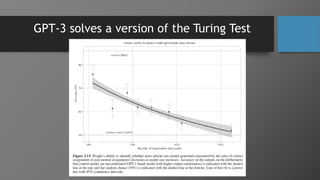
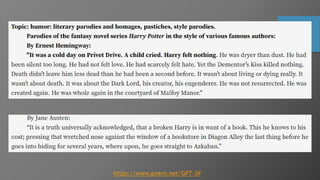
GPT-3 solves a version of the Turing Test
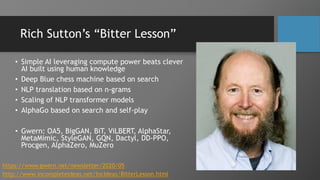
Rich Sutton’s “Bitter Lesson”
• Simple AI leveraging compute power beats clever
AI built using human knowledge
• Deep Blue chess machine based on search
• NLP translation based on n-grams
• Scaling of NLP transformer models
• AlphaGo based on search and self-play
• Gwern: OA5, BigGAN, BiT, ViLBERT, AlphaStar,
MetaMimic, StyleGAN, GQN, Dactyl, DD-PPO,
Procgen, AlphaZero, MuZero
http://www.incompleteideas.net/IncIdeas/BitterLesson.html
https://www.gwern.net/newsletter/2020/05
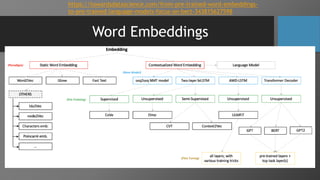
Word Embeddings
https://towardsdatascience.com/from-pre-trained-word-embeddings-
to-pre-trained-language-models-focus-on-bert-343815627598
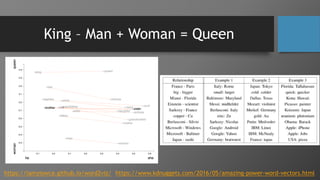
King – Man + Woman = Queen
https://lamyiowce.github.io/word2viz/ https://www.kdnuggets.com/2016/05/amazing-power-word-vectors.html
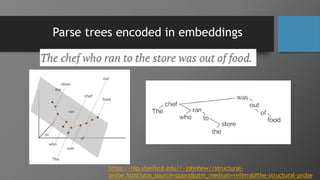
Parse trees encoded in embeddings
https://nlp.stanford.edu//~johnhew//structural-
probe.html?utm_source=quora&utm_medium=referral#the-structural-probe
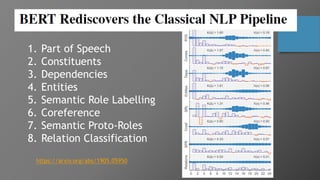
1. Part of Speech
2. Constituents
3. Dependencies
4. Entities
5. Semantic Role Labelling
6. Coreference
7. Semantic Proto-Roles
8. Relation Classification
https://arxiv.org/abs/1905.05950
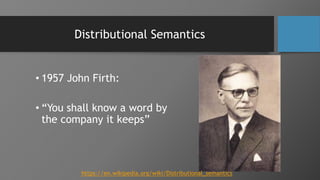
Distributional Semantics
• 1957 John Firth:
• “You shall know a word by
the company it keeps”
https://en.wikipedia.org/wiki/Distributional_semantics
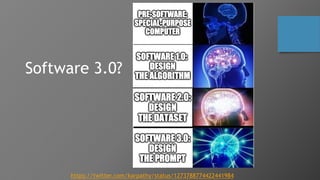
https://twitter.com/karpathy/status/1273788774422441984
Software 3.0?
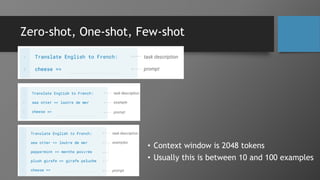
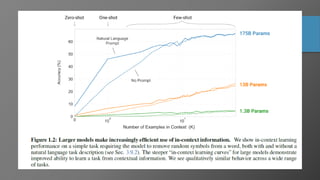
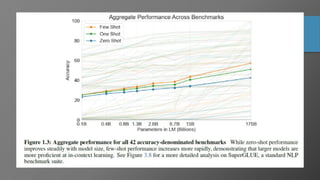
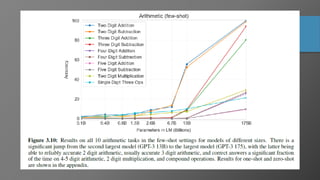
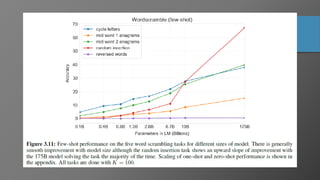
Zero-shot, One-shot, Few-shot
• Context window is 2048 tokens
• Usually this is between 10 and 100 examples
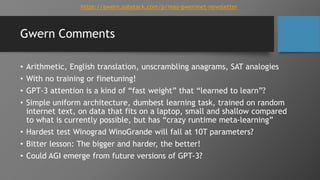
Gwern Comments
• Arithmetic, English translation, unscrambling anagrams, SAT analogies
• With no training or finetuning!
• GPT-3 attention is a kind of “fast weight” that “learned to learn”?
• Simple uniform architecture, dumbest learning task, trained on random
internet text, on data that fits on a laptop, small and shallow compared
to what is currently possible, but has “crazy runtime meta-learning”
• Hardest test Winograd WinoGrande will fall at 10T parameters?
• Bitter lesson: The bigger and harder, the better!
• Could AGI emerge from future versions of GPT-3?
https://gwern.substack.com/p/may-gwernnet-newsletter
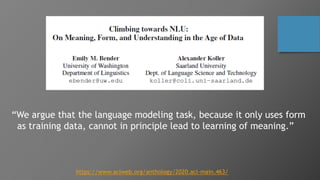
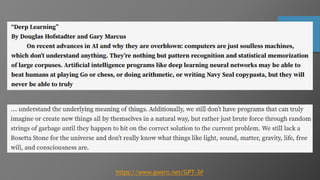
https://www.aclweb.org/anthology/2020.acl-main.463/
“We argue that the language modeling task, because it only uses form
as training data, cannot in principle lead to learning of meaning.”
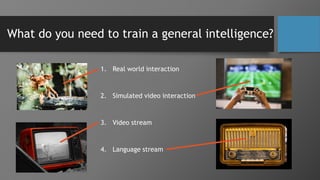
What do you need to train a general intelligence?
1. Real world interaction
2. Simulated video interaction
3. Video stream
4. Language stream
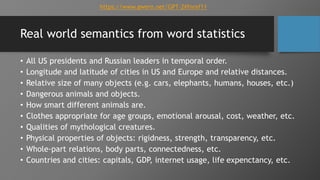
Real world semantics from word statistics
• All US presidents and Russian leaders in temporal order.
• Longitude and latitude of cities in US and Europe and relative distances.
• Relative size of many objects (e.g. cars, elephants, humans, houses, etc.)
• Dangerous animals and objects.
• How smart different animals are.
• Clothes appropriate for age groups, emotional arousal, cost, weather, etc.
• Qualities of mythological creatures.
• Physical properties of objects: rigidness, strength, transparency, etc.
• Whole-part relations, body parts, connectedness, etc.
• Countries and cities: capitals, GDP, internet usage, life expenctancy, etc.
https://www.gwern.net/GPT-2#fnref11
https://www.gwern.net/GPT-3#
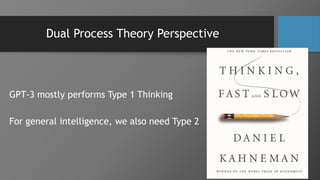
Dual Process Theory Perspective
GPT-3 mostly performs Type 1 Thinking
For general intelligence, we also need Type 2