Department of Information and Computer Sciences
NATIONAL UNIVERSITY OF MONGOLIA
NATIONAL INFORMATION
TECHNOLOGY PARK OF MONGOLIA
TOWARDS OPEN DATA DEVELOPMENT IN
MONGOLIA
Amarsanaa Ganbold, Tsolmon Zundui
DEPARTMENT OF INFORMATION, COMPUTER SCIENCE
School of Engineering and Applied Sciences
National University of Mongolia
amarsanaag@disi.unitn.it, tsolmonz@num.edu.mn
2014-11-25 DISI Seminar
Contents
 About Mongolia
1. Issues
 Legal
 Organizational
2. Open Data Initiative in Mongolia
 At the National Information Technology Park (NITP) of Mongolia
 Discussions
2
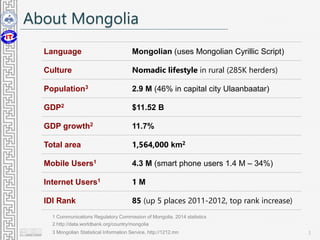
About Mongolia
3
Language Mongolian (uses Mongolian Cyrillic Script)
Culture Nomadic lifestyle in rural (285K herders)
Population3 2.9 M (46% in capital city Ulaanbaatar)
GDP2 $11.52 B
GDP growth2 11.7%
Total area 1,564,000 km2
Mobile Users1 4.3 M (smart phone users 1.4 M – 34%)
Internet Users1 1 M
IDI Rank 85 (up 5 places 2011-2012, top rank increase)
2 http://data.worldbank.org/country/mongolia
1 Communications Regulatory Commission of Mongolia, 2014 statistics
3 Mongolian Statistical Information Service, http://1212.mn
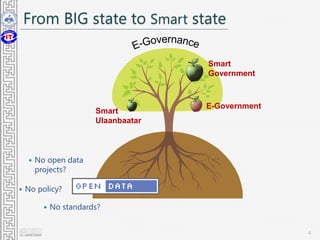
From BIG state to Smart state
4
E-Government
 No open data
projects?
 No standards?
 No policy?
Smart
Ulaanbaatar
Smart
Government
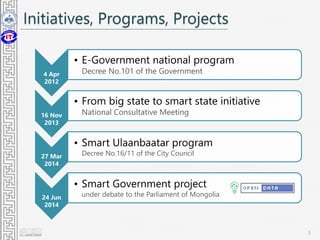
Initiatives, Programs, Projects
4 Apr
2012
• E-Government national program
Decree No.101 of the Government
16 Nov
2013
• From big state to smart state initiative
National Consultative Meeting
27 Mar
2014
• Smart Ulaanbaatar program
Decree No.16/11 of the City Council
24 Jun
2014
• Smart Government project
under debate to the Parliament of Mongolia
5
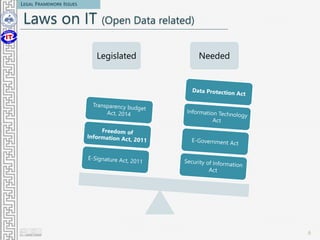
Laws on IT (Open Data related)
6
Legislated Needed
LEGAL FRAMEWORK ISSUES
Freedom of Information
 Constitution of the Mongolian People's Republic, 1992
 16.17 Right to seek and receive information except that which the State and its
bodies are legally bound to protect as secret
 Information Transparency, Right to Receive Information Act, 2011 (=FOIA)
 5.1.3. any other information should be open except legally protected as secret
 11.1.3. right to receive any other information related to institution activities
 Directive to use of database of government organizations, 2013
 1.3.2. organizations should provide citizens and institutions to receive and use of
information stored in database of government organizations by alternative rules
 Regulation on payment to provide information, discount and exemption, 2013
 2.1 information in digital format should be provided free for citizen, legal body
 Transparency Budget Act, 2014
 3.2. budget, financial plan, performance, implementation, report and related cash
flow and transactions should be open
7
LEGAL FRAMEWORK ISSUES
Freedom of Information (2)
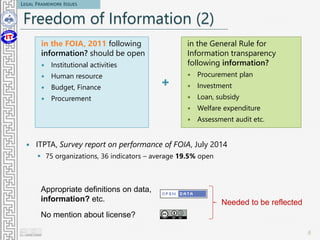
in the FOIA, 2011 following
information? should be open
 Institutional activities
 Human resource
 Budget, Finance
 Procurement
8
in the General Rule for
Information transparency
following information?
 Procurement plan
 Investment
 Loan, subsidy
 Welfare expenditure
 Assessment audit etc.
+
Appropriate definitions on data,
information? etc.
No mention about license?
Needed to be reflected
LEGAL FRAMEWORK ISSUES
 ITPTA, Survey report on performance of FOIA, July 2014
 75 organizations, 36 indicators – average 19.5% open
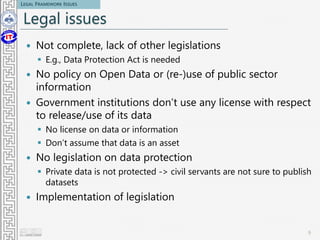
Legal issues
 Not complete, lack of other legislations
 E.g., Data Protection Act is needed
 No policy on Open Data or (re-)use of public sector
information
 Government institutions don’t use any license with respect
to release/use of its data
 No license on data or information
 Don’t assume that data is an asset
 No legislation on data protection
 Private data is not protected -> civil servants are not sure to publish
datasets
 Implementation of legislation
9
LEGAL FRAMEWORK ISSUES
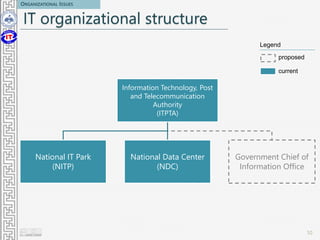
IT organizational structure
Information Technology, Post
and Telecommunication
Authority
(ITPTA)
National IT Park
(NITP)
National Data Center
(NDC)
Government Chief of
Information Office
10
ORGANIZATIONAL ISSUES
proposed
current
Legend
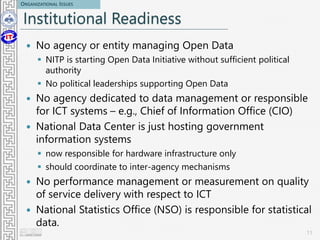
Institutional Readiness
 No agency or entity managing Open Data
 NITP is starting Open Data Initiative without sufficient political
authority
 No political leaderships supporting Open Data
 No agency dedicated to data management or responsible
for ICT systems – e.g., Chief of Information Office (CIO)
 National Data Center is just hosting government
information systems
 now responsible for hardware infrastructure only
 should coordinate to inter-agency mechanisms
 No performance management or measurement on quality
of service delivery with respect to ICT
 National Statistics Office (NSO) is responsible for statistical
data.
11
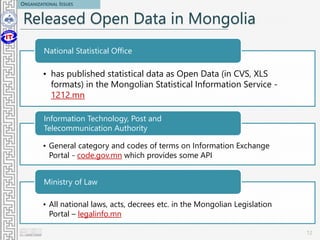
ORGANIZATIONAL ISSUES
Released Open Data in Mongolia
• has published statistical data as Open Data (in CVS, XLS
formats) in the Mongolian Statistical Information Service -
1212.mn
National Statistical Office
• General category and codes of terms on Information Exchange
Portal - code.gov.mn which provides some API
Information Technology, Post and
Telecommunication Authority
• All national laws, acts, decrees etc. in the Mongolian Legislation
Portal – legalinfo.mn
Ministry of Law
12
ORGANIZATIONAL ISSUES
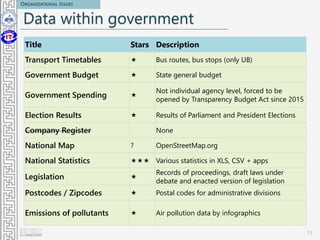
Data within government
Title Stars Description
Transport Timetables  Bus routes, bus stops (only UB)
Government Budget  State general budget
Government Spending 
Not individual agency level, forced to be
opened by Transparency Budget Act since 2015
Election Results  Results of Parliament and President Elections
Company Register None
National Map ? OpenStreetMap.org
National Statistics  Various statistics in XLS, CSV + apps
Legislation 
Records of proceedings, draft laws under
debate and enacted version of legislation
Postcodes / Zipcodes  Postal codes for administrative divisions
Emissions of pollutants  Air pollution data by infographics
13
ORGANIZATIONAL ISSUES
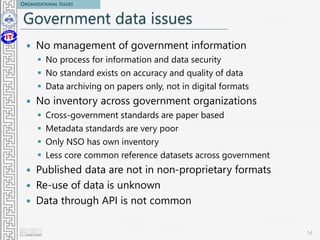
Government data issues
 No management of government information
 No process for information and data security
 No standard exists on accuracy and quality of data
 Data archiving on papers only, not in digital formats
 No inventory across government organizations
 Cross-government standards are paper based
 Metadata standards are very poor
 Only NSO has own inventory
 Less core common reference datasets across government
 Published data are not in non-proprietary formats
 Re-use of data is unknown
 Data through API is not common
14
ORGANIZATIONAL ISSUES
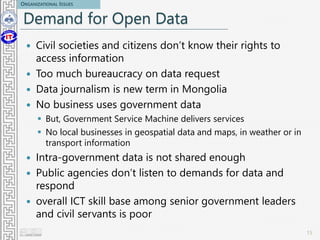
Demand for Open Data
 Civil societies and citizens don’t know their rights to
access information
 Too much bureaucracy on data request
 Data journalism is new term in Mongolia
 No business uses government data
 But, Government Service Machine delivers services
 No local businesses in geospatial data and maps, in weather or in
transport information
 Intra-government data is not shared enough
 Public agencies don’t listen to demands for data and
respond
 overall ICT skill base among senior government leaders
and civil servants is poor
15
ORGANIZATIONAL ISSUES
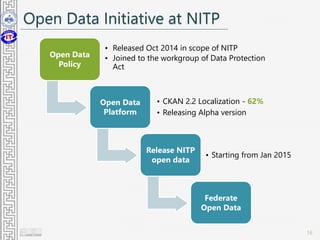
Open Data Initiative at NITP
Open Data
Policy
Open Data
Platform
• CKAN 2.2 Localization - 62%
• Releasing Alpha version
Release NITP
open data
• Starting from Jan 2015
Federate
Open Data
16
• Released Oct 2014 in scope of NITP
• Joined to the workgroup of Data Protection
Act
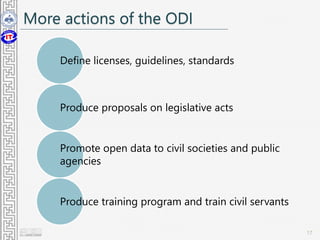
More actions of the ODI
Define licenses, guidelines, standards
Produce proposals on legislative acts
Promote open data to civil societies and public
agencies
Produce training program and train civil servants
17
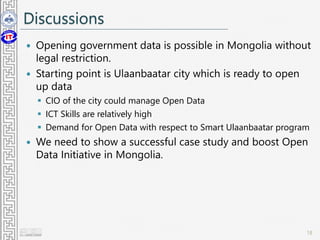
Discussions
 Opening government data is possible in Mongolia without
legal restriction.
 Starting point is Ulaanbaatar city which is ready to open
up data
 CIO of the city could manage Open Data
 ICT Skills are relatively high
 Demand for Open Data with respect to Smart Ulaanbaatar program
 We need to show a successful case study and boost Open
Data Initiative in Mongolia.
18
Thank you for your attention.
amarsanaag@disi.unitn.it
Any questions?
19

Towards Open Data Development in Mongolia

  • 1.
    Department of Informationand Computer Sciences NATIONAL UNIVERSITY OF MONGOLIA NATIONAL INFORMATION TECHNOLOGY PARK OF MONGOLIA TOWARDS OPEN DATA DEVELOPMENT IN MONGOLIA Amarsanaa Ganbold, Tsolmon Zundui DEPARTMENT OF INFORMATION, COMPUTER SCIENCE School of Engineering and Applied Sciences National University of Mongolia amarsanaag@disi.unitn.it, tsolmonz@num.edu.mn 2014-11-25 DISI Seminar
  • 2.
    Contents  About Mongolia 1.Issues  Legal  Organizational 2. Open Data Initiative in Mongolia  At the National Information Technology Park (NITP) of Mongolia  Discussions 2
  • 3.
    About Mongolia 3 Language Mongolian(uses Mongolian Cyrillic Script) Culture Nomadic lifestyle in rural (285K herders) Population3 2.9 M (46% in capital city Ulaanbaatar) GDP2 $11.52 B GDP growth2 11.7% Total area 1,564,000 km2 Mobile Users1 4.3 M (smart phone users 1.4 M – 34%) Internet Users1 1 M IDI Rank 85 (up 5 places 2011-2012, top rank increase) 2 http://data.worldbank.org/country/mongolia 1 Communications Regulatory Commission of Mongolia, 2014 statistics 3 Mongolian Statistical Information Service, http://1212.mn
  • 4.
    From BIG stateto Smart state 4 E-Government  No open data projects?  No standards?  No policy? Smart Ulaanbaatar Smart Government
  • 5.
    Initiatives, Programs, Projects 4Apr 2012 • E-Government national program Decree No.101 of the Government 16 Nov 2013 • From big state to smart state initiative National Consultative Meeting 27 Mar 2014 • Smart Ulaanbaatar program Decree No.16/11 of the City Council 24 Jun 2014 • Smart Government project under debate to the Parliament of Mongolia 5
  • 6.
    Laws on IT(Open Data related) 6 Legislated Needed LEGAL FRAMEWORK ISSUES
  • 7.
    Freedom of Information Constitution of the Mongolian People's Republic, 1992  16.17 Right to seek and receive information except that which the State and its bodies are legally bound to protect as secret  Information Transparency, Right to Receive Information Act, 2011 (=FOIA)  5.1.3. any other information should be open except legally protected as secret  11.1.3. right to receive any other information related to institution activities  Directive to use of database of government organizations, 2013  1.3.2. organizations should provide citizens and institutions to receive and use of information stored in database of government organizations by alternative rules  Regulation on payment to provide information, discount and exemption, 2013  2.1 information in digital format should be provided free for citizen, legal body  Transparency Budget Act, 2014  3.2. budget, financial plan, performance, implementation, report and related cash flow and transactions should be open 7 LEGAL FRAMEWORK ISSUES
  • 8.
    Freedom of Information(2) in the FOIA, 2011 following information? should be open  Institutional activities  Human resource  Budget, Finance  Procurement 8 in the General Rule for Information transparency following information?  Procurement plan  Investment  Loan, subsidy  Welfare expenditure  Assessment audit etc. + Appropriate definitions on data, information? etc. No mention about license? Needed to be reflected LEGAL FRAMEWORK ISSUES  ITPTA, Survey report on performance of FOIA, July 2014  75 organizations, 36 indicators – average 19.5% open
  • 9.
    Legal issues  Notcomplete, lack of other legislations  E.g., Data Protection Act is needed  No policy on Open Data or (re-)use of public sector information  Government institutions don’t use any license with respect to release/use of its data  No license on data or information  Don’t assume that data is an asset  No legislation on data protection  Private data is not protected -> civil servants are not sure to publish datasets  Implementation of legislation 9 LEGAL FRAMEWORK ISSUES
  • 10.
    IT organizational structure InformationTechnology, Post and Telecommunication Authority (ITPTA) National IT Park (NITP) National Data Center (NDC) Government Chief of Information Office 10 ORGANIZATIONAL ISSUES proposed current Legend
  • 11.
    Institutional Readiness  Noagency or entity managing Open Data  NITP is starting Open Data Initiative without sufficient political authority  No political leaderships supporting Open Data  No agency dedicated to data management or responsible for ICT systems – e.g., Chief of Information Office (CIO)  National Data Center is just hosting government information systems  now responsible for hardware infrastructure only  should coordinate to inter-agency mechanisms  No performance management or measurement on quality of service delivery with respect to ICT  National Statistics Office (NSO) is responsible for statistical data. 11 ORGANIZATIONAL ISSUES
  • 12.
    Released Open Datain Mongolia • has published statistical data as Open Data (in CVS, XLS formats) in the Mongolian Statistical Information Service - 1212.mn National Statistical Office • General category and codes of terms on Information Exchange Portal - code.gov.mn which provides some API Information Technology, Post and Telecommunication Authority • All national laws, acts, decrees etc. in the Mongolian Legislation Portal – legalinfo.mn Ministry of Law 12 ORGANIZATIONAL ISSUES
  • 13.
    Data within government TitleStars Description Transport Timetables  Bus routes, bus stops (only UB) Government Budget  State general budget Government Spending  Not individual agency level, forced to be opened by Transparency Budget Act since 2015 Election Results  Results of Parliament and President Elections Company Register None National Map ? OpenStreetMap.org National Statistics  Various statistics in XLS, CSV + apps Legislation  Records of proceedings, draft laws under debate and enacted version of legislation Postcodes / Zipcodes  Postal codes for administrative divisions Emissions of pollutants  Air pollution data by infographics 13 ORGANIZATIONAL ISSUES
  • 14.
    Government data issues No management of government information  No process for information and data security  No standard exists on accuracy and quality of data  Data archiving on papers only, not in digital formats  No inventory across government organizations  Cross-government standards are paper based  Metadata standards are very poor  Only NSO has own inventory  Less core common reference datasets across government  Published data are not in non-proprietary formats  Re-use of data is unknown  Data through API is not common 14 ORGANIZATIONAL ISSUES
  • 15.
    Demand for OpenData  Civil societies and citizens don’t know their rights to access information  Too much bureaucracy on data request  Data journalism is new term in Mongolia  No business uses government data  But, Government Service Machine delivers services  No local businesses in geospatial data and maps, in weather or in transport information  Intra-government data is not shared enough  Public agencies don’t listen to demands for data and respond  overall ICT skill base among senior government leaders and civil servants is poor 15 ORGANIZATIONAL ISSUES
  • 16.
    Open Data Initiativeat NITP Open Data Policy Open Data Platform • CKAN 2.2 Localization - 62% • Releasing Alpha version Release NITP open data • Starting from Jan 2015 Federate Open Data 16 • Released Oct 2014 in scope of NITP • Joined to the workgroup of Data Protection Act
  • 17.
    More actions ofthe ODI Define licenses, guidelines, standards Produce proposals on legislative acts Promote open data to civil societies and public agencies Produce training program and train civil servants 17
  • 18.
    Discussions  Opening governmentdata is possible in Mongolia without legal restriction.  Starting point is Ulaanbaatar city which is ready to open up data  CIO of the city could manage Open Data  ICT Skills are relatively high  Demand for Open Data with respect to Smart Ulaanbaatar program  We need to show a successful case study and boost Open Data Initiative in Mongolia. 18
  • 19.
    Thank you foryour attention. amarsanaag@disi.unitn.it Any questions? 19