Accessing,Opening & Using
Government Data in Five Indian Cities
Principal Researchers: Sumandro Chattapadhyay, Zainab Bawa
HasGeek
Funding for this work has been provided through the World Wide Web Foundation 'Exploring the Emerging Impacts of Open Data in Developing Countries'
research project, supported by grant 107075 from Canada’s International Development Research Centre (web.idrc.ca). Find out more at
www.opendataresearch.org/emergingimpacts
The Project
✤ Thorough analysis of the National Data Sharing and Accessibility Policy
(NDSAP) introduced in January 2012 to further publication of government
data in open and machine-readable formats
✤ Study the role of government and para-government bodies in implementing
NDSAP
✤ Examine and evaluate how non-government and advocacy organizations are
collecting data on the ground, and how RTI and NDSAP have influenced their
data collection practices
✤ Assess how government agencies in cities are transitioning from paper-based
systems to digitizing data
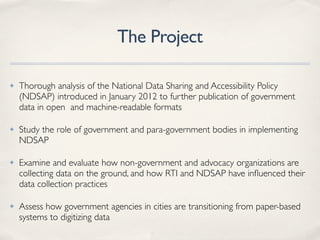
Open data in India:
evolution and standpoints
Computerization in government
departments
E-governance
Efficiency in Administration
Computerization of land records
Government
Digital delivery of services and
records
Digitize government department
datasets
Build applications with / on top of
datasets
Para-government agencies
Digitization
Provide IT capabilities
Engage with tech communities
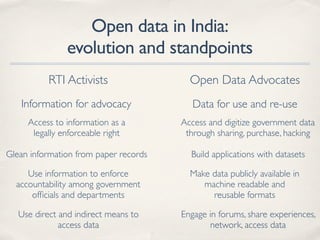
Open data in India:
evolution and standpoints
Access to information as a
legally enforceable right
Glean information from paper records
Information for advocacy
Use information to enforce
accountability among government
officials and departments
RTI Activists
Access and digitize government data
through sharing, purchase, hacking
Build applications with datasets
Open Data Advocates
Data for use and re-use
Make data publicly available in
machine readable and
reusable formats
Engage in forums, share experiences,
network, access data
Use direct and indirect means to
access data
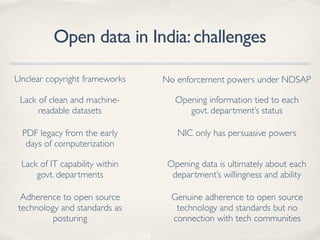
Open data in India:challenges
Lack of clean and machine-
readable datasets
PDF legacy from the early
days of computerization
No enforcement powers under NDSAPUnclear copyright frameworks
Lack of IT capability within
govt. departments
Opening data is ultimately about each
department’s willingness and ability
Opening information tied to each
govt. department’s status
NIC only has persuasive powers
Adherence to open source
technology and standards as
posturing
Genuine adherence to open source
technology and standards but no
connection with tech communities
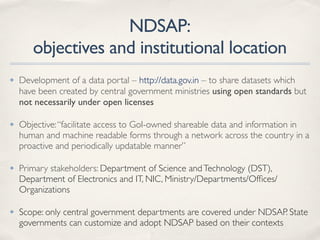
NDSAP:
objectives and institutional location
✤ Development of a data portal – http://data.gov.in – to share datasets which
have been created by central government ministries using open standards but
not necessarily under open licenses
✤ Objective:“facilitate access to GoI-owned shareable data and information in
human and machine readable forms through a network across the country in a
proactive and periodically updatable manner”
✤ Primary stakeholders: Department of Science andTechnology (DST),
Department of Electronics and IT, NIC, Ministry/Departments/Offices/
Organizations
✤ Scope: only central government departments are covered under NDSAP. State
governments can customize and adopt NDSAP based on their contexts
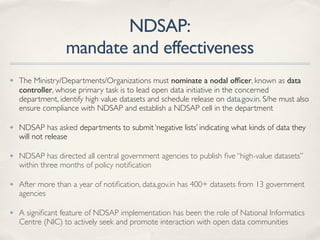
NDSAP:
mandate and effectiveness
✤ The Ministry/Departments/Organizations must nominate a nodal officer, known as data
controller, whose primary task is to lead open data initiative in the concerned
department, identify high value datasets and schedule release on data.gov.in. S/he must also
ensure compliance with NDSAP and establish a NDSAP cell in the department
✤ NDSAP has asked departments to submit ‘negative lists’ indicating what kinds of data they
will not release
✤ NDSAP has directed all central government agencies to publish five “high-value datasets”
within three months of policy notification
✤ After more than a year of notification, data.gov.in has 400+ datasets from 13 government
agencies
✤ A significant feature of NDSAP implementation has been the role of National Informatics
Centre (NIC) to actively seek and promote interaction with open data communities
NDSAP:
political and governance context
✤ NDSAP has a curious political position: on the one hand, it is connected to the RTI
Act and to people’s movements for transparency. On the other hand, it is
connected to a broad administrative reforms agenda for embracing e-governance
✤ Government agencies in India are about to adapt to a new digital data culture
where networked IT-based solutions are deployed to raise service delivery
efficiency
✤ Simultaneous collaborations and conflicts with IT and web-based media companies
is also a sign of an uncertain but quickly changing policy and regulation environment
✤ NDSAP connects both: the concerns of an older generation of transparency
movements as well as emerging issues of openness in a networked, data-driven
state
Objectives of the Research
We will focus on the following questions:
✤ Is the focus on born-digital and digitized data relevant for a government data
policy in India?
✤ How do different organizations negotiate with legal restrictions regarding
accessing and/or sharing government data?
✤ What primary and secondary data collection exercises do organizations
undertake in order to replace / augment government data? How are such
datasets are managed and circulated?
✤ How will NDSAP tackle paper-based legacy systems of government data
management? Do such plans affect advocacy and research initiatives?
Research Methods
✤ Archival research: policy documents, parliamentary discussions on RTI Act and
NDSAP, policies and position papers on e-governance initiatives and standards
✤ Interviews with government officials directly and indirectly associated with
developing / implementing NDSAP
✤ Interviews with civil society actors using RTI and/or open data approaches for
retrieving / using geospatial data, property records and land use information,
sanitation and health data, and electoral data
✤ Interviews with government officials in the chosen five Indian cities
✤ Consultation workshop with government officials and civil society actors on
research findings
Contact Information
Sumandro Chattapadhyay
mail@ajantriks.net
+91 78381 63651
@ajantriks
Zainab Bawa
zainab@hasgeek.com
+91 99454 73641
@zainabbawa
Blog: http://oddc.hasgeek.com

Revised presentation

  • 1.
    Accessing,Opening & Using GovernmentData in Five Indian Cities Principal Researchers: Sumandro Chattapadhyay, Zainab Bawa HasGeek Funding for this work has been provided through the World Wide Web Foundation 'Exploring the Emerging Impacts of Open Data in Developing Countries' research project, supported by grant 107075 from Canada’s International Development Research Centre (web.idrc.ca). Find out more at www.opendataresearch.org/emergingimpacts
  • 2.
    The Project ✤ Thoroughanalysis of the National Data Sharing and Accessibility Policy (NDSAP) introduced in January 2012 to further publication of government data in open and machine-readable formats ✤ Study the role of government and para-government bodies in implementing NDSAP ✤ Examine and evaluate how non-government and advocacy organizations are collecting data on the ground, and how RTI and NDSAP have influenced their data collection practices ✤ Assess how government agencies in cities are transitioning from paper-based systems to digitizing data
  • 3.
    Open data inIndia: evolution and standpoints Computerization in government departments E-governance Efficiency in Administration Computerization of land records Government Digital delivery of services and records Digitize government department datasets Build applications with / on top of datasets Para-government agencies Digitization Provide IT capabilities Engage with tech communities
  • 4.
    Open data inIndia: evolution and standpoints Access to information as a legally enforceable right Glean information from paper records Information for advocacy Use information to enforce accountability among government officials and departments RTI Activists Access and digitize government data through sharing, purchase, hacking Build applications with datasets Open Data Advocates Data for use and re-use Make data publicly available in machine readable and reusable formats Engage in forums, share experiences, network, access data Use direct and indirect means to access data
  • 5.
    Open data inIndia:challenges Lack of clean and machine- readable datasets PDF legacy from the early days of computerization No enforcement powers under NDSAPUnclear copyright frameworks Lack of IT capability within govt. departments Opening data is ultimately about each department’s willingness and ability Opening information tied to each govt. department’s status NIC only has persuasive powers Adherence to open source technology and standards as posturing Genuine adherence to open source technology and standards but no connection with tech communities
  • 6.
    NDSAP: objectives and institutionallocation ✤ Development of a data portal – http://data.gov.in – to share datasets which have been created by central government ministries using open standards but not necessarily under open licenses ✤ Objective:“facilitate access to GoI-owned shareable data and information in human and machine readable forms through a network across the country in a proactive and periodically updatable manner” ✤ Primary stakeholders: Department of Science andTechnology (DST), Department of Electronics and IT, NIC, Ministry/Departments/Offices/ Organizations ✤ Scope: only central government departments are covered under NDSAP. State governments can customize and adopt NDSAP based on their contexts
  • 7.
    NDSAP: mandate and effectiveness ✤The Ministry/Departments/Organizations must nominate a nodal officer, known as data controller, whose primary task is to lead open data initiative in the concerned department, identify high value datasets and schedule release on data.gov.in. S/he must also ensure compliance with NDSAP and establish a NDSAP cell in the department ✤ NDSAP has asked departments to submit ‘negative lists’ indicating what kinds of data they will not release ✤ NDSAP has directed all central government agencies to publish five “high-value datasets” within three months of policy notification ✤ After more than a year of notification, data.gov.in has 400+ datasets from 13 government agencies ✤ A significant feature of NDSAP implementation has been the role of National Informatics Centre (NIC) to actively seek and promote interaction with open data communities
  • 8.
    NDSAP: political and governancecontext ✤ NDSAP has a curious political position: on the one hand, it is connected to the RTI Act and to people’s movements for transparency. On the other hand, it is connected to a broad administrative reforms agenda for embracing e-governance ✤ Government agencies in India are about to adapt to a new digital data culture where networked IT-based solutions are deployed to raise service delivery efficiency ✤ Simultaneous collaborations and conflicts with IT and web-based media companies is also a sign of an uncertain but quickly changing policy and regulation environment ✤ NDSAP connects both: the concerns of an older generation of transparency movements as well as emerging issues of openness in a networked, data-driven state
  • 9.
    Objectives of theResearch We will focus on the following questions: ✤ Is the focus on born-digital and digitized data relevant for a government data policy in India? ✤ How do different organizations negotiate with legal restrictions regarding accessing and/or sharing government data? ✤ What primary and secondary data collection exercises do organizations undertake in order to replace / augment government data? How are such datasets are managed and circulated? ✤ How will NDSAP tackle paper-based legacy systems of government data management? Do such plans affect advocacy and research initiatives?
  • 10.
    Research Methods ✤ Archivalresearch: policy documents, parliamentary discussions on RTI Act and NDSAP, policies and position papers on e-governance initiatives and standards ✤ Interviews with government officials directly and indirectly associated with developing / implementing NDSAP ✤ Interviews with civil society actors using RTI and/or open data approaches for retrieving / using geospatial data, property records and land use information, sanitation and health data, and electoral data ✤ Interviews with government officials in the chosen five Indian cities ✤ Consultation workshop with government officials and civil society actors on research findings
  • 11.
    Contact Information Sumandro Chattapadhyay mail@ajantriks.net +9178381 63651 @ajantriks Zainab Bawa zainab@hasgeek.com +91 99454 73641 @zainabbawa Blog: http://oddc.hasgeek.com