Towards an
ecosystem of
    data and
  ontologies
      Mathieu d’Aquin
     and Enrico Motta
  Knowledge Media Institute
       The Open University
Large scale semantics on the web

            •   Traditional research and use of
                ontologies has been piecemeal:
                 1. develop ontology
                 2. annotate data with ontology

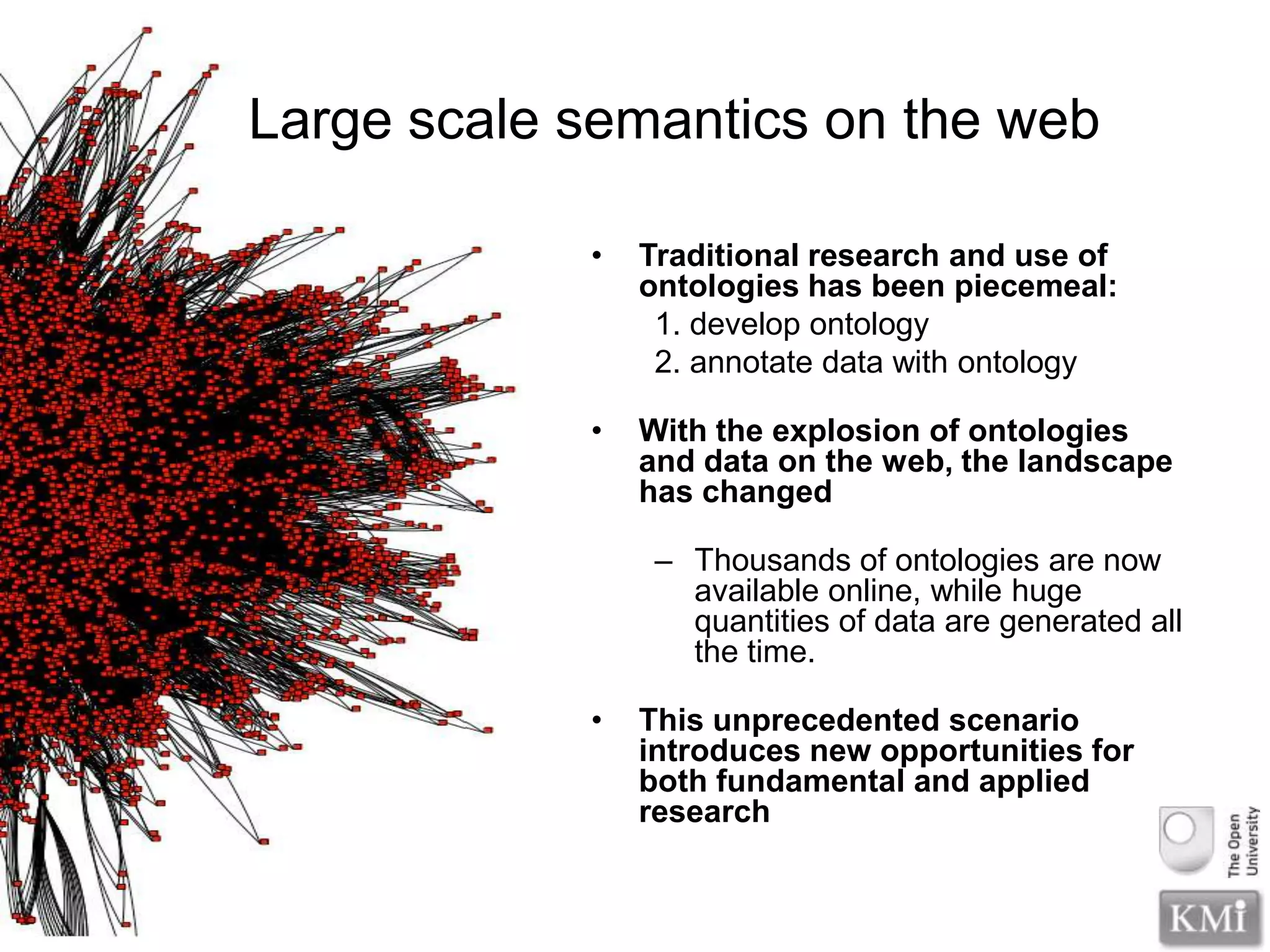
            •   With the explosion of ontologies
                and data on the web, the landscape
                has changed

                 – Thousands of ontologies are now
                   available online, while huge
                   quantities of data are generated all
                   the time.

            •   This unprecedented scenario
                introduces new opportunities for
                both fundamental and applied
                research
Experience from using online ontologies
    NeOn Project
    Methodological and technological support for
    networked ontologies
           – Ontology modularization, ontology design
             patterns, ontology alignments, ontology
             reuse, ontology search, ontology
             visualisation, ontology evolution…

    Key Infrastructure Component
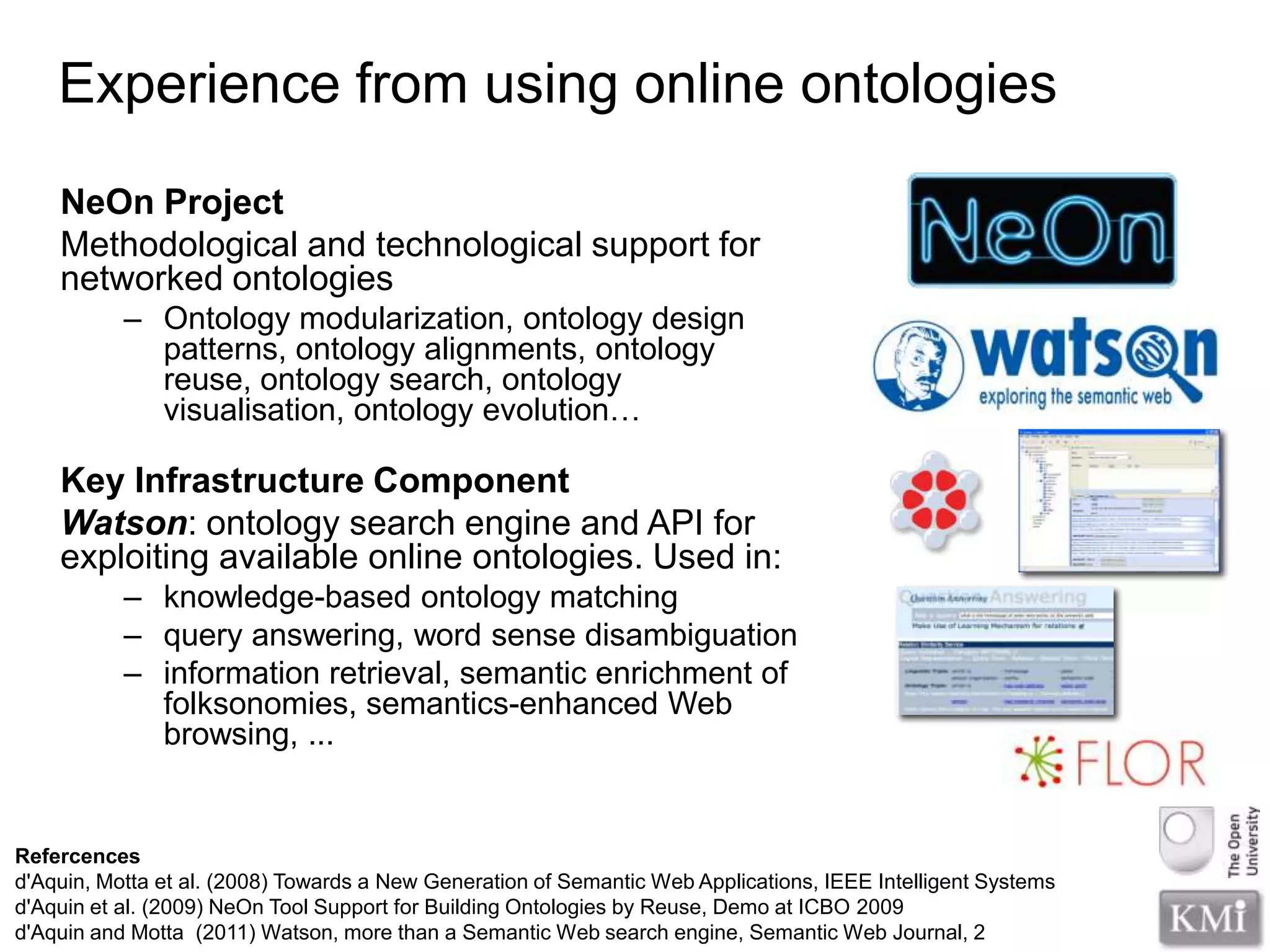
    Watson: ontology search engine and API for
    exploiting available online ontologies. Used in:
           – knowledge-based ontology matching
           – query answering, word sense disambiguation
           – information retrieval, semantic enrichment of
             folksonomies, semantics-enhanced Web
             browsing, ...


Refercences
d'Aquin, Motta et al. (2008) Towards a New Generation of Semantic Web Applications, IEEE Intelligent Systems
d'Aquin et al. (2009) NeOn Tool Support for Building Ontologies by Reuse, Demo at ICBO 2009
d'Aquin and Motta (2011) Watson, more than a Semantic Web search engine, Semantic Web Journal, 2
New challenges/research directions
                – Automatically aligning data and ontologies to make sense
                  of both data and ontologies. For example:
                      • Enabling automatic evolution of ontologies
                      • Tidying up and automatically augment linked data sources
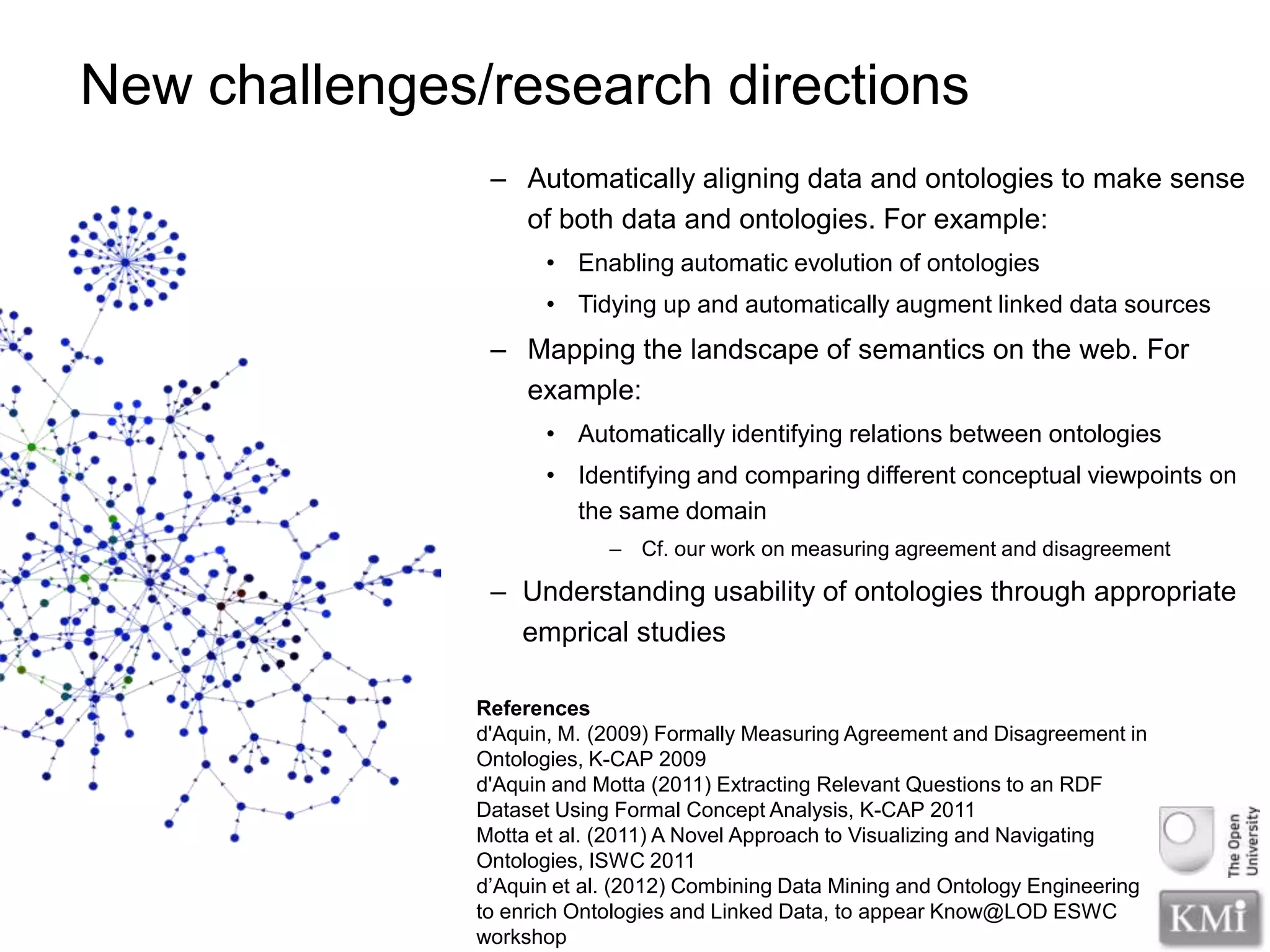
                – Mapping the landscape of semantics on the web. For
                  example:
                      • Automatically identifying relations between ontologies
                      • Identifying and comparing different conceptual viewpoints on
                        the same domain
                            – Cf. our work on measuring agreement and disagreement

                – Understanding usability of ontologies through appropriate
                  emprical studies

               References
               d'Aquin, M. (2009) Formally Measuring Agreement and Disagreement in
               Ontologies, K-CAP 2009
               d'Aquin and Motta (2011) Extracting Relevant Questions to an RDF
               Dataset Using Formal Concept Analysis, K-CAP 2011
               Motta et al. (2011) A Novel Approach to Visualizing and Navigating
               Ontologies, ISWC 2011
               d’Aquin et al. (2012) Combining Data Mining and Ontology Engineering
               to enrich Ontologies and Linked Data, to appear Know@LOD ESWC
               workshop
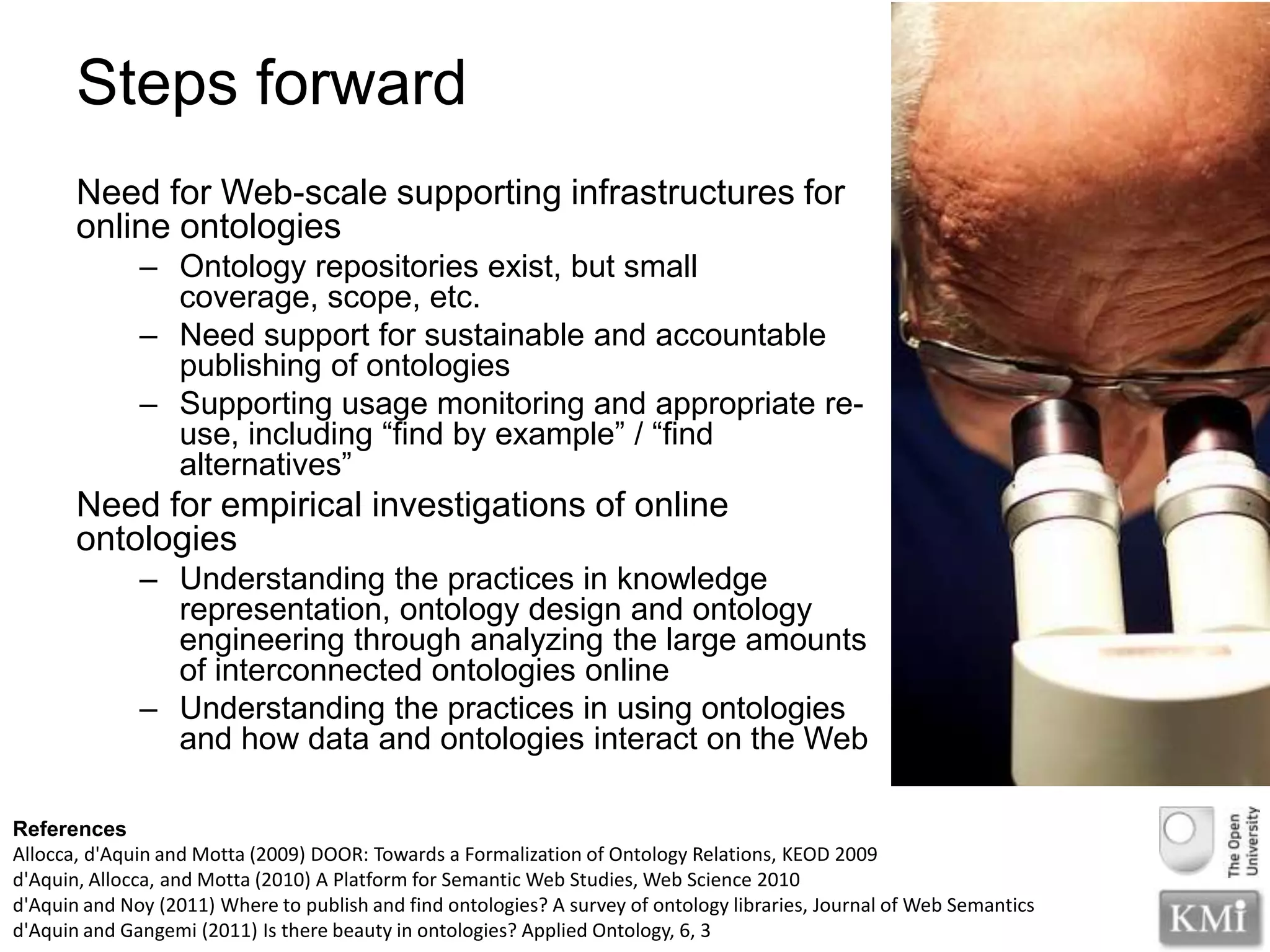
Steps forward
       Need for Web-scale supporting infrastructures for
       online ontologies
              – Ontology repositories exist, but small
                coverage, scope, etc.
              – Need support for sustainable and accountable
                publishing of ontologies
              – Supporting usage monitoring and appropriate re-
                use, including “find by example” / “find
                alternatives”
       Need for empirical investigations of online
       ontologies
              – Understanding the practices in knowledge
                representation, ontology design and ontology
                engineering through analyzing the large amounts
                of interconnected ontologies online
              – Understanding the practices in using ontologies
                and how data and ontologies interact on the Web

References
Allocca, d'Aquin and Motta (2009) DOOR: Towards a Formalization of Ontology Relations, KEOD 2009
d'Aquin, Allocca, and Motta (2010) A Platform for Semantic Web Studies, Web Science 2010
d'Aquin and Noy (2011) Where to publish and find ontologies? A survey of ontology libraries, Journal of Web Semantics
d'Aquin and Gangemi (2011) Is there beauty in ontologies? Applied Ontology, 6, 3

Towards an ecosystem of data and ontologies

  • 1.
    Towards an ecosystem of data and ontologies Mathieu d’Aquin and Enrico Motta Knowledge Media Institute The Open University
  • 2.
    Large scale semanticson the web • Traditional research and use of ontologies has been piecemeal: 1. develop ontology 2. annotate data with ontology • With the explosion of ontologies and data on the web, the landscape has changed – Thousands of ontologies are now available online, while huge quantities of data are generated all the time. • This unprecedented scenario introduces new opportunities for both fundamental and applied research
  • 3.
    Experience from usingonline ontologies NeOn Project Methodological and technological support for networked ontologies – Ontology modularization, ontology design patterns, ontology alignments, ontology reuse, ontology search, ontology visualisation, ontology evolution… Key Infrastructure Component Watson: ontology search engine and API for exploiting available online ontologies. Used in: – knowledge-based ontology matching – query answering, word sense disambiguation – information retrieval, semantic enrichment of folksonomies, semantics-enhanced Web browsing, ... Refercences d'Aquin, Motta et al. (2008) Towards a New Generation of Semantic Web Applications, IEEE Intelligent Systems d'Aquin et al. (2009) NeOn Tool Support for Building Ontologies by Reuse, Demo at ICBO 2009 d'Aquin and Motta (2011) Watson, more than a Semantic Web search engine, Semantic Web Journal, 2
  • 4.
    New challenges/research directions – Automatically aligning data and ontologies to make sense of both data and ontologies. For example: • Enabling automatic evolution of ontologies • Tidying up and automatically augment linked data sources – Mapping the landscape of semantics on the web. For example: • Automatically identifying relations between ontologies • Identifying and comparing different conceptual viewpoints on the same domain – Cf. our work on measuring agreement and disagreement – Understanding usability of ontologies through appropriate emprical studies References d'Aquin, M. (2009) Formally Measuring Agreement and Disagreement in Ontologies, K-CAP 2009 d'Aquin and Motta (2011) Extracting Relevant Questions to an RDF Dataset Using Formal Concept Analysis, K-CAP 2011 Motta et al. (2011) A Novel Approach to Visualizing and Navigating Ontologies, ISWC 2011 d’Aquin et al. (2012) Combining Data Mining and Ontology Engineering to enrich Ontologies and Linked Data, to appear Know@LOD ESWC workshop
  • 5.
    Steps forward Need for Web-scale supporting infrastructures for online ontologies – Ontology repositories exist, but small coverage, scope, etc. – Need support for sustainable and accountable publishing of ontologies – Supporting usage monitoring and appropriate re- use, including “find by example” / “find alternatives” Need for empirical investigations of online ontologies – Understanding the practices in knowledge representation, ontology design and ontology engineering through analyzing the large amounts of interconnected ontologies online – Understanding the practices in using ontologies and how data and ontologies interact on the Web References Allocca, d'Aquin and Motta (2009) DOOR: Towards a Formalization of Ontology Relations, KEOD 2009 d'Aquin, Allocca, and Motta (2010) A Platform for Semantic Web Studies, Web Science 2010 d'Aquin and Noy (2011) Where to publish and find ontologies? A survey of ontology libraries, Journal of Web Semantics d'Aquin and Gangemi (2011) Is there beauty in ontologies? Applied Ontology, 6, 3