An Introduction to
Network Science
Colleen M. Farrelly,
Staticlysm/Datasembly
About Me
• Senior data scientist (Datasembly/Staticlysm)
with experience in education, healthcare,
biotech, advertising technologies, and
marketing data.
• Expertise in topological data analysis,
geometry-based machine learning, quantum
algorithms, network science, natural language
processing, and traditional fields of machine
learning.
• Currently working on a two-part book including
many methods in network science.
Networks Are Everywhere!
• Gene networks
• Social networks
• Travel networks
• Communications networks
• Contact tracing networks
• Linguistic networks
• Many more!
Vertex
Edge
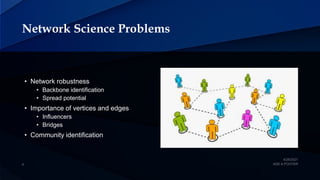
Network Science Problems
• Network robustness
• Backbone identification
• Spread potential
• Importance of vertices and edges
• Influencers
• Bridges
• Community identification
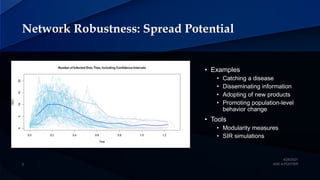
Network Robustness: Spread Potential
• Examples
• Catching a disease
• Disseminating information
• Adopting of new products
• Promoting population-level
behavior change
• Tools
• Modularity measures
• SIR simulations
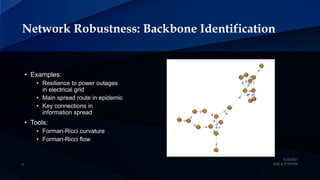
Network Robustness: Backbone Identification
• Examples:
• Resilience to power outages
in electrical grid
• Main spread route in epidemic
• Key connections in
information spread
• Tools:
• Forman-Ricci curvature
• Forman-Ricci flow
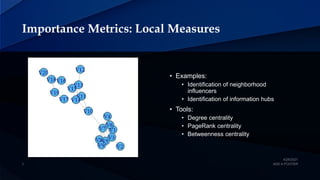
Importance Metrics: Local Measures
• Examples:
• Identification of neighborhood
influencers
• Identification of information hubs
• Tools:
• Degree centrality
• PageRank centrality
• Betweenness centrality
Importance Metrics: Global Measures
• Examples:
• Convergence of functions
imposed on a network to
measure quantities of interest
• Maximum travel distance to
estimate disease timings
• Tools:
• Eccentricity
• Spectral radius
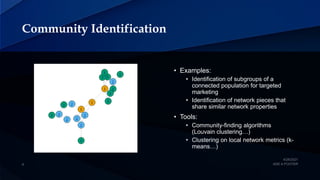
Community Identification
• Examples:
• Identification of subgroups of a
connected population for targeted
marketing
• Identification of network pieces that
share similar network properties
• Tools:
• Community-finding algorithms
(Louvain clustering…)
• Clustering on local network metrics (k-
means…)
Network Analysis Software
• Python
• igraph
• NetworkX
• R
• igraph
• sna
• netdiffuseR
• Gephi
• GraphStream
• NetMiner4
References
• Bapat, R. B. (2010). Graphs and matrices (Vol. 27). London: Springer.
• Barabási, A. L. (2016). Network science. Cambridge university press.
• Lewis, T. G. (2011). Network science: Theory and applications. John Wiley & Sons.
• Newman, M. E. (2002). Spread of epidemic disease on networks. Physical review E,
66(1), 016128.
• Newman, M. E. (2006). Modularity and community structure in networks. Proceedings of
the national academy of sciences, 103(23), 8577-8582.
• Valente, T. W. (2005). Network models and methods for studying the diffusion of
innovations. Models and methods in social network analysis, 28, 98-116.
• Wasserman, S., & Faust, K. (1994). Social network analysis: Methods and applications
(Vol. 8). Cambridge university press.

WIDS 2021--An Introduction to Network Science

  • 1.
    An Introduction to NetworkScience Colleen M. Farrelly, Staticlysm/Datasembly
  • 2.
    About Me • Seniordata scientist (Datasembly/Staticlysm) with experience in education, healthcare, biotech, advertising technologies, and marketing data. • Expertise in topological data analysis, geometry-based machine learning, quantum algorithms, network science, natural language processing, and traditional fields of machine learning. • Currently working on a two-part book including many methods in network science.
  • 3.
    Networks Are Everywhere! •Gene networks • Social networks • Travel networks • Communications networks • Contact tracing networks • Linguistic networks • Many more! Vertex Edge
  • 4.
    Network Science Problems •Network robustness • Backbone identification • Spread potential • Importance of vertices and edges • Influencers • Bridges • Community identification
  • 5.
    Network Robustness: SpreadPotential • Examples • Catching a disease • Disseminating information • Adopting of new products • Promoting population-level behavior change • Tools • Modularity measures • SIR simulations
  • 6.
    Network Robustness: BackboneIdentification • Examples: • Resilience to power outages in electrical grid • Main spread route in epidemic • Key connections in information spread • Tools: • Forman-Ricci curvature • Forman-Ricci flow
  • 7.
    Importance Metrics: LocalMeasures • Examples: • Identification of neighborhood influencers • Identification of information hubs • Tools: • Degree centrality • PageRank centrality • Betweenness centrality
  • 8.
    Importance Metrics: GlobalMeasures • Examples: • Convergence of functions imposed on a network to measure quantities of interest • Maximum travel distance to estimate disease timings • Tools: • Eccentricity • Spectral radius
  • 9.
    Community Identification • Examples: •Identification of subgroups of a connected population for targeted marketing • Identification of network pieces that share similar network properties • Tools: • Community-finding algorithms (Louvain clustering…) • Clustering on local network metrics (k- means…)
  • 10.
    Network Analysis Software •Python • igraph • NetworkX • R • igraph • sna • netdiffuseR • Gephi • GraphStream • NetMiner4
  • 11.
    References • Bapat, R.B. (2010). Graphs and matrices (Vol. 27). London: Springer. • Barabási, A. L. (2016). Network science. Cambridge university press. • Lewis, T. G. (2011). Network science: Theory and applications. John Wiley & Sons. • Newman, M. E. (2002). Spread of epidemic disease on networks. Physical review E, 66(1), 016128. • Newman, M. E. (2006). Modularity and community structure in networks. Proceedings of the national academy of sciences, 103(23), 8577-8582. • Valente, T. W. (2005). Network models and methods for studying the diffusion of innovations. Models and methods in social network analysis, 28, 98-116. • Wasserman, S., & Faust, K. (1994). Social network analysis: Methods and applications (Vol. 8). Cambridge university press.