Ā 
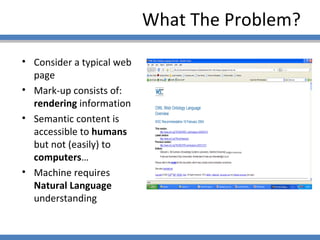
What The Problem? Consider a typical web page Mark-up consists of:  rendering  information  Semantic content is accessible to  humans  but not (easily) to  computers … Machine requires  Natural Language  understanding
Our Goal Accessing the deep web by various web technologies e.g. XML Schema, RDF, OWL Represent the data in a machine accessible way Enriching ontologies using this data
The Semantic Web The  Semantic Web  is an extension of the current web in which information is given well-defined  meaning , better enabling computers and people to  work in   co-operation . [Tim Berners-Lee , 2001]
Accessing semantic deep web Two main approaches- Ontology plug-in search Deep web service annotation Both approaches require a semantic deep web crawler or bot.
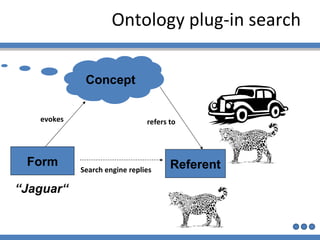
Ontology plug-in search Referent Form Search engine replies refers to evokes Concept ā€œ Jaguarā€œ
Ontology plug-in search Two processes- Harvesting concepts or deep web form attribute. Iteratively link this concepts to build enriched ontology. This   ontology provides- - domain specific terms. - useful relationship and further related information.
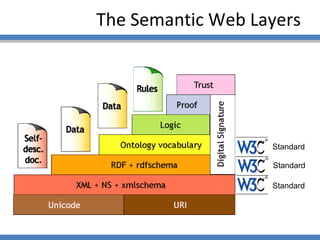
Deep web service annotation How to represent data in a machine accessible way? Semantic data signature represented in computational graph -XML -RDF -RDF Schema -OWL (Web ontology language)
The Semantic Web Layers Standard Standard Standard
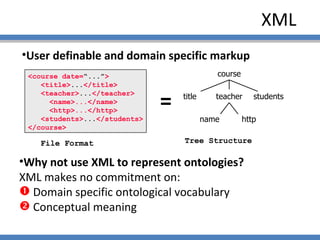
XML  User definable and domain specific markup <course date= ā€œ...ā€ >   <title> ... </title>   <teacher> ... </teacher> <name>...</name> <http>...</http>   <students> ... </students> </course> File Format Tree Structure  Why not use XML to represent ontologies? XML makes no commitment on: Domain specific ontological vocabulary Conceptual meaning  course teacher title students name http =
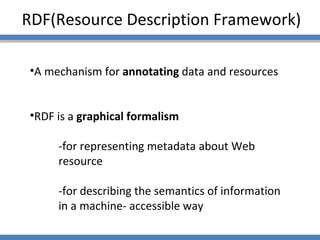
RDF(Resource Description Framework) A mechanism for  annotating  data and resources RDF is a  graphical formalism -for representing metadata about Web resource -for describing the semantics of information in a machine- accessible way
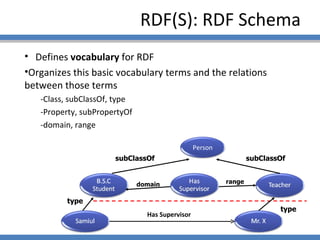
RDF(S): RDF Schema Defines  vocabulary  for RDF Organizes this  basic vocabulary terms and the relations between those terms -Class, subClassOf, type -Property, subPropertyOf -domain, range Has Supervisor Person subClassOf subClassOf type domain range type
OWL :Web Ontology Language Ontologies  standardize  and  formalize  the meaning of words through concepts It helps softbots by serving knowledge about synonyms, antonyms, semantic relationship between concept.
Conclusion Ontology helps to find the concepts. Semi-automatic ontology generation from the deep web, quality of ontology measurement(reliability) is challenging. It requires  natural language processing.
Reference Y. Sure and R. Studer.  Vision for Semantically-Enabled Knowledge Technologies.  Online at:  KTweb  -- Connecting Knowledge Technologies Communities, 2003. Search on the semantic web  IEEE Computer october 2005. www.w3.org/TR/owl-features/ . M. Dean and G. Schreiber,  OWL Web Ontology Language Reference , Feb. 2004; http://www.w3.org/ TR/2004/REC-owl-ref-20040210/.  T. Berners-Lee, J. Hendler, and O. Lassila, ā€œ The Semantic Web ,ā€  Scientific American , May 2001

Toward The Semantic Deep Web

  • 1.
  • 2.
    What The Problem?Consider a typical web page Mark-up consists of: rendering information Semantic content is accessible to humans but not (easily) to computers … Machine requires Natural Language understanding
  • 3.
    Our Goal Accessingthe deep web by various web technologies e.g. XML Schema, RDF, OWL Represent the data in a machine accessible way Enriching ontologies using this data
  • 4.
    The Semantic WebThe Semantic Web is an extension of the current web in which information is given well-defined meaning , better enabling computers and people to work in co-operation . [Tim Berners-Lee , 2001]
  • 5.
    Accessing semantic deepweb Two main approaches- Ontology plug-in search Deep web service annotation Both approaches require a semantic deep web crawler or bot.
  • 6.
    Ontology plug-in searchReferent Form Search engine replies refers to evokes Concept ā€œ Jaguarā€œ
  • 7.
    Ontology plug-in searchTwo processes- Harvesting concepts or deep web form attribute. Iteratively link this concepts to build enriched ontology. This ontology provides- - domain specific terms. - useful relationship and further related information.
  • 8.
    Deep web serviceannotation How to represent data in a machine accessible way? Semantic data signature represented in computational graph -XML -RDF -RDF Schema -OWL (Web ontology language)
  • 9.
    The Semantic WebLayers Standard Standard Standard
  • 10.
    XML Userdefinable and domain specific markup <course date= ā€œ...ā€ > <title> ... </title> <teacher> ... </teacher> <name>...</name> <http>...</http> <students> ... </students> </course> File Format Tree Structure Why not use XML to represent ontologies? XML makes no commitment on: Domain specific ontological vocabulary Conceptual meaning course teacher title students name http =
  • 11.
    RDF(Resource Description Framework)A mechanism for annotating data and resources RDF is a graphical formalism -for representing metadata about Web resource -for describing the semantics of information in a machine- accessible way
  • 12.
    RDF(S): RDF SchemaDefines vocabulary for RDF Organizes this basic vocabulary terms and the relations between those terms -Class, subClassOf, type -Property, subPropertyOf -domain, range Has Supervisor Person subClassOf subClassOf type domain range type
  • 13.
    OWL :Web OntologyLanguage Ontologies standardize and formalize the meaning of words through concepts It helps softbots by serving knowledge about synonyms, antonyms, semantic relationship between concept.
  • 14.
    Conclusion Ontology helpsto find the concepts. Semi-automatic ontology generation from the deep web, quality of ontology measurement(reliability) is challenging. It requires natural language processing.
  • 15.
    Reference Y. Sureand R. Studer. Vision for Semantically-Enabled Knowledge Technologies. Online at: KTweb -- Connecting Knowledge Technologies Communities, 2003. Search on the semantic web IEEE Computer october 2005. www.w3.org/TR/owl-features/ . M. Dean and G. Schreiber, OWL Web Ontology Language Reference , Feb. 2004; http://www.w3.org/ TR/2004/REC-owl-ref-20040210/. T. Berners-Lee, J. Hendler, and O. Lassila, ā€œ The Semantic Web ,ā€ Scientific American , May 2001