The word Travel derived from the French word
‘Travail’
All Tourism involves Travel; but not all Travel
involves Tourism
CONCEPT OF TOURISM
Tourism is the sum of the phenomena and relationships
arising from the travel and stay of non-residents, in so
far as they do not lead to permanent residence and are
not connected with any earning activity
Hunziker and Krapf (A tourism research professor at University of
St. Gallen, Switzerland)
Definition according to UNWTO
• "Tourism comprises the activities of persons
traveling to and staying in places outside their
usual environment for not more than one
consecutive year for leisure, business and
other purposes."
Features of Tourism
• Temporary movement of people
• Takes place outside the normal place of
residence and work
• Visit for purposes other than taking up
permanent residence or employment
Difference between Tourism and
Travel
Tourism is different from travel. But, in order for tourism to happen, there
must be a displacement: an individual has to travel, using any type of means of
transportation But all travel is not tourism.
Three criteria are used simultaneously in order to characterize a trip as
belonging to tourism. The displacement must be such that;
• It involves a displacement outside the usual environment
• Type of purpose: the travel must occur for any purpose different from being
remunerated from within the place visited: the previous limits, where
tourism was restricted to recreation and visiting family and friends are now
expanded to include a vast array of purposes;
• Duration: only a maximal duration is mentioned, not a minimal. Tourism
displacement can be with or without an overnight stay.
Every traveller is a ‘potential’ tourist and is upto the managers of
the industry to tap this ‘potential’ and convert the traveller into
an ‘actual’ tourist. Some of the characteristics that distinguish
tourism from travel are:
Tourism is:
• Temporary, to distinguish it from the permanent travel of the
tramp and nomad
• Voluntary, to distinguish it from the forced travel of the exile
and refugee
• Round up, to distinguish it from the one-way journey of the
migrant
• Relatively long, to distinguish it from the recurrent trips of the
holiday house owner
Visitor
• A visitor is a traveller taking a trip to a main
destination outside his/her usual
environment, for less than a year, for any main
purpose (business, leisure or other personal
purpose) other than to be employed by a
resident entity in the country or place visited.
The term includes two types of visitors:
1. Tourist (Overnight visitor) – A visitor (domestic,
inbound or outbound) is classified as a tourist, if
his/her trip includes an overnight stay. The purpose
of whose journey can be classified under one of the
following heads:
a) Leisure (recreation, holiday, health, study, religion
and sport)
b) Business, family, mission, meeting.
2. Excursionist (Same day visitor)—is a temporary
visitor staying for a period of less than 24 hours in
the country visited. (Including travellers on the
cruises).
Business visitor
• A business visitor is a visitor whose main
purpose for a tourism trip corresponds to the
business and professional category.
Country of reference
The country of reference refers to the country for which
the measurement is done.
• The term “country” can be transposed to a different
geographical level using the term “place” instead
(either a region, municipality or other subnational
geographic location);
Country of residence
• The country of residence of a household is
determined according to the centre of
predominant economic interest of its members.
• If a person resides (or intends to reside) for more
than one year in a given country and has there
his/her centre of economic interest (for example,
where the predominant amount of time is
spent), he/she is considered as a resident of this
country.
Forms of tourism / Classification
of tourism
Domestic tourism
• Comprises the activities of a resident visitor
within the country of reference, either as part
of a domestic tourism trip or part of an
outbound tourism trip.
Internal tourism
• Internal tourism comprises domestic tourism
plus inbound tourism, that is to say, the
activities of resident and non-resident visitors
within the country of reference as part of
domestic or international tourism trips.
International tourism
• International tourism comprises inbound
tourism plus outbound tourism, that is to say,
the activities of resident visitors outside the
country of reference, either as part of
domestic or outbound tourism trips and the
activities of non-resident visitors within the
country of reference on inbound tourism trips.
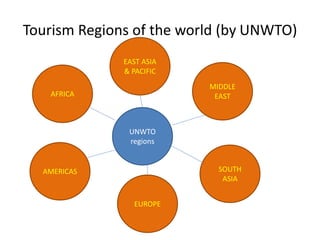
Tourism Regions of the world (by UNWTO)
UNWTO
regions
MIDDLE
EAST
EAST ASIA
& PACIFIC
AFRICA
AMERICAS
EUROPE
SOUTH
ASIA
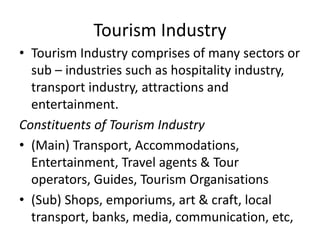
Tourism Industry
• Tourism Industry comprises of many sectors or
sub – industries such as hospitality industry,
transport industry, attractions and
entertainment.
Constituents of Tourism Industry
• (Main) Transport, Accommodations,
Entertainment, Travel agents & Tour
operators, Guides, Tourism Organisations
• (Sub) Shops, emporiums, art & craft, local
transport, banks, media, communication, etc,
Components of Tourism
• 5 A’s or 6 A’s or 8 A’s
Tourism Product
• A tourism product can be defined as the sum of the physical
and psychological satisfaction it provides to tourists during
their travelling en route to the destination. The tourist product
focuses on facilities and services designed to meet the needs
of the tourist.
• It can be seen as a composite product, as the sum total of a
country’s tourist attractions, transport, and accommodation
and of entertainment which result in customer satisfaction.
Each of the components of a tourist product is supplied by
individual providers of services like hotel companies, airlines,
travel agencies, etc.
• The tourist product can be analysed in terms of Components.
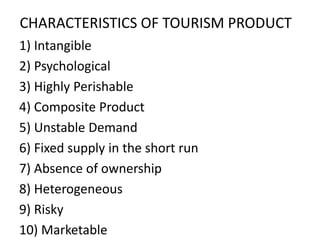
CHARACTERISTICS OF TOURISM PRODUCT
1) Intangible
2) Psychological
3) Highly Perishable
4) Composite Product
5) Unstable Demand
6) Fixed supply in the short run
7) Absence of ownership
8) Heterogeneous
9) Risky
10) Marketable
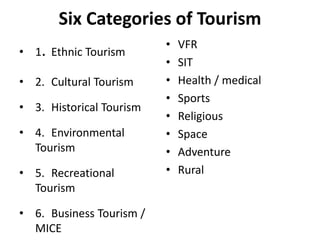
Six Categories of Tourism
• 1. Ethnic Tourism
• 2. Cultural Tourism
• 3. Historical Tourism
• 4. Environmental
Tourism
• 5. Recreational
Tourism
• 6. Business Tourism /
MICE
• VFR
• SIT
• Health / medical
• Sports
• Religious
• Space
• Adventure
• Rural
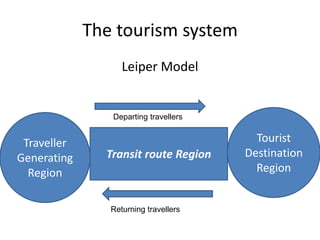
The tourism system
Leiper Model
Transit route Region
Traveller
Generating
Region
Tourist
Destination
Region
Departing travellers
Returning travellers
Overview
of
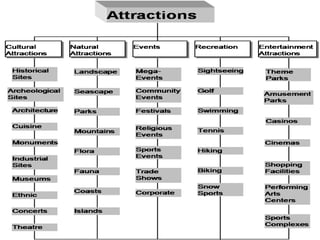
Attractions
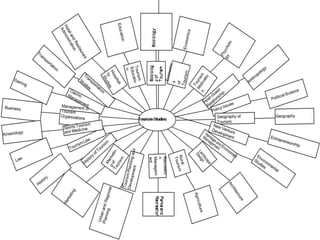
Disciplinary
inputs to the
tourism field
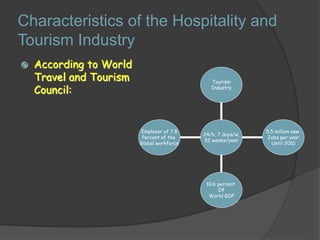
Characteristics of the Hospitality and
Tourism Industry
 According to World
Travel and Tourism
Council:
Employer of 7.8
Percent of the
Global workforce
10.6 percent
Of
World GDP
5.5 million new
Jobs per year
Until 2010
Tourism
Industry
24/h, 7 days/w,
52 weeks/year
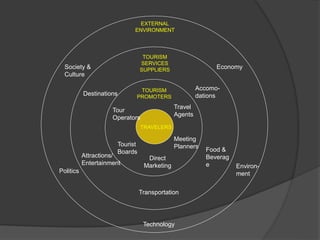
TRAVELERS
TOURISM
PROMOTERS
TOURISM
SERVICES
SUPPLIERS
EXTERNAL
ENVIRONMENT
Tour
Operators
Tourist
Boards
Meeting
Planners
Travel
Agents
Direct
Marketing
Destinations
Attractions/
Entertainment
Transportation
Food &
Beverag
e
Accomo-
dations
Society &
Culture
Politics
Technology
Environ-
ment
Economy
Integrated Model
Of Tourism
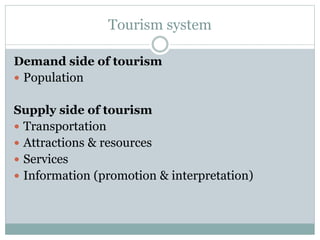
Tourism system
Demand side of tourism
 Population
Supply side of tourism
 Transportation
 Attractions & resources
 Services
 Information (promotion & interpretation)
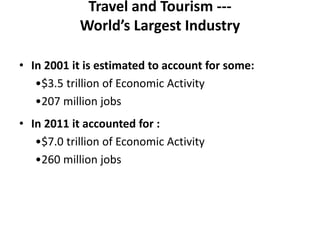
Travel and Tourism ---
World’s Largest Industry
• In 2001 it is estimated to account for some:
•$3.5 trillion of Economic Activity
•207 million jobs
• In 2011 it accounted for :
•$7.0 trillion of Economic Activity
•260 million jobs
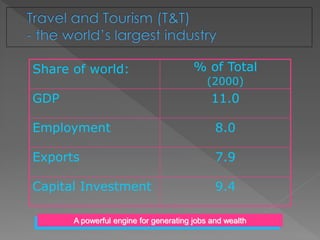
Share of world: % of Total
(2000)
GDP 11.0
Employment 8.0
Exports 7.9
Capital Investment 9.4
A powerful engine for generating jobs and wealth
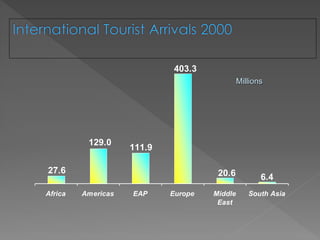
27.6
129.0
111.9
403.3
6.420.6
Africa Americas EAP Europe Middle
East
South Asia
Millions
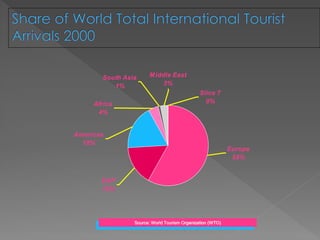
Slice 7
0%
Americas
18%
EAP
16%
Europe
58%
Middle East
3%
Africa
4%
South Asia
1%
Source: World Tourism Organization (WTO)
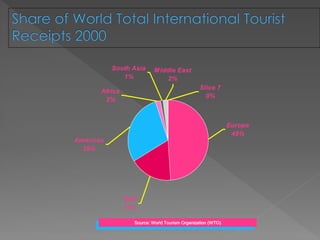
Slice 7
0%
Americas
29%
EAP
17%
Europe
49%
Middle East
2%
Africa
2%
South Asia
1%
Source: World Tourism Organization (WTO)
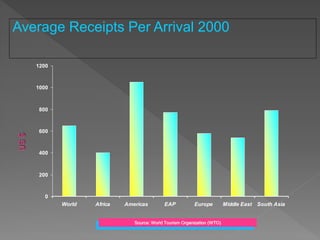
Average Receipts Per Arrival 2000
0
200
400
600
800
1000
1200
World Africa Americas EAP Europe Middle East South Asia
Source: World Tourism Organization (WTO)
US$
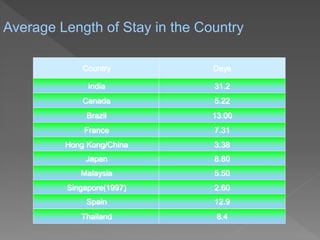
Average Length of Stay in the Country
Country
India
Canada
Brazil
France
Hong Kong/China
Japan
Malaysia
Singapore(1997)
Spain
Thailand
Days
31.2
5.22
13.00
7.31
3.38
8.80
5.50
2.60
12.9
8.4
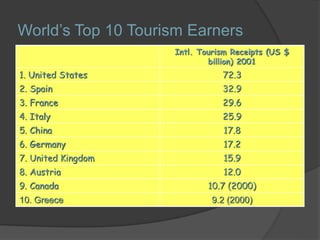
World’s Top 10 Tourism Earners
Intl. Tourism Receipts (US $
billion) 2001
1. United States 72.3
2. Spain 32.9
3. France 29.6
4. Italy 25.9
5. China 17.8
6. Germany 17.2
7. United Kingdom 15.9
8. Austria 12.0
9. Canada 10.7 (2000)
10. Greece 9.2 (2000)
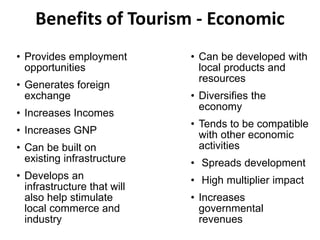
Benefits of Tourism - Economic
• Can be developed with
local products and
resources
• Diversifies the
economy
• Tends to be compatible
with other economic
activities
• Spreads development
• High multiplier impact
• Increases
governmental
revenues
• Provides employment
opportunities
• Generates foreign
exchange
• Increases Incomes
• Increases GNP
• Can be built on
existing infrastructure
• Develops an
infrastructure that will
also help stimulate
local commerce and
industry
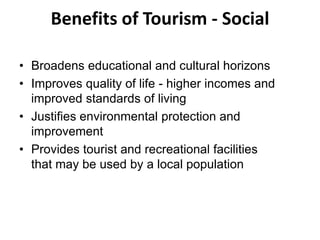
Benefits of Tourism - Social
• Broadens educational and cultural horizons
• Improves quality of life - higher incomes and
improved standards of living
• Justifies environmental protection and
improvement
• Provides tourist and recreational facilities
that may be used by a local population
Benefits of Tourism - Cultural
• Reinforces preservation of heritage and tradition
• Visitor interest in local culture provides
employment for artists, musicians and other
performing artists enhancing cultural heritage
• Breaks down language barriers, socio-cultural
barriers, class barriers, racial barriers, political
barriers, and religious barriers
• Creates a favorable worldwide image for a
destination
• Promotes a global community
• Promotes international understanding and peace
Disadvantages of Tourism - Economic
• Develops excess demand
• Results in high leakage
• Creates difficulties of seasonality
• Causes inflation
• Can result in unbalanced economic
development
• Increases vulnerability to economic and
political changes
Disadvantages of Tourism - Social
• Creates social problems
• Degrades the natural physical environment and
creates pollution
• Degrades the cultural environment
• Threatens family structure
• Commercializes culture, religion, and the arts
• Creates misunderstanding
• Creates conflicts in the host society
• Contributes to disease, economic fluctuation, and
transportation problems
Steps for
Marketing & Promotion
1. Identify tourism product
2. Identify visitor market groups
3. Determine market position
4. Write market statement
5. Identify & implement suitable promotion &
interpretation strategies
Step 1. Identifying the tourism product
 Conduct an inventory
 Attractions
 Resources
 Services
 Facilities & infrastructure
 What is unique about the product?
 How is the product different from that of
competitors?
Step 2. Identifying visitor markets (segments)
1. What are the demographics of visitors?
 Group composition
 Origin (location of residence)
 Age
 Gender
 Education level
 Income level
Step 2. Identifying visitor markets (segments)
2. What are the interests and needs of visitors?
 demographics
 visitor/resident input
 observations l Group composition
l Origin (location of residence)
l Age
l Gender
l Education level
l Income level
l Visitor interests
l Visitor needs
Step 2. Identifying visitor markets (segments)
 How is each market segment anticipated to
change in the future?
 Existing
 Growth
 Potential
Step 3. Market position
A brief paragraph that states how your area or
community is situated with regard to visitor
market groups, travel routes, competing
tourism destinations, attractions, & resources.
Step 4. Market statement
A short statement or slogan which
summarizes the market position.
Step 5. Types of promotion
 Tourism guidebooks
 Videos
 FAM (familiarization) tours
 Motorcoach tours
 Trade show exhibits
 Media press releases (e.g., newspapers, radio)
 Advertisements in magazines, other guides, etc…
 Web sites
 Word-of-mouth advertising
Promotion & the five phases of the tourism
experience
 Anticipation & planning
 Traveling to site
 Activities at site
 Traveling to home
 Recollection
India - “ A Civilization Alive”
Heritage Site
Cultural Attractions
Beaches / Benchmarks
Health And Wellness - Yoga & Ayurveda
Shopping
Indian Cuisine
New Experience - Meditation, Naturopathy
India - Business Opportunity
5th largest Economy (PPP) High Growth - 250 Middle Class
Huge Outbound Market - Growth
Huge Infrastructure Investment Opportunities
100% FDI Permitted
Investment Facilitation System
Union Government
State Government
Single Window System
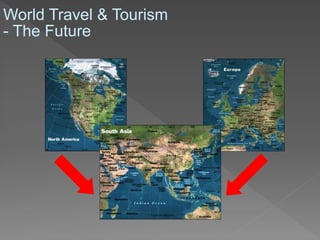
World Travel & Tourism
- The Future
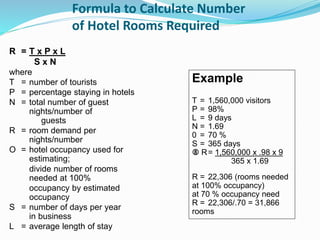
Formula to Calculate Number
of Hotel Rooms Required
R = T x P x L
S x N
where
T = number of tourists
P = percentage staying in hotels
N = total number of guest
nights/number of
guests
R = room demand per
nights/number
O = hotel occupancy used for
estimating;
divide number of rooms
needed at 100%
occupancy by estimated
occupancy
S = number of days per year
in business
L = average length of stay
Example
T = 1,560,000 visitors
P = 98%
L = 9 days
N = 1.69
0 = 70 %
S = 365 days
 R= 1,560,000 x .98 x 9
365 x 1.69
R = 22,306 (rooms needed
at 100% occupancy)
at 70 % occupancy need
R = 22,306/.70 = 31,866
rooms
Assignment Topics
 Tourism administration in India
 Growth of travel through ages

Tourism

  • 1.
    The word Travelderived from the French word ‘Travail’ All Tourism involves Travel; but not all Travel involves Tourism
  • 2.
    CONCEPT OF TOURISM Tourismis the sum of the phenomena and relationships arising from the travel and stay of non-residents, in so far as they do not lead to permanent residence and are not connected with any earning activity Hunziker and Krapf (A tourism research professor at University of St. Gallen, Switzerland)
  • 3.
    Definition according toUNWTO • "Tourism comprises the activities of persons traveling to and staying in places outside their usual environment for not more than one consecutive year for leisure, business and other purposes."
  • 4.
    Features of Tourism •Temporary movement of people • Takes place outside the normal place of residence and work • Visit for purposes other than taking up permanent residence or employment
  • 5.
    Difference between Tourismand Travel Tourism is different from travel. But, in order for tourism to happen, there must be a displacement: an individual has to travel, using any type of means of transportation But all travel is not tourism. Three criteria are used simultaneously in order to characterize a trip as belonging to tourism. The displacement must be such that; • It involves a displacement outside the usual environment • Type of purpose: the travel must occur for any purpose different from being remunerated from within the place visited: the previous limits, where tourism was restricted to recreation and visiting family and friends are now expanded to include a vast array of purposes; • Duration: only a maximal duration is mentioned, not a minimal. Tourism displacement can be with or without an overnight stay.
  • 6.
    Every traveller isa ‘potential’ tourist and is upto the managers of the industry to tap this ‘potential’ and convert the traveller into an ‘actual’ tourist. Some of the characteristics that distinguish tourism from travel are: Tourism is: • Temporary, to distinguish it from the permanent travel of the tramp and nomad • Voluntary, to distinguish it from the forced travel of the exile and refugee • Round up, to distinguish it from the one-way journey of the migrant • Relatively long, to distinguish it from the recurrent trips of the holiday house owner
  • 7.
    Visitor • A visitoris a traveller taking a trip to a main destination outside his/her usual environment, for less than a year, for any main purpose (business, leisure or other personal purpose) other than to be employed by a resident entity in the country or place visited.
  • 8.
    The term includestwo types of visitors: 1. Tourist (Overnight visitor) – A visitor (domestic, inbound or outbound) is classified as a tourist, if his/her trip includes an overnight stay. The purpose of whose journey can be classified under one of the following heads: a) Leisure (recreation, holiday, health, study, religion and sport) b) Business, family, mission, meeting. 2. Excursionist (Same day visitor)—is a temporary visitor staying for a period of less than 24 hours in the country visited. (Including travellers on the cruises).
  • 9.
    Business visitor • Abusiness visitor is a visitor whose main purpose for a tourism trip corresponds to the business and professional category.
  • 10.
    Country of reference Thecountry of reference refers to the country for which the measurement is done. • The term “country” can be transposed to a different geographical level using the term “place” instead (either a region, municipality or other subnational geographic location);
  • 11.
    Country of residence •The country of residence of a household is determined according to the centre of predominant economic interest of its members. • If a person resides (or intends to reside) for more than one year in a given country and has there his/her centre of economic interest (for example, where the predominant amount of time is spent), he/she is considered as a resident of this country.
  • 12.
    Forms of tourism/ Classification of tourism
  • 13.
    Domestic tourism • Comprisesthe activities of a resident visitor within the country of reference, either as part of a domestic tourism trip or part of an outbound tourism trip.
  • 14.
    Internal tourism • Internaltourism comprises domestic tourism plus inbound tourism, that is to say, the activities of resident and non-resident visitors within the country of reference as part of domestic or international tourism trips.
  • 15.
    International tourism • Internationaltourism comprises inbound tourism plus outbound tourism, that is to say, the activities of resident visitors outside the country of reference, either as part of domestic or outbound tourism trips and the activities of non-resident visitors within the country of reference on inbound tourism trips.
  • 16.
    Tourism Regions ofthe world (by UNWTO) UNWTO regions MIDDLE EAST EAST ASIA & PACIFIC AFRICA AMERICAS EUROPE SOUTH ASIA
  • 17.
    Tourism Industry • TourismIndustry comprises of many sectors or sub – industries such as hospitality industry, transport industry, attractions and entertainment. Constituents of Tourism Industry • (Main) Transport, Accommodations, Entertainment, Travel agents & Tour operators, Guides, Tourism Organisations • (Sub) Shops, emporiums, art & craft, local transport, banks, media, communication, etc,
  • 18.
    Components of Tourism •5 A’s or 6 A’s or 8 A’s
  • 19.
    Tourism Product • Atourism product can be defined as the sum of the physical and psychological satisfaction it provides to tourists during their travelling en route to the destination. The tourist product focuses on facilities and services designed to meet the needs of the tourist. • It can be seen as a composite product, as the sum total of a country’s tourist attractions, transport, and accommodation and of entertainment which result in customer satisfaction. Each of the components of a tourist product is supplied by individual providers of services like hotel companies, airlines, travel agencies, etc. • The tourist product can be analysed in terms of Components.
  • 20.
    CHARACTERISTICS OF TOURISMPRODUCT 1) Intangible 2) Psychological 3) Highly Perishable 4) Composite Product 5) Unstable Demand 6) Fixed supply in the short run 7) Absence of ownership 8) Heterogeneous 9) Risky 10) Marketable
  • 21.
    Six Categories ofTourism • 1. Ethnic Tourism • 2. Cultural Tourism • 3. Historical Tourism • 4. Environmental Tourism • 5. Recreational Tourism • 6. Business Tourism / MICE • VFR • SIT • Health / medical • Sports • Religious • Space • Adventure • Rural
  • 22.
    The tourism system LeiperModel Transit route Region Traveller Generating Region Tourist Destination Region Departing travellers Returning travellers
  • 23.
  • 25.
  • 27.
    Characteristics of theHospitality and Tourism Industry  According to World Travel and Tourism Council: Employer of 7.8 Percent of the Global workforce 10.6 percent Of World GDP 5.5 million new Jobs per year Until 2010 Tourism Industry 24/h, 7 days/w, 52 weeks/year
  • 28.
  • 29.
    Tourism system Demand sideof tourism  Population Supply side of tourism  Transportation  Attractions & resources  Services  Information (promotion & interpretation)
  • 30.
    Travel and Tourism--- World’s Largest Industry • In 2001 it is estimated to account for some: •$3.5 trillion of Economic Activity •207 million jobs • In 2011 it accounted for : •$7.0 trillion of Economic Activity •260 million jobs
  • 31.
    Share of world:% of Total (2000) GDP 11.0 Employment 8.0 Exports 7.9 Capital Investment 9.4 A powerful engine for generating jobs and wealth
  • 32.
    27.6 129.0 111.9 403.3 6.420.6 Africa Americas EAPEurope Middle East South Asia Millions
  • 33.
    Slice 7 0% Americas 18% EAP 16% Europe 58% Middle East 3% Africa 4% SouthAsia 1% Source: World Tourism Organization (WTO)
  • 34.
    Slice 7 0% Americas 29% EAP 17% Europe 49% Middle East 2% Africa 2% SouthAsia 1% Source: World Tourism Organization (WTO)
  • 35.
    Average Receipts PerArrival 2000 0 200 400 600 800 1000 1200 World Africa Americas EAP Europe Middle East South Asia Source: World Tourism Organization (WTO) US$
  • 36.
    Average Length ofStay in the Country Country India Canada Brazil France Hong Kong/China Japan Malaysia Singapore(1997) Spain Thailand Days 31.2 5.22 13.00 7.31 3.38 8.80 5.50 2.60 12.9 8.4
  • 37.
    World’s Top 10Tourism Earners Intl. Tourism Receipts (US $ billion) 2001 1. United States 72.3 2. Spain 32.9 3. France 29.6 4. Italy 25.9 5. China 17.8 6. Germany 17.2 7. United Kingdom 15.9 8. Austria 12.0 9. Canada 10.7 (2000) 10. Greece 9.2 (2000)
  • 38.
    Benefits of Tourism- Economic • Can be developed with local products and resources • Diversifies the economy • Tends to be compatible with other economic activities • Spreads development • High multiplier impact • Increases governmental revenues • Provides employment opportunities • Generates foreign exchange • Increases Incomes • Increases GNP • Can be built on existing infrastructure • Develops an infrastructure that will also help stimulate local commerce and industry
  • 39.
    Benefits of Tourism- Social • Broadens educational and cultural horizons • Improves quality of life - higher incomes and improved standards of living • Justifies environmental protection and improvement • Provides tourist and recreational facilities that may be used by a local population
  • 40.
    Benefits of Tourism- Cultural • Reinforces preservation of heritage and tradition • Visitor interest in local culture provides employment for artists, musicians and other performing artists enhancing cultural heritage • Breaks down language barriers, socio-cultural barriers, class barriers, racial barriers, political barriers, and religious barriers • Creates a favorable worldwide image for a destination • Promotes a global community • Promotes international understanding and peace
  • 41.
    Disadvantages of Tourism- Economic • Develops excess demand • Results in high leakage • Creates difficulties of seasonality • Causes inflation • Can result in unbalanced economic development • Increases vulnerability to economic and political changes
  • 42.
    Disadvantages of Tourism- Social • Creates social problems • Degrades the natural physical environment and creates pollution • Degrades the cultural environment • Threatens family structure • Commercializes culture, religion, and the arts • Creates misunderstanding • Creates conflicts in the host society • Contributes to disease, economic fluctuation, and transportation problems
  • 43.
    Steps for Marketing &Promotion 1. Identify tourism product 2. Identify visitor market groups 3. Determine market position 4. Write market statement 5. Identify & implement suitable promotion & interpretation strategies
  • 44.
    Step 1. Identifyingthe tourism product  Conduct an inventory  Attractions  Resources  Services  Facilities & infrastructure  What is unique about the product?  How is the product different from that of competitors?
  • 45.
    Step 2. Identifyingvisitor markets (segments) 1. What are the demographics of visitors?  Group composition  Origin (location of residence)  Age  Gender  Education level  Income level
  • 46.
    Step 2. Identifyingvisitor markets (segments) 2. What are the interests and needs of visitors?  demographics  visitor/resident input  observations l Group composition l Origin (location of residence) l Age l Gender l Education level l Income level l Visitor interests l Visitor needs
  • 47.
    Step 2. Identifyingvisitor markets (segments)  How is each market segment anticipated to change in the future?  Existing  Growth  Potential
  • 48.
    Step 3. Marketposition A brief paragraph that states how your area or community is situated with regard to visitor market groups, travel routes, competing tourism destinations, attractions, & resources.
  • 49.
    Step 4. Marketstatement A short statement or slogan which summarizes the market position.
  • 50.
    Step 5. Typesof promotion  Tourism guidebooks  Videos  FAM (familiarization) tours  Motorcoach tours  Trade show exhibits  Media press releases (e.g., newspapers, radio)  Advertisements in magazines, other guides, etc…  Web sites  Word-of-mouth advertising
  • 51.
    Promotion & thefive phases of the tourism experience  Anticipation & planning  Traveling to site  Activities at site  Traveling to home  Recollection
  • 52.
    India - “A Civilization Alive” Heritage Site Cultural Attractions Beaches / Benchmarks Health And Wellness - Yoga & Ayurveda Shopping Indian Cuisine New Experience - Meditation, Naturopathy
  • 53.
    India - BusinessOpportunity 5th largest Economy (PPP) High Growth - 250 Middle Class Huge Outbound Market - Growth Huge Infrastructure Investment Opportunities 100% FDI Permitted Investment Facilitation System Union Government State Government Single Window System
  • 54.
    World Travel &Tourism - The Future
  • 55.
    Formula to CalculateNumber of Hotel Rooms Required R = T x P x L S x N where T = number of tourists P = percentage staying in hotels N = total number of guest nights/number of guests R = room demand per nights/number O = hotel occupancy used for estimating; divide number of rooms needed at 100% occupancy by estimated occupancy S = number of days per year in business L = average length of stay Example T = 1,560,000 visitors P = 98% L = 9 days N = 1.69 0 = 70 % S = 365 days  R= 1,560,000 x .98 x 9 365 x 1.69 R = 22,306 (rooms needed at 100% occupancy) at 70 % occupancy need R = 22,306/.70 = 31,866 rooms
  • 56.
    Assignment Topics  Tourismadministration in India  Growth of travel through ages