MODULE-1
INTRODUCTION TO HISTORICAL
TOURISM
TOPIC-DEFINITIONS ; TOURISM,EXCURSION
 Tourism is traveling mainly for recreational purposes or
utilizing the leisure to know and experience different
cultures and heritage.
 Tourism is the fastest growing industry with a huge
potential to generate employment for people and revenue
for the government.
 Etymologically, the word ‘tour’ is traced or derived from
the Latin word ‘tornare’ and the Greek,‘tornos’ meaning
‘a kind of round wheel’ and ‘a lathe or circle’
respectively.
 Both words signify the idea of a journey or travel circuit.
 The circle represents here a starting point of trip, which a person
ultimately comes back to its beginning or native or place of
domicile(residence).
 The meaning of these two words got changed as per English
language marginally to ‘one’s turn’.
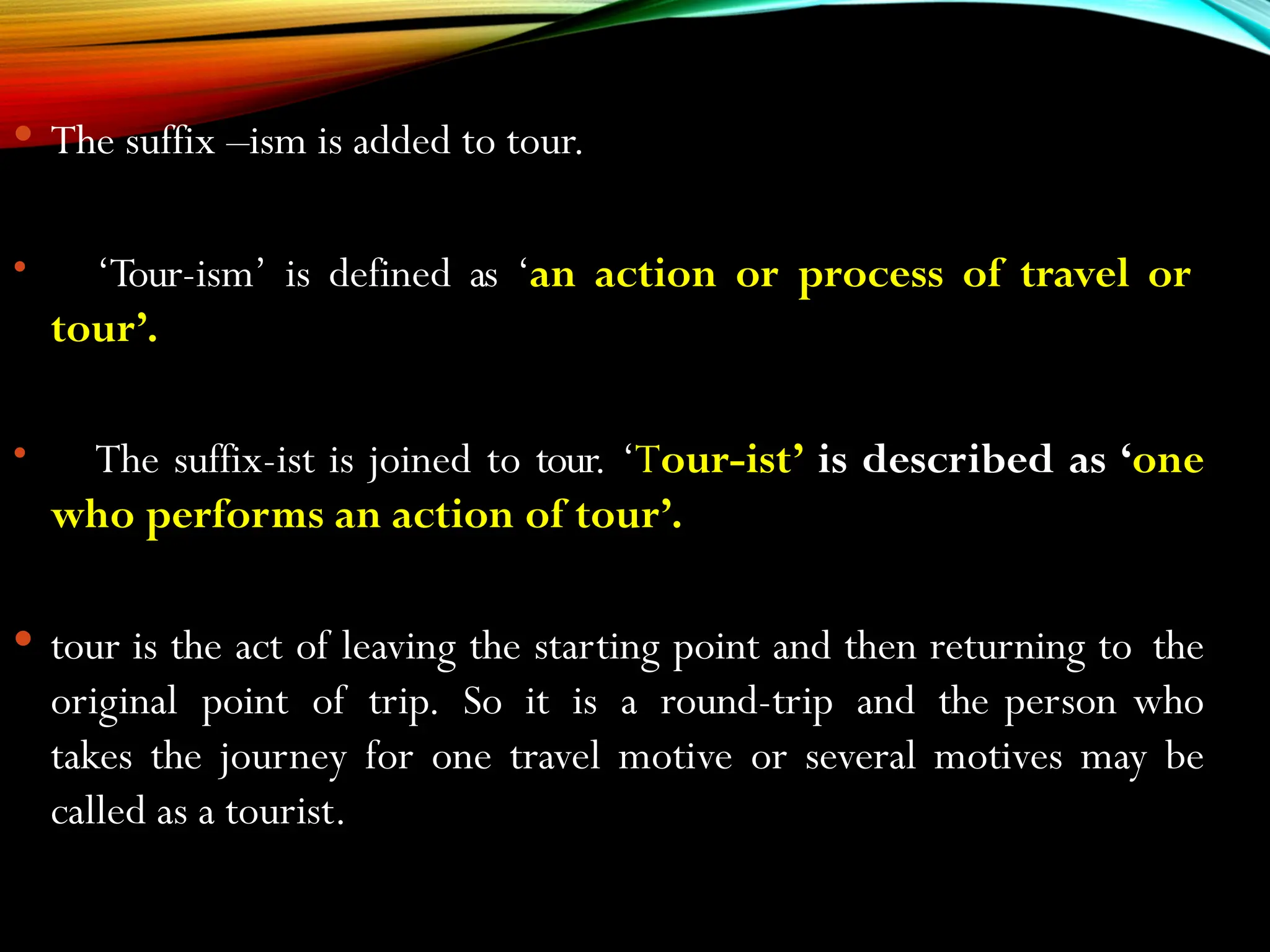
 The suffix –ism is added to tour.
 ‘Tour-ism’ is defined as ‘an action or process of travel or
tour’.
 The suffix-ist is joined to tour. ‘Tour-ist’ is described as ‘one
who performs an action of tour’.
 tour is the act of leaving the starting point and then returning to the
original point of trip. So it is a round-trip and the person who
takes the journey for one travel motive or several motives may be
called as a tourist.
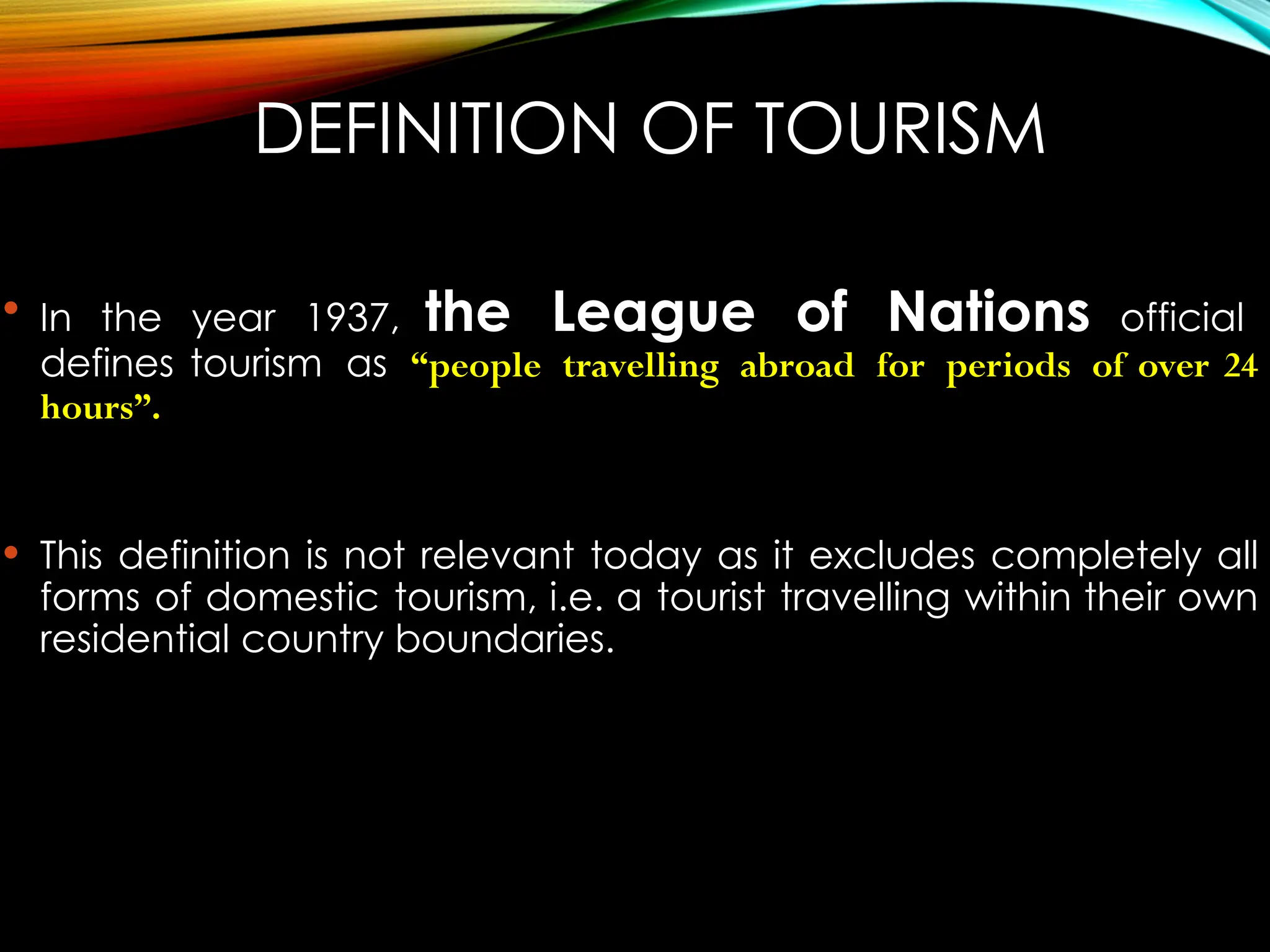
DEFINITION OF TOURISM
 In the year 1937, the League of Nations official
defines tourism as “people travelling abroad for periods of over 24
hours”.
 This definition is not relevant today as it excludes completely all
forms of domestic tourism, i.e. a tourist travelling within their own
residential country boundaries.
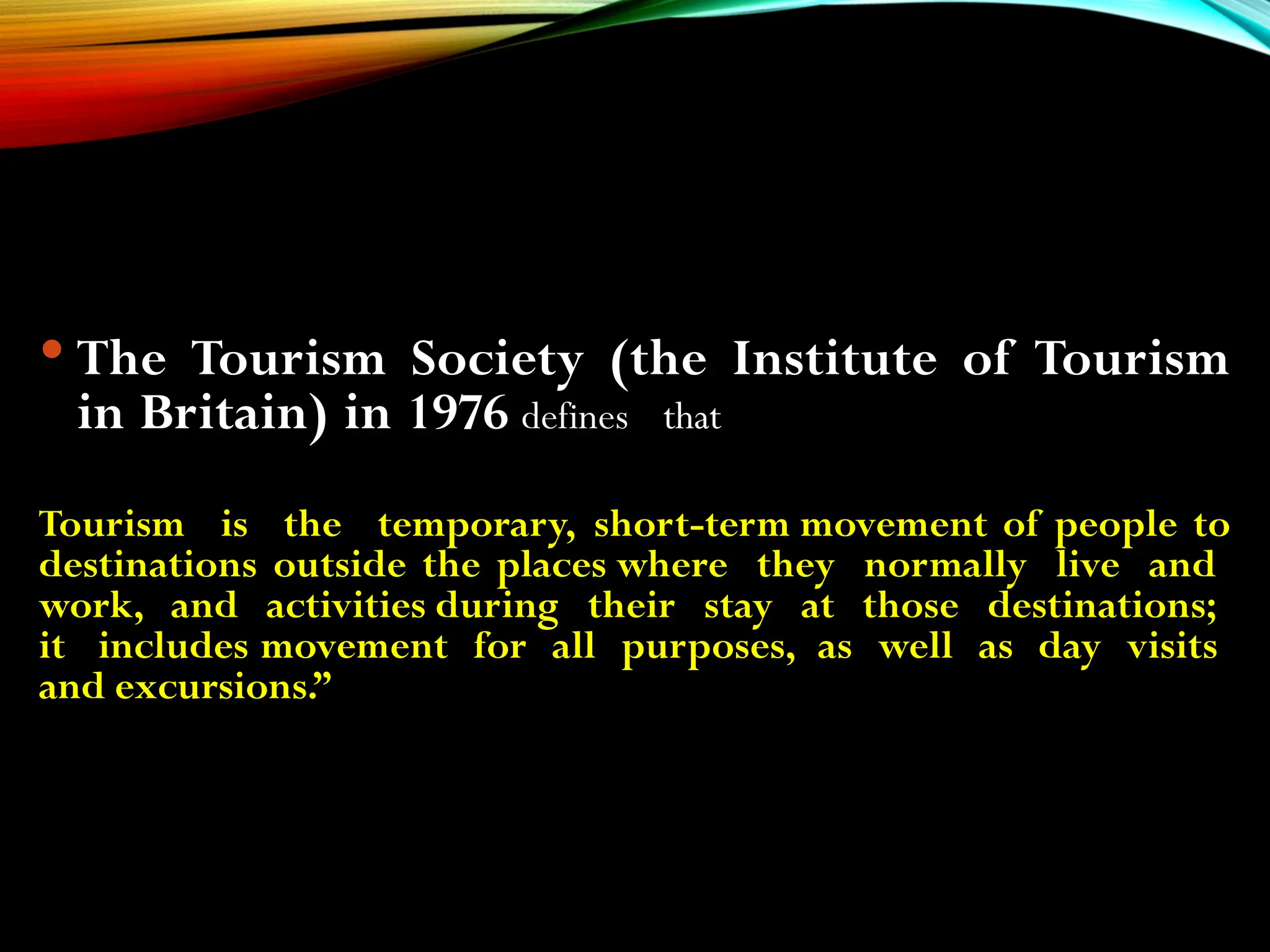
 The Tourism Society (the Institute of Tourism
in Britain) in 1976 defines that
Tourism is the temporary, short-term movement of people to
destinations outside the places where they normally live and
work, and activities during their stay at those destinations;
it includes movement for all purposes, as well as day visits
and excursions.”
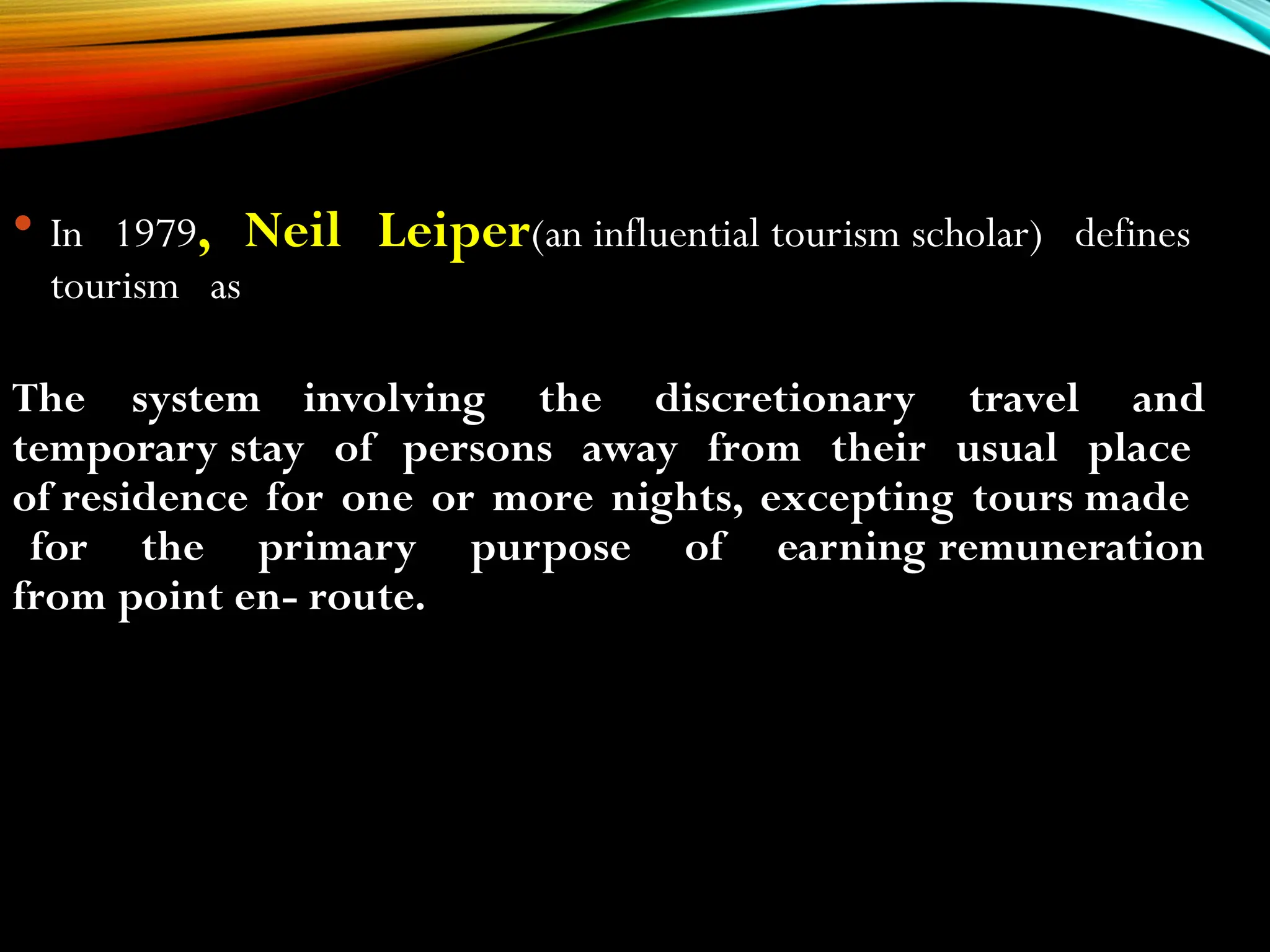
 In 1979, Neil Leiper(an influential tourism scholar) defines
tourism as
The system involving the discretionary travel and
temporary stay of persons away from their usual place
of residence for one or more nights, excepting tours made
for the primary purpose of earning remuneration
from point en- route.
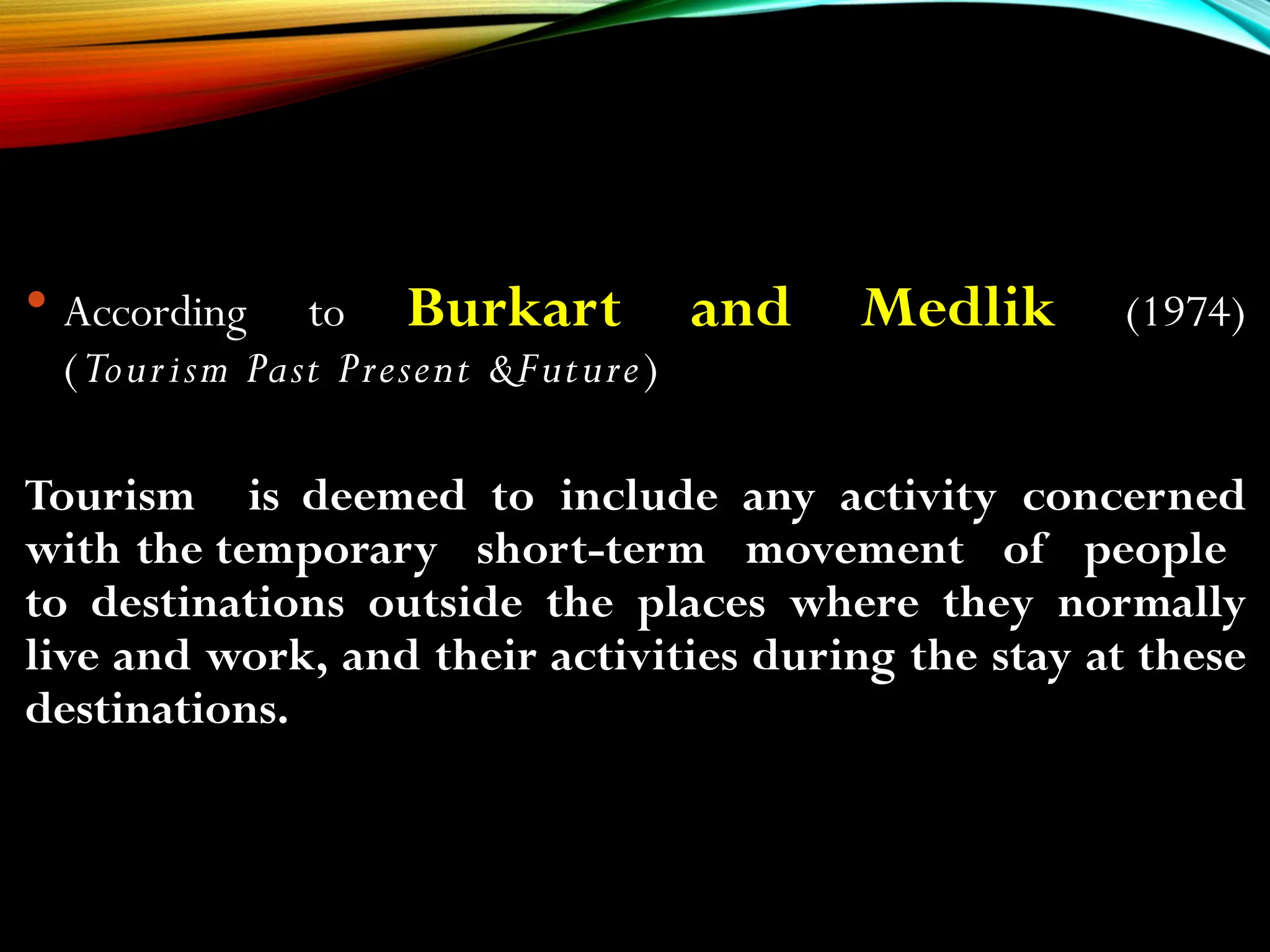
 According to Burkart and Medlik (1974)
(Tourism Past Present &Future)
Tourism is deemed to include any activity concerned
with the temporary short-term movement of people
to destinations outside the places where they normally
live and work, and their activities during the stay at these
destinations.
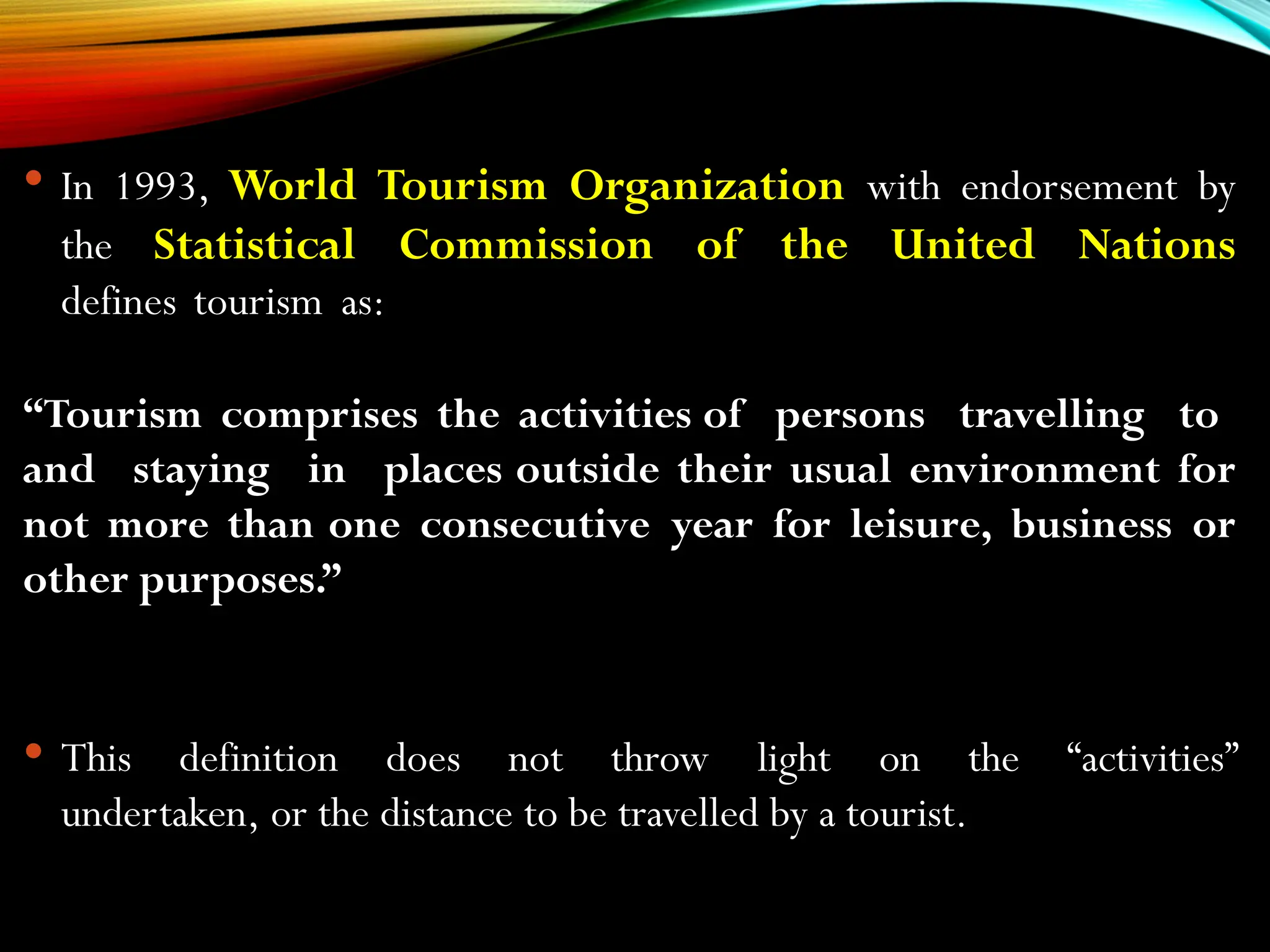
 In 1993, World Tourism Organization with endorsement by
the Statistical Commission of the United Nations
defines tourism as:
“Tourism comprises the activities of persons travelling to
and staying in places outside their usual environment for
not more than one consecutive year for leisure, business or
other purposes.”
 This definition does not throw light on the “activities”
undertaken, or the distance to be travelled by a tourist.
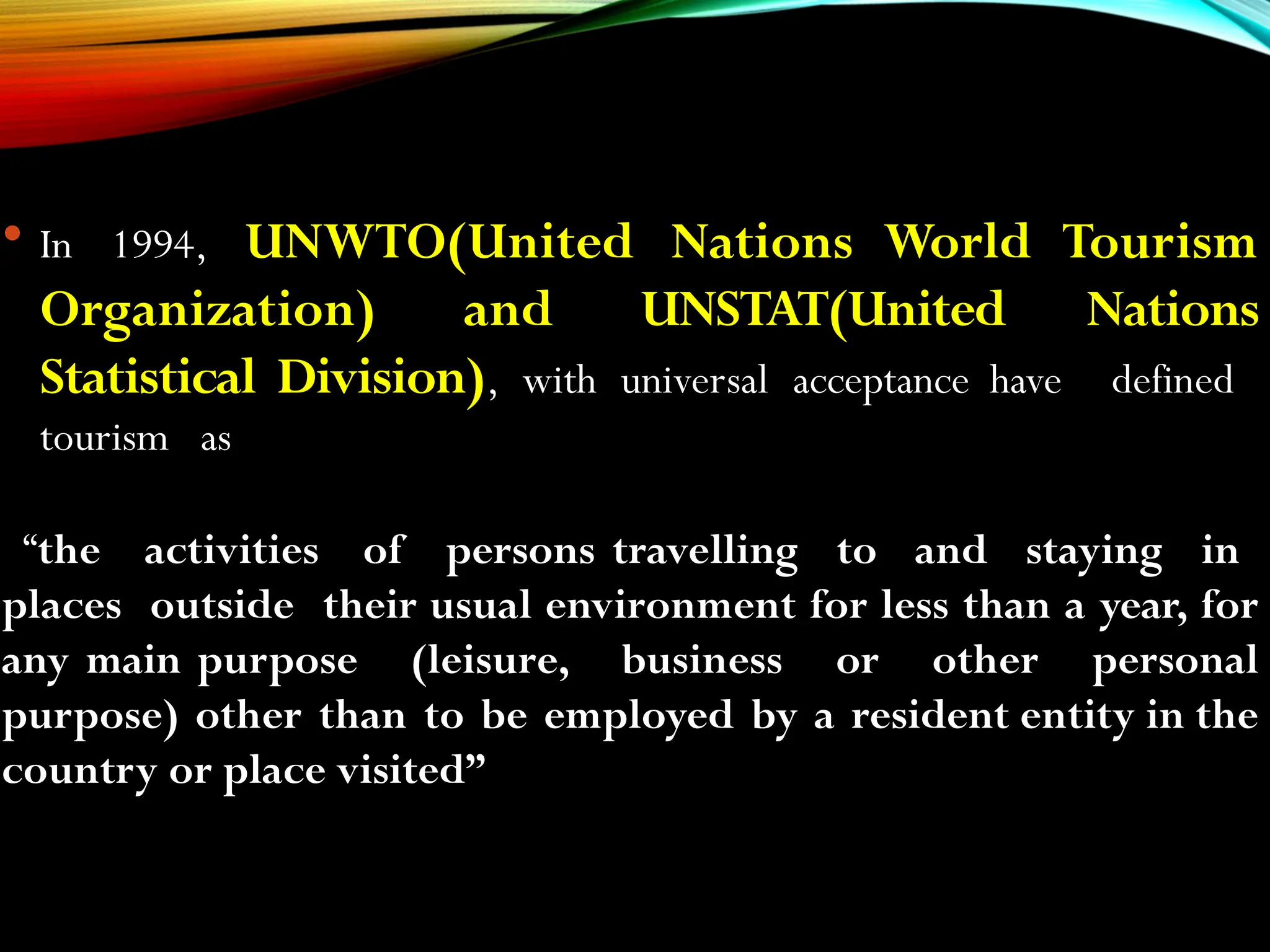
 In 1994, UNWTO(United Nations World Tourism
Organization) and UNSTAT(United Nations
Statistical Division), with universal acceptance have defined
tourism as
“the activities of persons travelling to and staying in
places outside their usual environment for less than a year, for
any main purpose (leisure, business or other personal
purpose) other than to be employed by a resident entity in the
country or place visited”
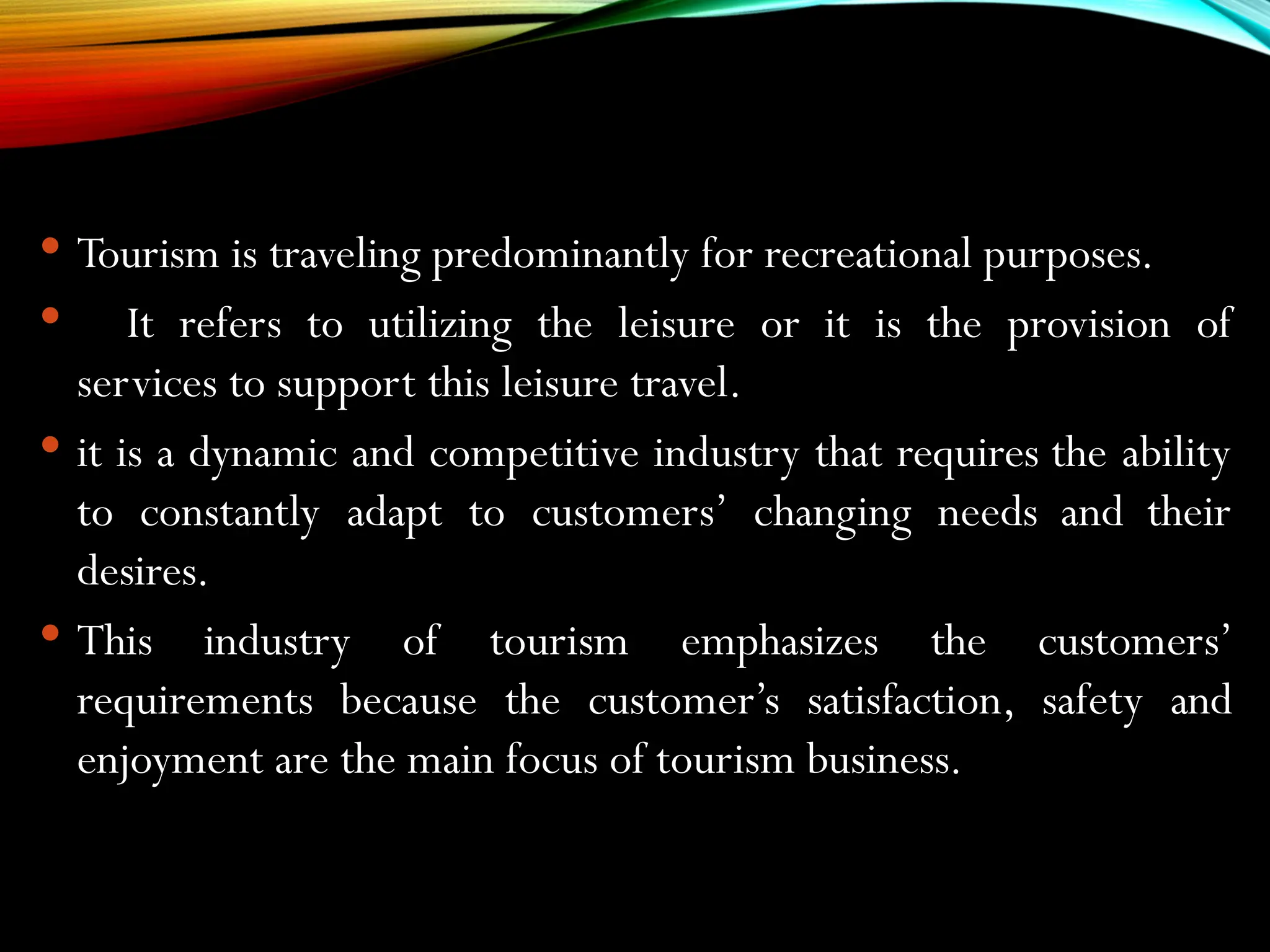
 Tourism is traveling predominantly for recreational purposes.
 It refers to utilizing the leisure or it is the provision of
services to support this leisure travel.
 it is a dynamic and competitive industry that requires the ability
to constantly adapt to customers’ changing needs and their
desires.
 This industry of tourism emphasizes the customers’
requirements because the customer’s satisfaction, safety and
enjoyment are the main focus of tourism business.
 Tourism is vital for many countries because of many factors.
 They are: the income generated by the consumption of goods and
services by the tourists,
 the taxes levied on businesses in the tourism industry
 the opportunity for employment in the service industries associated
with tourism.
 These service industries include transportation services such as
cruise ships(large ships that carries passengers who are travelling for
pleasure) , airlines and taxis; facilities for accommodation
such as hotels, restaurants, bars, and entertainment venues and
other hospitality industry services, for example, theme parks and
resorts
 Tourism embraces nearly all aspects of our society.
 Apart from its role in economic changes, human socio-
cultural activities and environmental development, tourism is also
related to academic subjects such as geography, economics,
history, languages, psychology, marketing, business and law, etc.
 Therefore, it is necessary to integrate a number of subjects to study
tourism.
 For example, subjects such as history and geography help us
understand more about the development of the historical and
geographical resources of a tourist destination respectively
Motivational factors
 In any tourism trip, there are likely to be different and a number
of reasons which, when combined, can be considered as the
motivational factors.
 These reasons could be visiting a particular place for
sightseeing, visiting friends and relatives, taking a vacation or having a
good time.
 These people may spend their leisure time engaging in various
activities at tourist spots like sports, sunbathing, talking, singing,
taking rides, touring, reading or simply enjoying the
environment.
 According to Peter Mason there are some major motivations that
are presented as major reasons for a tourist to travel. They are,
 Escape
 Relaxation
 Play
 Strengthening family bonds
 Prestige
 Social interaction
 Educational opportunity
 Self-fulfillment
 Wish fulfillment
 Shopping
 Enhancing an individual’s overall health and lifestyle
 Finding the family roots & history.
The movement of tourists from the place of origin to the destination is
described as:
1. International tourism: when the travel is from one country to
another.
2. Domestic Tourism: when the travel is within the country, i.e., trips
taken by a tourist within his or her own country or where the origin
and destination are in the same way.
In International Tourism there are:
a) Inbound: This refers to tourists entering a country.
b) Outbound: This refers to tourists leaving their country of origin.
On the basis of distance, tourism can be divided into two types
(a) Long-distance tourism is generally taken to be journeys of over
3,000 kms
(b) Short-distance tourism is below that limit.
ELEMENTS OF TOURISM
Elements of tourism mean the basic fundamentals needed for the tourism
activity to function. No tourism activity is possible without them. The concept
of tourism as a phenomenon involves the movement of people within their
own country or across the national borders for a certain period of time.
Tourism basically composed of three elements, namely;
1.Man :the human element as the creator of the act of tourism.
2.Space :the physical element to be necessarily covered by the act itself.
3.Time :the temporal element which is composed by the trip itself and
the stay at the destination. It varies according to the distance between
the points of departure and the destination countries or areas ,
transport means used and the length of stay at destination etc. .
These elements constitute the essential conditions for the existence of
the phenomenon of tourism. There could be no tourism act without
them.
Components of Tourism
The five vital components of tourism system are
1.Attraction
2.Accessibility
3.Accommodation
4.Amenities (facilities)
5.Activities.
1.Attraction:
Tourism activity starts with the attractions. At a place or
destination there has to be some attraction, only then people
or tourists will visit that area. Attractions are believed to be
the greatest influencers of all the components.
Attractions are of two types:
2.Natural Attractions like lakes, rivers, mountains, etc.
3.Man-made attractions like monuments, museums, shopping
areas, etc.
2.Accessibility:
Accessibility or otherwise said as transportation is an
essential component of tourism system as it creates linkage
between market source and destination. If there are
attractions then those has to be visited by the tourists.
Eg; Bangalore
3.Accommodation:
Accommodation is one of the most crucial aspects of a
destination. Any traveller choosing to visit any destination
would firstly look for accommodation suited to his/her needs.
It should provide him/her food and beverage services, resting
facilities, etc. up to his satisfaction level. Accommodation
units itself act as tourist attractions for a large number of
people.
4.Amenities:
Every tourist travelling to a new destination desires for
world class facilities and services. In order to fulfil their
demand huge efforts are made by the industry. High
quality facilities are important aid to every tourist
destination or centre. For a coastal resort, services like
swimming, boating, yachting, surf-riding and other
amenities like recreation, dancing and other entertainment
and amusement services are very essential for each and
every tourist destination.
5.Activities:
Attractions are often assisted by various activities that
enhance tourist experience. For example: a lake in
Nainital(Himalayan resort town) may have boating and cruise
facilities, a monument in Agra may offer a guided tour by a
tour guide or a light and sound show in Khajaraho, hiking in a
mountain, skiing(use of skis to glide on snow) in the snow
slopes in Himalayas, white water river rafting in Ganges river,
fishing in Manalsu river(river in manali), paragliding in Bir,
Trek in Hamta pass et al.
Excursion
An excursion is a short trip or journey, usually taken for pleasure or
education, that is a departure from one's regular routine or surroundings.
It can be a day trip, a guided tour, or a brief visit to a place of interest.
Example: "The school organized an excursion to the museum for the
students.
"Synonyms:- Trip- Journey- Outing- Tour- Adventure Antonym:-
Staycation-.
Excursion and tourism are related but distinct concepts:Excursion:- A
short trip or outing, usually for a specific purpose (e.g., education,
recreation)- or Typically a day trip or a brief visit- Often focuses on a
particular activity or attraction-May not involve overnight stays.
Tourism:- Traveling for pleasure or business, often involving overnight
stays- Encompasses a broader range of activities and experiences- Can
involve multiple destinations and longer durations- Focuses on exploring
and experiencing new places, cultures, and environments.
Key differences:- Duration: Excursions are shorter, while tourism often
involves longer trips-
Purpose: Excursions may have a specific focus, while tourism is more
open-ended.
Scope: Excursions are typically localized, while tourism can cover larger
geographic areas.
To illustrate the difference:- A day trip to a nearby park is an excursion-
A week-long vacation to a foreign country/other is tourism.
In short an excursion refers to a short trip or outing that
generally lasts less than 24 hours, often undertaken for
leisure, education, or health reasons. Unlike tourism,
excursions typically involve travel within a relatively close
distance from home and do not usually require overnight
accommodation. Excursions are often part of a broader
travel itinerary but can also be standalone trips to nearby
locations like parks, heritage sites, museums, or
natural attractions.

1.Tourism meaning & definition,elemts,& scope

  • 1.
  • 3.
     Tourism istraveling mainly for recreational purposes or utilizing the leisure to know and experience different cultures and heritage.  Tourism is the fastest growing industry with a huge potential to generate employment for people and revenue for the government.  Etymologically, the word ‘tour’ is traced or derived from the Latin word ‘tornare’ and the Greek,‘tornos’ meaning ‘a kind of round wheel’ and ‘a lathe or circle’ respectively.
  • 4.
     Both wordssignify the idea of a journey or travel circuit.  The circle represents here a starting point of trip, which a person ultimately comes back to its beginning or native or place of domicile(residence).  The meaning of these two words got changed as per English language marginally to ‘one’s turn’.
  • 5.
     The suffix–ism is added to tour.  ‘Tour-ism’ is defined as ‘an action or process of travel or tour’.  The suffix-ist is joined to tour. ‘Tour-ist’ is described as ‘one who performs an action of tour’.  tour is the act of leaving the starting point and then returning to the original point of trip. So it is a round-trip and the person who takes the journey for one travel motive or several motives may be called as a tourist.
  • 6.
    DEFINITION OF TOURISM In the year 1937, the League of Nations official defines tourism as “people travelling abroad for periods of over 24 hours”.  This definition is not relevant today as it excludes completely all forms of domestic tourism, i.e. a tourist travelling within their own residential country boundaries.
  • 7.
     The TourismSociety (the Institute of Tourism in Britain) in 1976 defines that Tourism is the temporary, short-term movement of people to destinations outside the places where they normally live and work, and activities during their stay at those destinations; it includes movement for all purposes, as well as day visits and excursions.”
  • 8.
     In 1979,Neil Leiper(an influential tourism scholar) defines tourism as The system involving the discretionary travel and temporary stay of persons away from their usual place of residence for one or more nights, excepting tours made for the primary purpose of earning remuneration from point en- route.
  • 9.
     According toBurkart and Medlik (1974) (Tourism Past Present &Future) Tourism is deemed to include any activity concerned with the temporary short-term movement of people to destinations outside the places where they normally live and work, and their activities during the stay at these destinations.
  • 10.
     In 1993,World Tourism Organization with endorsement by the Statistical Commission of the United Nations defines tourism as: “Tourism comprises the activities of persons travelling to and staying in places outside their usual environment for not more than one consecutive year for leisure, business or other purposes.”  This definition does not throw light on the “activities” undertaken, or the distance to be travelled by a tourist.
  • 11.
     In 1994,UNWTO(United Nations World Tourism Organization) and UNSTAT(United Nations Statistical Division), with universal acceptance have defined tourism as “the activities of persons travelling to and staying in places outside their usual environment for less than a year, for any main purpose (leisure, business or other personal purpose) other than to be employed by a resident entity in the country or place visited”
  • 12.
     Tourism istraveling predominantly for recreational purposes.  It refers to utilizing the leisure or it is the provision of services to support this leisure travel.  it is a dynamic and competitive industry that requires the ability to constantly adapt to customers’ changing needs and their desires.  This industry of tourism emphasizes the customers’ requirements because the customer’s satisfaction, safety and enjoyment are the main focus of tourism business.
  • 13.
     Tourism isvital for many countries because of many factors.  They are: the income generated by the consumption of goods and services by the tourists,  the taxes levied on businesses in the tourism industry  the opportunity for employment in the service industries associated with tourism.  These service industries include transportation services such as cruise ships(large ships that carries passengers who are travelling for pleasure) , airlines and taxis; facilities for accommodation such as hotels, restaurants, bars, and entertainment venues and other hospitality industry services, for example, theme parks and resorts
  • 14.
     Tourism embracesnearly all aspects of our society.  Apart from its role in economic changes, human socio- cultural activities and environmental development, tourism is also related to academic subjects such as geography, economics, history, languages, psychology, marketing, business and law, etc.  Therefore, it is necessary to integrate a number of subjects to study tourism.  For example, subjects such as history and geography help us understand more about the development of the historical and geographical resources of a tourist destination respectively
  • 15.
    Motivational factors  Inany tourism trip, there are likely to be different and a number of reasons which, when combined, can be considered as the motivational factors.  These reasons could be visiting a particular place for sightseeing, visiting friends and relatives, taking a vacation or having a good time.  These people may spend their leisure time engaging in various activities at tourist spots like sports, sunbathing, talking, singing, taking rides, touring, reading or simply enjoying the environment.
  • 16.
     According toPeter Mason there are some major motivations that are presented as major reasons for a tourist to travel. They are,  Escape  Relaxation  Play  Strengthening family bonds  Prestige  Social interaction  Educational opportunity  Self-fulfillment  Wish fulfillment  Shopping  Enhancing an individual’s overall health and lifestyle  Finding the family roots & history.
  • 17.
    The movement oftourists from the place of origin to the destination is described as: 1. International tourism: when the travel is from one country to another. 2. Domestic Tourism: when the travel is within the country, i.e., trips taken by a tourist within his or her own country or where the origin and destination are in the same way.
  • 18.
    In International Tourismthere are: a) Inbound: This refers to tourists entering a country. b) Outbound: This refers to tourists leaving their country of origin. On the basis of distance, tourism can be divided into two types (a) Long-distance tourism is generally taken to be journeys of over 3,000 kms (b) Short-distance tourism is below that limit.
  • 19.
    ELEMENTS OF TOURISM Elementsof tourism mean the basic fundamentals needed for the tourism activity to function. No tourism activity is possible without them. The concept of tourism as a phenomenon involves the movement of people within their own country or across the national borders for a certain period of time.
  • 20.
    Tourism basically composedof three elements, namely; 1.Man :the human element as the creator of the act of tourism. 2.Space :the physical element to be necessarily covered by the act itself. 3.Time :the temporal element which is composed by the trip itself and the stay at the destination. It varies according to the distance between the points of departure and the destination countries or areas , transport means used and the length of stay at destination etc. . These elements constitute the essential conditions for the existence of the phenomenon of tourism. There could be no tourism act without them.
  • 21.
    Components of Tourism Thefive vital components of tourism system are 1.Attraction 2.Accessibility 3.Accommodation 4.Amenities (facilities) 5.Activities.
  • 22.
    1.Attraction: Tourism activity startswith the attractions. At a place or destination there has to be some attraction, only then people or tourists will visit that area. Attractions are believed to be the greatest influencers of all the components. Attractions are of two types: 2.Natural Attractions like lakes, rivers, mountains, etc. 3.Man-made attractions like monuments, museums, shopping areas, etc.
  • 23.
    2.Accessibility: Accessibility or otherwisesaid as transportation is an essential component of tourism system as it creates linkage between market source and destination. If there are attractions then those has to be visited by the tourists. Eg; Bangalore
  • 24.
    3.Accommodation: Accommodation is oneof the most crucial aspects of a destination. Any traveller choosing to visit any destination would firstly look for accommodation suited to his/her needs. It should provide him/her food and beverage services, resting facilities, etc. up to his satisfaction level. Accommodation units itself act as tourist attractions for a large number of people.
  • 25.
    4.Amenities: Every tourist travellingto a new destination desires for world class facilities and services. In order to fulfil their demand huge efforts are made by the industry. High quality facilities are important aid to every tourist destination or centre. For a coastal resort, services like swimming, boating, yachting, surf-riding and other amenities like recreation, dancing and other entertainment and amusement services are very essential for each and every tourist destination.
  • 26.
    5.Activities: Attractions are oftenassisted by various activities that enhance tourist experience. For example: a lake in Nainital(Himalayan resort town) may have boating and cruise facilities, a monument in Agra may offer a guided tour by a tour guide or a light and sound show in Khajaraho, hiking in a mountain, skiing(use of skis to glide on snow) in the snow slopes in Himalayas, white water river rafting in Ganges river, fishing in Manalsu river(river in manali), paragliding in Bir, Trek in Hamta pass et al.
  • 27.
    Excursion An excursion isa short trip or journey, usually taken for pleasure or education, that is a departure from one's regular routine or surroundings. It can be a day trip, a guided tour, or a brief visit to a place of interest. Example: "The school organized an excursion to the museum for the students. "Synonyms:- Trip- Journey- Outing- Tour- Adventure Antonym:- Staycation-. Excursion and tourism are related but distinct concepts:Excursion:- A short trip or outing, usually for a specific purpose (e.g., education, recreation)- or Typically a day trip or a brief visit- Often focuses on a particular activity or attraction-May not involve overnight stays.
  • 28.
    Tourism:- Traveling forpleasure or business, often involving overnight stays- Encompasses a broader range of activities and experiences- Can involve multiple destinations and longer durations- Focuses on exploring and experiencing new places, cultures, and environments. Key differences:- Duration: Excursions are shorter, while tourism often involves longer trips- Purpose: Excursions may have a specific focus, while tourism is more open-ended. Scope: Excursions are typically localized, while tourism can cover larger geographic areas. To illustrate the difference:- A day trip to a nearby park is an excursion- A week-long vacation to a foreign country/other is tourism.
  • 29.
    In short anexcursion refers to a short trip or outing that generally lasts less than 24 hours, often undertaken for leisure, education, or health reasons. Unlike tourism, excursions typically involve travel within a relatively close distance from home and do not usually require overnight accommodation. Excursions are often part of a broader travel itinerary but can also be standalone trips to nearby locations like parks, heritage sites, museums, or natural attractions.