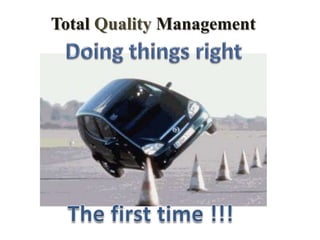
Total Quality Management
Introduction
• In today’s world, insufficient quality or indifference in
  quality leads to disputes, which imposes serious drain
  on the financial resources of a company and limits
  profit potential.
• To be competitive in today’s market, it is essential for
  construction companies to provide more consistent
  quality and value to their owners/customers.
• It is high time to develop better and more direct
  relationships with our owners/customers, to initiate
  more team work at the job-site, and to produce better
  quality work.
Definition
“TQM is a management philosophy, a paradigm, a
  continuous improvement approach to doing business
  through a new management model”

• TQM is a philosophy which applies equally to all
  parts of the organization.
• TQM can be viewed as an extension of the traditional
  approach to quality.
• TQM places the customer at the forefront of quality
  decision making.

• Greater emphasis on the roles and responsibilities of
  every member of staff within an organization to
  influence quality.

• All staff are empowered.
TQM is a comprehensive
         management system which:
• Focuses on meeting owners’/customers’ needs, by providing
  quality services at a reasonable cost.

• Focuses on continuous improvement.

• Recognizes role of everyone in the organization.

• Views organization as an internal system with a common aim.

• Focuses on the way tasks are accomplished.

• Emphasizes teamwork .
Universal TQM Beliefs
• Owner/customer satisfaction is the measure of
  quality.

• Quality improvement must be continuous.

• Analysis of the processes is the key to quality
  improvement.
•Measurement, a skilled use of analytical tools, and
employee involvement are critical sources of quality
improvement ideas and innovations.

•Sustained total quality management is not possible
without active, visible, consistent, and enabling
leadership by managers at all levels.

•It is essential to continuously improve the quality of
products and services that we provide to our
owners/customers.
Origin of TQM
• Total quality management has evolved from the
  quality assurance methods that were first developed
  around the time of the First World War. Quality
  inspectors were introduced on the production line to
  ensure that the level of failures due to quality was
  minimized.
• After the First World War, quality inspection became
  more commonplace in manufacturing environments
  and this led to the introduction of Statistical Quality
  Control (SQC).
• After World War Two, the industrial manufacturers in
  Japan produced poor quality items. In a response to
  this, the Japanese Union of Scientists and Engineers
  invited Dr. Deming to train engineers in quality
  processes.
• In the next decade more non-Japanese companies
  were introducing quality management procedures that
  based on the results seen in Japan. The new wave of
  quality control became known as Total Quality
  Management.
Deming’s fourteen points for TQM
1. Create constancy of purpose.

2. Adopt the new philosophy.

3. Cease dependence on inspection to achieve quality.

4. End the practice of awarding business on the basis of price tag
   alone.

5. Improve constantly and forever every process.

6. Institute modern training (for everybody!).
7. Institute modern methods of supervision.
8. Drive out fear.

9. Break down barriers between departments.

10. Eliminate slogans, exhortations, and targets for
   the work force asking for zero defects and new
   levels of productivity.
     a. Eliminate work standards (quotas) on the
   factory floor.
     b. Eliminate management by objective.
11. Remove barriers that rob the hourly worker of his
    right to pride of workmanship.

12. Remove barriers that rob people in management and
    in engineering of their right to pride of
    workmanship.

13. Institute a vigorous program of education and self-
    improvement.

14. Massive training.
Seven deadly diseases
• Lack of constancy of purpose.

• Emphasis on short-term profits: short-term thinking.

• Management by fear.

• Mobility of management: job hopping.
• Use of visible figures only for management, with
  little or no consideration of figures that are unknown
  or unknowable.

• Excessive medical costs.

• Excessive costs of liability, fueled by lawyers that
  work on contingency fees.
IMPLEMENTING THE TQM
            PHILOSOPHY
• To be successful in implementing TQM, an organization
  must concentrate on the eight key elements:
•   Ethics
•   Integrity
•   Trust
•   Training
•   Teamwork
•   Leadership
•   Recognition
•   Communication
Characteristics of Successful TQM
            Companies
The characteristics that are common to companies
  that have successfully implemented TQM in their
  daily operations are as follows:
• Strive for owner/customer satisfaction and
  employee satisfaction
• Strive for accident-free jobsites
• Recognize the need for measurement and fact-
  based decision making
• Arrange for employees to become involved in
  helping the company improve
• Train extensively
• Work hard at improving communication inside
  and outside the company
• Use teams of employees to improve processes
• Place a strong emphasis on the right kind of
  leadership.
• Involve subcontractors and suppliers in
  continuous improvement.
• Strive for continuous improvement.

 Some of the companies who have successfully
 implemented TQM include Ford Motor
 Company, Phillips Semiconductor, SGL
 Carbon, Motorola and Toyota Motor Company.
HOW TO BEGIN CONTINUOUS
      IMPROVEMENT
• Continuous improvement must deal not only
  with improving results, but more importantly
  with improving capabilities to produce better
  results in the future. The five major areas of
  focus for capability improvement are demand
  generation, supply
  generation, technology, operations and people
  capability.
• There are three major mechanisms of
  prevention:

• Preventing mistakes (defects) from occurring
  (Mistake – proofing or Poka-Yoke).
• Where mistakes can’t be absolutely
  prevented, detecting them early to prevent them
  being passed down the value added chain
  (Inspection at source or by the next operation).
• Where mistakes recur, stopping production until
  the process can be corrected, to prevent the
  production of more defects.
Pitfalls to be avoided in TQM
• The Failed Attempt of IBM to implement 6-
  sigma Policy. Six Sigma is a business
  management strategy originally developed by
  Motorola, USA in 1981.IBM was one of the
  first companies to implement Six-Sigma.
  IBM’s estimate was that by implementing six-
  sigma, they would add $2.4 billion directly to
  the bottom line.
• Why did IBM fail to implement TQM?
Total Quality Management
CONCLUSION
Total quality management (TQM) has become a part of
the corporate management parlance on a global scale.
     Compelling reasons to adopt TQM are: pressure
set in due to decreased profits, inability to penetrate
into new markets, intensifying competition, and above
all quality conscious customers demanding better and
improved products and services from the companies.

total quality management

  • 1.
  • 2.
    Introduction • In today’sworld, insufficient quality or indifference in quality leads to disputes, which imposes serious drain on the financial resources of a company and limits profit potential. • To be competitive in today’s market, it is essential for construction companies to provide more consistent quality and value to their owners/customers. • It is high time to develop better and more direct relationships with our owners/customers, to initiate more team work at the job-site, and to produce better quality work.
  • 3.
    Definition “TQM is amanagement philosophy, a paradigm, a continuous improvement approach to doing business through a new management model” • TQM is a philosophy which applies equally to all parts of the organization. • TQM can be viewed as an extension of the traditional approach to quality.
  • 4.
    • TQM placesthe customer at the forefront of quality decision making. • Greater emphasis on the roles and responsibilities of every member of staff within an organization to influence quality. • All staff are empowered.
  • 5.
    TQM is acomprehensive management system which: • Focuses on meeting owners’/customers’ needs, by providing quality services at a reasonable cost. • Focuses on continuous improvement. • Recognizes role of everyone in the organization. • Views organization as an internal system with a common aim. • Focuses on the way tasks are accomplished. • Emphasizes teamwork .
  • 6.
    Universal TQM Beliefs •Owner/customer satisfaction is the measure of quality. • Quality improvement must be continuous. • Analysis of the processes is the key to quality improvement.
  • 7.
    •Measurement, a skilleduse of analytical tools, and employee involvement are critical sources of quality improvement ideas and innovations. •Sustained total quality management is not possible without active, visible, consistent, and enabling leadership by managers at all levels. •It is essential to continuously improve the quality of products and services that we provide to our owners/customers.
  • 8.
    Origin of TQM •Total quality management has evolved from the quality assurance methods that were first developed around the time of the First World War. Quality inspectors were introduced on the production line to ensure that the level of failures due to quality was minimized. • After the First World War, quality inspection became more commonplace in manufacturing environments and this led to the introduction of Statistical Quality Control (SQC).
  • 9.
    • After WorldWar Two, the industrial manufacturers in Japan produced poor quality items. In a response to this, the Japanese Union of Scientists and Engineers invited Dr. Deming to train engineers in quality processes. • In the next decade more non-Japanese companies were introducing quality management procedures that based on the results seen in Japan. The new wave of quality control became known as Total Quality Management.
  • 10.
    Deming’s fourteen pointsfor TQM 1. Create constancy of purpose. 2. Adopt the new philosophy. 3. Cease dependence on inspection to achieve quality. 4. End the practice of awarding business on the basis of price tag alone. 5. Improve constantly and forever every process. 6. Institute modern training (for everybody!).
  • 11.
    7. Institute modernmethods of supervision. 8. Drive out fear. 9. Break down barriers between departments. 10. Eliminate slogans, exhortations, and targets for the work force asking for zero defects and new levels of productivity. a. Eliminate work standards (quotas) on the factory floor. b. Eliminate management by objective.
  • 12.
    11. Remove barriersthat rob the hourly worker of his right to pride of workmanship. 12. Remove barriers that rob people in management and in engineering of their right to pride of workmanship. 13. Institute a vigorous program of education and self- improvement. 14. Massive training.
  • 13.
    Seven deadly diseases •Lack of constancy of purpose. • Emphasis on short-term profits: short-term thinking. • Management by fear. • Mobility of management: job hopping.
  • 14.
    • Use ofvisible figures only for management, with little or no consideration of figures that are unknown or unknowable. • Excessive medical costs. • Excessive costs of liability, fueled by lawyers that work on contingency fees.
  • 15.
    IMPLEMENTING THE TQM PHILOSOPHY • To be successful in implementing TQM, an organization must concentrate on the eight key elements: • Ethics • Integrity • Trust • Training • Teamwork • Leadership • Recognition • Communication
  • 16.
    Characteristics of SuccessfulTQM Companies The characteristics that are common to companies that have successfully implemented TQM in their daily operations are as follows: • Strive for owner/customer satisfaction and employee satisfaction • Strive for accident-free jobsites • Recognize the need for measurement and fact- based decision making • Arrange for employees to become involved in helping the company improve • Train extensively
  • 17.
    • Work hardat improving communication inside and outside the company • Use teams of employees to improve processes • Place a strong emphasis on the right kind of leadership. • Involve subcontractors and suppliers in continuous improvement. • Strive for continuous improvement. Some of the companies who have successfully implemented TQM include Ford Motor Company, Phillips Semiconductor, SGL Carbon, Motorola and Toyota Motor Company.
  • 18.
    HOW TO BEGINCONTINUOUS IMPROVEMENT • Continuous improvement must deal not only with improving results, but more importantly with improving capabilities to produce better results in the future. The five major areas of focus for capability improvement are demand generation, supply generation, technology, operations and people capability.
  • 19.
    • There arethree major mechanisms of prevention: • Preventing mistakes (defects) from occurring (Mistake – proofing or Poka-Yoke). • Where mistakes can’t be absolutely prevented, detecting them early to prevent them being passed down the value added chain (Inspection at source or by the next operation). • Where mistakes recur, stopping production until the process can be corrected, to prevent the production of more defects.
  • 20.
    Pitfalls to beavoided in TQM • The Failed Attempt of IBM to implement 6- sigma Policy. Six Sigma is a business management strategy originally developed by Motorola, USA in 1981.IBM was one of the first companies to implement Six-Sigma. IBM’s estimate was that by implementing six- sigma, they would add $2.4 billion directly to the bottom line. • Why did IBM fail to implement TQM?
  • 21.
  • 22.
    CONCLUSION Total quality management(TQM) has become a part of the corporate management parlance on a global scale. Compelling reasons to adopt TQM are: pressure set in due to decreased profits, inability to penetrate into new markets, intensifying competition, and above all quality conscious customers demanding better and improved products and services from the companies.