Teacher Education:
Perspective and Prospects
TOPIC: TEACHER EDUCATION REFORMS IN
NORWAY AND FINLAND
Presented By: Muhammad Munsif
Dr./E-2024-F-10
munsifsail@gmail.com
Presented To: Dr. Muhammad Akram
Educational & Teacher Education
Reforms
Educational reforms are systemic efforts to improve teaching quality, ensure equity, and
modernize pedagogical practices to meet contemporary challenges.
Teacher education reforms focus on enhancing teacher preparation, continuous professional
development, and elevating the teaching profession’s status.
Globally, teacher education reform addresses four critical pillars:
 Access: Expanding opportunities for teacher training, particularly in underserved regions.
 Quality: Ensuring rigorous academic standards and practical training.
 Innovation: Integrating technology and contemporary pedagogical methods.
 Sustainability: Addressing shortages and improving teacher retention.
Key Insights on Teacher Education
(Global Data)
1. According to UNESCO’s 2022 report, 69 million more teachers are needed globally by
2030 to meet education goals.
2. The OECD’s TALIS 2019 survey shows only 67% of teachers worldwide feel
adequately prepared for classroom challenges.
3. Finland and Norway rank among the top 10 countries in global education indices due
to their exemplary teacher education models.
4. Teacher salaries in high-ranking countries average 15-30% above GDP per capita,
ensuring motivation and retention.
5. Countries with robust teacher education systems consistently score higher in the Global
Education Monitoring Report (2023).
Norway: Inclusive and Digitally
Advanced Teacher Education
Educational Context
 Ranked 8th globally in the GEM Report
(2023) for education equity and quality.
 Teachers in Norway are highly respected
professionals, with competitive salaries
averaging $50,000 per year, higher than
the OECD average.
 The Norwegian education system
emphasizes inclusivity, ensuring equal
access to education for all students and
teachers.
Key Teacher Education Reforms
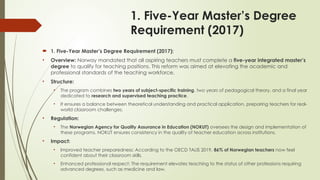
1. Five-Year Master’s Degree
Requirement (2017)
 1. Five-Year Master’s Degree Requirement (2017):
• Overview: Norway mandated that all aspiring teachers must complete a five-year integrated master’s
degree to qualify for teaching positions. This reform was aimed at elevating the academic and
professional standards of the teaching workforce.
• Structure:
• The program combines two years of subject-specific training, two years of pedagogical theory, and a final year
dedicated to research and supervised teaching practice.
• It ensures a balance between theoretical understanding and practical application, preparing teachers for real-
world classroom challenges.
• Regulation:
• The Norwegian Agency for Quality Assurance in Education (NOKUT) oversees the design and implementation of
these programs. NOKUT ensures consistency in the quality of teacher education across institutions.
• Impact:
• Improved teacher preparedness: According to the OECD TALIS 2019, 86% of Norwegian teachers now feel
confident about their classroom skills.
• Enhanced professional respect: The requirement elevates teaching to the status of other professions requiring
advanced degrees, such as medicine and law.
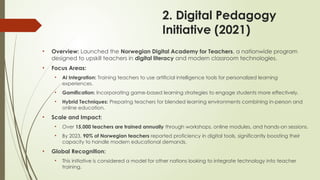
2. Digital Pedagogy
Initiative (2021)
• Overview: Launched the Norwegian Digital Academy for Teachers, a nationwide program
designed to upskill teachers in digital literacy and modern classroom technologies.
• Focus Areas:
• AI Integration: Training teachers to use artificial intelligence tools for personalized learning
experiences.
• Gamification: Incorporating game-based learning strategies to engage students more effectively.
• Hybrid Techniques: Preparing teachers for blended learning environments combining in-person and
online education.
• Scale and Impact:
• Over 15,000 teachers are trained annually through workshops, online modules, and hands-on sessions.
• By 2023, 90% of Norwegian teachers reported proficiency in digital tools, significantly boosting their
capacity to handle modern educational demands.
• Global Recognition:
• This initiative is considered a model for other nations looking to integrate technology into teacher
training.
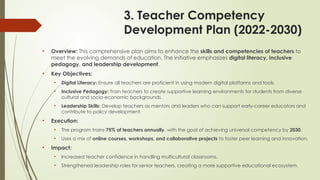
3. Teacher Competency
Development Plan (2022-2030)
• Overview: This comprehensive plan aims to enhance the skills and competencies of teachers to
meet the evolving demands of education. The initiative emphasizes digital literacy, inclusive
pedagogy, and leadership development.
• Key Objectives:
• Digital Literacy: Ensure all teachers are proficient in using modern digital platforms and tools.
• Inclusive Pedagogy: Train teachers to create supportive learning environments for students from diverse
cultural and socio-economic backgrounds.
• Leadership Skills: Develop teachers as mentors and leaders who can support early-career educators and
contribute to policy development.
• Execution:
• The program trains 75% of teachers annually, with the goal of achieving universal competency by 2030.
• Uses a mix of online courses, workshops, and collaborative projects to foster peer learning and innovation.
• Impact:
• Increased teacher confidence in handling multicultural classrooms.
• Strengthened leadership roles for senior teachers, creating a more supportive educational ecosystem.
4. Rural Recruitment and Retention
Programs
• Overview: Addressing teacher shortages in remote and underserved areas has been a long-
standing challenge in Norway. This program provides financial and professional incentives to
encourage teachers to work in rural schools.
• Key Features:
• Financial Support: Includes bonuses, relocation allowances, and higher pay scales for rural teachers.
• Housing Assistance: Offers subsidized or free housing to make rural postings more attractive.
• Professional Growth: Provides enhanced opportunities for training and promotions.
• Achievements:
• Rural teacher shortages decreased by 23% in 2022, marking significant progress.
• Student-teacher ratios in remote areas improved, leading to better educational outcomes.
• Challenges:
• Despite incentives, retaining teachers in remote areas remains a challenge due to lifestyle and
infrastructure issues.
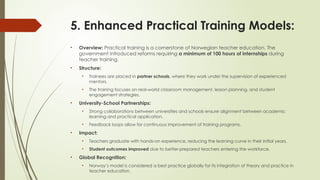
5. Enhanced Practical Training Models:
• Overview: Practical training is a cornerstone of Norwegian teacher education. The
government introduced reforms requiring a minimum of 100 hours of internships during
teacher training.
• Structure:
• Trainees are placed in partner schools, where they work under the supervision of experienced
mentors.
• The training focuses on real-world classroom management, lesson planning, and student
engagement strategies.
• University-School Partnerships:
• Strong collaborations between universities and schools ensure alignment between academic
learning and practical application.
• Feedback loops allow for continuous improvement of training programs.
• Impact:
• Teachers graduate with hands-on experience, reducing the learning curve in their initial years.
• Student outcomes improved due to better-prepared teachers entering the workforce.
• Global Recognition:
• Norway’s model is considered a best practice globally for its integration of theory and practice in
teacher education.
Scope and Challenges
1. Scope: Digital modernization, multicultural classroom management, and teacher
autonomy.
2. Challenges: Retaining rural teachers, balancing theory with practical training, and
addressing evolving digital demands.
3. Budget: Norway allocates 6.5% of GDP to education, with 25% earmarked for teacher
training and CPD.
4. Impact: TALIS (2019) reported 86% of Norwegian teachers feel prepared for classroom
challenges.
5. Outcome: Norway’s reforms improved student-teacher engagement, with 90% of
teachers proficient in digital pedagogy by 2023.
Finland: A Global Benchmark in
Teacher Education
Educational Context
 Ranked 1st globally for education quality
in the Global Competitiveness Report
(2023).
 Teaching is among the most prestigious
professions, with entry limited to the top
10% of applicants.
 Teacher autonomy is unparalleled, with
educators designing their curricula and
assessment methods.
1. Rigorous Selection Criteria:
• Overview: Finland’s teacher education programs are among the most selective
globally, with only the top 10% of applicants gaining admission. This ensures a highly
capable and motivated teaching workforce.
• Selection Process:
• National Aptitude Test: Candidates are assessed on their analytical thinking,
problem-solving abilities, and interpersonal skills.
• Interviews: Focus on motivation, resilience, and interpersonal communication to
identify candidates who are not only academically strong but also emotionally
intelligent.
• Impact:
• This rigorous process results in teachers who are both highly skilled and
committed to the profession.
• Finland consistently ranks first in global education indices, largely due to the
exceptional quality of its teachers.
2. Mandatory Master’s Degree
Requirement:
• Overview: Since 1979, Finland has required teachers to hold a five-year
master’s degree, integrating subject specialization with pedagogical
training.
• Structure:
• 20 Weeks of Supervised Classroom Teaching: Provides hands-on experience
under the mentorship of experienced teachers.
• Research-Based Pedagogy: Includes thesis work to ensure that teachers are well-
versed in educational research.
• Impact:
• Finnish teachers are recognized as professionals on par with doctors and lawyers.
• TALIS 2019 reported that 93% of Finnish teachers feel well-prepared for the
classroom, the highest globally.
3. National Teacher Education Development Strategy
(2021):
• Overview: This strategic initiative aims to modernize teacher training by
integrating technology and addressing global challenges like climate change.
• Key Focus Areas:
• AI Integration: Teachers are trained to use artificial intelligence to personalize learning
experiences.
• Co-Teaching Models: Emphasizes collaborative teaching practices to foster peer
learning and innovation.
• Climate Education: Equips teachers to incorporate sustainability into the curriculum.
• Impact:
• Enhanced teacher collaboration and adaptability to modern classroom needs.
• Finland is now a global leader in using AI and sustainability education.
4. Bicultural Education Initiative (2040
Vision):
• Overview: This long-term initiative aims to unify Finland’s Finnish and Swedish
cultural identities in teacher education.
• Key Objectives:
• Develop teachers who are culturally competent and bilingual.
• Strengthen the integration of minority perspectives into mainstream education.
• Impact:
• By 2040, Finland aims to produce educators who can teach in multicultural and
multilingual settings.
• This reform enhances social cohesion and inclusivity in Finnish classrooms.
5. Continuous Professional
Development (CPD)
• Overview: Teachers are required to complete 20 hours of CPD annually,
focusing on the latest pedagogical trends and digital tools.
• Key Features:
• Topics include emerging technologies, student mental health, and classroom
management.
• Over 70% of Finnish teachers participate in research projects, directly influencing
education policies.
• Impact:
• Ensures that teachers remain at the forefront of educational innovation.
• Encourages lifelong learning and adaptability among educators.
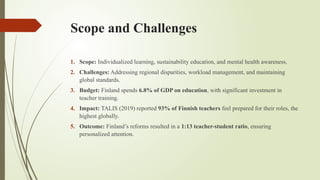
Scope and Challenges
1. Scope: Individualized learning, sustainability education, and mental health awareness.
2. Challenges: Addressing regional disparities, workload management, and maintaining
global standards.
3. Budget: Finland spends 6.8% of GDP on education, with significant investment in
teacher training.
4. Impact: TALIS (2019) reported 93% of Finnish teachers feel prepared for their roles, the
highest globally.
5. Outcome: Finland’s reforms resulted in a 1:13 teacher-student ratio, ensuring
personalized attention.
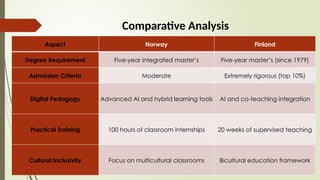
Comparative Analysis
Aspect Norway Finland
Degree Requirement Five-year integrated master’s Five-year master’s (since 1979)
Admission Criteria Moderate Extremely rigorous (top 10%)
Digital Pedagogy Advanced AI and hybrid learning tools AI and co-teaching integration
Practical Training 100 hours of classroom internships 20 weeks of supervised teaching
Cultural Inclusivity Focus on multicultural classrooms Bicultural education framework
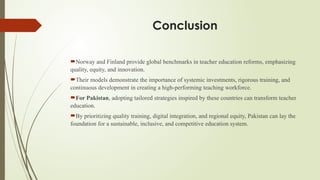
Conclusion
Norway and Finland provide global benchmarks in teacher education reforms, emphasizing
quality, equity, and innovation.
Their models demonstrate the importance of systemic investments, rigorous training, and
continuous development in creating a high-performing teaching workforce.
For Pakistan, adopting tailored strategies inspired by these countries can transform teacher
education.
By prioritizing quality training, digital integration, and regional equity, Pakistan can lay the
foundation for a sustainable, inclusive, and competitive education system.
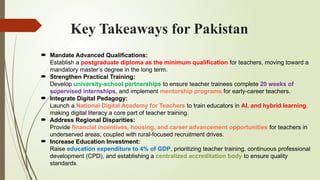
Key Takeaways for Pakistan
 Mandate Advanced Qualifications:
Establish a postgraduate diploma as the minimum qualification for teachers, moving toward a
mandatory master’s degree in the long term.
 Strengthen Practical Training:
Develop university-school partnerships to ensure teacher trainees complete 20 weeks of
supervised internships, and implement mentorship programs for early-career teachers.
 Integrate Digital Pedagogy:
Launch a National Digital Academy for Teachers to train educators in AI, and hybrid learning,
making digital literacy a core part of teacher training.
 Address Regional Disparities:
Provide financial incentives, housing, and career advancement opportunities for teachers in
underserved areas, coupled with rural-focused recruitment drives.
 Increase Education Investment:
Raise education expenditure to 4% of GDP, prioritizing teacher training, continuous professional
development (CPD), and establishing a centralized accreditation body to ensure quality
standards.

Education comparison between NORWAY & FINLAND

  • 1.
    Teacher Education: Perspective andProspects TOPIC: TEACHER EDUCATION REFORMS IN NORWAY AND FINLAND Presented By: Muhammad Munsif Dr./E-2024-F-10 munsifsail@gmail.com Presented To: Dr. Muhammad Akram
  • 2.
    Educational & TeacherEducation Reforms Educational reforms are systemic efforts to improve teaching quality, ensure equity, and modernize pedagogical practices to meet contemporary challenges. Teacher education reforms focus on enhancing teacher preparation, continuous professional development, and elevating the teaching profession’s status. Globally, teacher education reform addresses four critical pillars:  Access: Expanding opportunities for teacher training, particularly in underserved regions.  Quality: Ensuring rigorous academic standards and practical training.  Innovation: Integrating technology and contemporary pedagogical methods.  Sustainability: Addressing shortages and improving teacher retention.
  • 3.
    Key Insights onTeacher Education (Global Data) 1. According to UNESCO’s 2022 report, 69 million more teachers are needed globally by 2030 to meet education goals. 2. The OECD’s TALIS 2019 survey shows only 67% of teachers worldwide feel adequately prepared for classroom challenges. 3. Finland and Norway rank among the top 10 countries in global education indices due to their exemplary teacher education models. 4. Teacher salaries in high-ranking countries average 15-30% above GDP per capita, ensuring motivation and retention. 5. Countries with robust teacher education systems consistently score higher in the Global Education Monitoring Report (2023).
  • 4.
    Norway: Inclusive andDigitally Advanced Teacher Education Educational Context  Ranked 8th globally in the GEM Report (2023) for education equity and quality.  Teachers in Norway are highly respected professionals, with competitive salaries averaging $50,000 per year, higher than the OECD average.  The Norwegian education system emphasizes inclusivity, ensuring equal access to education for all students and teachers. Key Teacher Education Reforms
  • 5.
    1. Five-Year Master’sDegree Requirement (2017)  1. Five-Year Master’s Degree Requirement (2017): • Overview: Norway mandated that all aspiring teachers must complete a five-year integrated master’s degree to qualify for teaching positions. This reform was aimed at elevating the academic and professional standards of the teaching workforce. • Structure: • The program combines two years of subject-specific training, two years of pedagogical theory, and a final year dedicated to research and supervised teaching practice. • It ensures a balance between theoretical understanding and practical application, preparing teachers for real- world classroom challenges. • Regulation: • The Norwegian Agency for Quality Assurance in Education (NOKUT) oversees the design and implementation of these programs. NOKUT ensures consistency in the quality of teacher education across institutions. • Impact: • Improved teacher preparedness: According to the OECD TALIS 2019, 86% of Norwegian teachers now feel confident about their classroom skills. • Enhanced professional respect: The requirement elevates teaching to the status of other professions requiring advanced degrees, such as medicine and law.
  • 6.
    2. Digital Pedagogy Initiative(2021) • Overview: Launched the Norwegian Digital Academy for Teachers, a nationwide program designed to upskill teachers in digital literacy and modern classroom technologies. • Focus Areas: • AI Integration: Training teachers to use artificial intelligence tools for personalized learning experiences. • Gamification: Incorporating game-based learning strategies to engage students more effectively. • Hybrid Techniques: Preparing teachers for blended learning environments combining in-person and online education. • Scale and Impact: • Over 15,000 teachers are trained annually through workshops, online modules, and hands-on sessions. • By 2023, 90% of Norwegian teachers reported proficiency in digital tools, significantly boosting their capacity to handle modern educational demands. • Global Recognition: • This initiative is considered a model for other nations looking to integrate technology into teacher training.
  • 7.
    3. Teacher Competency DevelopmentPlan (2022-2030) • Overview: This comprehensive plan aims to enhance the skills and competencies of teachers to meet the evolving demands of education. The initiative emphasizes digital literacy, inclusive pedagogy, and leadership development. • Key Objectives: • Digital Literacy: Ensure all teachers are proficient in using modern digital platforms and tools. • Inclusive Pedagogy: Train teachers to create supportive learning environments for students from diverse cultural and socio-economic backgrounds. • Leadership Skills: Develop teachers as mentors and leaders who can support early-career educators and contribute to policy development. • Execution: • The program trains 75% of teachers annually, with the goal of achieving universal competency by 2030. • Uses a mix of online courses, workshops, and collaborative projects to foster peer learning and innovation. • Impact: • Increased teacher confidence in handling multicultural classrooms. • Strengthened leadership roles for senior teachers, creating a more supportive educational ecosystem.
  • 8.
    4. Rural Recruitmentand Retention Programs • Overview: Addressing teacher shortages in remote and underserved areas has been a long- standing challenge in Norway. This program provides financial and professional incentives to encourage teachers to work in rural schools. • Key Features: • Financial Support: Includes bonuses, relocation allowances, and higher pay scales for rural teachers. • Housing Assistance: Offers subsidized or free housing to make rural postings more attractive. • Professional Growth: Provides enhanced opportunities for training and promotions. • Achievements: • Rural teacher shortages decreased by 23% in 2022, marking significant progress. • Student-teacher ratios in remote areas improved, leading to better educational outcomes. • Challenges: • Despite incentives, retaining teachers in remote areas remains a challenge due to lifestyle and infrastructure issues.
  • 9.
    5. Enhanced PracticalTraining Models: • Overview: Practical training is a cornerstone of Norwegian teacher education. The government introduced reforms requiring a minimum of 100 hours of internships during teacher training. • Structure: • Trainees are placed in partner schools, where they work under the supervision of experienced mentors. • The training focuses on real-world classroom management, lesson planning, and student engagement strategies. • University-School Partnerships: • Strong collaborations between universities and schools ensure alignment between academic learning and practical application. • Feedback loops allow for continuous improvement of training programs. • Impact: • Teachers graduate with hands-on experience, reducing the learning curve in their initial years. • Student outcomes improved due to better-prepared teachers entering the workforce. • Global Recognition: • Norway’s model is considered a best practice globally for its integration of theory and practice in teacher education.
  • 10.
    Scope and Challenges 1.Scope: Digital modernization, multicultural classroom management, and teacher autonomy. 2. Challenges: Retaining rural teachers, balancing theory with practical training, and addressing evolving digital demands. 3. Budget: Norway allocates 6.5% of GDP to education, with 25% earmarked for teacher training and CPD. 4. Impact: TALIS (2019) reported 86% of Norwegian teachers feel prepared for classroom challenges. 5. Outcome: Norway’s reforms improved student-teacher engagement, with 90% of teachers proficient in digital pedagogy by 2023.
  • 11.
    Finland: A GlobalBenchmark in Teacher Education Educational Context  Ranked 1st globally for education quality in the Global Competitiveness Report (2023).  Teaching is among the most prestigious professions, with entry limited to the top 10% of applicants.  Teacher autonomy is unparalleled, with educators designing their curricula and assessment methods.
  • 12.
    1. Rigorous SelectionCriteria: • Overview: Finland’s teacher education programs are among the most selective globally, with only the top 10% of applicants gaining admission. This ensures a highly capable and motivated teaching workforce. • Selection Process: • National Aptitude Test: Candidates are assessed on their analytical thinking, problem-solving abilities, and interpersonal skills. • Interviews: Focus on motivation, resilience, and interpersonal communication to identify candidates who are not only academically strong but also emotionally intelligent. • Impact: • This rigorous process results in teachers who are both highly skilled and committed to the profession. • Finland consistently ranks first in global education indices, largely due to the exceptional quality of its teachers.
  • 13.
    2. Mandatory Master’sDegree Requirement: • Overview: Since 1979, Finland has required teachers to hold a five-year master’s degree, integrating subject specialization with pedagogical training. • Structure: • 20 Weeks of Supervised Classroom Teaching: Provides hands-on experience under the mentorship of experienced teachers. • Research-Based Pedagogy: Includes thesis work to ensure that teachers are well- versed in educational research. • Impact: • Finnish teachers are recognized as professionals on par with doctors and lawyers. • TALIS 2019 reported that 93% of Finnish teachers feel well-prepared for the classroom, the highest globally.
  • 14.
    3. National TeacherEducation Development Strategy (2021): • Overview: This strategic initiative aims to modernize teacher training by integrating technology and addressing global challenges like climate change. • Key Focus Areas: • AI Integration: Teachers are trained to use artificial intelligence to personalize learning experiences. • Co-Teaching Models: Emphasizes collaborative teaching practices to foster peer learning and innovation. • Climate Education: Equips teachers to incorporate sustainability into the curriculum. • Impact: • Enhanced teacher collaboration and adaptability to modern classroom needs. • Finland is now a global leader in using AI and sustainability education.
  • 15.
    4. Bicultural EducationInitiative (2040 Vision): • Overview: This long-term initiative aims to unify Finland’s Finnish and Swedish cultural identities in teacher education. • Key Objectives: • Develop teachers who are culturally competent and bilingual. • Strengthen the integration of minority perspectives into mainstream education. • Impact: • By 2040, Finland aims to produce educators who can teach in multicultural and multilingual settings. • This reform enhances social cohesion and inclusivity in Finnish classrooms.
  • 16.
    5. Continuous Professional Development(CPD) • Overview: Teachers are required to complete 20 hours of CPD annually, focusing on the latest pedagogical trends and digital tools. • Key Features: • Topics include emerging technologies, student mental health, and classroom management. • Over 70% of Finnish teachers participate in research projects, directly influencing education policies. • Impact: • Ensures that teachers remain at the forefront of educational innovation. • Encourages lifelong learning and adaptability among educators.
  • 17.
    Scope and Challenges 1.Scope: Individualized learning, sustainability education, and mental health awareness. 2. Challenges: Addressing regional disparities, workload management, and maintaining global standards. 3. Budget: Finland spends 6.8% of GDP on education, with significant investment in teacher training. 4. Impact: TALIS (2019) reported 93% of Finnish teachers feel prepared for their roles, the highest globally. 5. Outcome: Finland’s reforms resulted in a 1:13 teacher-student ratio, ensuring personalized attention.
  • 18.
    Comparative Analysis Aspect NorwayFinland Degree Requirement Five-year integrated master’s Five-year master’s (since 1979) Admission Criteria Moderate Extremely rigorous (top 10%) Digital Pedagogy Advanced AI and hybrid learning tools AI and co-teaching integration Practical Training 100 hours of classroom internships 20 weeks of supervised teaching Cultural Inclusivity Focus on multicultural classrooms Bicultural education framework
  • 19.
    Conclusion Norway and Finlandprovide global benchmarks in teacher education reforms, emphasizing quality, equity, and innovation. Their models demonstrate the importance of systemic investments, rigorous training, and continuous development in creating a high-performing teaching workforce. For Pakistan, adopting tailored strategies inspired by these countries can transform teacher education. By prioritizing quality training, digital integration, and regional equity, Pakistan can lay the foundation for a sustainable, inclusive, and competitive education system.
  • 20.
    Key Takeaways forPakistan  Mandate Advanced Qualifications: Establish a postgraduate diploma as the minimum qualification for teachers, moving toward a mandatory master’s degree in the long term.  Strengthen Practical Training: Develop university-school partnerships to ensure teacher trainees complete 20 weeks of supervised internships, and implement mentorship programs for early-career teachers.  Integrate Digital Pedagogy: Launch a National Digital Academy for Teachers to train educators in AI, and hybrid learning, making digital literacy a core part of teacher training.  Address Regional Disparities: Provide financial incentives, housing, and career advancement opportunities for teachers in underserved areas, coupled with rural-focused recruitment drives.  Increase Education Investment: Raise education expenditure to 4% of GDP, prioritizing teacher training, continuous professional development (CPD), and establishing a centralized accreditation body to ensure quality standards.