8
Chapter Title
16/e PPT
Tailoring
Strategy to Fit
Specific
Industry and
Company
Situations
Screen graphics created by:
Jana F. Kuzmicki, Ph.D.
Troy University-Florida Region
McGraw-Hill/Irwin Copyright © 2008 by The McGraw-Hill Companies, Inc. All rights reserved.
8-2
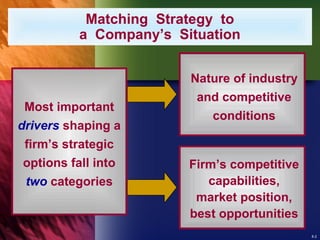
Matching Strategy to
a Company’s Situation
Most important
drivers shaping a
firm’s strategic
options fall into
two categories
Firm’s competitive
capabilities,
market position,
best opportunities
Nature of industry
and competitive
conditions
8-3
 New and unproven market
 Proprietary technology
 Lack of consensus regarding which of
several competing technologies will win out
 Low entry barriers
 Experience curve effects may permit
cost reductions as volume builds
 Buyers are first-time users and marketing involves inducing
initial purchase and overcoming customer concerns
 First-generation products are expected to be rapidly
improved so buyers delay purchase until technology matures
 Possible difficulties in securing raw materials
 Firms struggle to fund R&D, operations and build resource
capabilities for rapid growth
Features of an Emerging Industry
8-4
Strategy Options for Competing
in Emerging Industries
 Win early race for industry leadership by employing a bold,
creative strategy
 Push hard to perfect technology, improve product quality,
and develop attractive performance features
 Consider merging with or acquiring another firm to
 Gain added expertise
 Pool resource strengths
 When technological uncertainty clears and a dominant
technology emerges, try to capture any first-mover
advantages by moving quickly
 Form strategic alliances with
 Companies having related technological expertise or
 Key suppliers
8-5
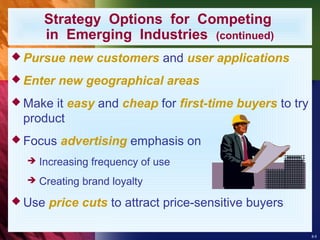
Strategy Options for Competing
in Emerging Industries (continued)
 Pursue new customers and user applications
 Enter new geographical areas
 Make it easy and cheap for first-time buyers to try
product
 Focus advertising emphasis on
 Increasing frequency of use
 Creating brand loyalty
 Use price cuts to attract price-sensitive buyers
8-6
Strategic Hurdles for Companies
in Emerging Industries
 Raising capital to finance initial operations until
 Sales and revenues take off
 Profits appear
 Cash flows turn positive
 Developing a strategy to ride the wave of industry
growth
 What market segments to pursue
 What competitive advantages to go after
 Managing the rapid expansion of facilities and sales to
position a company to contend for industry leadership
 Defending against competitors trying to horn in on the
company’s success
8-7
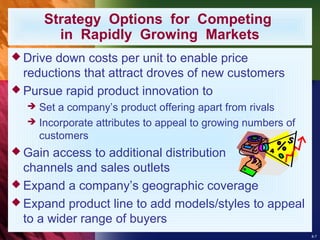
Strategy Options for Competing
in Rapidly Growing Markets
 Drive down costs per unit to enable price
reductions that attract droves of new customers
 Pursue rapid product innovation to
 Set a company’s product offering apart from rivals
 Incorporate attributes to appeal to growing numbers of
customers
 Gain access to additional distribution
channels and sales outlets
 Expand a company’s geographic coverage
 Expand product line to add models/styles to appeal
to a wider range of buyers
8-8
 Slowing demand breeds stiffer competition
 More sophisticated buyers demand bargains
 Greater emphasis on cost and service
 “Topping out” problem in adding
production capacity
 Product innovation and new
end uses harder to come by
 International competition increases
 Industry profitability falls
 Mergers and acquisitions reduce number of rivals
Industry Maturity: The Standout Features
8-9
Strategy Options for Competing
in a Mature Industry
 Prune marginal products and models
 Emphasize innovation in the value chain
 Strong focus on cost reduction
 Increase sales to present customers
 Purchase rivals at bargain prices
 Expand internationally
 Build new, more flexible competitive capabilities
8-10
Features of High-Velocity Markets
 Rapid-fire technological change
 Short product life-cycles
 Entry of important new rivals
 Frequent launches of
new competitive moves
 Rapidly evolving
customer expectations
8-11
 Cutting-edge expertise
 Speed in responding to new developments
 Collaboration with others
 Agility
 Innovativeness
 Opportunism
 Resource flexibility
 First-to-market capabilities
Keys to Success in Competing
in High Velocity Markets
8-12
Risks of Pursuing
Multiple Strategy Horizons
 Firm should not pursue all options
to avoid stretching itself too thin
 Pursuit of medium- and long-jump
initiatives may cause firm to stray
too far from its core competencies
 Competitive advantage may be difficult to achieve
in medium- and long-jump businesses that do not
mesh well with firm’s present resource strengths
 Payoffs of long-jump initiatives may prove elusive
8-13
Industry Leaders:
The Defining Characteristics
 Strong to powerful market position
 Well-known reputation
 Proven strategy
 Key strategic concern – How to sustain
dominant leadership position
8-14
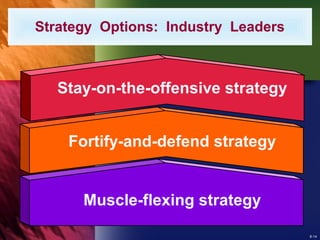
Strategy Options: Industry Leaders
Stay-on-the-offensive strategy
Fortify-and-defend strategy
Muscle-flexing strategy
8-15
Stay-on-the-Offensive Strategies
 Be a first-mover, leading industry change
 Best defense is a good offense
 Concentrate on achieving a competitive advantage
and then widening the advantage over time
 Relentlessly pursue continuous improvement
and innovation, being first to market with
 Technological improvements
 New or better products
 More attractive performance features
 Customer service improvements
8-16
Fortify-and-Defend Strategy
 Make it harder for new firms to enter and for
challengers to gain ground
 Hold onto present market share
 Strengthen current market position
 Protect competitive advantage
Objectives
8-17
 Play competitive hardball with smaller
rivals that threaten leader’s position
 Signal smaller rivals that moves to cut
into leader’s business will be hard fought
 Convince rivals they are better off playing
“follow-the-leader” or else attacking each
other rather the industry leader
Muscle-Flexing Strategy
Objectives
8-18
 Running afoul of antitrust laws
 Alienating customers with bullying tactics
 Arousing adverse public opinion
Muscle-Flexing Strategy
Risks
8-19
What Is a Harvest Strategy?
 Steers middle course between status quo and
exiting quickly
 Involves gradually sacrificing market position
in return for bigger near-term cash flow/profit
 Objectives
 Short-term - Generate largest
feasible cash flow
 Long-term - Exit market
8-20
Types of Harvest Options
 Reduce operating expenses to rock-bottom
 Hold reinvestment to minimum
 Place little priority on new capital investments
 Emphasize stringent internal cost controls
 Trim advertising and promotion expenses
 Do not replace employees who leave
 Shave equipment maintenance
8-21
 Industry’s long-term prospects are unattractive
 Building up business would be too costly
 Market share is increasingly costly to maintain
 Reduced levels of competitive effort will not trigger
immediate fall-off in sales
 Firm can re-deploy freed-up resources
in higher opportunity areas
 Business is not a major component of
diversified firm’s portfolio of businesses
When Should a Harvest
Strategy Be Considered?
8-22
Wisest strategic option in certain situations
 Lack of resources
 Dim profit prospects
 May serve stockholder interests
better than bankruptcy
Unpleasant strategic option
 Hardship of job eliminations
 Effects of closing on local community
Liquidation Strategy
8-23
10 Commandments for Crafting
Successful Business Strategies
1. Always put top priority on crafting and executing
strategic moves that enhance a firm’s competitive
position for the long-term and that serve to
establish it as an industry leader.
2. Be prompt in adapting and responding to changing
market conditions, unmet customer needs and
buyer wishes for something better, emerging
technological alternatives, and new initiatives of
rivals. Responding late or with too little often puts
a firm in the precarious position of playing catch-
up.
8-24
10 Commandments for Crafting
Successful Business Strategies
3. Invest in creating a sustainable competitive
advantage, for it is a most dependable contributor
to above-average profitability.
4. Avoid strategies capable of succeeding only in the
best of circumstances.
5. Don’t underestimate the reactions and the
commitment of rival firms.
6. Consider that attacking competitive weakness is
usually more profitable than attacking competitive
strength.
7. Be judicious in cutting prices without an
established cost advantage.
8-25
10 Commandments for Crafting
Successful Business Strategies
8. Employ bold strategic moves in pursuing
differentiation strategies so as to open up very
meaningful gaps in quality or service or
advertising or other product attributes.
9. Endeavor not to get “stuck back in the pack” with
no coherent long-term strategy or distinctive
competitive position, and little prospect of
climbing into the ranks of the industry leaders.
10. Be aware that aggressive strategic moves to
wrest crucial market share away from rivals often
provoke aggressive retaliation in the form of a
marketing “arms race” and/or price wars.

Chapter 8

  • 1.
    8 Chapter Title 16/e PPT Tailoring Strategyto Fit Specific Industry and Company Situations Screen graphics created by: Jana F. Kuzmicki, Ph.D. Troy University-Florida Region McGraw-Hill/Irwin Copyright © 2008 by The McGraw-Hill Companies, Inc. All rights reserved.
  • 2.
    8-2 Matching Strategy to aCompany’s Situation Most important drivers shaping a firm’s strategic options fall into two categories Firm’s competitive capabilities, market position, best opportunities Nature of industry and competitive conditions
  • 3.
    8-3  New andunproven market  Proprietary technology  Lack of consensus regarding which of several competing technologies will win out  Low entry barriers  Experience curve effects may permit cost reductions as volume builds  Buyers are first-time users and marketing involves inducing initial purchase and overcoming customer concerns  First-generation products are expected to be rapidly improved so buyers delay purchase until technology matures  Possible difficulties in securing raw materials  Firms struggle to fund R&D, operations and build resource capabilities for rapid growth Features of an Emerging Industry
  • 4.
    8-4 Strategy Options forCompeting in Emerging Industries  Win early race for industry leadership by employing a bold, creative strategy  Push hard to perfect technology, improve product quality, and develop attractive performance features  Consider merging with or acquiring another firm to  Gain added expertise  Pool resource strengths  When technological uncertainty clears and a dominant technology emerges, try to capture any first-mover advantages by moving quickly  Form strategic alliances with  Companies having related technological expertise or  Key suppliers
  • 5.
    8-5 Strategy Options forCompeting in Emerging Industries (continued)  Pursue new customers and user applications  Enter new geographical areas  Make it easy and cheap for first-time buyers to try product  Focus advertising emphasis on  Increasing frequency of use  Creating brand loyalty  Use price cuts to attract price-sensitive buyers
  • 6.
    8-6 Strategic Hurdles forCompanies in Emerging Industries  Raising capital to finance initial operations until  Sales and revenues take off  Profits appear  Cash flows turn positive  Developing a strategy to ride the wave of industry growth  What market segments to pursue  What competitive advantages to go after  Managing the rapid expansion of facilities and sales to position a company to contend for industry leadership  Defending against competitors trying to horn in on the company’s success
  • 7.
    8-7 Strategy Options forCompeting in Rapidly Growing Markets  Drive down costs per unit to enable price reductions that attract droves of new customers  Pursue rapid product innovation to  Set a company’s product offering apart from rivals  Incorporate attributes to appeal to growing numbers of customers  Gain access to additional distribution channels and sales outlets  Expand a company’s geographic coverage  Expand product line to add models/styles to appeal to a wider range of buyers
  • 8.
    8-8  Slowing demandbreeds stiffer competition  More sophisticated buyers demand bargains  Greater emphasis on cost and service  “Topping out” problem in adding production capacity  Product innovation and new end uses harder to come by  International competition increases  Industry profitability falls  Mergers and acquisitions reduce number of rivals Industry Maturity: The Standout Features
  • 9.
    8-9 Strategy Options forCompeting in a Mature Industry  Prune marginal products and models  Emphasize innovation in the value chain  Strong focus on cost reduction  Increase sales to present customers  Purchase rivals at bargain prices  Expand internationally  Build new, more flexible competitive capabilities
  • 10.
    8-10 Features of High-VelocityMarkets  Rapid-fire technological change  Short product life-cycles  Entry of important new rivals  Frequent launches of new competitive moves  Rapidly evolving customer expectations
  • 11.
    8-11  Cutting-edge expertise Speed in responding to new developments  Collaboration with others  Agility  Innovativeness  Opportunism  Resource flexibility  First-to-market capabilities Keys to Success in Competing in High Velocity Markets
  • 12.
    8-12 Risks of Pursuing MultipleStrategy Horizons  Firm should not pursue all options to avoid stretching itself too thin  Pursuit of medium- and long-jump initiatives may cause firm to stray too far from its core competencies  Competitive advantage may be difficult to achieve in medium- and long-jump businesses that do not mesh well with firm’s present resource strengths  Payoffs of long-jump initiatives may prove elusive
  • 13.
    8-13 Industry Leaders: The DefiningCharacteristics  Strong to powerful market position  Well-known reputation  Proven strategy  Key strategic concern – How to sustain dominant leadership position
  • 14.
    8-14 Strategy Options: IndustryLeaders Stay-on-the-offensive strategy Fortify-and-defend strategy Muscle-flexing strategy
  • 15.
    8-15 Stay-on-the-Offensive Strategies  Bea first-mover, leading industry change  Best defense is a good offense  Concentrate on achieving a competitive advantage and then widening the advantage over time  Relentlessly pursue continuous improvement and innovation, being first to market with  Technological improvements  New or better products  More attractive performance features  Customer service improvements
  • 16.
    8-16 Fortify-and-Defend Strategy  Makeit harder for new firms to enter and for challengers to gain ground  Hold onto present market share  Strengthen current market position  Protect competitive advantage Objectives
  • 17.
    8-17  Play competitivehardball with smaller rivals that threaten leader’s position  Signal smaller rivals that moves to cut into leader’s business will be hard fought  Convince rivals they are better off playing “follow-the-leader” or else attacking each other rather the industry leader Muscle-Flexing Strategy Objectives
  • 18.
    8-18  Running afoulof antitrust laws  Alienating customers with bullying tactics  Arousing adverse public opinion Muscle-Flexing Strategy Risks
  • 19.
    8-19 What Is aHarvest Strategy?  Steers middle course between status quo and exiting quickly  Involves gradually sacrificing market position in return for bigger near-term cash flow/profit  Objectives  Short-term - Generate largest feasible cash flow  Long-term - Exit market
  • 20.
    8-20 Types of HarvestOptions  Reduce operating expenses to rock-bottom  Hold reinvestment to minimum  Place little priority on new capital investments  Emphasize stringent internal cost controls  Trim advertising and promotion expenses  Do not replace employees who leave  Shave equipment maintenance
  • 21.
    8-21  Industry’s long-termprospects are unattractive  Building up business would be too costly  Market share is increasingly costly to maintain  Reduced levels of competitive effort will not trigger immediate fall-off in sales  Firm can re-deploy freed-up resources in higher opportunity areas  Business is not a major component of diversified firm’s portfolio of businesses When Should a Harvest Strategy Be Considered?
  • 22.
    8-22 Wisest strategic optionin certain situations  Lack of resources  Dim profit prospects  May serve stockholder interests better than bankruptcy Unpleasant strategic option  Hardship of job eliminations  Effects of closing on local community Liquidation Strategy
  • 23.
    8-23 10 Commandments forCrafting Successful Business Strategies 1. Always put top priority on crafting and executing strategic moves that enhance a firm’s competitive position for the long-term and that serve to establish it as an industry leader. 2. Be prompt in adapting and responding to changing market conditions, unmet customer needs and buyer wishes for something better, emerging technological alternatives, and new initiatives of rivals. Responding late or with too little often puts a firm in the precarious position of playing catch- up.
  • 24.
    8-24 10 Commandments forCrafting Successful Business Strategies 3. Invest in creating a sustainable competitive advantage, for it is a most dependable contributor to above-average profitability. 4. Avoid strategies capable of succeeding only in the best of circumstances. 5. Don’t underestimate the reactions and the commitment of rival firms. 6. Consider that attacking competitive weakness is usually more profitable than attacking competitive strength. 7. Be judicious in cutting prices without an established cost advantage.
  • 25.
    8-25 10 Commandments forCrafting Successful Business Strategies 8. Employ bold strategic moves in pursuing differentiation strategies so as to open up very meaningful gaps in quality or service or advertising or other product attributes. 9. Endeavor not to get “stuck back in the pack” with no coherent long-term strategy or distinctive competitive position, and little prospect of climbing into the ranks of the industry leaders. 10. Be aware that aggressive strategic moves to wrest crucial market share away from rivals often provoke aggressive retaliation in the form of a marketing “arms race” and/or price wars.