TOPIC 1
INTRODUCTION TO
PRODUCT MANAGEMENT
Week 1(Lecture 1)
 Main Text:
 Lehmann, D. R. & Winer, R. S. (2005). Product management.
(4thed.).New York: McGraw-Hill.
 Keller, K. L. (2012). Strategic Brand Management: Building,
Measuring, and Managing Brand Equity. (4th ed.). Prentice Hall.
 Learning Outcomes:
 Demonstrate the art in managing product and services related
matters.
 Develop specific objectives and strategies with relation to products
and services.
 Apply the knowledge to other area of marketing such as pricing,
promotion and placing decisions.
 Mid-Trimester Test - 16% (40 marks)
 Week 7 (29 Feb 2016) - TOPIC 1-4. The duration of the test will be 1
hour. It will consist of TWO sections:
 Section A (10 marks) : 10 MCQ
 Section B (30 marks): Choose one out of two questions. All
questions are short essays.
OVERVIEW
 Responsible of product manager (PM).
 Differences between product and general marketing
management.
 Marketing organization:
 Product-focused organizations.
 Market-focused organizations.
 Functionally-focused organizations.
 Critical skills of PM.
 Changes in marketing organizations.
PRODUCT MANAGER
 The planning activities related to the management of
product(s) or product line.
 Analyzing the market & turning this information into marketing
objectives & strategies for the product.
 Obtaining organizational support for the marketing plan.
 Involve coordinating with other areas of the firm.
 Involve in internal marketing of the product – obtain assistance &
support of more senior managers in the firm.
 Analyzing potential partner relationship for the product.
A PRODUCT MANAGER’S POTENTIAL
INTERACTIONS
Manufacturing
& distribution
R&D
Legal
Fiscal
Market
Research
Sales
Publicity
Purchasing
Packaging
Promotion
services
Advertising
Agency Media
Product
Manager
PRODUCT VS GENERAL MARKETING
MANAGEMENT
Product
Management
General
Marketing Mgmt
Scope of
responsibility
Narrow: Single
product or product
line
Broad: Portfolio of
products
Nature of decision
making
Mainly tactical Mainly strategic
Time horizon Short-run(annual or
shorter)
Long-run
MARKETING ORGANIZATION
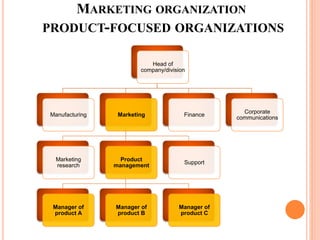
PRODUCT-FOCUSED ORGANIZATIONS
Head of
company/division
Manufacturing Marketing
Marketing
research
Product
management
Manager of
product A
Manager of
product B
Manager of
product C
Support
Finance
Corporate
communications
PRODUCT-FOCUSED ORGANIZATIONS
 Used where different products use the same channel
distribution.
 Product Manager acts as a “mini-CEO” by taking
responsibility for the overall health of the brand.
 A well-defined hierarchy within the product management
system will developed. (refer to the hierarchy structure)
 Key roles are assigned to assistant and associate product
managers
 Assistant PM - market & share forecasting, budgeting, coordinating
with production, executing promotion, packaging, etc.
 Associate PM – more freedom to develop brand extension.
 Advantages:
 Locus of responsibility is clear.
 PM’s training and experience - develop the ability to work with other
areas in organization.
 Advocate for the product.
 Fast response to customer request.
 Disadvantages:
 Focus on one product.
 Centralized structure.
 Too myopic – focus on ST sales & market share goals (increase in
sales promotion).
 Inefficient use of marketing funds – family brand such as “Kraft”.
PRODUCT-FOCUSED ORGANIZATIONS
GENERAL FOODS CORPORATION: DESSERTS
DIVISION ORGANIZATIONAL CHART
Lead to the “death of the product manager system” and
widespread burnout among them.
This burnout are:
 focus on short term - stifles innovation
 an explosion of marketing data leading into information
overloads,
 corporate downsizing; and
 more responsibility and pressure with less autonomy.
PRODUCT-FOCUSED ORGANIZATIONS
MARKETING ORGANIZATION
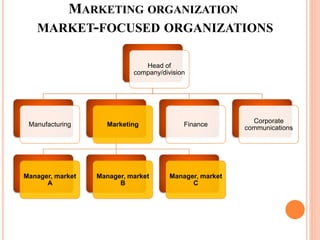
MARKET-FOCUSED ORGANIZATIONS
Head of
company/division
Manufacturing Marketing
Manager, market
A
Manager, market
B
Manager, market
C
Finance
Corporate
communications
MARKET-FOCUSED ORGANIZATIONS
 Defines marketing authority by market segment(s).
 Useful when there are differences in buyer behavior – different
marketing strategies and tactics are used.
 Example – banks define their segment into corporate vs
consumer business (customer size).
 Advantages:
 Focus on customer – modification/elimination of a product.
 Resource & knowledge sharing – easier to get the PM to pull
together.
 Work well for ‘system’ or bundle sale – different segment with
different strategy or tactic.
 Disadvantages:
 Potential conflict within the product management structure –
different internal system to serve different segments.
 Less sharing of resources across division.
MARKET-FOCUSED ORGANIZATIONS
REGIONAL BELL OPERATING COMPANY
MARKETING ORGANIZATION
FUNCTIONALLY-FOCUSED ORGANIZATIONS
Head of
company/division
Manufacturing Marketing
Product
marketing
Advertising Sales promotion
Marketing
research
Finance
Corporate
communications
FUNCTIONALLY-FOCUSED ORGANIZATIONS
 Align the company by marketing functions.
 No single person is responsible for the day-to-day health of
a product.
 CEO and VP make marketing strategy decisions.
 Strategies are implemented through discussion and
coordination among the functional areas.
 Works well when the company is producing only two
products.
 Advantages:
 Administrative simple – the groups are designed to be parallel to
normal marketing activities.
 Specialization.
 Well-coordinated.
 Disadvantages:
 Who is ultimately responsible for the product?
 Substantial time in solving problems.
 Focused only on functional development.
FUNCTIONALLY-FOCUSED ORGANIZATIONS
MARKETING ORGANIZATION:
TOY MANUFACTURER
Vice president,
marketing
Marketing
support
Advertising and
public relations
Publications
Merchandising
Consumer
administration
CRITICAL SKILLS OF PRODUCT
MANAGEMENT
 Negotiation
 Product manager must be persuasive & able to influence the
management.
 Teamwork
 Product manager must synthesize information from a variety
departments.
 Communication skills
 Product manager communicates the product/brand to internal &
external parties.
 Analytical ability
 Product manager needs to analyze & interpret all the figures such
as sales targets, share vs competition, e.g.
CHANGES AFFECTING PRODUCT MANAGEMENT
 The web
 New channel distribution, communication medium, & creating a
community around a brand.
 customer acquisition and retention.
 part of the brand building and will affect many facets of the product
manager’s job.
 The data explosion
 Increase the use of IT - effective marketing today requires
sophisticated information management.
 For consumer goods better time for market shares, sales and
distribution. (Eg: Scanner ).
 Laptop computer guide transmission of competitor information.
 Use of “data mining’ software and traffic data.
CHANGES AFFECTING PRODUCT MANAGEMENT
 The increased emphasis on brands
 Brand is the greatest assets of a company.
 Focus on brand equity.
 Changes in the balance of market power
 Involvement in IT partners between manufacturers and sellers both
has equal access to sales and market share data.
 The balance power in distribution channels has shifted from the
manufacturer to retailer.
 Consumers & retailers hold bigger marker power.
CHANGES AFFECTING PRODUCT MANAGEMENT
 Increased importance of customer retention programs
 Company focus on the lifetime-value-of-a-customer concept.
 Customer services and satisfaction programs, advertising and
promotion programs.
 Increased global competition
 Not appropriate organization structure .
 Obtain experience & knowledge about how a variety of cultures
conduct business.
 Forming trade blocks (Eg: European Union, South America,
economy free – trade zone).
COMING CLASS – CUSTOMER ANALYSIS
 What we need to know about customers?
 Who buys & uses the product?
 What customers buy & how they use it?
 Where customers buy?
 When customers buy?
 How customers choose?
 Why they prefer a product?
 How they respond to marketing program(s)?
 Will they buy it (again)?
 Segmentation.
 Desirable criteria for segments.
 Methods for market segmentations.

TOPIC_1_Introduction_to_Product_Manageme.ppt

  • 1.
    TOPIC 1 INTRODUCTION TO PRODUCTMANAGEMENT Week 1(Lecture 1)
  • 2.
     Main Text: Lehmann, D. R. & Winer, R. S. (2005). Product management. (4thed.).New York: McGraw-Hill.  Keller, K. L. (2012). Strategic Brand Management: Building, Measuring, and Managing Brand Equity. (4th ed.). Prentice Hall.  Learning Outcomes:  Demonstrate the art in managing product and services related matters.  Develop specific objectives and strategies with relation to products and services.  Apply the knowledge to other area of marketing such as pricing, promotion and placing decisions.  Mid-Trimester Test - 16% (40 marks)  Week 7 (29 Feb 2016) - TOPIC 1-4. The duration of the test will be 1 hour. It will consist of TWO sections:  Section A (10 marks) : 10 MCQ  Section B (30 marks): Choose one out of two questions. All questions are short essays.
  • 3.
    OVERVIEW  Responsible ofproduct manager (PM).  Differences between product and general marketing management.  Marketing organization:  Product-focused organizations.  Market-focused organizations.  Functionally-focused organizations.  Critical skills of PM.  Changes in marketing organizations.
  • 4.
    PRODUCT MANAGER  Theplanning activities related to the management of product(s) or product line.  Analyzing the market & turning this information into marketing objectives & strategies for the product.  Obtaining organizational support for the marketing plan.  Involve coordinating with other areas of the firm.  Involve in internal marketing of the product – obtain assistance & support of more senior managers in the firm.  Analyzing potential partner relationship for the product.
  • 5.
    A PRODUCT MANAGER’SPOTENTIAL INTERACTIONS Manufacturing & distribution R&D Legal Fiscal Market Research Sales Publicity Purchasing Packaging Promotion services Advertising Agency Media Product Manager
  • 6.
    PRODUCT VS GENERALMARKETING MANAGEMENT Product Management General Marketing Mgmt Scope of responsibility Narrow: Single product or product line Broad: Portfolio of products Nature of decision making Mainly tactical Mainly strategic Time horizon Short-run(annual or shorter) Long-run
  • 7.
    MARKETING ORGANIZATION PRODUCT-FOCUSED ORGANIZATIONS Headof company/division Manufacturing Marketing Marketing research Product management Manager of product A Manager of product B Manager of product C Support Finance Corporate communications
  • 8.
    PRODUCT-FOCUSED ORGANIZATIONS  Usedwhere different products use the same channel distribution.  Product Manager acts as a “mini-CEO” by taking responsibility for the overall health of the brand.  A well-defined hierarchy within the product management system will developed. (refer to the hierarchy structure)  Key roles are assigned to assistant and associate product managers  Assistant PM - market & share forecasting, budgeting, coordinating with production, executing promotion, packaging, etc.  Associate PM – more freedom to develop brand extension.
  • 9.
     Advantages:  Locusof responsibility is clear.  PM’s training and experience - develop the ability to work with other areas in organization.  Advocate for the product.  Fast response to customer request.  Disadvantages:  Focus on one product.  Centralized structure.  Too myopic – focus on ST sales & market share goals (increase in sales promotion).  Inefficient use of marketing funds – family brand such as “Kraft”. PRODUCT-FOCUSED ORGANIZATIONS
  • 10.
    GENERAL FOODS CORPORATION:DESSERTS DIVISION ORGANIZATIONAL CHART
  • 11.
    Lead to the“death of the product manager system” and widespread burnout among them. This burnout are:  focus on short term - stifles innovation  an explosion of marketing data leading into information overloads,  corporate downsizing; and  more responsibility and pressure with less autonomy. PRODUCT-FOCUSED ORGANIZATIONS
  • 12.
    MARKETING ORGANIZATION MARKET-FOCUSED ORGANIZATIONS Headof company/division Manufacturing Marketing Manager, market A Manager, market B Manager, market C Finance Corporate communications
  • 13.
    MARKET-FOCUSED ORGANIZATIONS  Definesmarketing authority by market segment(s).  Useful when there are differences in buyer behavior – different marketing strategies and tactics are used.  Example – banks define their segment into corporate vs consumer business (customer size).
  • 14.
     Advantages:  Focuson customer – modification/elimination of a product.  Resource & knowledge sharing – easier to get the PM to pull together.  Work well for ‘system’ or bundle sale – different segment with different strategy or tactic.  Disadvantages:  Potential conflict within the product management structure – different internal system to serve different segments.  Less sharing of resources across division. MARKET-FOCUSED ORGANIZATIONS
  • 15.
  • 16.
    MARKETING ORGANIZATION FUNCTIONALLY-FOCUSED ORGANIZATIONS Headof company/division Manufacturing Marketing Product marketing Advertising Sales promotion Marketing research Finance Corporate communications
  • 17.
    FUNCTIONALLY-FOCUSED ORGANIZATIONS  Alignthe company by marketing functions.  No single person is responsible for the day-to-day health of a product.  CEO and VP make marketing strategy decisions.  Strategies are implemented through discussion and coordination among the functional areas.  Works well when the company is producing only two products.
  • 18.
     Advantages:  Administrativesimple – the groups are designed to be parallel to normal marketing activities.  Specialization.  Well-coordinated.  Disadvantages:  Who is ultimately responsible for the product?  Substantial time in solving problems.  Focused only on functional development. FUNCTIONALLY-FOCUSED ORGANIZATIONS
  • 19.
    MARKETING ORGANIZATION: TOY MANUFACTURER Vicepresident, marketing Marketing support Advertising and public relations Publications Merchandising Consumer administration
  • 20.
    CRITICAL SKILLS OFPRODUCT MANAGEMENT  Negotiation  Product manager must be persuasive & able to influence the management.  Teamwork  Product manager must synthesize information from a variety departments.  Communication skills  Product manager communicates the product/brand to internal & external parties.  Analytical ability  Product manager needs to analyze & interpret all the figures such as sales targets, share vs competition, e.g.
  • 21.
    CHANGES AFFECTING PRODUCTMANAGEMENT  The web  New channel distribution, communication medium, & creating a community around a brand.  customer acquisition and retention.  part of the brand building and will affect many facets of the product manager’s job.  The data explosion  Increase the use of IT - effective marketing today requires sophisticated information management.  For consumer goods better time for market shares, sales and distribution. (Eg: Scanner ).  Laptop computer guide transmission of competitor information.  Use of “data mining’ software and traffic data.
  • 22.
    CHANGES AFFECTING PRODUCTMANAGEMENT  The increased emphasis on brands  Brand is the greatest assets of a company.  Focus on brand equity.  Changes in the balance of market power  Involvement in IT partners between manufacturers and sellers both has equal access to sales and market share data.  The balance power in distribution channels has shifted from the manufacturer to retailer.  Consumers & retailers hold bigger marker power.
  • 23.
    CHANGES AFFECTING PRODUCTMANAGEMENT  Increased importance of customer retention programs  Company focus on the lifetime-value-of-a-customer concept.  Customer services and satisfaction programs, advertising and promotion programs.  Increased global competition  Not appropriate organization structure .  Obtain experience & knowledge about how a variety of cultures conduct business.  Forming trade blocks (Eg: European Union, South America, economy free – trade zone).
  • 24.
    COMING CLASS –CUSTOMER ANALYSIS  What we need to know about customers?  Who buys & uses the product?  What customers buy & how they use it?  Where customers buy?  When customers buy?  How customers choose?  Why they prefer a product?  How they respond to marketing program(s)?  Will they buy it (again)?  Segmentation.  Desirable criteria for segments.  Methods for market segmentations.