Chapter 9
STP: Segmentation,
Targeting, and
Positioning
2
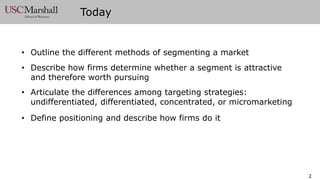
• Outline the different methods of segmenting a market
• Describe how firms determine whether a segment is attractive
and therefore worth pursuing
• Articulate the differences among targeting strategies:
undifferentiated, differentiated, concentrated, or micromarketing
• Define positioning and describe how firms do it
Today
3
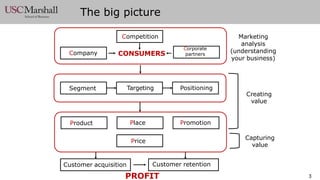
The big picture
Company
Competition
Corporate
partners
Segment Targeting Positioning
Product Place Promotion
Price
Customer acquisition Customer retention
PROFIT
Marketing
analysis
(understanding
your business)
Creating
value
Capturing
value
CONSUMERS
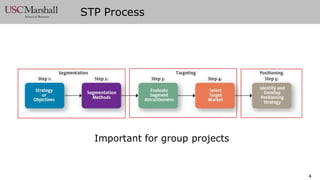
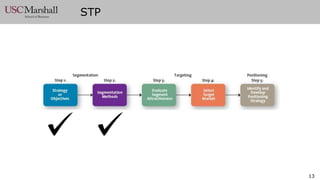
STP Process
4
Important for group projects
Segmentation strategy MUST be consistent with
– Firm’s mission/objective
– Firm’s current situation (SWOT)
Step 1: Establish overall
vision or objectives for your marketing strategy
5
Segmentation strategy MUST be consistent with
– Firm’s mission/objective
– Firm’s current situation (SWOT)
Step 1: Establish Overall
Vision or Objectives for your Marketing Strategy
“Coca-Cola’s objective is to increase
sales in a mature industry.” If this is
our objective:
1. What research should we be doing
about our consumer?
2. Who is our consumer?
3.What benefits is he/she seeking?
The above questions lead you through
the STP process.
6
Segmentation Method Sample Segments
Geographic
Continent: North America, Asia, Europe, Africa. Within the
United States: Pacific, mountain, central, south, mid-
Atlantic, northeast
Demographic Age, gender, income
Psychographic Lifestyle, self-concept, self-values
Benefits Convenience, economy, prestige
Behavioral Occasion, loyalty
7
Step 2: Segmentation Methods
Geographic Segmentation
• Consumers organized on the basis of where they live
8
Step 2: Segmentation Methods
https://www.youtube.com/watch?v=6Pkq_eBHXJ4
Step 2: Segmentation Methods
9
Psychographic Segmentation
• Consumers organized on the basis of lifestyle and values
Step 2: Segmentation Methods
10
Behavioral Segmentation
• Consumers organized on the basis of how they use the
product/service
Step 2: Segmentation Methods
11
Behavioral Segmentation
• Consumers organized on the basis of how they use the
product/service
Step 2: Segmentation Methods
https://www.adventuretravelnews.com/using-the-us-adventure-travel-personas-to-strengthen-your-marketing
12
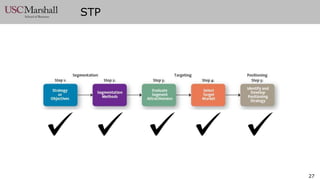
STP
13
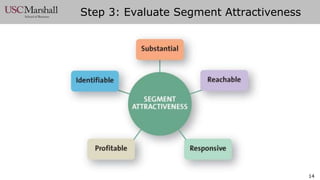
Step 3: Evaluate Segment Attractiveness
14
Step 3: Evaluate Segment Attractiveness
Identifiable
• Who is in their market?
• Are the segments unique?
• Does each segment require a unique marketing mix?
15
Step 3: Evaluate Segment Attractiveness
Substantial
• Too small and it is insignificant – can you create an effective message to
reach the segment in question?
• Too big and it may be impossible to craft a message that resonates
equally with all the members of your chosen “segment”!
• Effective segmentation is critical, even if your product has a general
market appeal.
16
Step 3: Evaluate Segment Attractiveness
Reachable
Know the product
exists
Understand what
it can do
Recognize how to
buy
17
Step 3: Evaluate Segment Attractiveness
Responsive
Customers in each segment must:
React positively
to firm’s offering
Accept the
firm’s value
proposition
Trust your firm!
(Reputation,
ethics)
Benefits to be received
from a product or service
18
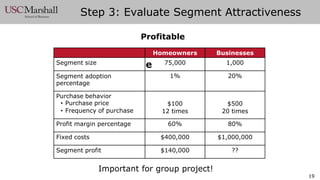
Pr
Important for group project!
19
ofitabl
e
Step 3: Evaluate Segment Attractiveness
Homeowners Businesses
Segment size 75,000 1,000
Segment adoption
percentage
1% 20%
Purchase behavior
• Purchase price
• Frequency of purchase
$100
12 times
$500
20 times
Profit margin percentage 60% 80%
Fixed costs $400,000 $1,000,000
Segment profit $140,000 ??
Profitable
Pr
Important for group project!
20
ofitabl
e
Step 3: Evaluate Segment Attractiveness
Homeowners Businesses
Segment size 75,000 1,000
Segment adoption
percentage
1% 20%
Purchase behavior
• Purchase price
• Frequency of purchase
$100
12 times
$500
20 times
Profit margin percentage 60% 80%
Fixed costs $400,000 $1,000,000
Segment profit $140,000 $600,000
Profitable
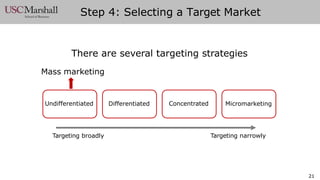
There are several targeting strategies
Mass marketing
Step 4: Selecting a Target Market
Targeting broadly Targeting narrowly
Undifferentiated Differentiated Micromarketing
Concentrated
21
Assume a restaurant is trying to market its new business.
• Using a differentiated marketing strategy, the restaurant can appeal to the
college crowd by marketing cheap specials on food and drinks, the family
crowd by marketing kid-friendly meal options and table entertainment and to
the elderly by marketing senior discounts and early-bird specials.
• Using a concentrated marketing strategy, the restaurant can market its
convenient location to a group of residents within 10 miles of the business.
• Using an undifferentiated marketing strategy, the restaurant can highlight
its grand opening celebration.
22
Restaurant example
Step 4: Selecting a Target Market
23
Step 4: Selecting a Target Market
24
Whole food target market
• Working parents, aged approximately 30 to 50
• Diverse, multi-cultural, embrace opportunities to “try new
foods”
• Environmentally-conscious
• Sustainability, animal welfare, organically-grown foods are
among these consumers shopping priorities
• City and suburban
• Educated professionals (B.A., M.A., MBA, Ph.D., etc.)
• Seeking premium service
• Willing to pay premium prices for a specific grocery-shopping
experience
STP
25
Positioning methods
– Value (relationship price to quality)
– Salient attributes
– Symbol
– Competition
What sets your product or service apart from the others
(unique value proposition)? You already offer what they
offer, but your company takes it to the next level!
26
Step 5:
Develop a Positioning Strategy
STP
27
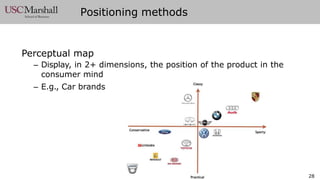
Perceptual map
– Display, in 2+ dimensions, the position of the product in the
consumer mind
– E.g., Car brands
28
Positioning methods
Tesla example
https://www.youtube.com/watch?v=BCPaO1Sv-hE
29

Segmentation Targeting and Positioning ppt

  • 1.
  • 2.
    2 • Outline thedifferent methods of segmenting a market • Describe how firms determine whether a segment is attractive and therefore worth pursuing • Articulate the differences among targeting strategies: undifferentiated, differentiated, concentrated, or micromarketing • Define positioning and describe how firms do it Today
  • 3.
    3 The big picture Company Competition Corporate partners SegmentTargeting Positioning Product Place Promotion Price Customer acquisition Customer retention PROFIT Marketing analysis (understanding your business) Creating value Capturing value CONSUMERS
  • 4.
  • 5.
    Segmentation strategy MUSTbe consistent with – Firm’s mission/objective – Firm’s current situation (SWOT) Step 1: Establish overall vision or objectives for your marketing strategy 5
  • 6.
    Segmentation strategy MUSTbe consistent with – Firm’s mission/objective – Firm’s current situation (SWOT) Step 1: Establish Overall Vision or Objectives for your Marketing Strategy “Coca-Cola’s objective is to increase sales in a mature industry.” If this is our objective: 1. What research should we be doing about our consumer? 2. Who is our consumer? 3.What benefits is he/she seeking? The above questions lead you through the STP process. 6
  • 7.
    Segmentation Method SampleSegments Geographic Continent: North America, Asia, Europe, Africa. Within the United States: Pacific, mountain, central, south, mid- Atlantic, northeast Demographic Age, gender, income Psychographic Lifestyle, self-concept, self-values Benefits Convenience, economy, prestige Behavioral Occasion, loyalty 7 Step 2: Segmentation Methods
  • 8.
    Geographic Segmentation • Consumersorganized on the basis of where they live 8 Step 2: Segmentation Methods https://www.youtube.com/watch?v=6Pkq_eBHXJ4
  • 9.
  • 10.
    Psychographic Segmentation • Consumersorganized on the basis of lifestyle and values Step 2: Segmentation Methods 10
  • 11.
    Behavioral Segmentation • Consumersorganized on the basis of how they use the product/service Step 2: Segmentation Methods 11
  • 12.
    Behavioral Segmentation • Consumersorganized on the basis of how they use the product/service Step 2: Segmentation Methods https://www.adventuretravelnews.com/using-the-us-adventure-travel-personas-to-strengthen-your-marketing 12
  • 13.
  • 14.
    Step 3: EvaluateSegment Attractiveness 14
  • 15.
    Step 3: EvaluateSegment Attractiveness Identifiable • Who is in their market? • Are the segments unique? • Does each segment require a unique marketing mix? 15
  • 16.
    Step 3: EvaluateSegment Attractiveness Substantial • Too small and it is insignificant – can you create an effective message to reach the segment in question? • Too big and it may be impossible to craft a message that resonates equally with all the members of your chosen “segment”! • Effective segmentation is critical, even if your product has a general market appeal. 16
  • 17.
    Step 3: EvaluateSegment Attractiveness Reachable Know the product exists Understand what it can do Recognize how to buy 17
  • 18.
    Step 3: EvaluateSegment Attractiveness Responsive Customers in each segment must: React positively to firm’s offering Accept the firm’s value proposition Trust your firm! (Reputation, ethics) Benefits to be received from a product or service 18
  • 19.
    Pr Important for groupproject! 19 ofitabl e Step 3: Evaluate Segment Attractiveness Homeowners Businesses Segment size 75,000 1,000 Segment adoption percentage 1% 20% Purchase behavior • Purchase price • Frequency of purchase $100 12 times $500 20 times Profit margin percentage 60% 80% Fixed costs $400,000 $1,000,000 Segment profit $140,000 ?? Profitable
  • 20.
    Pr Important for groupproject! 20 ofitabl e Step 3: Evaluate Segment Attractiveness Homeowners Businesses Segment size 75,000 1,000 Segment adoption percentage 1% 20% Purchase behavior • Purchase price • Frequency of purchase $100 12 times $500 20 times Profit margin percentage 60% 80% Fixed costs $400,000 $1,000,000 Segment profit $140,000 $600,000 Profitable
  • 21.
    There are severaltargeting strategies Mass marketing Step 4: Selecting a Target Market Targeting broadly Targeting narrowly Undifferentiated Differentiated Micromarketing Concentrated 21
  • 22.
    Assume a restaurantis trying to market its new business. • Using a differentiated marketing strategy, the restaurant can appeal to the college crowd by marketing cheap specials on food and drinks, the family crowd by marketing kid-friendly meal options and table entertainment and to the elderly by marketing senior discounts and early-bird specials. • Using a concentrated marketing strategy, the restaurant can market its convenient location to a group of residents within 10 miles of the business. • Using an undifferentiated marketing strategy, the restaurant can highlight its grand opening celebration. 22 Restaurant example
  • 23.
    Step 4: Selectinga Target Market 23
  • 24.
    Step 4: Selectinga Target Market 24 Whole food target market • Working parents, aged approximately 30 to 50 • Diverse, multi-cultural, embrace opportunities to “try new foods” • Environmentally-conscious • Sustainability, animal welfare, organically-grown foods are among these consumers shopping priorities • City and suburban • Educated professionals (B.A., M.A., MBA, Ph.D., etc.) • Seeking premium service • Willing to pay premium prices for a specific grocery-shopping experience
  • 25.
  • 26.
    Positioning methods – Value(relationship price to quality) – Salient attributes – Symbol – Competition What sets your product or service apart from the others (unique value proposition)? You already offer what they offer, but your company takes it to the next level! 26 Step 5: Develop a Positioning Strategy
  • 27.
  • 28.
    Perceptual map – Display,in 2+ dimensions, the position of the product in the consumer mind – E.g., Car brands 28 Positioning methods
  • 29.