htpp://econ621.wordpress.com


ECON621
Topic 6
Policies to improve competitiveness and
development
htpp://econ621.wordpress.com


Introduction
• One big hairball of risk (an institutional crisis?):
  • China
  • Europe
  • The US is the most perplexing
    • The comeback kid?
    • Or heading for a growth-destroying fiscal cliff?

• Only the Fed can do more.
  • Can they, should they?
  • "open mouth operations"?
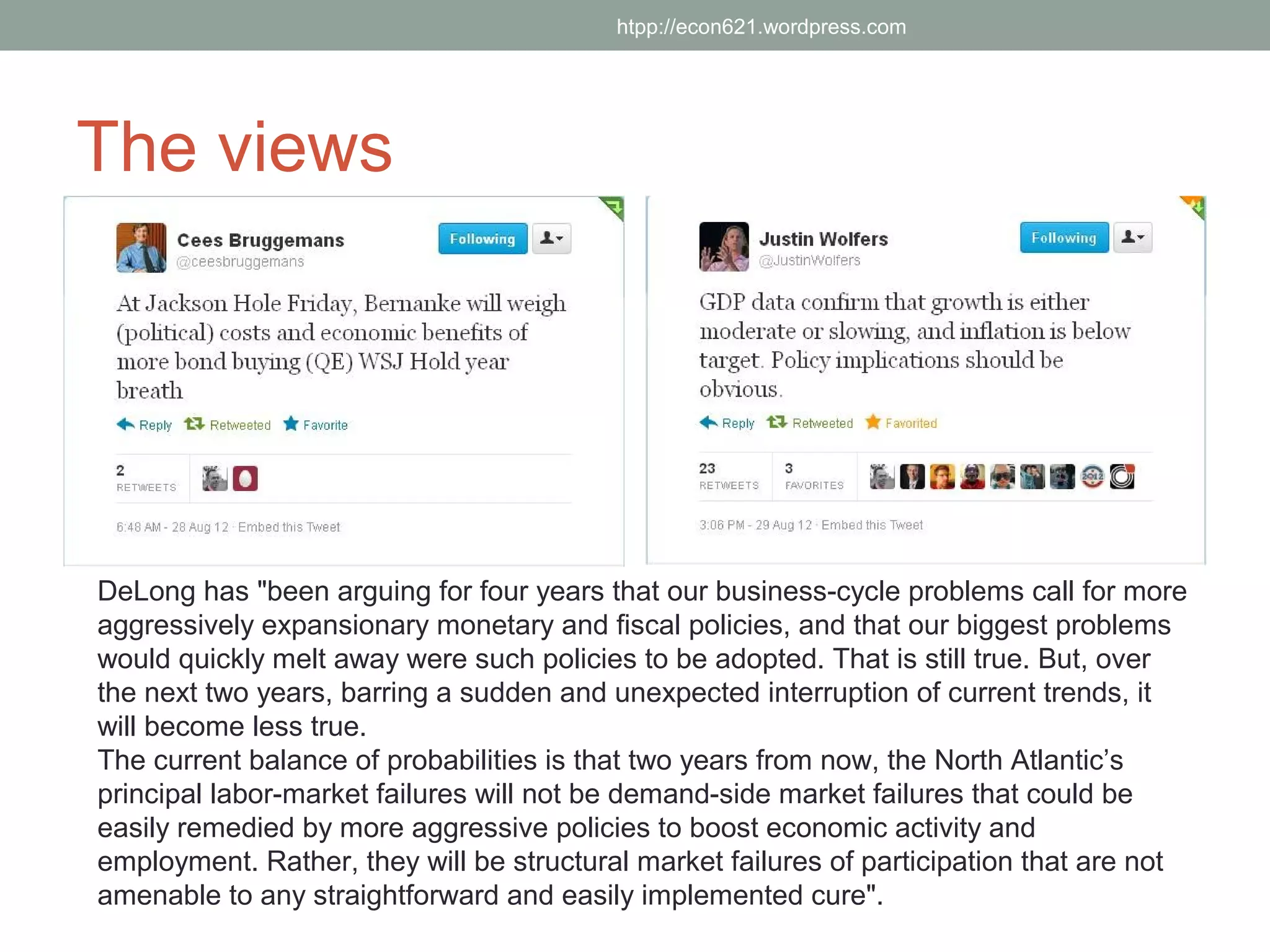
  • This weekend Bernanke is at Jackson Hole…
htpp://econ621.wordpress.com


The US economy
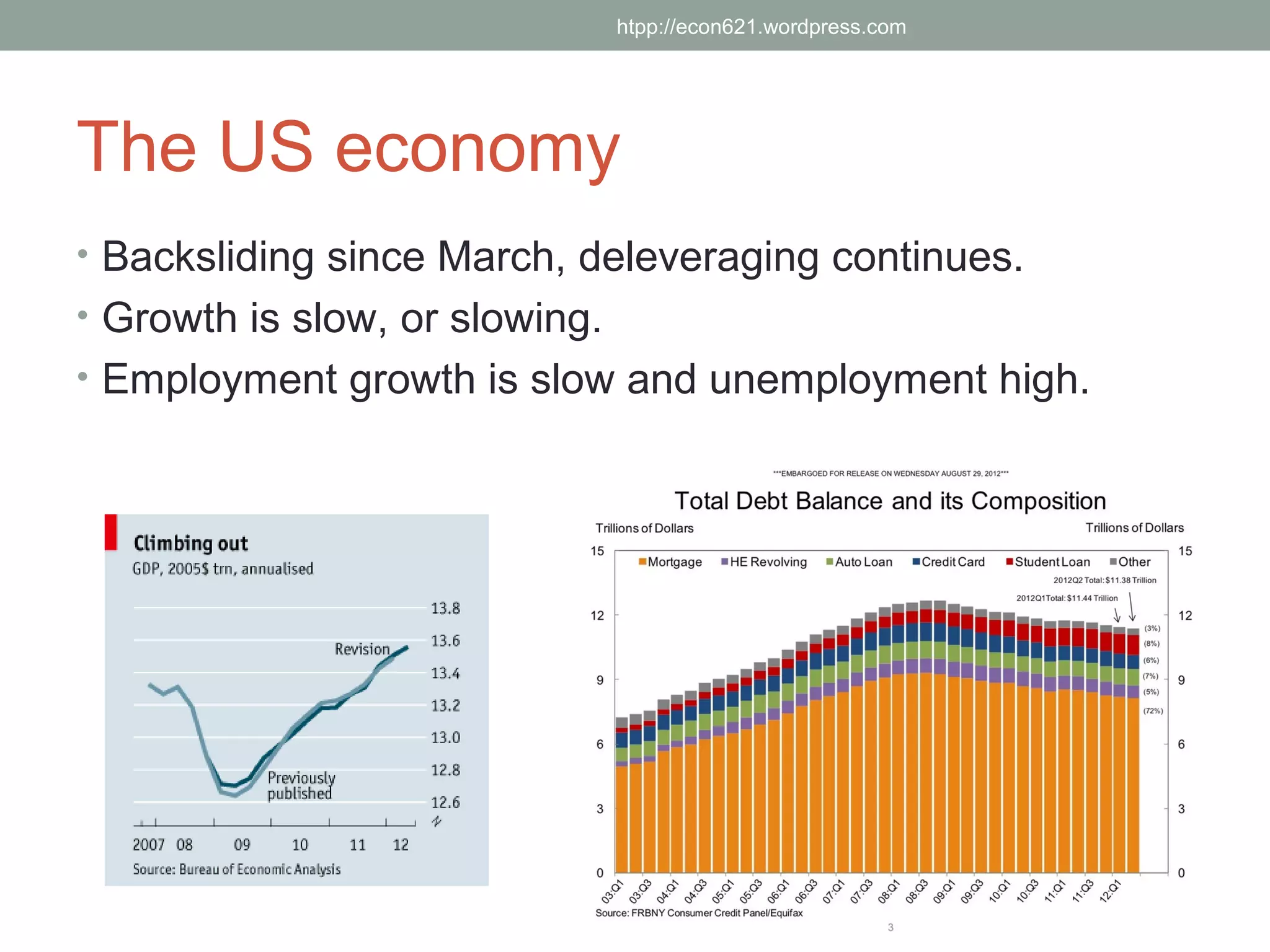
• Backsliding since March, deleveraging continues.
• Growth is slow, or slowing.
• Employment growth is slow and unemployment high.
htpp://econ621.wordpress.com


The latest numbers
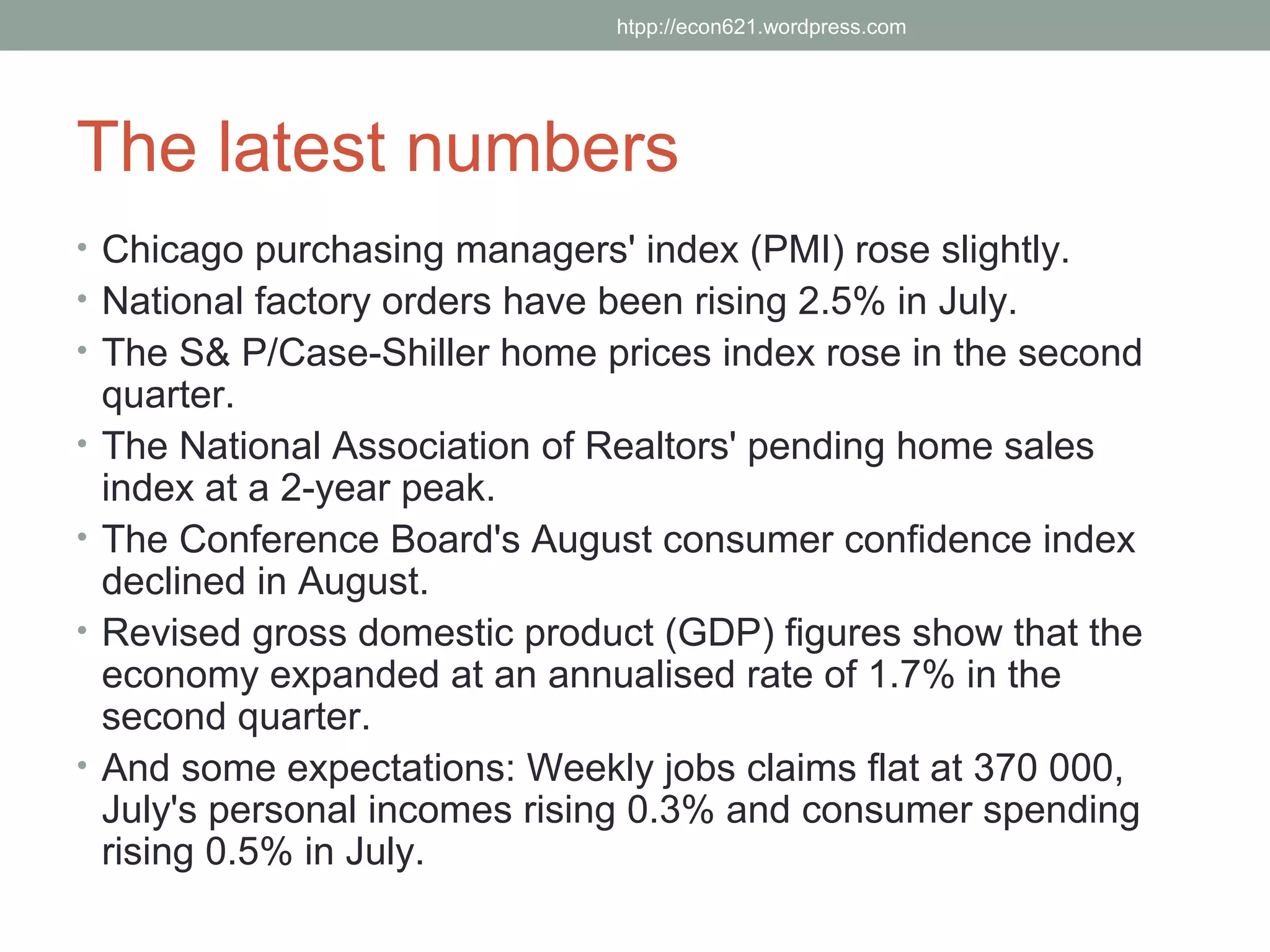
• Chicago purchasing managers' index (PMI) rose slightly.
• National factory orders have been rising 2.5% in July.
• The S& P/Case-Shiller home prices index rose in the second
    quarter.
•   The National Association of Realtors' pending home sales
    index at a 2-year peak.
•   The Conference Board's August consumer confidence index
    declined in August.
•   Revised gross domestic product (GDP) figures show that the
    economy expanded at an annualised rate of 1.7% in the
    second quarter.
•   And some expectations: Weekly jobs claims flat at 370 000,
    July's personal incomes rising 0.3% and consumer spending
    rising 0.5% in July.
htpp://econ621.wordpress.com


Then there is the fiscal cliff
• It is a fiscal policy story:
   • Bush-era tax cuts are set to expire in January, and
   • Automatic spending cuts are due in December – part of the 2011
     debt ceiling deal.
• This would push the US into recession.
• Even if the cliff is avoided, there is still a clifflet:
   • the expiration of the payroll tax cut,
   • the expiration of extended unemployment insurance benefits,
   • imposition of a new 3.8% Medicare investment tax on the wealthy.
• ISI Group projects $220 billion of fiscal tightening in 2013,
  or 1.4% of GDP.
• JPMorgan, puts the hit at a slightly higher $266 billion, or
  1.7% of GDP.
htpp://econ621.wordpress.com


The views


DeLong has "been arguing for four years that our business-cycle problems call for more
aggressively expansionary monetary and fiscal policies, and that our biggest problems
would quickly melt away were such policies to be adopted. That is still true. But, over
the next two years, barring a sudden and unexpected interruption of current trends, it
will become less true.
The current balance of probabilities is that two years from now, the North Atlantic’s
principal labor-market failures will not be demand-side market failures that could be
easily remedied by more aggressive policies to boost economic activity and
employment. Rather, they will be structural market failures of participation that are not
amenable to any straightforward and easily implemented cure".
htpp://econ621.wordpress.com


Can / should the Fed do more?

• What do we mean "do more"?
• How would they "do it"?
• Will it work?
• Should they do it?
htpp://econ621.wordpress.com


More…
• Monetary stimulus.
• Demand-siders, like Krugman, sees the slump as being
  caused by inadequate spending: thanks largely to the
  overhang of debt from the bubble years, aggregate
  demand fell, pushing the US into a classic liquidity trap.
• Stimulus should increase investment, (also in housing),
  consumer spending.
• a higher general inflation rate
facilitates relative price
adjustments
htpp://econ621.wordpress.com


How to do it…
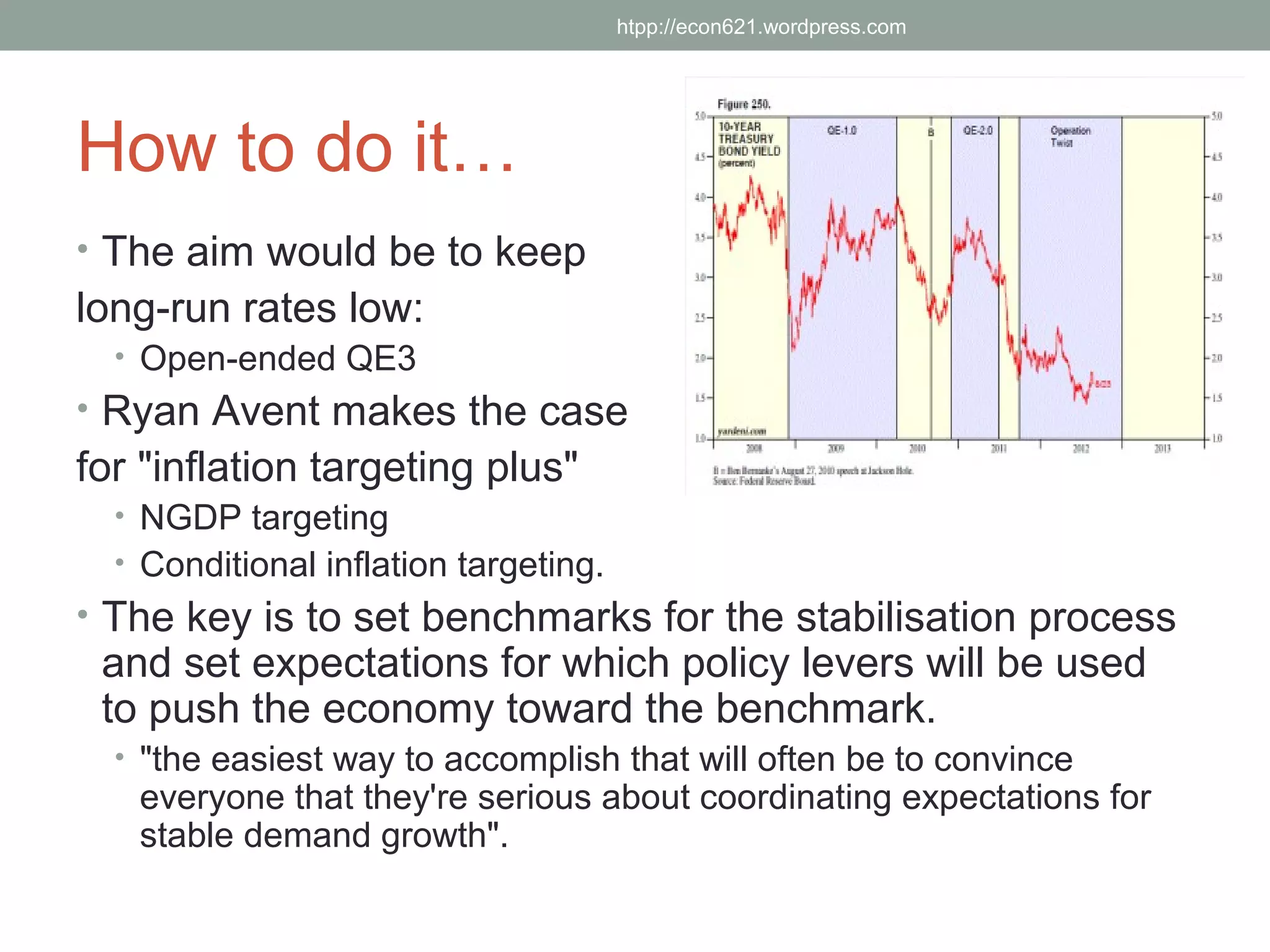
• The aim would be to keep
long-run rates low:
  • Open-ended QE3
• Ryan Avent makes the case
for "inflation targeting plus"
  • NGDP targeting
  • Conditional inflation targeting.
• The key is to set benchmarks for the stabilisation process
 and set expectations for which policy levers will be used
 to push the economy toward the benchmark.
  • "the easiest way to accomplish that will often be to convince
   everyone that they're serious about coordinating expectations for
   stable demand growth".
htpp://econ621.wordpress.com


Will it work…
• It will depend on the actions of consumers and markets.
• And to the extent that there is in fact, already, a liquidity
  trap.
• Some argue:
  • Since bond yields are already at record lows, could it be that Fed
    officials have concluded that the only transmission mechanism they
    have left between monetary policy and the economy is the stock
    market?
  • With QE2: “Stock prices rose and long-term interest rates fell when
    investors began to anticipate the most recent action. … And higher
    stock prices will boost consumer wealth and help increase
    confidence, which can also spur spending."
htpp://econ621.wordpress.com


But not everyone agrees
• But many people insist that the slump was actually some
 kind of supply shock instead.
  • Either they have an Austrian story in which the economy’s
    productive capacity was undermined by bad investments in the
    boom,
  • or they claim that Obama’s high taxes and regulation had
    undermined the incentive to work.
• Their fear is that monetary stimulus will fuel inflation –
 leading to hyperinflation.
  • (Have a look at the blogs and tweets of Zerohedge, or in SA: Chris
   L Becker, Russell Lamberti and the Mises blog.)
htpp://econ621.wordpress.com


But…
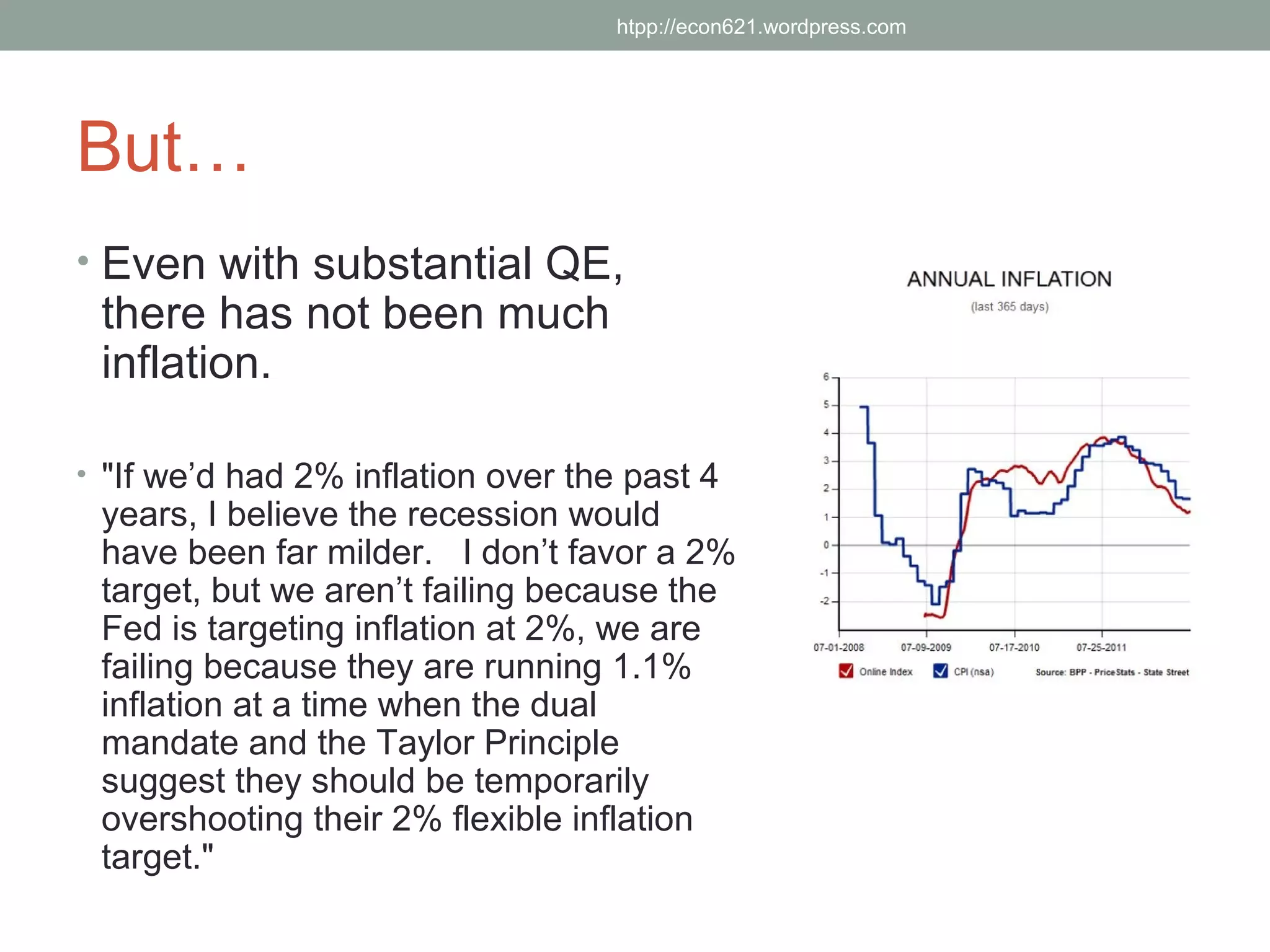
• Even with substantial QE,
 there has not been much
 inflation.

• "If we’d had 2% inflation over the past 4
 years, I believe the recession would
 have been far milder. I don’t favor a 2%
 target, but we aren’t failing because the
 Fed is targeting inflation at 2%, we are
 failing because they are running 1.1%
 inflation at a time when the dual
 mandate and the Taylor Principle
 suggest they should be temporarily
 overshooting their 2% flexible inflation
 target."
htpp://econ621.wordpress.com


Conclusions
• These are interesting times.
• Keep an eye on the news this weekend to see what
  happens at Jackson Hole.
• And remember, what happens in the US are linked to
  what happens in the EU and China.
• Next week:
  • The International Trade students take a road trip.
  • The rest of us have a class debate:
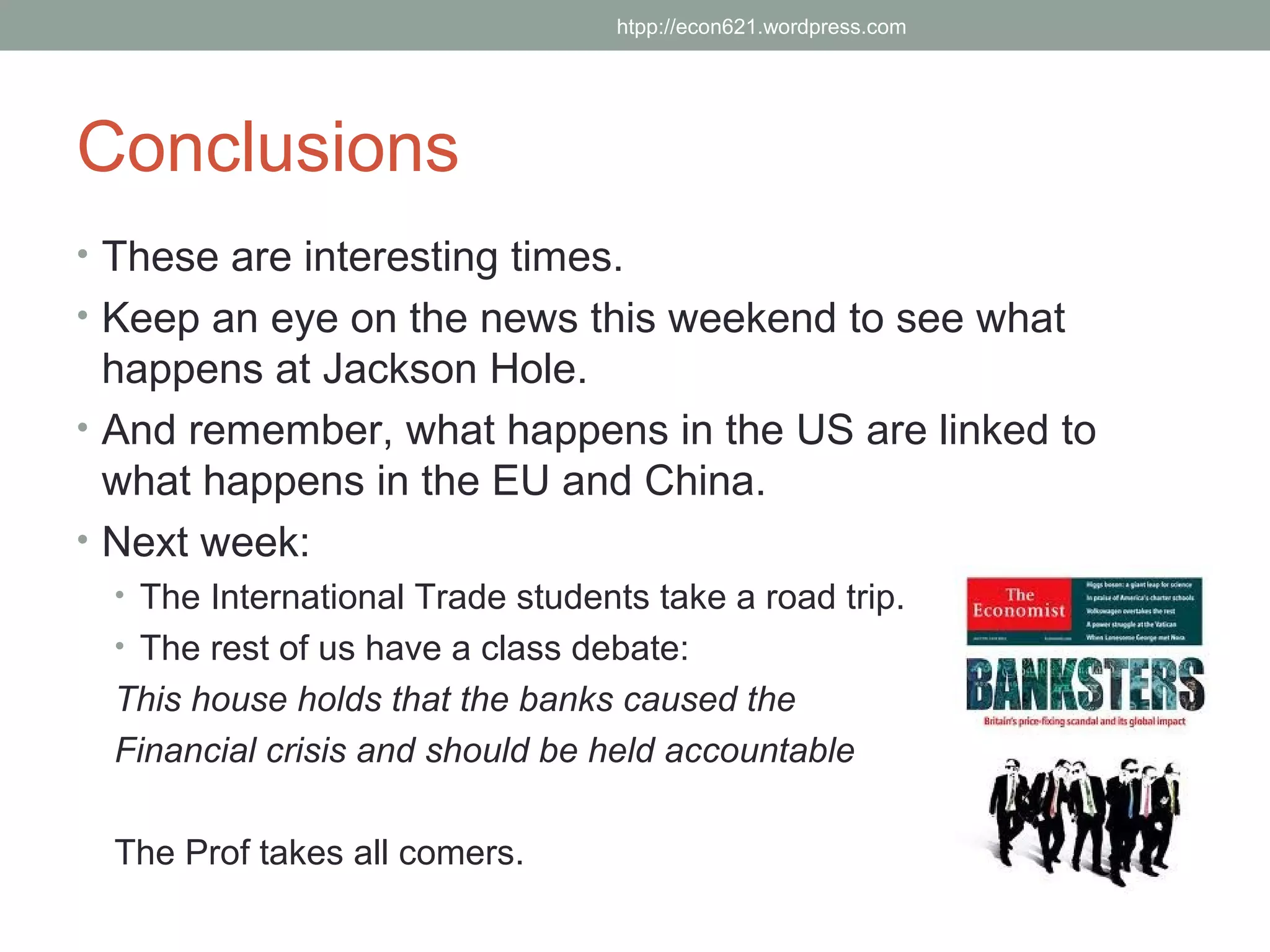
  This house holds that the banks caused the
  Financial crisis and should be held accountable

  The Prof takes all comers.

Topic 6

  • 1.
    htpp://econ621.wordpress.com ECON621 Topic 6 Policies toimprove competitiveness and development
  • 2.
    htpp://econ621.wordpress.com Introduction • One bighairball of risk (an institutional crisis?): • China • Europe • The US is the most perplexing • The comeback kid? • Or heading for a growth-destroying fiscal cliff? • Only the Fed can do more. • Can they, should they? • "open mouth operations"? • This weekend Bernanke is at Jackson Hole…
  • 3.
    htpp://econ621.wordpress.com The US economy •Backsliding since March, deleveraging continues. • Growth is slow, or slowing. • Employment growth is slow and unemployment high.
  • 4.
    htpp://econ621.wordpress.com The latest numbers •Chicago purchasing managers' index (PMI) rose slightly. • National factory orders have been rising 2.5% in July. • The S& P/Case-Shiller home prices index rose in the second quarter. • The National Association of Realtors' pending home sales index at a 2-year peak. • The Conference Board's August consumer confidence index declined in August. • Revised gross domestic product (GDP) figures show that the economy expanded at an annualised rate of 1.7% in the second quarter. • And some expectations: Weekly jobs claims flat at 370 000, July's personal incomes rising 0.3% and consumer spending rising 0.5% in July.
  • 5.
    htpp://econ621.wordpress.com Then there isthe fiscal cliff • It is a fiscal policy story: • Bush-era tax cuts are set to expire in January, and • Automatic spending cuts are due in December – part of the 2011 debt ceiling deal. • This would push the US into recession. • Even if the cliff is avoided, there is still a clifflet: • the expiration of the payroll tax cut, • the expiration of extended unemployment insurance benefits, • imposition of a new 3.8% Medicare investment tax on the wealthy. • ISI Group projects $220 billion of fiscal tightening in 2013, or 1.4% of GDP. • JPMorgan, puts the hit at a slightly higher $266 billion, or 1.7% of GDP.
  • 6.
    htpp://econ621.wordpress.com The views DeLong has"been arguing for four years that our business-cycle problems call for more aggressively expansionary monetary and fiscal policies, and that our biggest problems would quickly melt away were such policies to be adopted. That is still true. But, over the next two years, barring a sudden and unexpected interruption of current trends, it will become less true. The current balance of probabilities is that two years from now, the North Atlantic’s principal labor-market failures will not be demand-side market failures that could be easily remedied by more aggressive policies to boost economic activity and employment. Rather, they will be structural market failures of participation that are not amenable to any straightforward and easily implemented cure".
  • 7.
    htpp://econ621.wordpress.com Can / shouldthe Fed do more? • What do we mean "do more"? • How would they "do it"? • Will it work? • Should they do it?
  • 8.
    htpp://econ621.wordpress.com More… • Monetary stimulus. •Demand-siders, like Krugman, sees the slump as being caused by inadequate spending: thanks largely to the overhang of debt from the bubble years, aggregate demand fell, pushing the US into a classic liquidity trap. • Stimulus should increase investment, (also in housing), consumer spending. • a higher general inflation rate facilitates relative price adjustments
  • 9.
    htpp://econ621.wordpress.com How to doit… • The aim would be to keep long-run rates low: • Open-ended QE3 • Ryan Avent makes the case for "inflation targeting plus" • NGDP targeting • Conditional inflation targeting. • The key is to set benchmarks for the stabilisation process and set expectations for which policy levers will be used to push the economy toward the benchmark. • "the easiest way to accomplish that will often be to convince everyone that they're serious about coordinating expectations for stable demand growth".
  • 10.
    htpp://econ621.wordpress.com Will it work… •It will depend on the actions of consumers and markets. • And to the extent that there is in fact, already, a liquidity trap. • Some argue: • Since bond yields are already at record lows, could it be that Fed officials have concluded that the only transmission mechanism they have left between monetary policy and the economy is the stock market? • With QE2: “Stock prices rose and long-term interest rates fell when investors began to anticipate the most recent action. … And higher stock prices will boost consumer wealth and help increase confidence, which can also spur spending."
  • 11.
    htpp://econ621.wordpress.com But not everyoneagrees • But many people insist that the slump was actually some kind of supply shock instead. • Either they have an Austrian story in which the economy’s productive capacity was undermined by bad investments in the boom, • or they claim that Obama’s high taxes and regulation had undermined the incentive to work. • Their fear is that monetary stimulus will fuel inflation – leading to hyperinflation. • (Have a look at the blogs and tweets of Zerohedge, or in SA: Chris L Becker, Russell Lamberti and the Mises blog.)
  • 12.
    htpp://econ621.wordpress.com But… • Even withsubstantial QE, there has not been much inflation. • "If we’d had 2% inflation over the past 4 years, I believe the recession would have been far milder. I don’t favor a 2% target, but we aren’t failing because the Fed is targeting inflation at 2%, we are failing because they are running 1.1% inflation at a time when the dual mandate and the Taylor Principle suggest they should be temporarily overshooting their 2% flexible inflation target."
  • 13.
    htpp://econ621.wordpress.com Conclusions • These areinteresting times. • Keep an eye on the news this weekend to see what happens at Jackson Hole. • And remember, what happens in the US are linked to what happens in the EU and China. • Next week: • The International Trade students take a road trip. • The rest of us have a class debate: This house holds that the banks caused the Financial crisis and should be held accountable The Prof takes all comers.