BFI Club, Fall 2012
Video
   http://www.youtube.com/watch?v=ZS9w
    vyVEUK0
What is the Fiscal Cliff?
   December 31, 2012
     Expiration of almost every tax cut enacted since
      2001 (Bush era tax cuts)
     Reduction in government spending
   What’s the effect?
     Bankruptcy
   Isn’t that strange? – why would the
    generation of MORE tax revenue and
    spending CUTS be a bad thing? Why
    wouldn’t America’s huge deficit decrease?
Answer
   The deficit will decrease for a short time,
    but... If you INCREASE taxes and
    DECREASE spending, you DECREASE
    GDP. What does that mean?
Let’s start with increasing
taxes…
   GDP is Gross Domestic Product– “the market
    value of all officially recognized final goods
    and services produced within a country in a
    given period of time” [WFE]
     Really, it’s just the standard of living
   If you increase GDP, people will spend less,
    right?
   What happens when there is less spending?
     Business begin to fail (not enough people buying
      their stuff due to low spending confidence)
     Mass unemployment
Now let’s discuss decreasing
federal spending…
 This one’s pretty straightforward– saying
  “I want to decrease government
  spending” is the same as saying “let’s
  slash the government budget”
 If you slash the budget, there will be
  significant spending reductions on
  defense and government benefits (eg.
  let’s be mean to the old people and
  increase the Medicare age)
How did we get here?
   August 2011- Congress passed the
    Budget Control Act. What is that?
     This temporarily raised the national debt limit
      by $2 trillion
     Congress has to find a better solution (we
      can’t keep accumulating debt…)
     Also…
      ○ The act lowered funding for government
        organizations by over $1 trillion
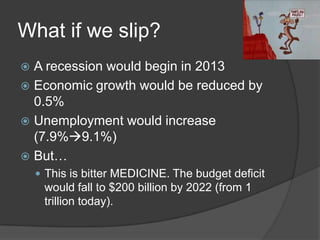
What if we slip?
 A recession would begin in 2013
 Economic growth would be reduced by
  0.5%
 Unemployment would increase
  (7.9%9.1%)
 But…
     This is bitter MEDICINE. The budget deficit
     would fall to $200 billion by 2022 (from 1
     trillion today).

Fiscal cliff

  • 1.
  • 2.
    Video  http://www.youtube.com/watch?v=ZS9w vyVEUK0
  • 3.
    What is theFiscal Cliff?  December 31, 2012  Expiration of almost every tax cut enacted since 2001 (Bush era tax cuts)  Reduction in government spending  What’s the effect?  Bankruptcy  Isn’t that strange? – why would the generation of MORE tax revenue and spending CUTS be a bad thing? Why wouldn’t America’s huge deficit decrease?
  • 4.
    Answer  The deficit will decrease for a short time, but... If you INCREASE taxes and DECREASE spending, you DECREASE GDP. What does that mean?
  • 5.
    Let’s start withincreasing taxes…  GDP is Gross Domestic Product– “the market value of all officially recognized final goods and services produced within a country in a given period of time” [WFE]  Really, it’s just the standard of living  If you increase GDP, people will spend less, right?  What happens when there is less spending?  Business begin to fail (not enough people buying their stuff due to low spending confidence)  Mass unemployment
  • 6.
    Now let’s discussdecreasing federal spending…  This one’s pretty straightforward– saying “I want to decrease government spending” is the same as saying “let’s slash the government budget”  If you slash the budget, there will be significant spending reductions on defense and government benefits (eg. let’s be mean to the old people and increase the Medicare age)
  • 7.
    How did weget here?  August 2011- Congress passed the Budget Control Act. What is that?  This temporarily raised the national debt limit by $2 trillion  Congress has to find a better solution (we can’t keep accumulating debt…)  Also… ○ The act lowered funding for government organizations by over $1 trillion
  • 8.
    What if weslip?  A recession would begin in 2013  Economic growth would be reduced by 0.5%  Unemployment would increase (7.9%9.1%)  But…  This is bitter MEDICINE. The budget deficit would fall to $200 billion by 2022 (from 1 trillion today).