DEFENSE MECHANISMS
LIJODI BRENDA
What are defence mechanisms?
 Defence mechanisms are unconscious mental
techniques used by the ego to keep conflicts out o
the conscious mind, thus decreasing anxiety and
maintaining a person’s sense o safety, equilibrium
, and self -esteem
More mature defence mechanisms
 Altruism
 Humour
 Sublimation
 suppression
Commonly Used Defense Mechanisms
Altruism
 Assisting others to avoid negative personal
feelings
 A man with a poor self-image, who is a social
worker during the week, donates every other
weekend to charity work
Humor
 Expressing personally uncomfortable feelings
without causing emotional discomfort
 A man who is concerned about his erectile
problems makes jokes about Viagra (sildenafil
citrate)
Commonly Used Defense Mechanisms
Suppression
 Deliberately pushing personally unacceptable
emotions out of conscious awareness (the only
defense mechanism that includes some aspect of
consciousness)
 Deliberately putting aside without repressing
 A medical student taking a review course for the
United States Medical Licensing Examination
mentally changes the subject when her mind
wanders to the exam during a lecture
Sublimation
 Rerouting an unacceptable drive in socially
acceptable way
 A man whose daughter was killed by a drunk
driver regularly speaks to high school students
about the dangers of drinking and driving
Commonly Used Defence Mechanisms
Acting out
 Avoiding personally unacceptable emotions by
behaving in an attention-getting, often socially
inappropriate manner
 Example A depressed 14-year-old girl with no
history of conduct disorder has sexual encounters
with multiple partners after her parents’ divorce
Commonly Used Defence Mechanisms
Denial
 Not accepting aspects of reality that the person
finds unbearable
 A man who has a problem with alcohol insists that
he is only a social drinker
Commonly Used Defence Mechanisms
Displacement
 Moving emotions from a personally intolerable
situation to one that is personally tolerable
 A surgeon with unacknowledged anger toward his
sister is abrasive to the female residents on his
service
 Attacking a drunk in the street after child killed
by drunk driver
Dissociation
 Mentally separating part of one’s consciousness
from real-life events or mentally distancing
oneself from others
 Although he was not injured, a teenager has no
memory of a car accident in which he was driving
and his girlfriend was killed, 2 different
personalities after abuse as a child
Commonly Used Defense Mechanisms
Idealization
 Seeing others as more competent or powerful
than they are
 A patient tells the doctor that he is not worried
because he is sure that the doctor will always
know what to do
Commonly Used Defense Mechanisms
Identification (introjection)
 Unconsciously patterning one’s behavior after
that of someone more powerful (can be either
positive or negative)
 A man who was terrorized by his gym teacher as a
child becomes a punitive, critical gym teacher
(identification with the aggressor)
 A man who had a punitive father always insults his
son
Projection
 Attributing one’s own personally unacceptable
feelings to others Associated with paranoid
symptoms and prejudice
 A man with unconscious homosexual impulses
begins to believe that a male colleague is
attracted to him
Intellectualization
 Using the mind’s higher functions to avoid
experiencing emotion
 A sailor whose boat is about to sink calmly
explains the technical aspects of the hull damage
in great detail to the other crew members
Commonly Used Defense Mechanisms
Isolation of affect
 Failing to experience the feelings associated with
a stressful life event, although logically
understanding the significance of the event
Without showing any emotion
 A woman tells her family the results of tests that
indicate her lung cancer has metastasized
Commonly Used Defence Mechanisms
Rationalization
 Distorting one’s perception of an event so that its
negative outcome seems reasonable
 A man who loses an arm in an accident says the
loss of his arm was good because it kept him from
getting in trouble with the law
 After failing behavioural sciences states it is not
important
Reaction formation
 Adopting opposite attitudes to avoid personally
unacceptable emotions, i.e., unconscious
hypocrisy
 A woman who unconsciously is resentful of the
responsibilities of child rearing overspends on
expensive gifts and clothing for her children,
when you like a co-worker and start picking fights
with her
Commonly Used Defense Mechanisms
Regression
 Reverting to behavior patterns like those seen in
someone of a younger age
 A woman insists that her husband stay overnight
in the hospital with her before surgery
Splitting
Categorizing people or situations into categories of
either “fabulous” or “dreadful” because of
intolerance of ambiguity Seen in patients with
borderline personality disorder
A patient tells the doctor that while all of the
doctors in the group practice are wonderful, all of
the nurses and office help are unfriendly and curt
Somatization
 Turning unacceptable feeling or impulse into
physical symptoms
 Example diarrhoea when results almost out
 Headache in the morning of interview
Commonly Used Defence Mechanisms
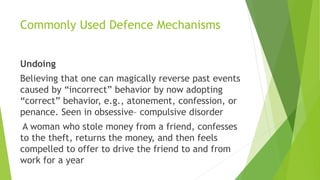
Undoing
Believing that one can magically reverse past events
caused by “incorrect” behavior by now adopting
“correct” behavior, e.g., atonement, confession, or
penance. Seen in obsessive– compulsive disorder
A woman who stole money from a friend, confesses
to the theft, returns the money, and then feels
compelled to offer to drive the friend to and from
work for a year
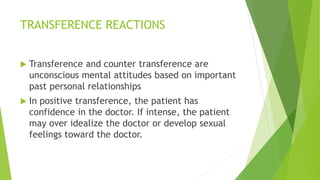
TRANSFERENCE REACTIONS
 Transference and counter transference are
unconscious mental attitudes based on important
past personal relationships
 In positive transference, the patient has
confidence in the doctor. If intense, the patient
may over idealize the doctor or develop sexual
feelings toward the doctor.
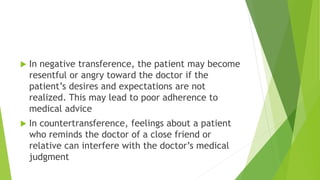
 In negative transference, the patient may become
resentful or angry toward the doctor if the
patient’s desires and expectations are not
realized. This may lead to poor adherence to
medical advice
 In countertransference, feelings about a patient
who reminds the doctor of a close friend or
relative can interfere with the doctor’s medical
judgment
THE END
THANK YOU

TOPIC 4 DEFENSE MECHANISMS.pptx

  • 1.
  • 2.
    What are defencemechanisms?  Defence mechanisms are unconscious mental techniques used by the ego to keep conflicts out o the conscious mind, thus decreasing anxiety and maintaining a person’s sense o safety, equilibrium , and self -esteem
  • 3.
    More mature defencemechanisms  Altruism  Humour  Sublimation  suppression
  • 4.
    Commonly Used DefenseMechanisms Altruism  Assisting others to avoid negative personal feelings  A man with a poor self-image, who is a social worker during the week, donates every other weekend to charity work
  • 5.
    Humor  Expressing personallyuncomfortable feelings without causing emotional discomfort  A man who is concerned about his erectile problems makes jokes about Viagra (sildenafil citrate)
  • 6.
    Commonly Used DefenseMechanisms Suppression  Deliberately pushing personally unacceptable emotions out of conscious awareness (the only defense mechanism that includes some aspect of consciousness)  Deliberately putting aside without repressing  A medical student taking a review course for the United States Medical Licensing Examination mentally changes the subject when her mind wanders to the exam during a lecture
  • 7.
    Sublimation  Rerouting anunacceptable drive in socially acceptable way  A man whose daughter was killed by a drunk driver regularly speaks to high school students about the dangers of drinking and driving
  • 8.
    Commonly Used DefenceMechanisms Acting out  Avoiding personally unacceptable emotions by behaving in an attention-getting, often socially inappropriate manner  Example A depressed 14-year-old girl with no history of conduct disorder has sexual encounters with multiple partners after her parents’ divorce
  • 9.
    Commonly Used DefenceMechanisms Denial  Not accepting aspects of reality that the person finds unbearable  A man who has a problem with alcohol insists that he is only a social drinker
  • 10.
    Commonly Used DefenceMechanisms Displacement  Moving emotions from a personally intolerable situation to one that is personally tolerable  A surgeon with unacknowledged anger toward his sister is abrasive to the female residents on his service  Attacking a drunk in the street after child killed by drunk driver
  • 11.
    Dissociation  Mentally separatingpart of one’s consciousness from real-life events or mentally distancing oneself from others  Although he was not injured, a teenager has no memory of a car accident in which he was driving and his girlfriend was killed, 2 different personalities after abuse as a child
  • 12.
    Commonly Used DefenseMechanisms Idealization  Seeing others as more competent or powerful than they are  A patient tells the doctor that he is not worried because he is sure that the doctor will always know what to do
  • 13.
    Commonly Used DefenseMechanisms Identification (introjection)  Unconsciously patterning one’s behavior after that of someone more powerful (can be either positive or negative)  A man who was terrorized by his gym teacher as a child becomes a punitive, critical gym teacher (identification with the aggressor)  A man who had a punitive father always insults his son
  • 14.
    Projection  Attributing one’sown personally unacceptable feelings to others Associated with paranoid symptoms and prejudice  A man with unconscious homosexual impulses begins to believe that a male colleague is attracted to him
  • 15.
    Intellectualization  Using themind’s higher functions to avoid experiencing emotion  A sailor whose boat is about to sink calmly explains the technical aspects of the hull damage in great detail to the other crew members
  • 16.
    Commonly Used DefenseMechanisms Isolation of affect  Failing to experience the feelings associated with a stressful life event, although logically understanding the significance of the event Without showing any emotion  A woman tells her family the results of tests that indicate her lung cancer has metastasized
  • 17.
    Commonly Used DefenceMechanisms Rationalization  Distorting one’s perception of an event so that its negative outcome seems reasonable  A man who loses an arm in an accident says the loss of his arm was good because it kept him from getting in trouble with the law  After failing behavioural sciences states it is not important
  • 18.
    Reaction formation  Adoptingopposite attitudes to avoid personally unacceptable emotions, i.e., unconscious hypocrisy  A woman who unconsciously is resentful of the responsibilities of child rearing overspends on expensive gifts and clothing for her children, when you like a co-worker and start picking fights with her
  • 19.
    Commonly Used DefenseMechanisms Regression  Reverting to behavior patterns like those seen in someone of a younger age  A woman insists that her husband stay overnight in the hospital with her before surgery
  • 20.
    Splitting Categorizing people orsituations into categories of either “fabulous” or “dreadful” because of intolerance of ambiguity Seen in patients with borderline personality disorder A patient tells the doctor that while all of the doctors in the group practice are wonderful, all of the nurses and office help are unfriendly and curt
  • 21.
    Somatization  Turning unacceptablefeeling or impulse into physical symptoms  Example diarrhoea when results almost out  Headache in the morning of interview
  • 22.
    Commonly Used DefenceMechanisms Undoing Believing that one can magically reverse past events caused by “incorrect” behavior by now adopting “correct” behavior, e.g., atonement, confession, or penance. Seen in obsessive– compulsive disorder A woman who stole money from a friend, confesses to the theft, returns the money, and then feels compelled to offer to drive the friend to and from work for a year
  • 23.
    TRANSFERENCE REACTIONS  Transferenceand counter transference are unconscious mental attitudes based on important past personal relationships  In positive transference, the patient has confidence in the doctor. If intense, the patient may over idealize the doctor or develop sexual feelings toward the doctor.
  • 24.
     In negativetransference, the patient may become resentful or angry toward the doctor if the patient’s desires and expectations are not realized. This may lead to poor adherence to medical advice  In countertransference, feelings about a patient who reminds the doctor of a close friend or relative can interfere with the doctor’s medical judgment
  • 25.