DEFENSE
MECHANISM
PRESENTED BY: Nancy Maurya
(Bsc.hons Nsg 3rd yr)
Why do we need
Ego defenses?
NEED OF DEFENSE MECHANISM
We use defense mechanisms to protect ourselves from
feelings of anxiety or guilt, which arise because we feel
threatened, or because our id or superego becomes too
demanding.
Defense mechanisms operate at an unconscious level
and help ward off unpleasant feelings (i.e., anxiety) or
make good things feel better for the individual.
Ego-defense mechanisms are natural and normal. When
they get out of proportion (i.e., used with frequency),
neuroses develop, such as anxiety states, phobias,
obsessions, or hysteria.
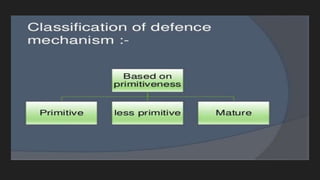
CLASSIFICATIONS
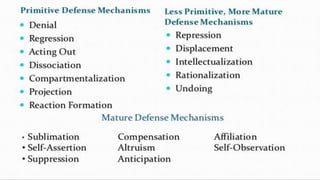
PRIMITIVE DEFENSE
MECHANISM
1.DENIAL
Failure to acknowledge an unbearable
condition; failure to admit the reality
of a situation or how one enables the
problem to continue ·
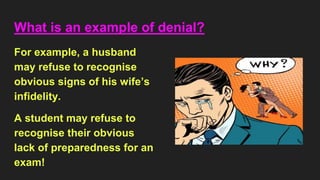
What is an example of denial?
For example, a husband
may refuse to recognise
obvious signs of his wife’s
infidelity.
A student may refuse to
recognise their obvious
lack of preparedness for an
exam!
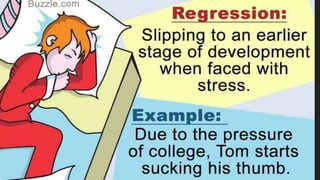
2. REGRESSION
Moving back to a previous developmental
stage to feel safe or have needs met ·
. Five-year-old asks for a bottle when new baby
brother is being fed.
· Man pouts like a 4-year-old if he is not the
center of his girlfriend’s attention.
3. ACTING OUT
Acting out is a defense mechanism used when
one is unable to manage a conflicted mental
content by means of thought and by putting it into
words.
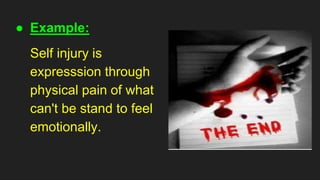
● Example:
Self injury is
expresssion through
physical pain of what
can't be stand to feel
emotionally.
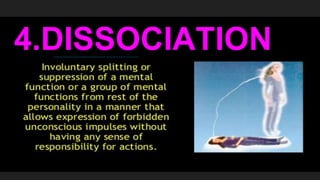
4.DISSOCIATION
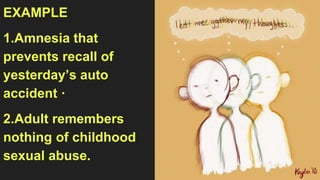
EXAMPLE
1.Amnesia that
prevents recall of
yesterday’s auto
accident ·
2.Adult remembers
nothing of childhood
sexual abuse.
5.
COMPARTMENTALIZATION
compartmentalization is defined as a defense
mechanism where someone suppresses their
thoughts and emotions. It is not always done
consciously but this can often justify or
defend a person's level of engagement in
certain behaviors.
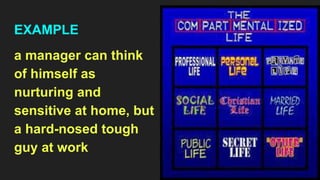
EXAMPLE
a manager can think
of himself as
nurturing and
sensitive at home, but
a hard-nosed tough
guy at work
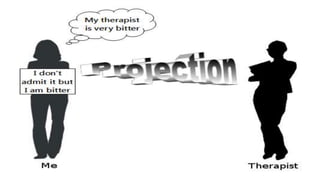
6.PROJECTION
Unconscious blaming of unacceptable inclinations or
thoughts on an external object ·
EXAMPLE:
Man who has thought about same-gender sexual
relationship, but never had one, beats a man who is gay.
· Person with many prejudices loudly identifies others as
bigots.
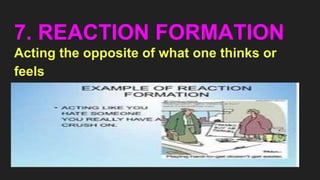
7. REACTION FORMATION
Acting the opposite of what one thinks or
feels
·
LESS PRIMITIVE
DEFENSE
MECHANISM
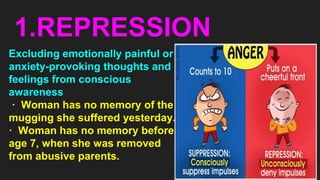
1.REPRESSION
Excluding emotionally painful or
anxiety-provoking thoughts and
feelings from conscious
awareness
· Woman has no memory of the
mugging she suffered yesterday.
· Woman has no memory before
age 7, when she was removed
from abusive parents.
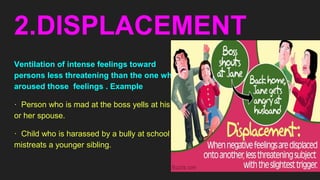
2.DISPLACEMENT
Ventilation of intense feelings toward
persons less threatening than the one who
aroused those feelings . Example
· Person who is mad at the boss yells at his
or her spouse.
· Child who is harassed by a bully at school
mistreats a younger sibling.
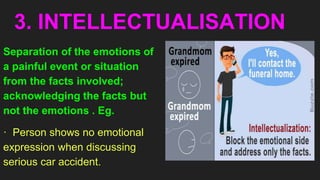
3. INTELLECTUALISATION
Separation of the emotions of
a painful event or situation
from the facts involved;
acknowledging the facts but
not the emotions . Eg.
· Person shows no emotional
expression when discussing
serious car accident.
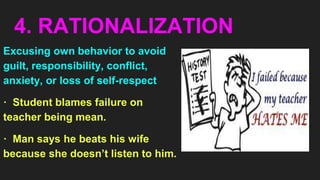
4. RATIONALIZATION
Excusing own behavior to avoid
guilt, responsibility, conflict,
anxiety, or loss of self-respect
· Student blames failure on
teacher being mean.
· Man says he beats his wife
because she doesn’t listen to him.
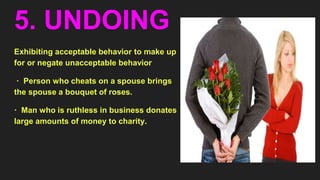
5. UNDOING
Exhibiting acceptable behavior to make up
for or negate unacceptable behavior
· Person who cheats on a spouse brings
the spouse a bouquet of roses.
· Man who is ruthless in business donates
large amounts of money to charity.
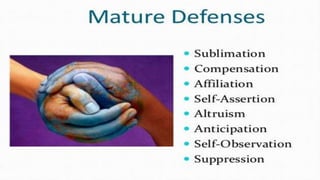
MATURE
DEFENSE
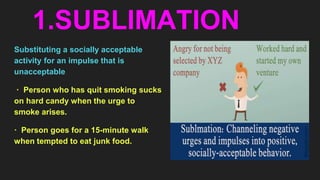
1.SUBLIMATION
Substituting a socially acceptable
activity for an impulse that is
unacceptable
· Person who has quit smoking sucks
on hard candy when the urge to
smoke arises.
· Person goes for a 15-minute walk
when tempted to eat junk food.
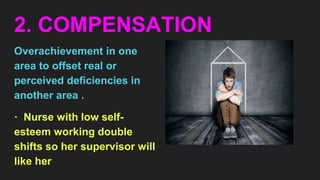
2. COMPENSATION
Overachievement in one
area to offset real or
perceived deficiencies in
another area .
· Nurse with low self-
esteem working double
shifts so her supervisor will
like her
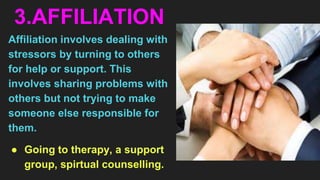
3.AFFILIATION
Affiliation involves dealing with
stressors by turning to others
for help or support. This
involves sharing problems with
others but not trying to make
someone else responsible for
them.
● Going to therapy, a support
group, spirtual counselling.
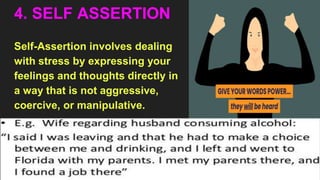
4. SELF ASSERTION
Self-Assertion involves dealing
with stress by expressing your
feelings and thoughts directly in
a way that is not aggressive,
coercive, or manipulative.
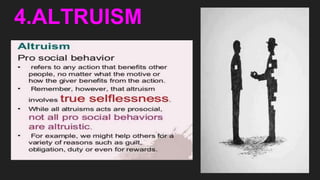
4.ALTRUISM
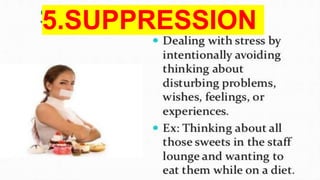
5.SUPPRESSION
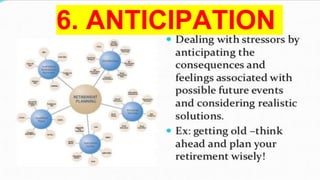
6. ANTICIPATION
Defense mechanism

Defense mechanism

  • 1.
    DEFENSE MECHANISM PRESENTED BY: NancyMaurya (Bsc.hons Nsg 3rd yr)
  • 7.
    Why do weneed Ego defenses?
  • 8.
    NEED OF DEFENSEMECHANISM We use defense mechanisms to protect ourselves from feelings of anxiety or guilt, which arise because we feel threatened, or because our id or superego becomes too demanding. Defense mechanisms operate at an unconscious level and help ward off unpleasant feelings (i.e., anxiety) or make good things feel better for the individual.
  • 9.
    Ego-defense mechanisms arenatural and normal. When they get out of proportion (i.e., used with frequency), neuroses develop, such as anxiety states, phobias, obsessions, or hysteria.
  • 10.
  • 13.
  • 14.
    1.DENIAL Failure to acknowledgean unbearable condition; failure to admit the reality of a situation or how one enables the problem to continue ·
  • 15.
    What is anexample of denial? For example, a husband may refuse to recognise obvious signs of his wife’s infidelity. A student may refuse to recognise their obvious lack of preparedness for an exam!
  • 16.
    2. REGRESSION Moving backto a previous developmental stage to feel safe or have needs met · . Five-year-old asks for a bottle when new baby brother is being fed. · Man pouts like a 4-year-old if he is not the center of his girlfriend’s attention.
  • 18.
    3. ACTING OUT Actingout is a defense mechanism used when one is unable to manage a conflicted mental content by means of thought and by putting it into words.
  • 19.
    ● Example: Self injuryis expresssion through physical pain of what can't be stand to feel emotionally.
  • 20.
  • 21.
    EXAMPLE 1.Amnesia that prevents recallof yesterday’s auto accident · 2.Adult remembers nothing of childhood sexual abuse.
  • 22.
    5. COMPARTMENTALIZATION compartmentalization is definedas a defense mechanism where someone suppresses their thoughts and emotions. It is not always done consciously but this can often justify or defend a person's level of engagement in certain behaviors.
  • 23.
    EXAMPLE a manager canthink of himself as nurturing and sensitive at home, but a hard-nosed tough guy at work
  • 24.
    6.PROJECTION Unconscious blaming ofunacceptable inclinations or thoughts on an external object · EXAMPLE: Man who has thought about same-gender sexual relationship, but never had one, beats a man who is gay. · Person with many prejudices loudly identifies others as bigots.
  • 26.
    7. REACTION FORMATION Actingthe opposite of what one thinks or feels ·
  • 27.
  • 29.
    1.REPRESSION Excluding emotionally painfulor anxiety-provoking thoughts and feelings from conscious awareness · Woman has no memory of the mugging she suffered yesterday. · Woman has no memory before age 7, when she was removed from abusive parents.
  • 30.
    2.DISPLACEMENT Ventilation of intensefeelings toward persons less threatening than the one who aroused those feelings . Example · Person who is mad at the boss yells at his or her spouse. · Child who is harassed by a bully at school mistreats a younger sibling.
  • 31.
    3. INTELLECTUALISATION Separation ofthe emotions of a painful event or situation from the facts involved; acknowledging the facts but not the emotions . Eg. · Person shows no emotional expression when discussing serious car accident.
  • 32.
    4. RATIONALIZATION Excusing ownbehavior to avoid guilt, responsibility, conflict, anxiety, or loss of self-respect · Student blames failure on teacher being mean. · Man says he beats his wife because she doesn’t listen to him.
  • 33.
    5. UNDOING Exhibiting acceptablebehavior to make up for or negate unacceptable behavior · Person who cheats on a spouse brings the spouse a bouquet of roses. · Man who is ruthless in business donates large amounts of money to charity.
  • 34.
  • 36.
    1.SUBLIMATION Substituting a sociallyacceptable activity for an impulse that is unacceptable · Person who has quit smoking sucks on hard candy when the urge to smoke arises. · Person goes for a 15-minute walk when tempted to eat junk food.
  • 38.
    2. COMPENSATION Overachievement inone area to offset real or perceived deficiencies in another area . · Nurse with low self- esteem working double shifts so her supervisor will like her
  • 39.
    3.AFFILIATION Affiliation involves dealingwith stressors by turning to others for help or support. This involves sharing problems with others but not trying to make someone else responsible for them. ● Going to therapy, a support group, spirtual counselling.
  • 40.
    4. SELF ASSERTION Self-Assertioninvolves dealing with stress by expressing your feelings and thoughts directly in a way that is not aggressive, coercive, or manipulative.
  • 41.
  • 42.
  • 43.