https://www.yenepoya.edu.in
YENEPOYA NURSING COLLEGE
Oct 16, 2024 Mr. MOHAMMED SAHAD 1
Oct 16, 2024 Mr. MOHAMMED SAHAD 2
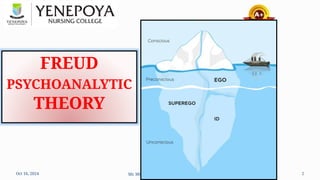
FREUD
PSYCHOANALYTIC
THEORY
Oct 16, 2024 MR. MOHAMMED SAHAD 3
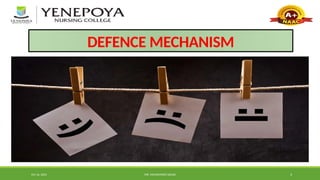
DEFENCE MECHANISM
10/16/2024 4
LEARNING OBJECTIVES
After the class you’ll be able to
• Define Defence Mechanism.
• Mean Defence Mechanism.
• Enlist functions of Defence mechanism.
• Understand and Explain classification of Defence mechanism.
MR. MOHAMMED SAHAD
Oct 16, 2024 MR. MOHAMMED SAHAD 5
INTRODUCTION
Defence mechanism are those adaptive responses
identified by Freud and that are employed by the ego in
the face of threat to biological or psychological integrity.
Oct 16, 2024 MR. MOHAMMED SAHAD 6
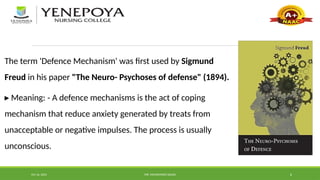
The term 'Defence Mechanism' was first used by Sigmund
Freud in his paper "The Neuro- Psychoses of defense" (1894).
▸ Meaning: - A defence mechanisms is the act of coping
mechanism that reduce anxiety generated by treats from
unacceptable or negative impulses. The process is usually
unconscious.
Oct 16, 2024 MR. MOHAMMED SAHAD 7
DEFINITION
In Freudian Psychoanalytical theory, Defence Mechanism are psychological strategies
brought into play by the unconscious mind to manipulate, deny or distort reality in
order to defend against feelings of anxiety & unacceptable impulses to maintain one's
self schema.
Defence Mechanism, in Psychoanalytical theory, any of a group mental processes that
enables the mid to reach compromise solutions to conflicts that is unable to resolve.
Oct 16, 2024 MR. MOHAMMED SAHAD 8
MEANING
Defence mechanisms are methods of attempting to protect self and cope
with basic drives or emotionally painful thoughts, feelings or events.
The purpose of defense mechanisms is to reduce or eliminate anxiety. They
can be helpful when used in very small doses, and if over used, become
ineffective and can lead to a breakdown of the personality. Most defense
mechanisms operate at the unconscious level of awareness.
Oct 16, 2024 MR. MOHAMMED SAHAD 9
FUNCTIONS OF DEFENCE MECHANISM
Facilitate the resolution of emotional conflict.
Provide relief from stress.
Cushion emotional pain.
Alleviate anxiety.
Protect and maintain the persons’ self esteem and ego identity.
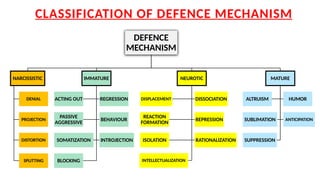
CLASSIFICATION OF DEFENCE MECHANISM
DEFENCE
MECHANISM
NARCISSISTIC
DENIAL
PROJECTION
DISTORTION
SPLITTING
IMMATURE
ACTING OUT REGRESSION
PASSIVE
AGGRESSIVE
BEHAVIOUR
SOMATIZATION INTROJECTION
BLOCKING
NEUROTIC
DISPLACEMENT DISSOCIATION
REACTION
FORMATION
REPRESSION
ISOLATION RATIONALIZATION
INTELLECTUALIZATION
MATURE
ALTRUISM HUMOR
SUBLIMATION ANTICIPATION
SUPPRESSION
Oct 16, 2024 MR. MOHAMMED SAHAD 11
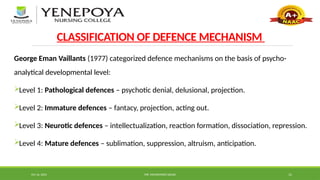
CLASSIFICATION OF DEFENCE MECHANISM
George Eman Vaillants (1977) categorized defence mechanisms on the basis of psycho-
analytical developmental level:
Level 1: Pathological defences – psychotic denial, delusional, projection.
Level 2: Immature defences – fantacy, projection, acting out.
Level 3: Neurotic defences – intellectualization, reaction formation, dissociation, repression.
Level 4: Mature defences – sublimation, suppression, altruism, anticipation.
Oct 16, 2024 MR. MOHAMMED SAHAD 12
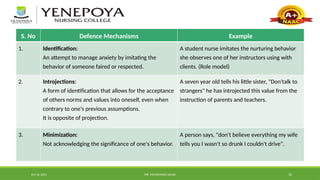
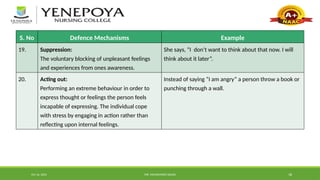
S. No Defence Mechanisms Example
1. Identification:
An attempt to manage anxiety by imitating the
behavior of someone faired or respected.
A student nurse imitates the nurturing behavior
she observes one of her instructors using with
clients. (Role model)
2. Introjections:
A form of identification that allows for the acceptance
of others norms and values into oneself, even when
contrary to one's previous assumptions.
It is opposite of projection.
A seven year old tells his little sister, "Don'talk to
strangers" he has introjected this value from the
instruction of parents and teachers.
3. Minimization:
Not acknowledging the significance of one's behavior.
A person says, "don't believe everything my wife
tells you I wasn't so drunk I couldn't drive".
Oct 16, 2024 MR. MOHAMMED SAHAD 13
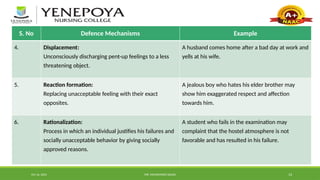
S. No Defence Mechanisms Example
4. Displacement:
Unconsciously discharging pent-up feelings to a less
threatening object.
A husband comes home after a bad day at work and
yells at his wife.
5. Reaction formation:
Replacing unacceptable feeling with their exact
opposites.
A jealous boy who hates his elder brother may
show him exaggerated respect and affection
towards him.
6. Rationalization:
Process in which an individual justifies his failures and
socially unacceptable behavior by giving socially
approved reasons.
A student who fails in the examination may
complaint that the hostel atmosphere is not
favorable and has resulted in his failure.
Oct 16, 2024 MR. MOHAMMED SAHAD 14
S. No Defence Mechanisms Example
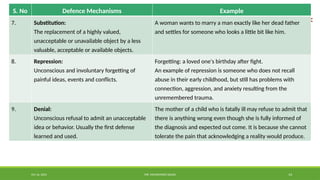
7. Substitution:
The replacement of a highly valued,
unacceptable or unavailable object by a less
valuable, acceptable or available objects.
A woman wants to marry a man exactly like her dead father
and settles for someone who looks a little bit like him.
8. Repression:
Unconscious and involuntary forgetting of
painful ideas, events and conflicts.
Forgetting: a loved one's birthday after fight.
An example of repression is someone who does not recall
abuse in their early childhood, but still has problems with
connection, aggression, and anxiety resulting from the
unremembered trauma.
9. Denial:
Unconscious refusal to admit an unacceptable
idea or behavior. Usually the first defense
learned and used.
The mother of a child who is fatally ill may refuse to admit that
there is anything wrong even though she is fully informed of
the diagnosis and expected out come. It is because she cannot
tolerate the pain that acknowledging a reality would produce.
Oct 16, 2024 MR. MOHAMMED SAHAD 15
S. No Defence Mechanisms Example
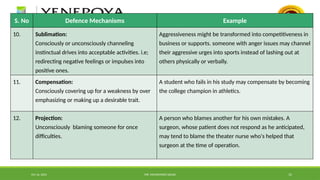
10. Sublimation:
Consciously or unconsciously channeling
instinctual drives into acceptable activities. i.e;
redirecting negative feelings or impulses into
positive ones.
Aggressiveness might be transformed into competitiveness in
business or supports. someone with anger issues may channel
their aggressive urges into sports instead of lashing out at
others physically or verbally.
11. Compensation:
Consciously covering up for a weakness by over
emphasizing or making up a desirable trait.
A student who fails in his study may compensate by becoming
the college champion in athletics.
12. Projection:
Unconsciously blaming someone for once
difficulties.
A person who blames another for his own mistakes. A
surgeon, whose patient does not respond as he anticipated,
may tend to blame the theater nurse who's helped that
surgeon at the time of operation.
Oct 16, 2024 MR. MOHAMMED SAHAD 16
S. No Defence Mechanisms Example
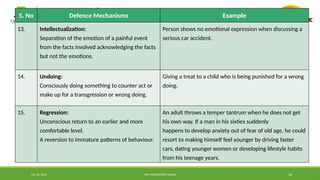
13. Intellectualization:
Separation of the emotion of a painful event
from the facts involved acknowledging the facts
but not the emotions.
Person shows no emotional expression when discussing a
serious car accident.
14. Undoing:
Consciously doing something to counter act or
make up for a transgression or wrong doing.
Giving a treat to a child who is being punished for a wrong
doing.
15. Regression:
Unconscious return to an earlier and more
comfortable level.
A reversion to immature patterns of behaviour.
An adult throws a temper tantrum when he does not get
his own way. If a man in his sixties suddenly
happens to develop anxiety out of fear of old age, he could
resort to making himself feel younger by driving faster
cars, dating younger women or developing lifestyle habits
from his teenage years.
Oct 16, 2024 MR. MOHAMMED SAHAD 17
S. No Defence Mechanisms Example
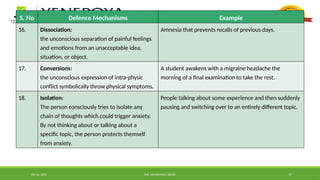
16. Dissociation:
the unconscious separation of painful feelings
and emotions from an unacceptable idea,
situation, or object.
Amnesia that prevents recalls of previous days.
17. Conversions:
the unconscious expression of intra-physic
conflict symbolically throw physical symptoms.
A student awakens with a migraine headache the
morning of a final examination to take the rest.
18. Isolation:
The person consciously tries to isolate any
chain of thoughts which could trigger anxiety.
By not thinking about or talking about a
specific topic, the person protects themself
from anxiety.
People talking about some experience and then suddenly
pausing and switching over to an entirely different topic.
Oct 16, 2024 MR. MOHAMMED SAHAD 18
S. No Defence Mechanisms Example
19. Suppression:
The voluntary blocking of unpleasant feelings
and experiences from ones awareness.
She says, ”I don’t want to think about that now. I will
think about it later”.
20. Acting out:
Performing an extreme behaviour in order to
express thought or feelings the person feels
incapable of expressing. The individual cope
with stress by engaging in action rather than
reflecting upon internal feelings.
Instead of saying “I am angry” a person throw a book or
punching through a wall.
Oct 16, 2024 MR. MOHAMMED SAHAD 19
ARTICLE
https://pubmed.ncbi.nlm.nih.gov/26583439/
Oct 16, 2024 MR. MOHAMMED SAHAD 20
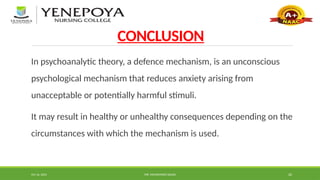
CONCLUSION
In psychoanalytic theory, a defence mechanism, is an unconscious
psychological mechanism that reduces anxiety arising from
unacceptable or potentially harmful stimuli.
It may result in healthy or unhealthy consequences depending on the
circumstances with which the mechanism is used.
Oct 16, 2024 MR. MOHAMMED SAHAD 21
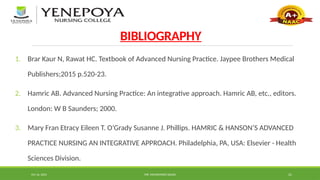
BIBLIOGRAPHY
1. Brar Kaur N, Rawat HC. Textbook of Advanced Nursing Practice. Jaypee Brothers Medical
Publishers;2015 p.520-23.
2. Hamric AB. Advanced Nursing Practice: An integrative approach. Hamric AB, etc., editors.
London: W B Saunders; 2000.
3. Mary Fran Etracy Eileen T. O’Grady Susanne J. Phillips. HAMRIC & HANSON’S ADVANCED
PRACTICE NURSING AN INTEGRATIVE APPROACH. Philadelphia, PA, USA: Elsevier - Health
Sciences Division.
Oct 16, 2024 MR. MOHAMMED SAHAD 22
BIBLIOGRAPHY
4. Basheer.P.Shebeer. Textbook of Advanced Nursing Practice. Jaypee
Publications.2015:1st ed.p405-10.
5. G.G. Redemma. Advance Concepts of Nursing Practice: changing roles and
clinical application.3rd ed. Philadelphia, PA: Lippincott Williams and Wilkins;
2003.p1019-20.
6. https://pubmed.ncbi.nlm.nih.gov/26583439/
Oct 16, 2024 MR. MOHAMMED SAHAD 23

DEFENCE MECHANISM - BASICS & CLASSIFICATION .pptx

  • 1.
  • 2.
    Oct 16, 2024Mr. MOHAMMED SAHAD 2 FREUD PSYCHOANALYTIC THEORY
  • 3.
    Oct 16, 2024MR. MOHAMMED SAHAD 3 DEFENCE MECHANISM
  • 4.
    10/16/2024 4 LEARNING OBJECTIVES Afterthe class you’ll be able to • Define Defence Mechanism. • Mean Defence Mechanism. • Enlist functions of Defence mechanism. • Understand and Explain classification of Defence mechanism. MR. MOHAMMED SAHAD
  • 5.
    Oct 16, 2024MR. MOHAMMED SAHAD 5 INTRODUCTION Defence mechanism are those adaptive responses identified by Freud and that are employed by the ego in the face of threat to biological or psychological integrity.
  • 6.
    Oct 16, 2024MR. MOHAMMED SAHAD 6 The term 'Defence Mechanism' was first used by Sigmund Freud in his paper "The Neuro- Psychoses of defense" (1894). ▸ Meaning: - A defence mechanisms is the act of coping mechanism that reduce anxiety generated by treats from unacceptable or negative impulses. The process is usually unconscious.
  • 7.
    Oct 16, 2024MR. MOHAMMED SAHAD 7 DEFINITION In Freudian Psychoanalytical theory, Defence Mechanism are psychological strategies brought into play by the unconscious mind to manipulate, deny or distort reality in order to defend against feelings of anxiety & unacceptable impulses to maintain one's self schema. Defence Mechanism, in Psychoanalytical theory, any of a group mental processes that enables the mid to reach compromise solutions to conflicts that is unable to resolve.
  • 8.
    Oct 16, 2024MR. MOHAMMED SAHAD 8 MEANING Defence mechanisms are methods of attempting to protect self and cope with basic drives or emotionally painful thoughts, feelings or events. The purpose of defense mechanisms is to reduce or eliminate anxiety. They can be helpful when used in very small doses, and if over used, become ineffective and can lead to a breakdown of the personality. Most defense mechanisms operate at the unconscious level of awareness.
  • 9.
    Oct 16, 2024MR. MOHAMMED SAHAD 9 FUNCTIONS OF DEFENCE MECHANISM Facilitate the resolution of emotional conflict. Provide relief from stress. Cushion emotional pain. Alleviate anxiety. Protect and maintain the persons’ self esteem and ego identity.
  • 10.
    CLASSIFICATION OF DEFENCEMECHANISM DEFENCE MECHANISM NARCISSISTIC DENIAL PROJECTION DISTORTION SPLITTING IMMATURE ACTING OUT REGRESSION PASSIVE AGGRESSIVE BEHAVIOUR SOMATIZATION INTROJECTION BLOCKING NEUROTIC DISPLACEMENT DISSOCIATION REACTION FORMATION REPRESSION ISOLATION RATIONALIZATION INTELLECTUALIZATION MATURE ALTRUISM HUMOR SUBLIMATION ANTICIPATION SUPPRESSION
  • 11.
    Oct 16, 2024MR. MOHAMMED SAHAD 11 CLASSIFICATION OF DEFENCE MECHANISM George Eman Vaillants (1977) categorized defence mechanisms on the basis of psycho- analytical developmental level: Level 1: Pathological defences – psychotic denial, delusional, projection. Level 2: Immature defences – fantacy, projection, acting out. Level 3: Neurotic defences – intellectualization, reaction formation, dissociation, repression. Level 4: Mature defences – sublimation, suppression, altruism, anticipation.
  • 12.
    Oct 16, 2024MR. MOHAMMED SAHAD 12 S. No Defence Mechanisms Example 1. Identification: An attempt to manage anxiety by imitating the behavior of someone faired or respected. A student nurse imitates the nurturing behavior she observes one of her instructors using with clients. (Role model) 2. Introjections: A form of identification that allows for the acceptance of others norms and values into oneself, even when contrary to one's previous assumptions. It is opposite of projection. A seven year old tells his little sister, "Don'talk to strangers" he has introjected this value from the instruction of parents and teachers. 3. Minimization: Not acknowledging the significance of one's behavior. A person says, "don't believe everything my wife tells you I wasn't so drunk I couldn't drive".
  • 13.
    Oct 16, 2024MR. MOHAMMED SAHAD 13 S. No Defence Mechanisms Example 4. Displacement: Unconsciously discharging pent-up feelings to a less threatening object. A husband comes home after a bad day at work and yells at his wife. 5. Reaction formation: Replacing unacceptable feeling with their exact opposites. A jealous boy who hates his elder brother may show him exaggerated respect and affection towards him. 6. Rationalization: Process in which an individual justifies his failures and socially unacceptable behavior by giving socially approved reasons. A student who fails in the examination may complaint that the hostel atmosphere is not favorable and has resulted in his failure.
  • 14.
    Oct 16, 2024MR. MOHAMMED SAHAD 14 S. No Defence Mechanisms Example 7. Substitution: The replacement of a highly valued, unacceptable or unavailable object by a less valuable, acceptable or available objects. A woman wants to marry a man exactly like her dead father and settles for someone who looks a little bit like him. 8. Repression: Unconscious and involuntary forgetting of painful ideas, events and conflicts. Forgetting: a loved one's birthday after fight. An example of repression is someone who does not recall abuse in their early childhood, but still has problems with connection, aggression, and anxiety resulting from the unremembered trauma. 9. Denial: Unconscious refusal to admit an unacceptable idea or behavior. Usually the first defense learned and used. The mother of a child who is fatally ill may refuse to admit that there is anything wrong even though she is fully informed of the diagnosis and expected out come. It is because she cannot tolerate the pain that acknowledging a reality would produce.
  • 15.
    Oct 16, 2024MR. MOHAMMED SAHAD 15 S. No Defence Mechanisms Example 10. Sublimation: Consciously or unconsciously channeling instinctual drives into acceptable activities. i.e; redirecting negative feelings or impulses into positive ones. Aggressiveness might be transformed into competitiveness in business or supports. someone with anger issues may channel their aggressive urges into sports instead of lashing out at others physically or verbally. 11. Compensation: Consciously covering up for a weakness by over emphasizing or making up a desirable trait. A student who fails in his study may compensate by becoming the college champion in athletics. 12. Projection: Unconsciously blaming someone for once difficulties. A person who blames another for his own mistakes. A surgeon, whose patient does not respond as he anticipated, may tend to blame the theater nurse who's helped that surgeon at the time of operation.
  • 16.
    Oct 16, 2024MR. MOHAMMED SAHAD 16 S. No Defence Mechanisms Example 13. Intellectualization: Separation of the emotion of a painful event from the facts involved acknowledging the facts but not the emotions. Person shows no emotional expression when discussing a serious car accident. 14. Undoing: Consciously doing something to counter act or make up for a transgression or wrong doing. Giving a treat to a child who is being punished for a wrong doing. 15. Regression: Unconscious return to an earlier and more comfortable level. A reversion to immature patterns of behaviour. An adult throws a temper tantrum when he does not get his own way. If a man in his sixties suddenly happens to develop anxiety out of fear of old age, he could resort to making himself feel younger by driving faster cars, dating younger women or developing lifestyle habits from his teenage years.
  • 17.
    Oct 16, 2024MR. MOHAMMED SAHAD 17 S. No Defence Mechanisms Example 16. Dissociation: the unconscious separation of painful feelings and emotions from an unacceptable idea, situation, or object. Amnesia that prevents recalls of previous days. 17. Conversions: the unconscious expression of intra-physic conflict symbolically throw physical symptoms. A student awakens with a migraine headache the morning of a final examination to take the rest. 18. Isolation: The person consciously tries to isolate any chain of thoughts which could trigger anxiety. By not thinking about or talking about a specific topic, the person protects themself from anxiety. People talking about some experience and then suddenly pausing and switching over to an entirely different topic.
  • 18.
    Oct 16, 2024MR. MOHAMMED SAHAD 18 S. No Defence Mechanisms Example 19. Suppression: The voluntary blocking of unpleasant feelings and experiences from ones awareness. She says, ”I don’t want to think about that now. I will think about it later”. 20. Acting out: Performing an extreme behaviour in order to express thought or feelings the person feels incapable of expressing. The individual cope with stress by engaging in action rather than reflecting upon internal feelings. Instead of saying “I am angry” a person throw a book or punching through a wall.
  • 19.
    Oct 16, 2024MR. MOHAMMED SAHAD 19 ARTICLE https://pubmed.ncbi.nlm.nih.gov/26583439/
  • 20.
    Oct 16, 2024MR. MOHAMMED SAHAD 20 CONCLUSION In psychoanalytic theory, a defence mechanism, is an unconscious psychological mechanism that reduces anxiety arising from unacceptable or potentially harmful stimuli. It may result in healthy or unhealthy consequences depending on the circumstances with which the mechanism is used.
  • 21.
    Oct 16, 2024MR. MOHAMMED SAHAD 21 BIBLIOGRAPHY 1. Brar Kaur N, Rawat HC. Textbook of Advanced Nursing Practice. Jaypee Brothers Medical Publishers;2015 p.520-23. 2. Hamric AB. Advanced Nursing Practice: An integrative approach. Hamric AB, etc., editors. London: W B Saunders; 2000. 3. Mary Fran Etracy Eileen T. O’Grady Susanne J. Phillips. HAMRIC & HANSON’S ADVANCED PRACTICE NURSING AN INTEGRATIVE APPROACH. Philadelphia, PA, USA: Elsevier - Health Sciences Division.
  • 22.
    Oct 16, 2024MR. MOHAMMED SAHAD 22 BIBLIOGRAPHY 4. Basheer.P.Shebeer. Textbook of Advanced Nursing Practice. Jaypee Publications.2015:1st ed.p405-10. 5. G.G. Redemma. Advance Concepts of Nursing Practice: changing roles and clinical application.3rd ed. Philadelphia, PA: Lippincott Williams and Wilkins; 2003.p1019-20. 6. https://pubmed.ncbi.nlm.nih.gov/26583439/
  • 23.
    Oct 16, 2024MR. MOHAMMED SAHAD 23

Editor's Notes

  • #2 Have you seen this picture before?
  • #12 Identification: A teenager who required lengthy rehabilitation after an accident decides to become a physical therapist as a result of his experience. Introjections: Children integrate their parents value system into the process of conscience formulation. A child says; “Don’t cheat. Its Wrong.” Minimization: Minimization is very closely related to rationalization. It is trying to reduce the apparent size of a sin or trauma. It's usually done through logical distortions. For example, “Dad wasn't alcoholic or abusive - I mean, everyone in the neighborhood got drunk and beat their kids on the weekends.
  • #13 Displacement: A client is angry with his physician, doesn’t express it but becomes verbally abusive with the nurse. Reaction formation: Mr. X hates nursing. He attended attended nursing school to please his parents. During career day he speaks to prospective students about the excellence of nursing as a career. Rationalization: Mr. Jhon tells the rehabilitative nurse, “I drink because it’s the only way I can deal with my bad marriage and my worse job.”
  • #14 Repression: An person who has repressed memories of abuse suffered as a child may later have difficulty in making relationships. Denial: Individual continues to smoke cigarettes even though he have been told about the risk involved.
  • #15 Sublimation: A mother whose son was killed by a drunk driver, she channels her anger and energy into being the president of the local chapter of mothers against drunk drivers. Compensation: Sarah, who feels unassertive in her personal relationships, compensates for this by taking on a leadership role in her workplace. She dedicates herself to managing projects and leading teams, finding success and fulfillment in her professional life, which serves as a compensation for the perceived lack of assertiveness in her personal relationships. Projection: Sam, who is consistently late for meetings, accuses his colleagues of having poor time management skills. In reality, Sam is projecting his own struggle with punctuality onto others, attributing the issue to his colleagues instead of acknowledging his own challenges with time management.
  • #16 Intellectualization: Mrs. X husband is being transferred to a city far away from her parents, she hides anxiety by explaining to her parents the advantages associated with the move. Undoing: Joe is nervous about his new job and yells at his wife. On his way home he stops and buys her some flowers. Regression: When 2 year old Jay is hospitalized for tonsilitis he’ll drink only from a bottle, even though his mom states he has been drinking from a cup for months.
  • #17 Dissociation: A person who is dissociate can disconnect from the real world for a time(multiple personality disorder) Conversions: Sara, feeling overwhelmed by the pressure to meet academic expectations, develops a sudden inability to speak before an important presentation. The speech impediment serves as a conversion of Sara's emotional distress and anxiety about performance into a physical symptom, disrupting her ability to verbally communicate. Isolation: A young women describes being attacked and raped, without showing any emotions.
  • #18 Suppression: David is dealing with a recent breakup and is finding it difficult to concentrate on his work. Rather than allowing his emotions to overwhelm him, David consciously decides to set aside thoughts about the breakup while at work, focusing on his tasks instead. In this case, David is using suppression to temporarily set aside or delay the processing of his emotional distress until he is better able to cope with it.
  • #23 I hope you all will feel relief from stress, Cushion emotional pain, could Alleviate your anxiety accordingly. THANK YOU