Introduction behavioural
sciences
Lijodi Brenda
Behavioral science
 Behavioral science is a branch of social science
that derives its concepts from observation of the
behavior of living organisms.
 Broadly defined, behavioral science is the study
of human habits, actions, and intentions.
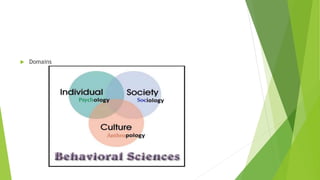
Behavioral science has three
domains:
1.Psychology
2.Sociology
3.Anthropology
 Domains
Behavior
Behavior is a response of an individual or group to an
action, environment, person, or stimulus.
1. Behavior is everything a person does.
2. Behaviors is
● that can be observed
• that can be heard/seen
• that can be measured
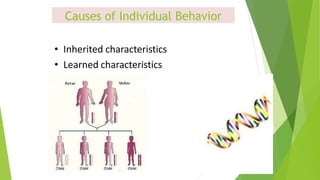
Causes of Individual Behavior
• Inherited characteristics
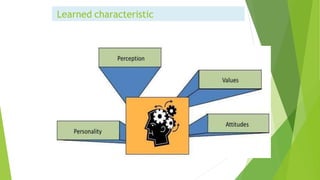
• Learned characteristics
Summaryof Nature &Nurture Perspectives
ofHumanDevelopment
7
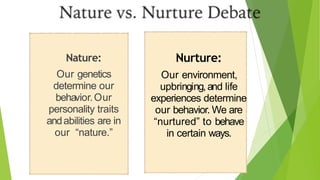
Nature:
Our genetics
determine our
behavior.Our
personality traits
andabilities are in
our “nature.”
Nurture:
Our environment,
upbringing,and life
experiences determine
our behavior. We are
“nurtured” to behave
in certain ways.
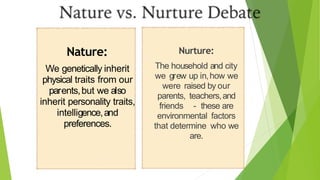
Nature:
We genetically inherit
physical traits from our
parents,but we also
inherit personality traits,
intelligence,and
preferences.
Nurture:
The household and city
we grew up in,how we
were raised by our
parents, teachers,and
friends - these are
environmental factors
that determine who we
are.
Learned characteristic
Attitude
Attitude is a settled way of thinking or feeling
about someone or something, typically one
that is reflected in a person's behavior.
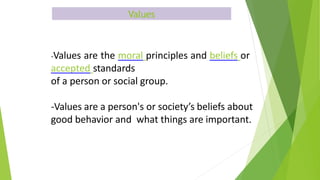
Values
-Values are the moral principles and beliefs or
accepted standards
of a person or social group.
-Values are a person's or society’s beliefs about
good behavior and what things are important.
Topic 1 Introduction behavioural sciences-1.pptx

Topic 1 Introduction behavioural sciences-1.pptx