DEFENSE MECHANISMS
MR. SATISH N. CHOURE
NURSING TUTOR, VMP CON,
AKLUJ.
Introduction :-
The term ‘ Defense Mechanism’ was first
used by sigmund freud in his paper “The
Neuro-Psychoses of defence” (1894).
Anna (1937) developed the ideas given by
Freud and elaborated them, adding 5 other
own .
Definition:
“Defense mechanisms
are a tactics developed by
ego to protect against
anxiety”.
- sigmund freud 1894
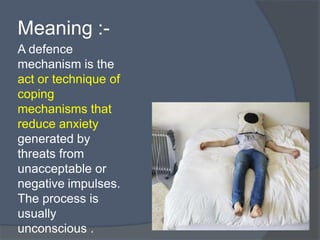
A defence
mechanism is the
act or technique of
coping
mechanisms that
reduce anxiety
generated by
threats from
unacceptable or
negative impulses.
The process is
usually
unconscious .
Meaning :-
DEFENSE
MECHANISMS
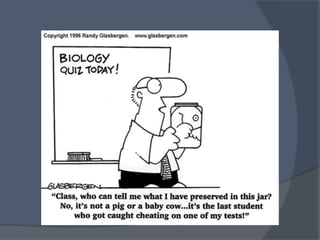
Is the substitution of a safe &
reasonable explanation for the true
cause of behavior.
It occurs when we tell an element of truth
but deny the larger truth of the matter.
Example:- a student who cheats on a test
may say : “I only cheated on a few
question , i know most of
the answers”.
1)Rationalization
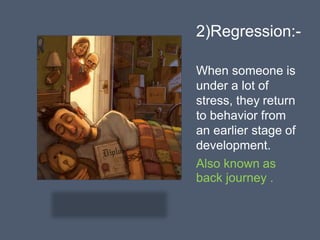
2)Regression:-
When someone is
under a lot of
stress, they return
to behavior from
an earlier stage of
development.
Also known as
back journey .
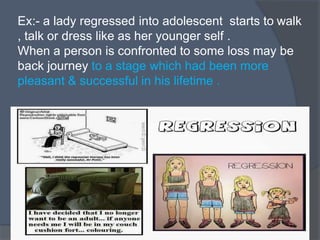
Ex:- a lady regressed into adolescent starts to walk
, talk or dress like as her younger self .
When a person is confronted to some loss may be
back journey to a stage which had been more
pleasant & successful in his lifetime .
3)Sublimation :-
Satisfying an impulse ( Ex- aggression)
with a substitute object in a socially
acceptable way .
This is similar to displacement but occurs
when we manage to displace our
emotions into a constructive rather than
destructive manner.
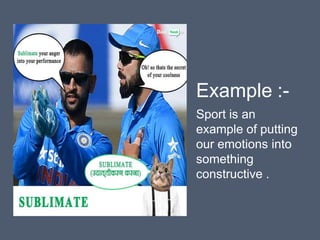
Example :-
Sport is an
example of putting
our emotions into
something
constructive .
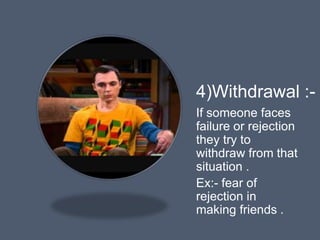
4)Withdrawal :-
If someone faces
failure or rejection
they try to
withdraw from that
situation .
Ex:- fear of
rejection in
making friends .
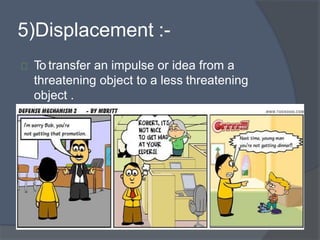
5)Displacement :-
To transfer an impulse or idea from a
threatening object to a less threatening
object .
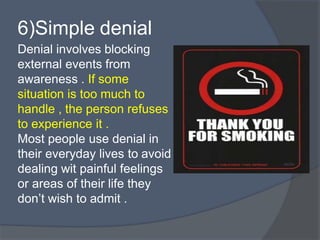
Denial involves blocking
external events from
awareness . If some
situation is too much to
handle , the person refuses
to experience it .
Most people use denial in
their everyday lives to avoid
dealing wit painful feelings
or areas of their life they
don’t wish to admit .
6)Simple denial
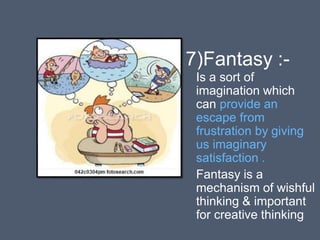
7)Fantasy :-
Is a sort of
imagination which
can provide an
escape from
frustration by giving
us imaginary
satisfaction .
Fantasy is a
mechanism of wishful
thinking & important
for creative thinking
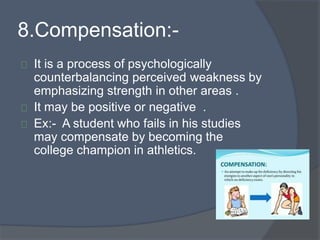
8.Compensation:-
It is a process of psychologically
counterbalancing perceived weakness by
emphasizing strength in other areas .
It may be positive or negative .
Ex:- A student who fails in his studies
may compensate by becoming the
college champion in athletics.
9) Repression :-
This was the first defence
mechanism that Freud discovered
& the most important one.
Unconsciously and involuntary
forgetting of painful ideas, events
and conflicts.
It can be defined as Motivated
Forgetting.
Example:-forgetting
physical/sexual abuse from
childhood due to trauma and
anxiety.
Repression is caused due to
forces active within
ourselves . We try to forget
what makes us feel inferior ,
ashamed , guilty & anxious.
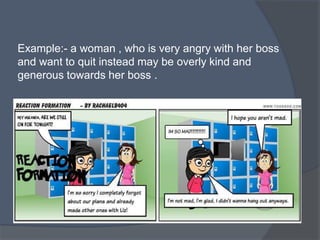
10) Reaction formation :-
Expressing emotions that are the exactly
opposite of what you feel.
Conceal anger/hate with kindness.
Teasing/bothering someone you like.
This is a point where a person goes beyond
denial & behaves in the opposite way to which
he or she thinks or feel .
It is also called Reversal Formation .
Example:- a woman , who is very angry with her boss
and want to quit instead may be overly kind and
generous towards her boss .
11) Projection:-
Is the misattribution of a person’s
undesired thoughts, feelings or impulses
onto another person who doesn’t have
feelings or thoughts .
Projection occurs when an individual
threatened by his own angry feelings
accuses another of harbouring hostile
thoughts .
People deal with unacceptable impulses by
acting as if other people have them .
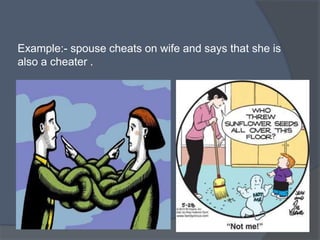
Example:- spouse cheats on wife and says that she is
also a cheater .
INTELLECTUALIZATION
Separation of the emotions of a
painful event or situation from the
facts involved.
Example- person shows no
emotional expression when
discussing serious car accident.
Relevance of defence mechanisms to
nursing practice
The nurse must recognize and understand
maladaptive defense mechanisms that patients
use. The nurse has to carefully point out these
mechanisms and work with patient to
discourage such behaviors and encourage
adaptive ones.
Conclusion:-
Defence mechanism helps to reduce the
anxiety & help an individual to adjust
better. But too much of everything is bad .
Same is true with defence mechanism .
Children should be guarded against too
much use of defence mechanism .
Because once they start using them it will
became a habit with them & later on they
will be using it unconsciously .
REFERENCES
1. R Sreevani, A Guide to Mental Health and
psychiatric Nursing, Jaypee publications, 3rd edition,
pg.no.-39-40.
2. D Ellakuvana Bhaskararaja,Text Book Of Mental
health Nursing,Emmess medical Publication pg.no. –
115-117.
3. Neeraj Ahuja, text book of mental health Nursing,
jaypee publications, pg.no. – 120.
4. McLeod, S. A. (2009). Defense Mechanisms.
Retrieved from
http://www.simplypsychology.org/defense-
mechanisms.html .
5. Defense mechanism: Encyclopaedia Briticana .
Thank you

Defence mechanisms

  • 3.
    DEFENSE MECHANISMS MR. SATISHN. CHOURE NURSING TUTOR, VMP CON, AKLUJ.
  • 4.
    Introduction :- The term‘ Defense Mechanism’ was first used by sigmund freud in his paper “The Neuro-Psychoses of defence” (1894). Anna (1937) developed the ideas given by Freud and elaborated them, adding 5 other own .
  • 5.
    Definition: “Defense mechanisms are atactics developed by ego to protect against anxiety”. - sigmund freud 1894
  • 6.
    A defence mechanism isthe act or technique of coping mechanisms that reduce anxiety generated by threats from unacceptable or negative impulses. The process is usually unconscious . Meaning :-
  • 7.
  • 8.
    Is the substitutionof a safe & reasonable explanation for the true cause of behavior. It occurs when we tell an element of truth but deny the larger truth of the matter. Example:- a student who cheats on a test may say : “I only cheated on a few question , i know most of the answers”. 1)Rationalization
  • 10.
    2)Regression:- When someone is undera lot of stress, they return to behavior from an earlier stage of development. Also known as back journey .
  • 11.
    Ex:- a ladyregressed into adolescent starts to walk , talk or dress like as her younger self . When a person is confronted to some loss may be back journey to a stage which had been more pleasant & successful in his lifetime .
  • 12.
    3)Sublimation :- Satisfying animpulse ( Ex- aggression) with a substitute object in a socially acceptable way . This is similar to displacement but occurs when we manage to displace our emotions into a constructive rather than destructive manner.
  • 13.
    Example :- Sport isan example of putting our emotions into something constructive .
  • 14.
    4)Withdrawal :- If someonefaces failure or rejection they try to withdraw from that situation . Ex:- fear of rejection in making friends .
  • 15.
    5)Displacement :- To transferan impulse or idea from a threatening object to a less threatening object .
  • 16.
    Denial involves blocking externalevents from awareness . If some situation is too much to handle , the person refuses to experience it . Most people use denial in their everyday lives to avoid dealing wit painful feelings or areas of their life they don’t wish to admit . 6)Simple denial
  • 17.
    7)Fantasy :- Is asort of imagination which can provide an escape from frustration by giving us imaginary satisfaction . Fantasy is a mechanism of wishful thinking & important for creative thinking
  • 18.
    8.Compensation:- It is aprocess of psychologically counterbalancing perceived weakness by emphasizing strength in other areas . It may be positive or negative . Ex:- A student who fails in his studies may compensate by becoming the college champion in athletics.
  • 19.
    9) Repression :- Thiswas the first defence mechanism that Freud discovered & the most important one. Unconsciously and involuntary forgetting of painful ideas, events and conflicts. It can be defined as Motivated Forgetting.
  • 20.
    Example:-forgetting physical/sexual abuse from childhooddue to trauma and anxiety. Repression is caused due to forces active within ourselves . We try to forget what makes us feel inferior , ashamed , guilty & anxious.
  • 21.
    10) Reaction formation:- Expressing emotions that are the exactly opposite of what you feel. Conceal anger/hate with kindness. Teasing/bothering someone you like. This is a point where a person goes beyond denial & behaves in the opposite way to which he or she thinks or feel . It is also called Reversal Formation .
  • 22.
    Example:- a woman, who is very angry with her boss and want to quit instead may be overly kind and generous towards her boss .
  • 23.
    11) Projection:- Is themisattribution of a person’s undesired thoughts, feelings or impulses onto another person who doesn’t have feelings or thoughts . Projection occurs when an individual threatened by his own angry feelings accuses another of harbouring hostile thoughts . People deal with unacceptable impulses by acting as if other people have them .
  • 24.
    Example:- spouse cheatson wife and says that she is also a cheater .
  • 25.
    INTELLECTUALIZATION Separation of theemotions of a painful event or situation from the facts involved. Example- person shows no emotional expression when discussing serious car accident.
  • 26.
    Relevance of defencemechanisms to nursing practice The nurse must recognize and understand maladaptive defense mechanisms that patients use. The nurse has to carefully point out these mechanisms and work with patient to discourage such behaviors and encourage adaptive ones.
  • 27.
    Conclusion:- Defence mechanism helpsto reduce the anxiety & help an individual to adjust better. But too much of everything is bad . Same is true with defence mechanism . Children should be guarded against too much use of defence mechanism . Because once they start using them it will became a habit with them & later on they will be using it unconsciously .
  • 30.
    REFERENCES 1. R Sreevani,A Guide to Mental Health and psychiatric Nursing, Jaypee publications, 3rd edition, pg.no.-39-40. 2. D Ellakuvana Bhaskararaja,Text Book Of Mental health Nursing,Emmess medical Publication pg.no. – 115-117. 3. Neeraj Ahuja, text book of mental health Nursing, jaypee publications, pg.no. – 120. 4. McLeod, S. A. (2009). Defense Mechanisms. Retrieved from http://www.simplypsychology.org/defense- mechanisms.html . 5. Defense mechanism: Encyclopaedia Briticana .
  • 31.