BY: SONALI KATOCH
 The term ‘Defence Mechanism’ was first used
by Sigmund Freud in his paper “The Neuro-
Psychoses of defense” (1894).
 Meaning: - A defence mechanisms is the act
of coping mechanism that reduce anxiety
generated by treats from unacceptable or
negative impulses. The process is usually
unconscious.
 Defence mechanisms are methods of
attempting to protect self and cope with basic
drives or emotionally painful thoughts,
feelings or events. The purpose of defense
mechanisms is to reduce or eliminate anxiety.
They can be helpful when used in very small
doses, and if over used, become ineffective
and can lead to a breakdown of the
personality. Most defense mechanisms
operate at the unconscious level of
awareness.
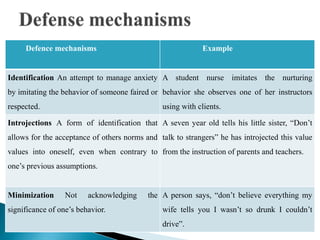
Defence mechanisms Example
Identification An attempt to manage anxiety
by imitating the behavior of someone faired or
respected.
A student nurse imitates the nurturing
behavior she observes one of her instructors
using with clients.
Introjections A form of identification that
allows for the acceptance of others norms and
values into oneself, even when contrary to
one’s previous assumptions.
A seven year old tells his little sister, “Don’t
talk to strangers” he has introjected this value
from the instruction of parents and teachers.
Minimization Not acknowledging the
significance of one’s behavior.
A person says, “don’t believe everything my
wife tells you I wasn’t so drunk I couldn’t
drive”.
Defence mechanisms Example
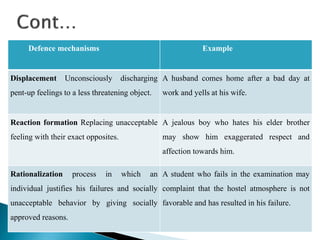
Displacement Unconsciously discharging
pent-up feelings to a less threatening object.
A husband comes home after a bad day at
work and yells at his wife.
Reaction formation Replacing unacceptable
feeling with their exact opposites.
A jealous boy who hates his elder brother
may show him exaggerated respect and
affection towards him.
Rationalization process in which an
individual justifies his failures and socially
unacceptable behavior by giving socially
approved reasons.
A student who fails in the examination may
complaint that the hostel atmosphere is not
favorable and has resulted in his failure.
Defence mechanisms Example
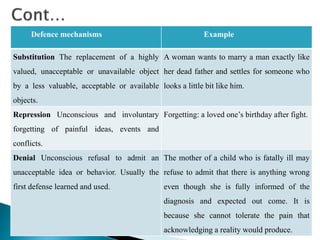
Substitution The replacement of a highly
valued, unacceptable or unavailable object
by a less valuable, acceptable or available
objects.
A woman wants to marry a man exactly like
her dead father and settles for someone who
looks a little bit like him.
Repression Unconscious and involuntary
forgetting of painful ideas, events and
conflicts.
Forgetting: a loved one’s birthday after fight.
Denial Unconscious refusal to admit an
unacceptable idea or behavior. Usually the
first defense learned and used.
The mother of a child who is fatally ill may
refuse to admit that there is anything wrong
even though she is fully informed of the
diagnosis and expected out come. It is
because she cannot tolerate the pain that
acknowledging a reality would produce.
Defence mechanisms Example
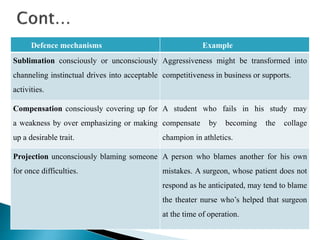
Sublimation consciously or unconsciously
channeling instinctual drives into acceptable
activities.
Aggressiveness might be transformed into
competitiveness in business or supports.
Compensation consciously covering up for
a weakness by over emphasizing or making
up a desirable trait.
A student who fails in his study may
compensate by becoming the collage
champion in athletics.
Projection unconsciously blaming someone
for once difficulties.
A person who blames another for his own
mistakes. A surgeon, whose patient does not
respond as he anticipated, may tend to blame
the theater nurse who’s helped that surgeon
at the time of operation.
Defence mechanisms Example
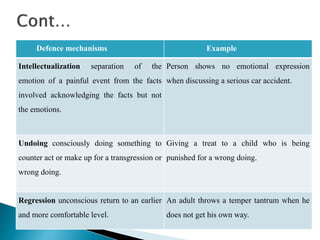
Intellectualization separation of the
emotion of a painful event from the facts
involved acknowledging the facts but not
the emotions.
Person shows no emotional expression
when discussing a serious car accident.
Undoing consciously doing something to
counter act or make up for a transgression or
wrong doing.
Giving a treat to a child who is being
punished for a wrong doing.
Regression unconscious return to an earlier
and more comfortable level.
An adult throws a temper tantrum when he
does not get his own way.
Defence mechanisms Example
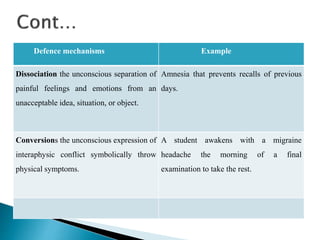
Dissociation the unconscious separation of
painful feelings and emotions from an
unacceptable idea, situation, or object.
Amnesia that prevents recalls of previous
days.
Conversions the unconscious expression of
interaphysic conflict symbolically throw
physical symptoms.
A student awakens with a migraine
headache the morning of a final
examination to take the rest.
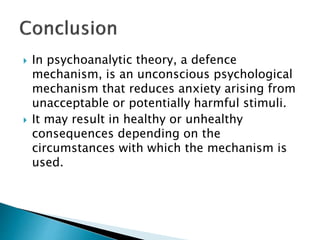
 In psychoanalytic theory, a defence
mechanism, is an unconscious psychological
mechanism that reduces anxiety arising from
unacceptable or potentially harmful stimuli.
 It may result in healthy or unhealthy
consequences depending on the
circumstances with which the mechanism is
used.
Defence mechanism

Defence mechanism

  • 1.
  • 2.
     The term‘Defence Mechanism’ was first used by Sigmund Freud in his paper “The Neuro- Psychoses of defense” (1894).  Meaning: - A defence mechanisms is the act of coping mechanism that reduce anxiety generated by treats from unacceptable or negative impulses. The process is usually unconscious.
  • 3.
     Defence mechanismsare methods of attempting to protect self and cope with basic drives or emotionally painful thoughts, feelings or events. The purpose of defense mechanisms is to reduce or eliminate anxiety. They can be helpful when used in very small doses, and if over used, become ineffective and can lead to a breakdown of the personality. Most defense mechanisms operate at the unconscious level of awareness.
  • 4.
    Defence mechanisms Example IdentificationAn attempt to manage anxiety by imitating the behavior of someone faired or respected. A student nurse imitates the nurturing behavior she observes one of her instructors using with clients. Introjections A form of identification that allows for the acceptance of others norms and values into oneself, even when contrary to one’s previous assumptions. A seven year old tells his little sister, “Don’t talk to strangers” he has introjected this value from the instruction of parents and teachers. Minimization Not acknowledging the significance of one’s behavior. A person says, “don’t believe everything my wife tells you I wasn’t so drunk I couldn’t drive”.
  • 5.
    Defence mechanisms Example DisplacementUnconsciously discharging pent-up feelings to a less threatening object. A husband comes home after a bad day at work and yells at his wife. Reaction formation Replacing unacceptable feeling with their exact opposites. A jealous boy who hates his elder brother may show him exaggerated respect and affection towards him. Rationalization process in which an individual justifies his failures and socially unacceptable behavior by giving socially approved reasons. A student who fails in the examination may complaint that the hostel atmosphere is not favorable and has resulted in his failure.
  • 6.
    Defence mechanisms Example SubstitutionThe replacement of a highly valued, unacceptable or unavailable object by a less valuable, acceptable or available objects. A woman wants to marry a man exactly like her dead father and settles for someone who looks a little bit like him. Repression Unconscious and involuntary forgetting of painful ideas, events and conflicts. Forgetting: a loved one’s birthday after fight. Denial Unconscious refusal to admit an unacceptable idea or behavior. Usually the first defense learned and used. The mother of a child who is fatally ill may refuse to admit that there is anything wrong even though she is fully informed of the diagnosis and expected out come. It is because she cannot tolerate the pain that acknowledging a reality would produce.
  • 7.
    Defence mechanisms Example Sublimationconsciously or unconsciously channeling instinctual drives into acceptable activities. Aggressiveness might be transformed into competitiveness in business or supports. Compensation consciously covering up for a weakness by over emphasizing or making up a desirable trait. A student who fails in his study may compensate by becoming the collage champion in athletics. Projection unconsciously blaming someone for once difficulties. A person who blames another for his own mistakes. A surgeon, whose patient does not respond as he anticipated, may tend to blame the theater nurse who’s helped that surgeon at the time of operation.
  • 8.
    Defence mechanisms Example Intellectualizationseparation of the emotion of a painful event from the facts involved acknowledging the facts but not the emotions. Person shows no emotional expression when discussing a serious car accident. Undoing consciously doing something to counter act or make up for a transgression or wrong doing. Giving a treat to a child who is being punished for a wrong doing. Regression unconscious return to an earlier and more comfortable level. An adult throws a temper tantrum when he does not get his own way.
  • 9.
    Defence mechanisms Example Dissociationthe unconscious separation of painful feelings and emotions from an unacceptable idea, situation, or object. Amnesia that prevents recalls of previous days. Conversions the unconscious expression of interaphysic conflict symbolically throw physical symptoms. A student awakens with a migraine headache the morning of a final examination to take the rest.
  • 10.
     In psychoanalytictheory, a defence mechanism, is an unconscious psychological mechanism that reduces anxiety arising from unacceptable or potentially harmful stimuli.  It may result in healthy or unhealthy consequences depending on the circumstances with which the mechanism is used.