 DEFINITION
 EVIDENCE
 PILLARS
 CONDITION OF MURABAHAH
 CONDITION OF PROFITS
 APPLICATION OF MURABAHAH
2
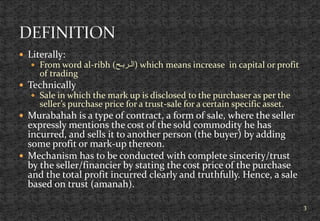
 Literally:
 From word al-ribh (‫)الـربـح‬ which means increase in capital or profit
of trading
 Technically
 Sale in which the mark up is disclosed to the purchaser as per the
seller’s purchase price for a trust-sale for a certain specific asset.
 Murabahah is a type of contract, a form of sale, where the seller
expressly mentions the cost of the sold commodity he has
incurred, and sells it to another person (the buyer) by adding
some profit or mark-up thereon.
 Mechanism has to be conducted with complete sincerity/trust
by the seller/financier by stating the cost price of the purchase
and the total profit incurred clearly and truthfully. Hence, a sale
based on trust (amanah).
3
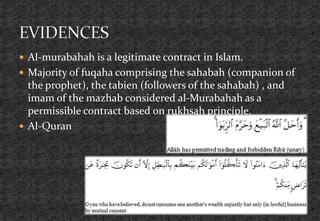
 Al-murabahah is a legitimate contract in Islam.
 Majority of fuqaha comprising the sahabah (companion of
the prophet), the tabien (followers of the sahabah) , and
imam of the mazhab considered al-Murabahah as a
permissible contract based on rukhsah principle.
 Al-Quran
4
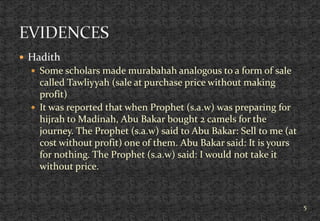
 Hadith
 Some scholars made murabahah analogous to a form of sale
called Tawliyyah (sale at purchase price without making
profit)
 It was reported that when Prophet (s.a.w) was preparing for
hijrah to Madinah, Abu Bakar bought 2 camels for the
journey. The Prophet (s.a.w) said to Abu Bakar: Sell to me (at
cost without profit) one of them. Abu Bakar said: It is yours
for nothing. The Prophet (s.a.w) said: I would not take it
without price.
5
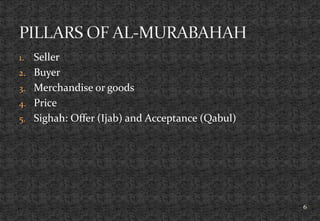
1. Seller
2. Buyer
3. Merchandise or goods
4. Price
5. Sighah: Offer (Ijab) and Acceptance (Qabul)
6
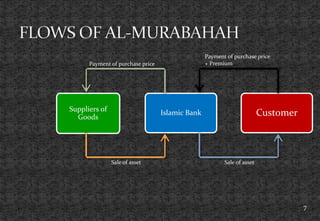
7
Islamic Bank CustomerSuppliers of
Goods
Payment of purchase price
+ Premium
Sale of asset Sale of asset
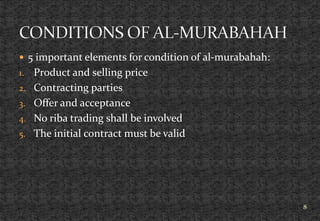
 5 important elements for condition of al-murabahah:
1. Product and selling price
2. Contracting parties
3. Offer and acceptance
4. No riba trading shall be involved
5. The initial contract must be valid
8
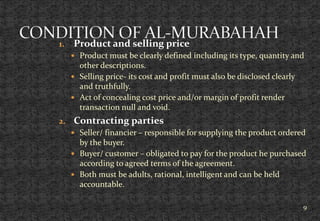
1. Product and selling price
 Product must be clearly defined including its type, quantity and
other descriptions.
 Selling price- its cost and profit must also be disclosed clearly
and truthfully.
 Act of concealing cost price and/or margin of profit render
transaction null and void.
2. Contracting parties
 Seller/ financier – responsible for supplying the product ordered
by the buyer.
 Buyer/ customer – obligated to pay for the product he purchased
according to agreed terms of the agreement.
 Both must be adults, rational, intelligent and can be held
accountable.
9
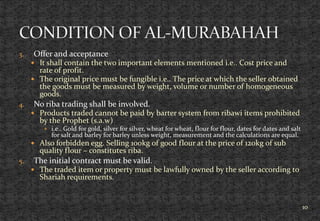
3. Offer and acceptance
 It shall contain the two important elements mentioned i.e.. Cost price and
rate of profit.
 The original price must be fungible i.e.. The price at which the seller obtained
the goods must be measured by weight, volume or number of homogeneous
goods.
4. No riba trading shall be involved.
 Products traded cannot be paid by barter system from ribawi items prohibited
by the Prophet (s.a.w)
 i.e.. Gold for gold, silver for silver, wheat for wheat, flour for flour, dates for dates and salt
for salt and barley for barley unless weight, measurement and the calculations are equal.
 Also forbidden egg. Selling 100kg of good flour at the price of 120kg of sub
quality flour – constitutes riba.
5. The initial contract must be valid.
 The traded item or property must be lawfully owned by the seller according to
Shariah requirements.
10
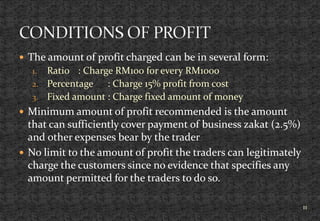
 The amount of profit charged can be in several form:
1. Ratio : Charge RM100 for every RM1000
2. Percentage : Charge 15% profit from cost
3. Fixed amount : Charge fixed amount of money
 Minimum amount of profit recommended is the amount
that can sufficiently cover payment of business zakat (2.5%)
and other expenses bear by the trader
 No limit to the amount of profit the traders can legitimately
charge the customers since no evidence that specifies any
amount permitted for the traders to do so.
11
 Reason to the non-specification of amount of profit in trade:
1. Limitation of profit rate allowable is something against the rule of fair
and justice
2. Differences between types of goods that have fast circulation in nature
compared to product that have rather slow circulation or slow demand;
hence profit rate for the former should be different from the latter
3. Differences between traders sell product in small quantity than those
sell massive amount of product
4. Differences between traders deal in cash compared to those that can
accept credit or deferred payment
5. Differences between goods that considered necessity (dharuriyyah)
compared to complementary (hajiyyah) and luxury (kamiliyyah) goods.
Necessity goods should be charge lower profit as it is needed item.
6. Differences between traders that easily acquire their product from those
that can only acquired it through difficult process. Or traders that sell
raw product compared to modified product.
12
 Murabahah is trust based contract and everything should be
disclosed including cost price and mode of payment. There are
several issues related to murabahah:
1. Rebate in the event of default
 Issues is whether the bank must give rebate to the customer in case
of default or to give early settlement or not.
2. Disclosure of cost price
 The seller obliged to disclose the actual cost; if the exact cost
cannot be ascertained or unknown, it is impossible to have
murabahah contract
3. Use of the interest rate as a benchmark
 Many IFI do murabahah financing to determine profit ot mark up
on the basis of current interest rate using conventional interest rate
benchmark or rating
13
 Islamic financial institutions aim to make use of bay al-
Murabahah in circumstances where they will purchase raw
materials, goods or equipment etc. and sell them to a client
at cost, plus a negotiated profit margin to be paid normally
by installments.
 Among others applications of contract of murabahah in
Islamic banking are:
 Murabahah financing
 Bank’s treasury product through murabahah commodity
 Issuance of sukuk murabahah
 International trade financing
14
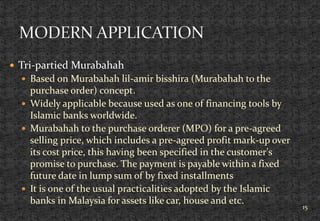
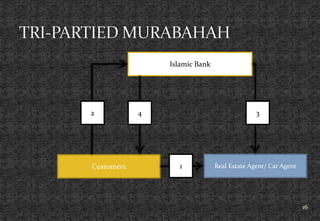
 Tri-partied Murabahah
 Based on Murabahah lil-amir bisshira (Murabahah to the
purchase order) concept.
 Widely applicable because used as one of financing tools by
Islamic banks worldwide.
 Murabahah to the purchase orderer (MPO) for a pre-agreed
selling price, which includes a pre-agreed profit mark-up over
its cost price, this having been specified in the customer's
promise to purchase. The payment is payable within a fixed
future date in lump sum of by fixed installments
 It is one of the usual practicalities adopted by the Islamic
banks in Malaysia for assets like car, house and etc.
15
16
Islamic Bank
Real Estate Agent/ Car AgentCustomers
3
1
42
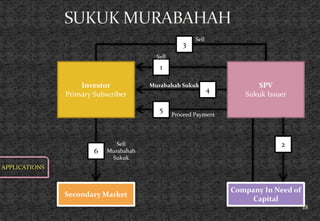
 Sukuk Murabahah
 Sukuk defined as trust certificate or participation securities
which grant the investor a share of an asset along with the
cash flows and risk commensurate with such ownership.
 Sukuk holder are entitled to shared in the revenues generated
by the sukuk assets and proceeds of the realization of the
sukuk assets.
17
APPLICATIONS
18
Investor
Primary Subscriber
SPV
Sukuk Issuer
Secondary Market
Company In Need of
Capital
6
2
3
4
1
5
Sell
Sell
Sell
Murabahah
Sukuk
Murabahah Sukuk
Proceed Payment
APPLICATIONS
19

BA'I AL MURABAHAH

  • 2.
     DEFINITION  EVIDENCE PILLARS  CONDITION OF MURABAHAH  CONDITION OF PROFITS  APPLICATION OF MURABAHAH 2
  • 3.
     Literally:  Fromword al-ribh (‫)الـربـح‬ which means increase in capital or profit of trading  Technically  Sale in which the mark up is disclosed to the purchaser as per the seller’s purchase price for a trust-sale for a certain specific asset.  Murabahah is a type of contract, a form of sale, where the seller expressly mentions the cost of the sold commodity he has incurred, and sells it to another person (the buyer) by adding some profit or mark-up thereon.  Mechanism has to be conducted with complete sincerity/trust by the seller/financier by stating the cost price of the purchase and the total profit incurred clearly and truthfully. Hence, a sale based on trust (amanah). 3
  • 4.
     Al-murabahah isa legitimate contract in Islam.  Majority of fuqaha comprising the sahabah (companion of the prophet), the tabien (followers of the sahabah) , and imam of the mazhab considered al-Murabahah as a permissible contract based on rukhsah principle.  Al-Quran 4
  • 5.
     Hadith  Somescholars made murabahah analogous to a form of sale called Tawliyyah (sale at purchase price without making profit)  It was reported that when Prophet (s.a.w) was preparing for hijrah to Madinah, Abu Bakar bought 2 camels for the journey. The Prophet (s.a.w) said to Abu Bakar: Sell to me (at cost without profit) one of them. Abu Bakar said: It is yours for nothing. The Prophet (s.a.w) said: I would not take it without price. 5
  • 6.
    1. Seller 2. Buyer 3.Merchandise or goods 4. Price 5. Sighah: Offer (Ijab) and Acceptance (Qabul) 6
  • 7.
    7 Islamic Bank CustomerSuppliersof Goods Payment of purchase price Payment of purchase price + Premium Sale of asset Sale of asset
  • 8.
     5 importantelements for condition of al-murabahah: 1. Product and selling price 2. Contracting parties 3. Offer and acceptance 4. No riba trading shall be involved 5. The initial contract must be valid 8
  • 9.
    1. Product andselling price  Product must be clearly defined including its type, quantity and other descriptions.  Selling price- its cost and profit must also be disclosed clearly and truthfully.  Act of concealing cost price and/or margin of profit render transaction null and void. 2. Contracting parties  Seller/ financier – responsible for supplying the product ordered by the buyer.  Buyer/ customer – obligated to pay for the product he purchased according to agreed terms of the agreement.  Both must be adults, rational, intelligent and can be held accountable. 9
  • 10.
    3. Offer andacceptance  It shall contain the two important elements mentioned i.e.. Cost price and rate of profit.  The original price must be fungible i.e.. The price at which the seller obtained the goods must be measured by weight, volume or number of homogeneous goods. 4. No riba trading shall be involved.  Products traded cannot be paid by barter system from ribawi items prohibited by the Prophet (s.a.w)  i.e.. Gold for gold, silver for silver, wheat for wheat, flour for flour, dates for dates and salt for salt and barley for barley unless weight, measurement and the calculations are equal.  Also forbidden egg. Selling 100kg of good flour at the price of 120kg of sub quality flour – constitutes riba. 5. The initial contract must be valid.  The traded item or property must be lawfully owned by the seller according to Shariah requirements. 10
  • 11.
     The amountof profit charged can be in several form: 1. Ratio : Charge RM100 for every RM1000 2. Percentage : Charge 15% profit from cost 3. Fixed amount : Charge fixed amount of money  Minimum amount of profit recommended is the amount that can sufficiently cover payment of business zakat (2.5%) and other expenses bear by the trader  No limit to the amount of profit the traders can legitimately charge the customers since no evidence that specifies any amount permitted for the traders to do so. 11
  • 12.
     Reason tothe non-specification of amount of profit in trade: 1. Limitation of profit rate allowable is something against the rule of fair and justice 2. Differences between types of goods that have fast circulation in nature compared to product that have rather slow circulation or slow demand; hence profit rate for the former should be different from the latter 3. Differences between traders sell product in small quantity than those sell massive amount of product 4. Differences between traders deal in cash compared to those that can accept credit or deferred payment 5. Differences between goods that considered necessity (dharuriyyah) compared to complementary (hajiyyah) and luxury (kamiliyyah) goods. Necessity goods should be charge lower profit as it is needed item. 6. Differences between traders that easily acquire their product from those that can only acquired it through difficult process. Or traders that sell raw product compared to modified product. 12
  • 13.
     Murabahah istrust based contract and everything should be disclosed including cost price and mode of payment. There are several issues related to murabahah: 1. Rebate in the event of default  Issues is whether the bank must give rebate to the customer in case of default or to give early settlement or not. 2. Disclosure of cost price  The seller obliged to disclose the actual cost; if the exact cost cannot be ascertained or unknown, it is impossible to have murabahah contract 3. Use of the interest rate as a benchmark  Many IFI do murabahah financing to determine profit ot mark up on the basis of current interest rate using conventional interest rate benchmark or rating 13
  • 14.
     Islamic financialinstitutions aim to make use of bay al- Murabahah in circumstances where they will purchase raw materials, goods or equipment etc. and sell them to a client at cost, plus a negotiated profit margin to be paid normally by installments.  Among others applications of contract of murabahah in Islamic banking are:  Murabahah financing  Bank’s treasury product through murabahah commodity  Issuance of sukuk murabahah  International trade financing 14
  • 15.
     Tri-partied Murabahah Based on Murabahah lil-amir bisshira (Murabahah to the purchase order) concept.  Widely applicable because used as one of financing tools by Islamic banks worldwide.  Murabahah to the purchase orderer (MPO) for a pre-agreed selling price, which includes a pre-agreed profit mark-up over its cost price, this having been specified in the customer's promise to purchase. The payment is payable within a fixed future date in lump sum of by fixed installments  It is one of the usual practicalities adopted by the Islamic banks in Malaysia for assets like car, house and etc. 15
  • 16.
    16 Islamic Bank Real EstateAgent/ Car AgentCustomers 3 1 42
  • 17.
     Sukuk Murabahah Sukuk defined as trust certificate or participation securities which grant the investor a share of an asset along with the cash flows and risk commensurate with such ownership.  Sukuk holder are entitled to shared in the revenues generated by the sukuk assets and proceeds of the realization of the sukuk assets. 17
  • 18.
    APPLICATIONS 18 Investor Primary Subscriber SPV Sukuk Issuer SecondaryMarket Company In Need of Capital 6 2 3 4 1 5 Sell Sell Sell Murabahah Sukuk Murabahah Sukuk Proceed Payment
  • 19.