BAY AL-ISTISNA’
CONTENT
• DEFINITION
• EVIDENCE
• PILLARS OF AL-ISTISNA’
• TYPES OF AL-ISTISNA’
• CONDITION OF AL-ISTISNA’
• DIFFERENCES BETWEEN AL-ISTISNA’ AND BAY’ AL-SALAM
• MODERN APPLICATION
DEFINITION
• Literally:
– The word istisna’ derived from the arabic verb “istasna’a”
which is mean to request someone to manufacture an
asset.
• Technically:
– Bay’ al-istisna’ is defined as a contractual agreement with
manufacturer to produce items with specified description
at a determined price, and manufactured from his own
materials with his own effort.
DEFINITION
• The Majallah al-Ahkam al-Adliyyah (Ottoman code of Islamic civil law)
defines istisna’ as
– A contract with the maker, (manufacturer) on the specific task that is liable
to complete.
• Malaysian Accounting Standards Board (MASB) defines the istisna’ as:
– A contract of exchange whereby an IFI, at the request of the customer,
acquires an asset for purchase or construction based on specifications by the
customer. The payment of acquisition price to manufacturer, developer or
vendor of the asset is made up-front by determined future date.
DEFINITION
• It is an order to producer to manufacture a specific commodity for the purchaser.
• The emphasis in istisna is the specificity of subject matter to avoid gharar
(uncertainty) ensuring that the seller cannot transact with something that cannot
be accurately described; one can describe equipment, a factory or an industrial
plant, but not fish in the sea prior catching them since their type and volume is
unknown.
• Upon delivery, the IFI sells it to the customer at a prevailing market price
comprising original acquisition price and a margin of profit.
• The customer repays by installments within a period and in the manner agreed
between the IFI and the customer.
EVIDENCE
• According to jurist, the legality on an istisna’ contract is established
from different legal sources such as the Sunnah, ijma’, qiyas and
istihsan.
• There is no differences of opinion on its permissibility. It clearly can
be seen from hadith:
– Indeed that the Prophet s.a.w booked the making of a golden ring
• The istisna’ contract is legitimate on the basis of the people’s
customary practice of this contract in all periods of time without
any objection, which in turn constitutes a legal consensus.
PILLARS OF ISTISNA’
• Mustasni’
– Customer
• Sani’
– Manufacturer
• Ra’s al-Mal
– The Price
• Masnu’
– The Product
• Sighah
– Ijab (Offer)
– Qabul (Acceptance)
FLOWS OF ISTISNA’
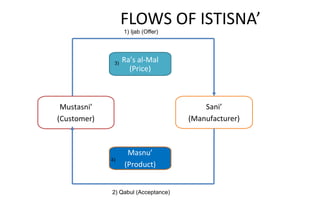
Ra’s al-Mal
(Price)
Sani’
(Manufacturer)
Masnu’
(Product)
Mustasni’
(Customer)
1) Ijab (Offer)
2) Qabul (Acceptance)
3)
4)
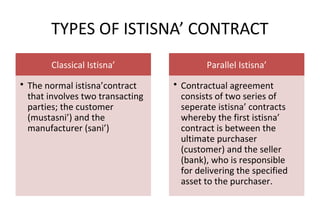
Classical Istisna’
• The normal istisna’contract
that involves two transacting
parties; the customer
(mustasni’) and the
manufacturer (sani’)
Parallel Istisna’
• Contractual agreement
consists of two series of
seperate istisna’ contracts
whereby the first istisna’
contract is between the
ultimate purchaser
(customer) and the seller
(bank), who is responsible
for delivering the specified
asset to the purchaser.
TYPES OF ISTISNA’ CONTRACT
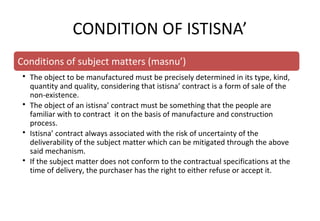
Conditions of subject matters (masnu’)
• The object to be manufactured must be precisely determined in its type, kind,
quantity and quality, considering that istisna’ contract is a form of sale of the
non-existence.
• The object of an istisna’ contract must be something that the people are
familiar with to contract it on the basis of manufacture and construction
process.
• Istisna’ contract always associated with the risk of uncertainty of the
deliverability of the subject matter which can be mitigated through the above
said mechanism.
• If the subject matter does not conform to the contractual specifications at the
time of delivery, the purchaser has the right to either refuse or accept it.
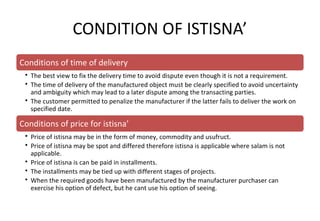
CONDITION OF ISTISNA’
Conditions of time of delivery
• The best view to fix the delivery time to avoid dispute even though it is not a requirement.
• The time of delivery of the manufactured object must be clearly specified to avoid uncertainty
and ambiguity which may lead to a later dispute among the transacting parties.
• The customer permitted to penalize the manufacturer if the latter fails to deliver the work on
specified date.
Conditions of price for istisna’
• Price of istisna may be in the form of money, commodity and usufruct.
• Price of istisna may be spot and differed therefore istisna is applicable where salam is not
applicable.
• Price of istisna is can be paid in installments.
• The installments may be tied up with different stages of projects.
• When the required goods have been manufactured by the manufacturer purchaser can
exercise his option of defect, but he cant use his option of seeing.
CONDITION OF ISTISNA’
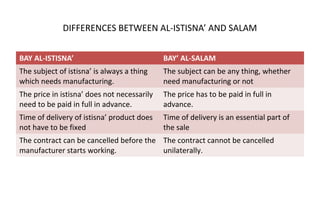
DIFFERENCES BETWEEN AL-ISTISNA’ AND SALAM
BAY AL-ISTISNA’ BAY’ AL-SALAM
The subject of istisna’ is always a thing
which needs manufacturing.
The subject can be any thing, whether
need manufacturing or not
The price in istisna’ does not necessarily
need to be paid in full in advance.
The price has to be paid in full in
advance.
Time of delivery of istisna’ product does
not have to be fixed
Time of delivery is an essential part of
the sale
The contract can be cancelled before the
manufacturer starts working.
The contract cannot be cancelled
unilaterally.
APPLICATIONS
• In contemporary Islamic finance, an istisna’ contract is
applicable to various industrial productions which can be
constructed or manufactured and supervised by specification.
• Customers are able to apply for the istisna’ financing facility
and other product offered by Islamic bank using istisna’
contract such as:
– Parallel istisna’ (Istisna’ Mawazi)
– Hybrid Istisna’
– Sukuk istisna’
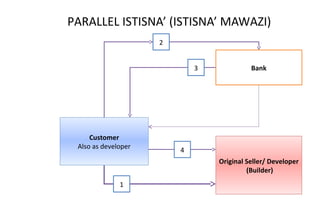
PARALLEL ISTISNA’ (ISTISNA’ MAWAZI)
Bank
Original Seller/ Developer
(Builder)
Customer
Also as developer
2
4
1
3
PARALLEL ISTISNA’ (ISTISNA’ MAWAZI)
• Parallel salam takes effect through two separate contract.
• In the first contract the IFI act in the capacity as manufacturer, builder or supplier
and concludes a contract with the customer.
• In the second contract the IFI act in the capacity of a purchaser and concludes
another contract with a manufacturer, builder or supplier in order to fulfill its
contractual obligations towards the customer in the first contract.
• By this process a profit is realized through the difference in price between the two
contracts and in most cases, one of the contract is concluded immediately and the
second contract concluded later.
END OF CHAPTER

Topic 3 istisna

  • 1.
  • 2.
    CONTENT • DEFINITION • EVIDENCE •PILLARS OF AL-ISTISNA’ • TYPES OF AL-ISTISNA’ • CONDITION OF AL-ISTISNA’ • DIFFERENCES BETWEEN AL-ISTISNA’ AND BAY’ AL-SALAM • MODERN APPLICATION
  • 3.
    DEFINITION • Literally: – Theword istisna’ derived from the arabic verb “istasna’a” which is mean to request someone to manufacture an asset. • Technically: – Bay’ al-istisna’ is defined as a contractual agreement with manufacturer to produce items with specified description at a determined price, and manufactured from his own materials with his own effort.
  • 4.
    DEFINITION • The Majallahal-Ahkam al-Adliyyah (Ottoman code of Islamic civil law) defines istisna’ as – A contract with the maker, (manufacturer) on the specific task that is liable to complete. • Malaysian Accounting Standards Board (MASB) defines the istisna’ as: – A contract of exchange whereby an IFI, at the request of the customer, acquires an asset for purchase or construction based on specifications by the customer. The payment of acquisition price to manufacturer, developer or vendor of the asset is made up-front by determined future date.
  • 5.
    DEFINITION • It isan order to producer to manufacture a specific commodity for the purchaser. • The emphasis in istisna is the specificity of subject matter to avoid gharar (uncertainty) ensuring that the seller cannot transact with something that cannot be accurately described; one can describe equipment, a factory or an industrial plant, but not fish in the sea prior catching them since their type and volume is unknown. • Upon delivery, the IFI sells it to the customer at a prevailing market price comprising original acquisition price and a margin of profit. • The customer repays by installments within a period and in the manner agreed between the IFI and the customer.
  • 6.
    EVIDENCE • According tojurist, the legality on an istisna’ contract is established from different legal sources such as the Sunnah, ijma’, qiyas and istihsan. • There is no differences of opinion on its permissibility. It clearly can be seen from hadith: – Indeed that the Prophet s.a.w booked the making of a golden ring • The istisna’ contract is legitimate on the basis of the people’s customary practice of this contract in all periods of time without any objection, which in turn constitutes a legal consensus.
  • 7.
    PILLARS OF ISTISNA’ •Mustasni’ – Customer • Sani’ – Manufacturer • Ra’s al-Mal – The Price • Masnu’ – The Product • Sighah – Ijab (Offer) – Qabul (Acceptance)
  • 8.
    FLOWS OF ISTISNA’ Ra’sal-Mal (Price) Sani’ (Manufacturer) Masnu’ (Product) Mustasni’ (Customer) 1) Ijab (Offer) 2) Qabul (Acceptance) 3) 4)
  • 9.
    Classical Istisna’ • Thenormal istisna’contract that involves two transacting parties; the customer (mustasni’) and the manufacturer (sani’) Parallel Istisna’ • Contractual agreement consists of two series of seperate istisna’ contracts whereby the first istisna’ contract is between the ultimate purchaser (customer) and the seller (bank), who is responsible for delivering the specified asset to the purchaser. TYPES OF ISTISNA’ CONTRACT
  • 10.
    Conditions of subjectmatters (masnu’) • The object to be manufactured must be precisely determined in its type, kind, quantity and quality, considering that istisna’ contract is a form of sale of the non-existence. • The object of an istisna’ contract must be something that the people are familiar with to contract it on the basis of manufacture and construction process. • Istisna’ contract always associated with the risk of uncertainty of the deliverability of the subject matter which can be mitigated through the above said mechanism. • If the subject matter does not conform to the contractual specifications at the time of delivery, the purchaser has the right to either refuse or accept it. CONDITION OF ISTISNA’
  • 11.
    Conditions of timeof delivery • The best view to fix the delivery time to avoid dispute even though it is not a requirement. • The time of delivery of the manufactured object must be clearly specified to avoid uncertainty and ambiguity which may lead to a later dispute among the transacting parties. • The customer permitted to penalize the manufacturer if the latter fails to deliver the work on specified date. Conditions of price for istisna’ • Price of istisna may be in the form of money, commodity and usufruct. • Price of istisna may be spot and differed therefore istisna is applicable where salam is not applicable. • Price of istisna is can be paid in installments. • The installments may be tied up with different stages of projects. • When the required goods have been manufactured by the manufacturer purchaser can exercise his option of defect, but he cant use his option of seeing. CONDITION OF ISTISNA’
  • 12.
    DIFFERENCES BETWEEN AL-ISTISNA’AND SALAM BAY AL-ISTISNA’ BAY’ AL-SALAM The subject of istisna’ is always a thing which needs manufacturing. The subject can be any thing, whether need manufacturing or not The price in istisna’ does not necessarily need to be paid in full in advance. The price has to be paid in full in advance. Time of delivery of istisna’ product does not have to be fixed Time of delivery is an essential part of the sale The contract can be cancelled before the manufacturer starts working. The contract cannot be cancelled unilaterally.
  • 13.
    APPLICATIONS • In contemporaryIslamic finance, an istisna’ contract is applicable to various industrial productions which can be constructed or manufactured and supervised by specification. • Customers are able to apply for the istisna’ financing facility and other product offered by Islamic bank using istisna’ contract such as: – Parallel istisna’ (Istisna’ Mawazi) – Hybrid Istisna’ – Sukuk istisna’
  • 14.
    PARALLEL ISTISNA’ (ISTISNA’MAWAZI) Bank Original Seller/ Developer (Builder) Customer Also as developer 2 4 1 3
  • 15.
    PARALLEL ISTISNA’ (ISTISNA’MAWAZI) • Parallel salam takes effect through two separate contract. • In the first contract the IFI act in the capacity as manufacturer, builder or supplier and concludes a contract with the customer. • In the second contract the IFI act in the capacity of a purchaser and concludes another contract with a manufacturer, builder or supplier in order to fulfill its contractual obligations towards the customer in the first contract. • By this process a profit is realized through the difference in price between the two contracts and in most cases, one of the contract is concluded immediately and the second contract concluded later.
  • 16.