Introduction to Behavioral Science
Col Zulfiquer Ahmed Amin
M Phil, MPH, PGD (Health Economics), MBBS
Armed Forces Medical Institute (AFMI)
Definition
Behavior is a response of an individual or group to an
action, environment, person, or stimulus.
1. Behavior is everything a person does.
2. Behaviors is
● that can be observed
• that can be heard/seen
• that can be measured
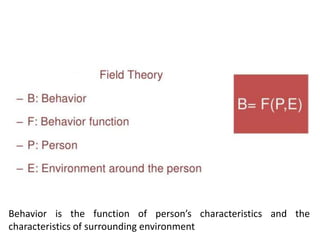
Behavior is the function of person’s characteristics and the
characteristics of surrounding environment
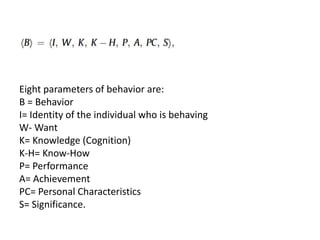
Eight parameters of behavior are:
B = Behavior
I= Identity of the individual who is behaving
W- Want
K= Knowledge (Cognition)
K-H= Know-How
P= Performance
A= Achievement
PC= Personal Characteristics
S= Significance.
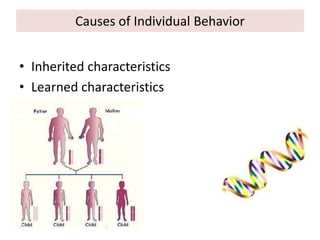
Causes of Individual Behavior
• Inherited characteristics
• Learned characteristics
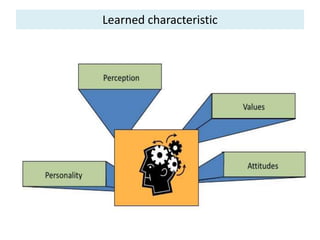
Learned characteristic
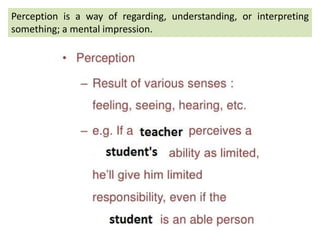
Perception is a way of regarding, understanding, or interpreting
something; a mental impression.
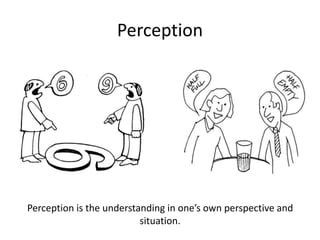
Perception
Perception is the understanding in one’s own perspective and
situation.
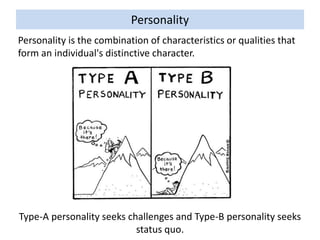
Personality
Personality is the combination of characteristics or qualities that
form an individual's distinctive character.
Type-A personality seeks challenges and Type-B personality seeks
status quo.
Attitude
Attitude is a settled way of thinking or feeling about someone or
something, typically one that is reflected in a person's behavior.
Values
-Values are the moral principles and beliefs or accepted standards
of a person or social group.
-Values are a person's or society’s beliefs about good behavior and
what things are important.
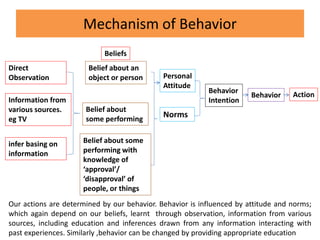
Mechanism of Behavior
ActionBehavior
Behavior
Intention
Personal
Attitude
Norms
Beliefs
Direct
Observation
Information from
various sources.
eg TV
infer basing on
information
Belief about an
object or person
Belief about
some performing
Belief about some
performing with
knowledge of
‘approval’/
‘disapproval’ of
people, or things
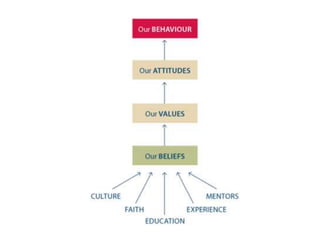
Our actions are determined by our behavior. Behavior is influenced by attitude and norms;
which again depend on our beliefs, learnt through observation, information from various
sources, including education and inferences drawn from any information interacting with
past experiences. Similarly ,behavior can be changed by providing appropriate education
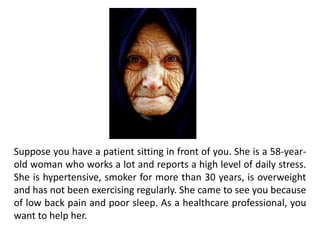
Suppose you have a patient sitting in front of you. She is a 58-year-
old woman who works a lot and reports a high level of daily stress.
She is hypertensive, smoker for more than 30 years, is overweight
and has not been exercising regularly. She came to see you because
of low back pain and poor sleep. As a healthcare professional, you
want to help her.
One major goal is to address the risk factors for cardiovascular
disease, but you will also want to alleviate her current acute
conditions. At this stage, you can simply follow the guidelines and
give her advice on the benefits of exercise, weight loss, healthy
eating and decreased sodium intake, inform her about
atherosclerotic cardiovascular disease risks and prescribe
medication on an evidence basis.
But will these recommendations really work? Will she adhere to
your recommendations? And how can you know? What are the
applicable incentives and penalties for complying or not with these
guidelines?
Behavioral sciences provide a starting point for healthcare
professionals to address the questions raised above and improve
health care delivery.
Behavioral Science
Behavioral science is a branch of social science that derives its
concepts from observation of the behavior of living organisms.
Broadly defined, behavioral science is the study of human habits,
actions, and intentions.
Combining knowledge of sociology, psychology and anthropology
with strong observation, research, and communication skills, a
behavioral scientist works with communities and individuals
examining behavior and decision-making.
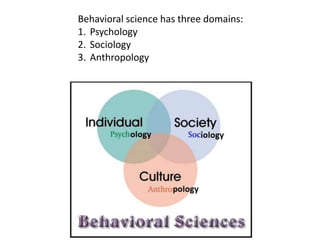
Behavioral science has three domains:
1. Psychology
2. Sociology
3. Anthropology
Psychology
-Psychology is the scientific study of the human mind
and its functions.
-Psychology is the scientific study of the mind and
behavior.
-Psychology is focused to individual person.
Sociology
Sociology is the study of the development, structure,
and functioning of human society. It is focused to a
group of people belonging to a society.
Sociology is the scientific study of society, including
patterns of social relationships, social interaction, and
culture.
Anthropology
Anthropology is the study of what makes us human.
Anthropology is the study of people throughout the world, their
evolutionary history, how they behave, adapt to different
environments, communicate and socialize with one another.
The study of anthropology is concerned both with the biological
features that make us human (such as physiology, genetic
makeup, nutritional history and evolution) and with social
aspects (such as language, culture, politics, family and religion).
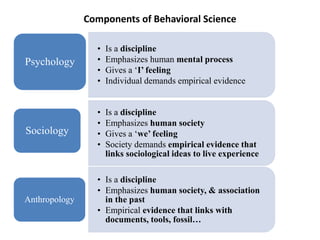
Components of Behavioral Science
• Is a discipline
• Emphasizes human mental process
• Gives a ‘I’ feeling
• Individual demands empirical evidence
Psychology
• Is a discipline
• Emphasizes human society
• Gives a ‘we’ feeling
• Society demands empirical evidence that
links sociological ideas to live experience
Sociology
• Is a discipline
• Emphasizes human society, & association
in the past
• Empirical evidence that links with
documents, tools, fossil…
Anthropology
Topic domains for the behaviour science in
medical teaching:
1. Mind body interaction
2. Patient behavior
3. Physician role and behavior
4. Physician patient interaction
5. Social and cultural issues in health care
6. Health policy and economics
Relevance and importance of Behavioral Science to
Health & Medicine
Relevance is demonstrated in the:
-Aetiology of illness,
-Presentation of illnesses,
-Delivery of health care,
-Aspects of social and psychological treatment.
-Behavioral and social factors are important in planning
for health care with assessment and treatment of both
physical and psychiatric disorder.
-Cultural factors play a role in the behavior of the patient
and treatment.
-Psychological tests help in the psychiatric diagnosis.
-Systematic study of psycho-social phenomena (including problems)
in health and disease
-Investigating and understanding psycho-social crises related to
health and disease (e.g., disease outbreak)
-Explaining social responses to poverty, exclusion, marginalization,
prejudice and discrimination which influences healthcare services.
-Address the issues of healthcare provider - patient relationship
Categories of Behavioral Sciences:
Decision Sciences: Decision sciences deals with the decision
processes .
It concentrate mainly on Psychology.
Communication Sciences: Communication Sciences deals with
communication strategies used by human. Communication
implies human interaction and relationship.
It concentrate mainly on Sociology and Anthropology.
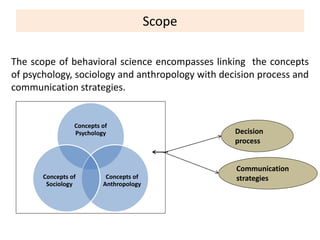
Concepts of
Psychology
Concepts of
Anthropology
Concepts of
Sociology
Decision
process
Communication
strategies
The scope of behavioral science encompasses linking the concepts
of psychology, sociology and anthropology with decision process and
communication strategies.
Scope
•Health behavior is a behavior that affects health:
–Health impairing habits, which is called "behavioral pathogens"
(for example smoking, eating a high fat diet)
–Health protective behaviors, which is defined as "behavioral
immunogens" (e.g. attending a health check).
-Illness behavior is a behavior aimed at seeking a remedy (e.g. going
to the doctor).
-Sick role behavior is an activity aimed at getting well (e.g. taking
prescribed medication or resting). In other words, sick role is
behavior and obligations expected from a sick person.
Health related Behaviors
-Illness behavior is described as the state when the
individual feels ill and behaves in a particular way
-Illness is a psychological concept:
– It has different meanings for different people
– It’s based upon an individual’s personal evaluation of
his/her bodily state and ability to function
Illness Behavior
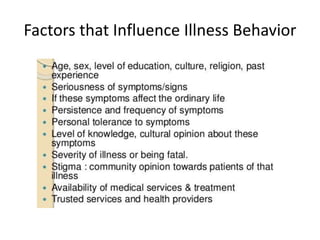
Factors that Influence Illness Behavior
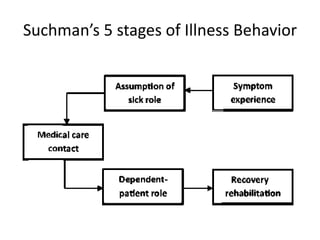
Suchman’s 5 stages of Illness Behavior
Stage 1: Symptom Experience
At this stage the person comes to believe something is wrong. Either
someone significant mentions that the person looks unwell, or the
person experiences some symptoms such pain, rash, cough, fever or
bleeding. It has 3 aspects:
1. The physical experience of symptoms.
2. The cognitive aspect (the interpretation of the symptoms in terms
that have some meaning to the person)
3. The emotional response (e.g. fear or anxiety)
During this stage, the unwell person usually consults others about
their symptoms or feelings. At this stage the sick person may try
home remedies. If self management is ineffective, the individual
enters the next stage.
Stage 2: Assumption of Sick Role
The individual now accepts the ‘sick role’ and seeks confirmation
from the family and friends. During this stage people may be
excused from normal duties and role expectations. Emotional
responses such as withdrawal, anxiety, fear and depression may
prevail. When symptoms of illness persist or increase, the person
is motivated to seek professional help.
Stage 3: Medical care contact
Sick people seek the advice of a health care professional either on
their own initiative or at the urging of significant others. When
people seek professional advice they are really asking for 3 types
of information:
1.Validation of real illness.
2.Explanation of the symptoms in understandable terms.
3.Reassurance that they will be alright or prediction of what the
outcome will be.
The health professional may determine that the client does not
have an illness or that an illness is present and may even be life
threatening. The client may accept or deny the diagnosis. If the
diagnosis is accepted, the client usually follows the prescribed
treatment plan. If the diagnosis is not accepted, the client may
seek the advice of other health care professionals or quasi-
practitioners who will provide a diagnosis that fits the client’s
perceptions.
Stage 4: Dependent-Patient Role
After accepting the illness and seeking treatment, the client
becomes dependent on the professional for help. People vary
greatly in the degree of ease with which they can give up their
independence, particularly in relation to life and death. Role
obligations-such as those of wage earners, father, mother, and
student-complicate the decision to give up independence.
Stage 5: Recovery or Rehabilitation
During this stage the client is expected to relinquish the
dependent role and resume former roles and responsibilities.
People who have long-term illness and must adjust their lifestyles
may find recovery more difficult. For clients with permanent
disability, the final stage may require therapy to learn how to make
major adjustments in functioning
Disease versus ill/illness behavior:
 Disease is physical malfunctioning of the body.
 Illness is subjective perception of whether one is
sick or not. It is possible to have a disease and not
feel ill, e.g., undetected diabetes. Also possible
to feel ill without any detectable disease, e.g.,
hypochondriasis.
Sick Role
• The sick role – any activity undertaken for the
purpose of getting well by those who consider
themselves ill.
• This is a social role.
• A patient who enters the sick role has both rights and
obligations.
• There are positives and negatives to the sick role.
Sick Role Behavior
There are four aspects of sick role behavior:
•The sick person is not at fault for being sick.
•The sick person is excused from usual (everyday)
responsibilities.
•The sick person must get well as soon as possible.
•The sick person must seek professional help.
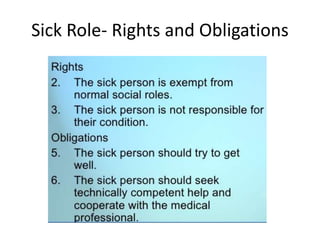
Sick Role- Rights and Obligations
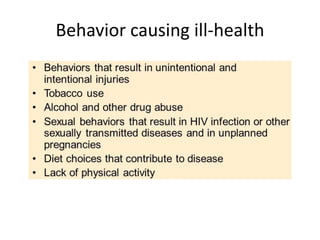
Behavior causing ill-health
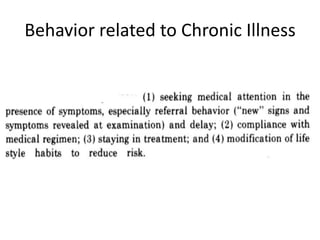
Behavior related to Chronic Illness
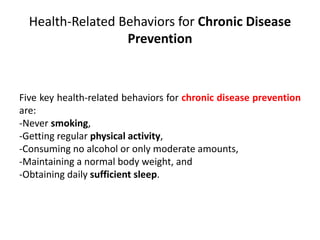
Health-Related Behaviors for Chronic Disease
Prevention
Five key health-related behaviors for chronic disease prevention
are:
-Never smoking,
-Getting regular physical activity,
-Consuming no alcohol or only moderate amounts,
-Maintaining a normal body weight, and
-Obtaining daily sufficient sleep.
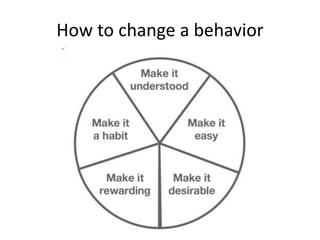
How to change a behavior
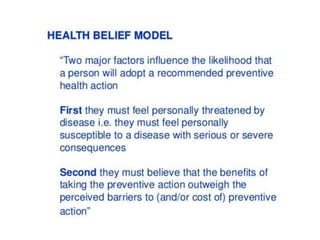
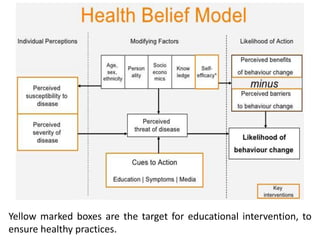
The Health Belief Model (HBM) is a psychological health behavior
change model developed to explain and predict health-related
behaviors, particularly in regard to the uptake of health services.
The health belief model suggests that people's beliefs about
health problems, perceived benefits of action and barriers to
action, and self-efficacy explain engagement (or lack of
engagement) in health-promoting behavior.
A stimulus, or cue (Peer pressure) to action, must also be present
in order to trigger the health-promoting behavior.
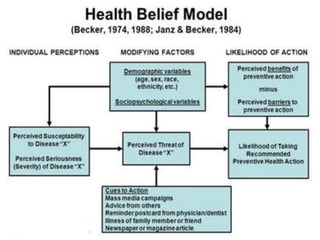
Health Belief Model (HBM)
Components of HBM
-Perceived susceptibility: This refers to a person's subjective
perception of the risk of acquiring an illness or disease.
-Perceived severity: This refers to a person's feelings on the
seriousness of contracting an illness or disease.
-Perceived benefits: The course of action a person takes in
preventing (or curing) illness or disease relies on consideration and
evaluation of both perceived susceptibility and perceived benefit,
such that the person would accept the recommended health action
if it was perceived as beneficial.
-Perceived barriers: This refers to a person's feelings on the
obstacles to performing a recommended health action. The person
weighs the effectiveness of the actions against the perceptions that
it may be expensive, dangerous (e.g., side effects), unpleasant (e.g.,
painful), time-consuming, or inconvenient.
-Cue to action: This is the stimulus needed to trigger the decision-
making process to accept a recommended health action. These cues
can be internal (e.g., chest pains, wheezing, etc.) or external (e.g.,
advice from others, illness of family member, newspaper article,
etc.).
-Self-efficacy: This refers to the level of a person's confidence in his
or her ability to successfully perform a behavior.
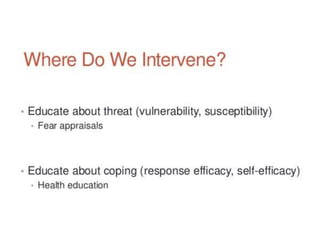
Yellow marked boxes are the target for educational intervention, to
ensure healthy practices.
Conclusion
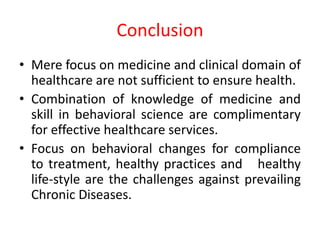
• Mere focus on medicine and clinical domain of
healthcare are not sufficient to ensure health.
• Combination of knowledge of medicine and
skill in behavioral science are complimentary
for effective healthcare services.
• Focus on behavioral changes for compliance
to treatment, healthy practices and healthy
life-style are the challenges against prevailing
Chronic Diseases.
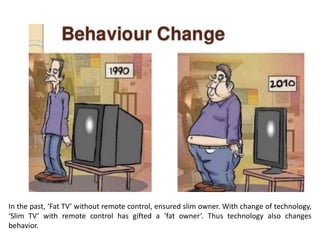
In the past, ‘Fat TV’ without remote control, ensured slim owner. With change of technology,
‘Slim TV’ with remote control has gifted a ‘fat owner’. Thus technology also changes
behavior.
Introduction to Behavioral Science

Introduction to Behavioral Science

  • 1.
    Introduction to BehavioralScience Col Zulfiquer Ahmed Amin M Phil, MPH, PGD (Health Economics), MBBS Armed Forces Medical Institute (AFMI)
  • 2.
    Definition Behavior is aresponse of an individual or group to an action, environment, person, or stimulus. 1. Behavior is everything a person does. 2. Behaviors is ● that can be observed • that can be heard/seen • that can be measured
  • 3.
    Behavior is thefunction of person’s characteristics and the characteristics of surrounding environment
  • 5.
    Eight parameters ofbehavior are: B = Behavior I= Identity of the individual who is behaving W- Want K= Knowledge (Cognition) K-H= Know-How P= Performance A= Achievement PC= Personal Characteristics S= Significance.
  • 6.
    Causes of IndividualBehavior • Inherited characteristics • Learned characteristics
  • 7.
  • 8.
    Perception is away of regarding, understanding, or interpreting something; a mental impression.
  • 9.
    Perception Perception is theunderstanding in one’s own perspective and situation.
  • 10.
    Personality Personality is thecombination of characteristics or qualities that form an individual's distinctive character. Type-A personality seeks challenges and Type-B personality seeks status quo.
  • 14.
    Attitude Attitude is asettled way of thinking or feeling about someone or something, typically one that is reflected in a person's behavior.
  • 15.
    Values -Values are themoral principles and beliefs or accepted standards of a person or social group. -Values are a person's or society’s beliefs about good behavior and what things are important.
  • 17.
    Mechanism of Behavior ActionBehavior Behavior Intention Personal Attitude Norms Beliefs Direct Observation Informationfrom various sources. eg TV infer basing on information Belief about an object or person Belief about some performing Belief about some performing with knowledge of ‘approval’/ ‘disapproval’ of people, or things Our actions are determined by our behavior. Behavior is influenced by attitude and norms; which again depend on our beliefs, learnt through observation, information from various sources, including education and inferences drawn from any information interacting with past experiences. Similarly ,behavior can be changed by providing appropriate education
  • 18.
    Suppose you havea patient sitting in front of you. She is a 58-year- old woman who works a lot and reports a high level of daily stress. She is hypertensive, smoker for more than 30 years, is overweight and has not been exercising regularly. She came to see you because of low back pain and poor sleep. As a healthcare professional, you want to help her.
  • 19.
    One major goalis to address the risk factors for cardiovascular disease, but you will also want to alleviate her current acute conditions. At this stage, you can simply follow the guidelines and give her advice on the benefits of exercise, weight loss, healthy eating and decreased sodium intake, inform her about atherosclerotic cardiovascular disease risks and prescribe medication on an evidence basis.
  • 20.
    But will theserecommendations really work? Will she adhere to your recommendations? And how can you know? What are the applicable incentives and penalties for complying or not with these guidelines? Behavioral sciences provide a starting point for healthcare professionals to address the questions raised above and improve health care delivery.
  • 21.
    Behavioral Science Behavioral scienceis a branch of social science that derives its concepts from observation of the behavior of living organisms. Broadly defined, behavioral science is the study of human habits, actions, and intentions. Combining knowledge of sociology, psychology and anthropology with strong observation, research, and communication skills, a behavioral scientist works with communities and individuals examining behavior and decision-making.
  • 22.
    Behavioral science hasthree domains: 1. Psychology 2. Sociology 3. Anthropology
  • 23.
    Psychology -Psychology is thescientific study of the human mind and its functions. -Psychology is the scientific study of the mind and behavior. -Psychology is focused to individual person.
  • 24.
    Sociology Sociology is thestudy of the development, structure, and functioning of human society. It is focused to a group of people belonging to a society. Sociology is the scientific study of society, including patterns of social relationships, social interaction, and culture.
  • 25.
    Anthropology Anthropology is thestudy of what makes us human. Anthropology is the study of people throughout the world, their evolutionary history, how they behave, adapt to different environments, communicate and socialize with one another. The study of anthropology is concerned both with the biological features that make us human (such as physiology, genetic makeup, nutritional history and evolution) and with social aspects (such as language, culture, politics, family and religion).
  • 26.
    Components of BehavioralScience • Is a discipline • Emphasizes human mental process • Gives a ‘I’ feeling • Individual demands empirical evidence Psychology • Is a discipline • Emphasizes human society • Gives a ‘we’ feeling • Society demands empirical evidence that links sociological ideas to live experience Sociology • Is a discipline • Emphasizes human society, & association in the past • Empirical evidence that links with documents, tools, fossil… Anthropology
  • 27.
    Topic domains forthe behaviour science in medical teaching: 1. Mind body interaction 2. Patient behavior 3. Physician role and behavior 4. Physician patient interaction 5. Social and cultural issues in health care 6. Health policy and economics
  • 28.
    Relevance and importanceof Behavioral Science to Health & Medicine Relevance is demonstrated in the: -Aetiology of illness, -Presentation of illnesses, -Delivery of health care, -Aspects of social and psychological treatment.
  • 29.
    -Behavioral and socialfactors are important in planning for health care with assessment and treatment of both physical and psychiatric disorder. -Cultural factors play a role in the behavior of the patient and treatment. -Psychological tests help in the psychiatric diagnosis.
  • 30.
    -Systematic study ofpsycho-social phenomena (including problems) in health and disease -Investigating and understanding psycho-social crises related to health and disease (e.g., disease outbreak) -Explaining social responses to poverty, exclusion, marginalization, prejudice and discrimination which influences healthcare services. -Address the issues of healthcare provider - patient relationship
  • 31.
    Categories of BehavioralSciences: Decision Sciences: Decision sciences deals with the decision processes . It concentrate mainly on Psychology. Communication Sciences: Communication Sciences deals with communication strategies used by human. Communication implies human interaction and relationship. It concentrate mainly on Sociology and Anthropology.
  • 32.
    Concepts of Psychology Concepts of Anthropology Conceptsof Sociology Decision process Communication strategies The scope of behavioral science encompasses linking the concepts of psychology, sociology and anthropology with decision process and communication strategies. Scope
  • 33.
    •Health behavior isa behavior that affects health: –Health impairing habits, which is called "behavioral pathogens" (for example smoking, eating a high fat diet) –Health protective behaviors, which is defined as "behavioral immunogens" (e.g. attending a health check). -Illness behavior is a behavior aimed at seeking a remedy (e.g. going to the doctor). -Sick role behavior is an activity aimed at getting well (e.g. taking prescribed medication or resting). In other words, sick role is behavior and obligations expected from a sick person. Health related Behaviors
  • 34.
    -Illness behavior isdescribed as the state when the individual feels ill and behaves in a particular way -Illness is a psychological concept: – It has different meanings for different people – It’s based upon an individual’s personal evaluation of his/her bodily state and ability to function Illness Behavior
  • 36.
    Factors that InfluenceIllness Behavior
  • 37.
    Suchman’s 5 stagesof Illness Behavior
  • 38.
    Stage 1: SymptomExperience At this stage the person comes to believe something is wrong. Either someone significant mentions that the person looks unwell, or the person experiences some symptoms such pain, rash, cough, fever or bleeding. It has 3 aspects: 1. The physical experience of symptoms. 2. The cognitive aspect (the interpretation of the symptoms in terms that have some meaning to the person) 3. The emotional response (e.g. fear or anxiety) During this stage, the unwell person usually consults others about their symptoms or feelings. At this stage the sick person may try home remedies. If self management is ineffective, the individual enters the next stage.
  • 39.
    Stage 2: Assumptionof Sick Role The individual now accepts the ‘sick role’ and seeks confirmation from the family and friends. During this stage people may be excused from normal duties and role expectations. Emotional responses such as withdrawal, anxiety, fear and depression may prevail. When symptoms of illness persist or increase, the person is motivated to seek professional help.
  • 40.
    Stage 3: Medicalcare contact Sick people seek the advice of a health care professional either on their own initiative or at the urging of significant others. When people seek professional advice they are really asking for 3 types of information: 1.Validation of real illness. 2.Explanation of the symptoms in understandable terms. 3.Reassurance that they will be alright or prediction of what the outcome will be. The health professional may determine that the client does not have an illness or that an illness is present and may even be life threatening. The client may accept or deny the diagnosis. If the diagnosis is accepted, the client usually follows the prescribed treatment plan. If the diagnosis is not accepted, the client may seek the advice of other health care professionals or quasi- practitioners who will provide a diagnosis that fits the client’s perceptions.
  • 41.
    Stage 4: Dependent-PatientRole After accepting the illness and seeking treatment, the client becomes dependent on the professional for help. People vary greatly in the degree of ease with which they can give up their independence, particularly in relation to life and death. Role obligations-such as those of wage earners, father, mother, and student-complicate the decision to give up independence.
  • 42.
    Stage 5: Recoveryor Rehabilitation During this stage the client is expected to relinquish the dependent role and resume former roles and responsibilities. People who have long-term illness and must adjust their lifestyles may find recovery more difficult. For clients with permanent disability, the final stage may require therapy to learn how to make major adjustments in functioning
  • 43.
    Disease versus ill/illnessbehavior:  Disease is physical malfunctioning of the body.  Illness is subjective perception of whether one is sick or not. It is possible to have a disease and not feel ill, e.g., undetected diabetes. Also possible to feel ill without any detectable disease, e.g., hypochondriasis.
  • 44.
    Sick Role • Thesick role – any activity undertaken for the purpose of getting well by those who consider themselves ill. • This is a social role. • A patient who enters the sick role has both rights and obligations. • There are positives and negatives to the sick role.
  • 45.
    Sick Role Behavior Thereare four aspects of sick role behavior: •The sick person is not at fault for being sick. •The sick person is excused from usual (everyday) responsibilities. •The sick person must get well as soon as possible. •The sick person must seek professional help.
  • 46.
    Sick Role- Rightsand Obligations
  • 47.
  • 48.
    Behavior related toChronic Illness
  • 49.
    Health-Related Behaviors forChronic Disease Prevention Five key health-related behaviors for chronic disease prevention are: -Never smoking, -Getting regular physical activity, -Consuming no alcohol or only moderate amounts, -Maintaining a normal body weight, and -Obtaining daily sufficient sleep.
  • 50.
    How to changea behavior
  • 51.
    The Health BeliefModel (HBM) is a psychological health behavior change model developed to explain and predict health-related behaviors, particularly in regard to the uptake of health services. The health belief model suggests that people's beliefs about health problems, perceived benefits of action and barriers to action, and self-efficacy explain engagement (or lack of engagement) in health-promoting behavior. A stimulus, or cue (Peer pressure) to action, must also be present in order to trigger the health-promoting behavior. Health Belief Model (HBM)
  • 53.
    Components of HBM -Perceivedsusceptibility: This refers to a person's subjective perception of the risk of acquiring an illness or disease. -Perceived severity: This refers to a person's feelings on the seriousness of contracting an illness or disease. -Perceived benefits: The course of action a person takes in preventing (or curing) illness or disease relies on consideration and evaluation of both perceived susceptibility and perceived benefit, such that the person would accept the recommended health action if it was perceived as beneficial.
  • 54.
    -Perceived barriers: Thisrefers to a person's feelings on the obstacles to performing a recommended health action. The person weighs the effectiveness of the actions against the perceptions that it may be expensive, dangerous (e.g., side effects), unpleasant (e.g., painful), time-consuming, or inconvenient. -Cue to action: This is the stimulus needed to trigger the decision- making process to accept a recommended health action. These cues can be internal (e.g., chest pains, wheezing, etc.) or external (e.g., advice from others, illness of family member, newspaper article, etc.). -Self-efficacy: This refers to the level of a person's confidence in his or her ability to successfully perform a behavior.
  • 56.
    Yellow marked boxesare the target for educational intervention, to ensure healthy practices.
  • 58.
    Conclusion • Mere focuson medicine and clinical domain of healthcare are not sufficient to ensure health. • Combination of knowledge of medicine and skill in behavioral science are complimentary for effective healthcare services. • Focus on behavioral changes for compliance to treatment, healthy practices and healthy life-style are the challenges against prevailing Chronic Diseases.
  • 59.
    In the past,‘Fat TV’ without remote control, ensured slim owner. With change of technology, ‘Slim TV’ with remote control has gifted a ‘fat owner’. Thus technology also changes behavior.