
NHS
CANCER
                                NHS Improvement
                                              Diagnostics


DIAGNOSTICS


HEART


LUNG


STROKE


              NHS Improvement - Diagnostics
              Top tips to overcome the
              challenge of commissioning
              diagnostic services
Top tips to overcome the challenge of
commissioning diagnostic services


              ing
 Commission
              services
 diagnostics
                but it is
 is complex,
                 get it
 essential to
               ver the
  right to deli
                 r
  best care fo
  patients.


This short guide presents top tips
for commissioners to meet the
most common challenges in the
delivery of diagnostic services. As
the National Directors for Diagnostics
(endoscopy, imaging, pathology and
physiological diagnostics), we consider
these top tips are key to delivering      We hope you find it useful.
high value, effective, and timely
diagnostics services which will           Dr Ian Barnes, National Clinical
support all clinical pathways.            Director for Pathology, Department
                                          of Health
The document draws on the                 Professor Erika Denton, National
experience and expertise of NHS           Clinical Director for Imaging,
Improvement diagnostic teams over         Department of Health
the last 10 years in piloting service     Professor Sue Hill, Chief Scientific
redesign with clinical teams. It is       Officer and National Clinical
supported by numerous examples and        Director for Physiological
quantifiable evidence which can be        Diagnostics, Department of Health
found in its companion document           Dr Roland Valori, National Clinical
‘Directory of Diagnostic Services for     Director for Endoscopy, Department
Commissioning Organisations’.             of Health


                                                                                 2
ared
 Develop a sh
              g of the
 understandin
              iagnostic
 end to end d
               m request
  pathway fro
               ing acted
  to result be
  upon


• Commissioners and service providers
  should have a joint understanding of
  what defines quality and value in
  diagnostic services which allows for a
  good patient experience.
• This understanding will inform the          • service accreditation which reflects
  development of a set of best practice          the needs of patients for both patient
  key performance indicators (KPIs)              facing services and those, like
  common across all diagnostics which            pathology, where direct patient
  will support improvements in quality,          contact is more limited
  safety, service delivery, costs and         • standard reporting templates.
  patient experience by, for example,       • Key Perfomance Indicators (KPIs) will
  measuring continuous service                highlight how diagnostics are key to
  improvement or reducing variation in        the delivery of all clinical pathways and
  service standards.                          also where opportunities exist for
• Service specifications and standards        improvement across the wider
  could be used to support enhanced           healthcare system. Examples could
  local tariffs to encourage compliance       include:
  with best practice and should include:      • reduced length of stay if inpatients
  • guaranteed and predictable                   can be imaged seven days per week
    turnaround times for each test –          • admission avoidance where prompt
    including reporting turnaround times         access to diagnostic tests and results
    and clinical action following                in A&E or outpatient clinics will
    availability of the diagnostic report        prevent unnecessary hospital
  • right first time approach to reduce          admissions or clinic attendance
    errors, improve safety and reduce         • earlier diagnosis where earlier
    waste                                        treatment results in improved
                                                 outcomes.


                                                                                      3
e need
    Recognise th
                tive
    for an effec
                 re to
    infrastructu
                  ostics
    support diagn
                                                     • provide adequate portering services
                                                       to support patient flow and enable
                                                       effective use of high value equipment
                                                       and increased productivity.
                                                     • provide vacuum systems where
                                                       appropriate to improve flow of
• Transport and administration functions               pathology specimens; reduce delays
  are key to service delivery. An                      in diagnosis; and the impact of
  understanding of how these can                       batching2
  influence efficient patient flow,                  • communications with evidence based
  equipment and staff utilisation is key to            requesting systems as mechanisms to
  effective productivity and therefore the             ensure the right test is done at the
  impact diagnostics can have on the                   right time to reduce inappropriate/
  whole healthcare system.                             repeat requests; and highlight
• A good supporting infrastructure                     unexpected results to the referrer
  should:                                            • support the use of next day postal
  • provide regular transport of samples               delivery and SMS systems to inform
     to reduce batch sizes1 in laboratory              patients of their appointments in a
     testing; improve turn-around times                timely manner. This reduces wasted
     and ensure faster results                         appointments where patients fail to
  • operate seven days a week where                    attend or cancel too late for the
     required to reduce inappropriate                  appointment to be re-offered.
     retesting where samples are time
     expired and/or spoiled


1
  Batch size - The designated number of investigations/samples which must be received before
  the group are processed.
2
  Batching - Gathering together a group of investigations, for example, pathology specimens
  and waiting until a designated number has been received before they are processed.
                                                                                               4
Support the
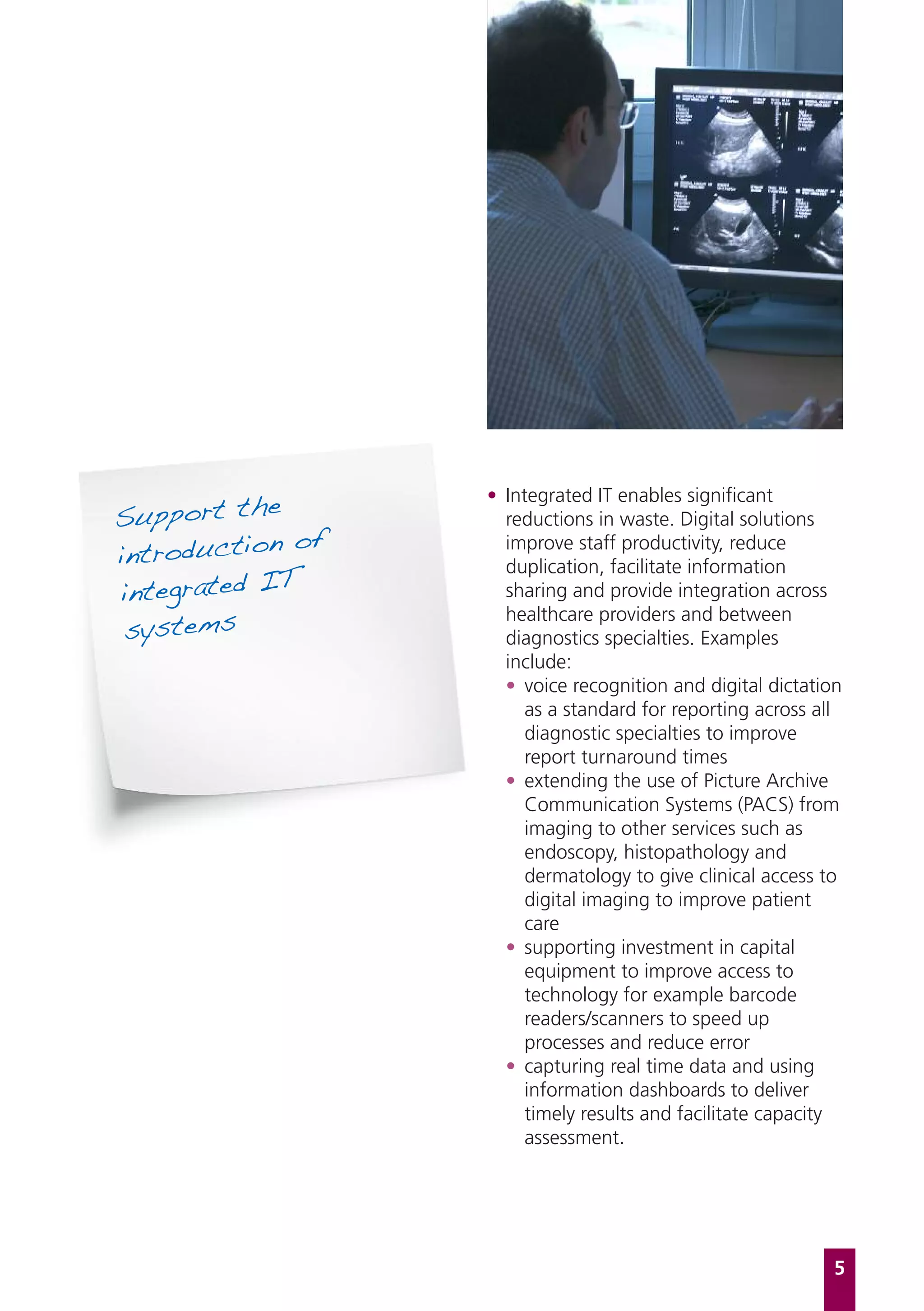
                  • Integrated IT enables significant
                    reductions in waste. Digital solutions
             of
introduction
                    improve staff productivity, reduce
                    duplication, facilitate information
integrated IT       sharing and provide integration across

 systems
                    healthcare providers and between
                    diagnostics specialties. Examples
                    include:
                    • voice recognition and digital dictation
                       as a standard for reporting across all
                       diagnostic specialties to improve
                       report turnaround times
                    • extending the use of Picture Archive
                       Communication Systems (PACS) from
                       imaging to other services such as
                       endoscopy, histopathology and
                       dermatology to give clinical access to
                       digital imaging to improve patient
                       care
                    • supporting investment in capital
                       equipment to improve access to
                       technology for example barcode
                       readers/scanners to speed up
                       processes and reduce error
                    • capturing real time data and using
                       information dashboards to deliver
                       timely results and facilitate capacity
                       assessment.


                                                            5
• Having the ability to capture real time
                  use of
    Promote the
                                                       capacity and demand data supports
                  demand
                                                       emergency, operational management
    capacity and                                       and longer term planning. The
                 h short
    data for bot
                                                       knowledge and skills to use this data

                    service
                                                       should be embedded in routine care
     and long term                                     and understood by clinical teams as
                   planning
     provision and
                                                       part of their day job. Access to the
                                                       data:
                                                       • reduces the need for reactive
                                                         operational management in the form
                                                         of costly short term waiting list
                                                         initiatives
                                                       • reduces variation in waiting times for
                                                         patients
                                                       • eliminates inappropriate carve out3
                                                       • promotes effective booking systems
                                                         and an understanding of single
                                                         queue4
                                                       • leads to appropriate demand
                                                         management
                                                       • begins to inform long term planning
                                                         and escalation plans.


• Ensuring patient and carer experience is
                                                                      nt and
                                                         Ensure patie
  captured appropriately (for example by
  using regular formal patient feedback
                                                                       ment and
  and questionnaires) forms the basis for                public engage
                                                                        PEE)
                                                         experience (P
  service redesign – especially where
                                                                        delivery
  direct patient contact is limited or
  absent.                                                 informs the
                                                                       f services
                                                          and design o
• Patients and carers can often provide a
  view on how diagnostic services
  integrate across multiple providers of
  emergency, elective and specialist
  pathways of care.


3
  Carve out - Ring fencing the time of a clinical expert/piece of specialised kit or dedicating
  resources or facilities for a particular group of patients or diagnostic tests.
4
  Single queue - Managing patient flow through the health systems on a first come first served
  basis, where patients are seen in the order that they are referred to the service.
                                                                                                  6
e use of
      Maximise th
                    support
      qualified and
      staff
                                                           Integrate service
                                                           improvement into
                                                           effective operational
• Ensure appropriate use of the skills of                  management practice
  both qualified and support staff.
• Promote the adoption of proven skill
  mix opportunities (and reduce variation
  in adoption across healthcare providers)
  to ensure that staff with a defined skill            • Continuous quality improvement (CQI)
  set perform only those tasks                           tools and techniques need to be
  appropriate to their role. This will                   integrated into daily working practice
  increase productivity and increase the                 and become a generic competency for
  usage of high value equipment.                         all staff in order to meet the financial
• While evidence based examples of best                  and demand challenges in diagnostics.
  practice in skill mix have been adopted              • There is a need to promote an
  across a number of diagnostic                          understanding that achievements from
  specialisms, others need to roll out                   elsewhere can be adapted locally to
  similar working practices to improve                   deliver significant benefits and increase
  service delivery. Examples for wide                    productivity. A directory5 has been
  scale adoption include:                                developed to increase the effectiveness
  • biomedical scientist reporting of                    of service improvement efforts by:
     histopathology slides                               • improving sustainability as the tools
  • further expansion of nurse                              are used and understood by teams
     endoscopists                                        • encouraging staff to walk the patient
  • use of assistant practitioners for                      pathway; ‘go see’ and then follow
     image acquisition in radiology                         this up by implementing changes
  • maximising skills across diagnostic                  • developing the improvement skills of
     disciplines and professional groups.                   all staff
                                                         • embedding measurement for
                                                            improvement into everyday work.


5
    Directory of Diagnostic Services for Commissioning Organisations - contains links to
    diagnostics policy documents, diagnostics service improvement and case studies


                                                                                                 7
uipment
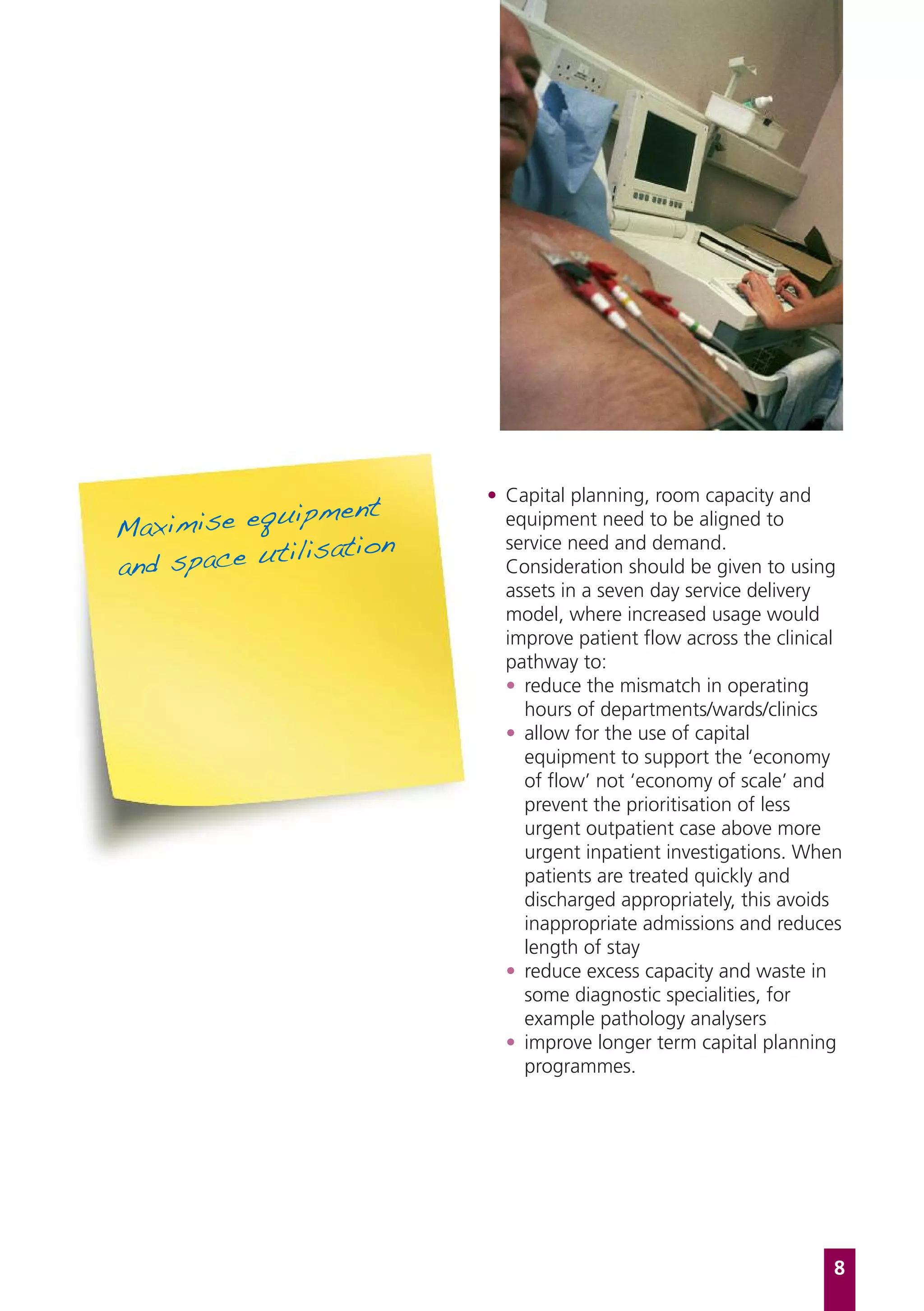
                         • Capital planning, room capacity and
Maximise eq                equipment need to be aligned to
            tilisation
and space u
                           service need and demand.
                           Consideration should be given to using
                           assets in a seven day service delivery
                           model, where increased usage would
                           improve patient flow across the clinical
                           pathway to:
                           • reduce the mismatch in operating
                             hours of departments/wards/clinics
                           • allow for the use of capital
                             equipment to support the ‘economy
                             of flow’ not ‘economy of scale’ and
                             prevent the prioritisation of less
                             urgent outpatient case above more
                             urgent inpatient investigations. When
                             patients are treated quickly and
                             discharged appropriately, this avoids
                             inappropriate admissions and reduces
                             length of stay
                           • reduce excess capacity and waste in
                             some diagnostic specialities, for
                             example pathology analysers
                           • improve longer term capital planning
                             programmes.


                                                                  8
Build strong
                    adership
     operational le
                   ent of
     and managem
                  ervices to
      diagnostic s
                   hole
      focus on w
                    ormance
      system perf


• Seeing diagnostics as part of the
  integrated whole system and
  understanding the impact of diagnostic
  service delivery on multiple clinical
  pathways would:
  • reduce dips in activity and
     performance due to annual leave
     and public holidays
  • reduce silo working6 and improve the
     integration between co-dependent
     pathways of care
  • enhance ownership of data for
     performance and improvement
  • allow for a greater understanding of
     ‘the bigger picture’ and how
     diagnostics can transform clinical
     pathways and impact positively on
     length of stay and admission                        • reduce the chance of inappropriate
     avoidance                                             additional activity to increase income
  • increase opportunities to incentivise                • highlight the key need to identify a
     redesign by encouraging innovation                    clear management, and performance
     and creative solutions within the                     and governance structure, where
     whole system, for example using                       diagnostic services straddle several
     tariff negotiations; avoiding                         directorates.
     disincentives


6
    Silo working - Working without explicit links and interfaces with other teams; working
    without ensuring interconnecting processes dovetail to ensure efficient patient flow.


                                                                                                9
NHS
CANCER
                                                                   NHS Improvement


DIAGNOSTICS


                       NHS Improvement

HEART
                       NHS Improvement’s strength and expertise lies in practical service
                       improvement. It has over a decade of experience in clinical patient
                       pathway redesign in cancer, diagnostics, heart, lung and stroke and
                       demonstrates some of the most leading edge improvement work in
                       England which supports improved patient experience and outcomes.
LUNG
                       Working closely with the Department of Health, trusts, clinical networks,
                       other health sector partners, professional bodies and charities, over the
                       past year it has tested, implemented, sustained and spread quantifiable
                       improvements with over 250 sites across the country as well as providing
STROKE
                       an improvement tool to over 2,400 GP practices.


NHS Improvement
3rd Floor | St John’s House | East Street | Leicester | LE1 6NB
Telephone: 0116 222 5184 | Fax: 0116 222 5101


www.improvement.nhs.uk
For further information contact:

Fiona Thow, Director, NHS Improvement
                                                                                                   Publication Ref: IMP/diagnostics0002 - March 2013


Email: fiona.thow@nhsiq.nhs.uk
                                                                                                   ©NHS Improvement 2012 | All Rights Reserved


Lesley Wright, Director, NHS Improvement
Email: lesley.wright@nhsiq.nhs.uk

Top tips to overcome the challenge of commissioning diagnostic services

  • 1.
    NHS CANCER NHS Improvement Diagnostics DIAGNOSTICS HEART LUNG STROKE NHS Improvement - Diagnostics Top tips to overcome the challenge of commissioning diagnostic services
  • 2.
    Top tips toovercome the challenge of commissioning diagnostic services ing Commission services diagnostics but it is is complex, get it essential to ver the right to deli r best care fo patients. This short guide presents top tips for commissioners to meet the most common challenges in the delivery of diagnostic services. As the National Directors for Diagnostics (endoscopy, imaging, pathology and physiological diagnostics), we consider these top tips are key to delivering We hope you find it useful. high value, effective, and timely diagnostics services which will Dr Ian Barnes, National Clinical support all clinical pathways. Director for Pathology, Department of Health The document draws on the Professor Erika Denton, National experience and expertise of NHS Clinical Director for Imaging, Improvement diagnostic teams over Department of Health the last 10 years in piloting service Professor Sue Hill, Chief Scientific redesign with clinical teams. It is Officer and National Clinical supported by numerous examples and Director for Physiological quantifiable evidence which can be Diagnostics, Department of Health found in its companion document Dr Roland Valori, National Clinical ‘Directory of Diagnostic Services for Director for Endoscopy, Department Commissioning Organisations’. of Health 2
  • 3.
    ared Develop ash g of the understandin iagnostic end to end d m request pathway fro ing acted to result be upon • Commissioners and service providers should have a joint understanding of what defines quality and value in diagnostic services which allows for a good patient experience. • This understanding will inform the • service accreditation which reflects development of a set of best practice the needs of patients for both patient key performance indicators (KPIs) facing services and those, like common across all diagnostics which pathology, where direct patient will support improvements in quality, contact is more limited safety, service delivery, costs and • standard reporting templates. patient experience by, for example, • Key Perfomance Indicators (KPIs) will measuring continuous service highlight how diagnostics are key to improvement or reducing variation in the delivery of all clinical pathways and service standards. also where opportunities exist for • Service specifications and standards improvement across the wider could be used to support enhanced healthcare system. Examples could local tariffs to encourage compliance include: with best practice and should include: • reduced length of stay if inpatients • guaranteed and predictable can be imaged seven days per week turnaround times for each test – • admission avoidance where prompt including reporting turnaround times access to diagnostic tests and results and clinical action following in A&E or outpatient clinics will availability of the diagnostic report prevent unnecessary hospital • right first time approach to reduce admissions or clinic attendance errors, improve safety and reduce • earlier diagnosis where earlier waste treatment results in improved outcomes. 3
  • 4.
    e need Recognise th tive for an effec re to infrastructu ostics support diagn • provide adequate portering services to support patient flow and enable effective use of high value equipment and increased productivity. • provide vacuum systems where appropriate to improve flow of • Transport and administration functions pathology specimens; reduce delays are key to service delivery. An in diagnosis; and the impact of understanding of how these can batching2 influence efficient patient flow, • communications with evidence based equipment and staff utilisation is key to requesting systems as mechanisms to effective productivity and therefore the ensure the right test is done at the impact diagnostics can have on the right time to reduce inappropriate/ whole healthcare system. repeat requests; and highlight • A good supporting infrastructure unexpected results to the referrer should: • support the use of next day postal • provide regular transport of samples delivery and SMS systems to inform to reduce batch sizes1 in laboratory patients of their appointments in a testing; improve turn-around times timely manner. This reduces wasted and ensure faster results appointments where patients fail to • operate seven days a week where attend or cancel too late for the required to reduce inappropriate appointment to be re-offered. retesting where samples are time expired and/or spoiled 1 Batch size - The designated number of investigations/samples which must be received before the group are processed. 2 Batching - Gathering together a group of investigations, for example, pathology specimens and waiting until a designated number has been received before they are processed. 4
  • 5.
    Support the • Integrated IT enables significant reductions in waste. Digital solutions of introduction improve staff productivity, reduce duplication, facilitate information integrated IT sharing and provide integration across systems healthcare providers and between diagnostics specialties. Examples include: • voice recognition and digital dictation as a standard for reporting across all diagnostic specialties to improve report turnaround times • extending the use of Picture Archive Communication Systems (PACS) from imaging to other services such as endoscopy, histopathology and dermatology to give clinical access to digital imaging to improve patient care • supporting investment in capital equipment to improve access to technology for example barcode readers/scanners to speed up processes and reduce error • capturing real time data and using information dashboards to deliver timely results and facilitate capacity assessment. 5
  • 6.
    • Having theability to capture real time use of Promote the capacity and demand data supports demand emergency, operational management capacity and and longer term planning. The h short data for bot knowledge and skills to use this data service should be embedded in routine care and long term and understood by clinical teams as planning provision and part of their day job. Access to the data: • reduces the need for reactive operational management in the form of costly short term waiting list initiatives • reduces variation in waiting times for patients • eliminates inappropriate carve out3 • promotes effective booking systems and an understanding of single queue4 • leads to appropriate demand management • begins to inform long term planning and escalation plans. • Ensuring patient and carer experience is nt and Ensure patie captured appropriately (for example by using regular formal patient feedback ment and and questionnaires) forms the basis for public engage PEE) experience (P service redesign – especially where delivery direct patient contact is limited or absent. informs the f services and design o • Patients and carers can often provide a view on how diagnostic services integrate across multiple providers of emergency, elective and specialist pathways of care. 3 Carve out - Ring fencing the time of a clinical expert/piece of specialised kit or dedicating resources or facilities for a particular group of patients or diagnostic tests. 4 Single queue - Managing patient flow through the health systems on a first come first served basis, where patients are seen in the order that they are referred to the service. 6
  • 7.
    e use of Maximise th support qualified and staff Integrate service improvement into effective operational • Ensure appropriate use of the skills of management practice both qualified and support staff. • Promote the adoption of proven skill mix opportunities (and reduce variation in adoption across healthcare providers) to ensure that staff with a defined skill • Continuous quality improvement (CQI) set perform only those tasks tools and techniques need to be appropriate to their role. This will integrated into daily working practice increase productivity and increase the and become a generic competency for usage of high value equipment. all staff in order to meet the financial • While evidence based examples of best and demand challenges in diagnostics. practice in skill mix have been adopted • There is a need to promote an across a number of diagnostic understanding that achievements from specialisms, others need to roll out elsewhere can be adapted locally to similar working practices to improve deliver significant benefits and increase service delivery. Examples for wide productivity. A directory5 has been scale adoption include: developed to increase the effectiveness • biomedical scientist reporting of of service improvement efforts by: histopathology slides • improving sustainability as the tools • further expansion of nurse are used and understood by teams endoscopists • encouraging staff to walk the patient • use of assistant practitioners for pathway; ‘go see’ and then follow image acquisition in radiology this up by implementing changes • maximising skills across diagnostic • developing the improvement skills of disciplines and professional groups. all staff • embedding measurement for improvement into everyday work. 5 Directory of Diagnostic Services for Commissioning Organisations - contains links to diagnostics policy documents, diagnostics service improvement and case studies 7
  • 8.
    uipment • Capital planning, room capacity and Maximise eq equipment need to be aligned to tilisation and space u service need and demand. Consideration should be given to using assets in a seven day service delivery model, where increased usage would improve patient flow across the clinical pathway to: • reduce the mismatch in operating hours of departments/wards/clinics • allow for the use of capital equipment to support the ‘economy of flow’ not ‘economy of scale’ and prevent the prioritisation of less urgent outpatient case above more urgent inpatient investigations. When patients are treated quickly and discharged appropriately, this avoids inappropriate admissions and reduces length of stay • reduce excess capacity and waste in some diagnostic specialities, for example pathology analysers • improve longer term capital planning programmes. 8
  • 9.
    Build strong adership operational le ent of and managem ervices to diagnostic s hole focus on w ormance system perf • Seeing diagnostics as part of the integrated whole system and understanding the impact of diagnostic service delivery on multiple clinical pathways would: • reduce dips in activity and performance due to annual leave and public holidays • reduce silo working6 and improve the integration between co-dependent pathways of care • enhance ownership of data for performance and improvement • allow for a greater understanding of ‘the bigger picture’ and how diagnostics can transform clinical pathways and impact positively on length of stay and admission • reduce the chance of inappropriate avoidance additional activity to increase income • increase opportunities to incentivise • highlight the key need to identify a redesign by encouraging innovation clear management, and performance and creative solutions within the and governance structure, where whole system, for example using diagnostic services straddle several tariff negotiations; avoiding directorates. disincentives 6 Silo working - Working without explicit links and interfaces with other teams; working without ensuring interconnecting processes dovetail to ensure efficient patient flow. 9
  • 10.
    NHS CANCER NHS Improvement DIAGNOSTICS NHS Improvement HEART NHS Improvement’s strength and expertise lies in practical service improvement. It has over a decade of experience in clinical patient pathway redesign in cancer, diagnostics, heart, lung and stroke and demonstrates some of the most leading edge improvement work in England which supports improved patient experience and outcomes. LUNG Working closely with the Department of Health, trusts, clinical networks, other health sector partners, professional bodies and charities, over the past year it has tested, implemented, sustained and spread quantifiable improvements with over 250 sites across the country as well as providing STROKE an improvement tool to over 2,400 GP practices. NHS Improvement 3rd Floor | St John’s House | East Street | Leicester | LE1 6NB Telephone: 0116 222 5184 | Fax: 0116 222 5101 www.improvement.nhs.uk For further information contact: Fiona Thow, Director, NHS Improvement Publication Ref: IMP/diagnostics0002 - March 2013 Email: fiona.thow@nhsiq.nhs.uk ©NHS Improvement 2012 | All Rights Reserved Lesley Wright, Director, NHS Improvement Email: lesley.wright@nhsiq.nhs.uk