Top Scientists in Ancient
Times
❖ AD is AFTER Jesus was born
❖ BC is BEFORE Jesus was born
❖ AD comes from Latin Anno Domini meaning
"In the year of Our Lord"
❖ BC comes from Before Christ
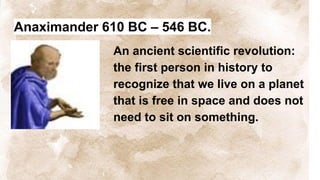
Anaximander 610 BC – 546 BC.
An ancient scientific revolution:
the first person in history to
recognize that we live on a planet
that is free in space and does not
need to sit on something.
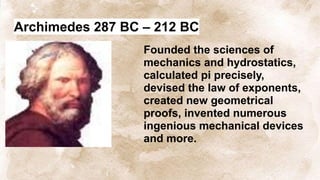
Archimedes 287 BC – 212 BC
Founded the sciences of
mechanics and hydrostatics,
calculated pi precisely,
devised the law of exponents,
created new geometrical
proofs, invented numerous
ingenious mechanical devices
and more.
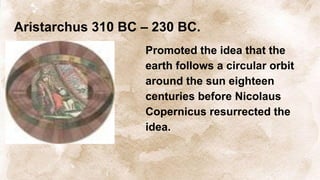
Aristarchus 310 BC – 230 BC.
Promoted the idea that the
earth follows a circular orbit
around the sun eighteen
centuries before Nicolaus
Copernicus resurrected the
idea.
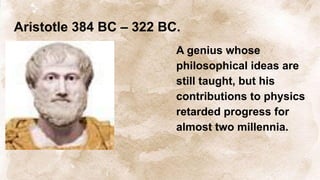
Aristotle 384 BC – 322 BC.
A genius whose
philosophical ideas are
still taught, but his
contributions to physics
retarded progress for
almost two millennia.
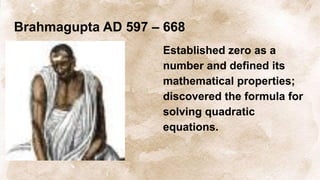
Brahmagupta AD 597 – 668
Established zero as a
number and defined its
mathematical properties;
discovered the formula for
solving quadratic
equations.
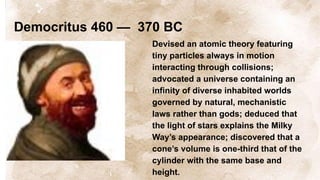
Democritus 460 — 370 BC
Devised an atomic theory featuring
tiny particles always in motion
interacting through collisions;
advocated a universe containing an
infinity of diverse inhabited worlds
governed by natural, mechanistic
laws rather than gods; deduced that
the light of stars explains the Milky
Way’s appearance; discovered that a
cone’s volume is one-third that of the
cylinder with the same base and
height.
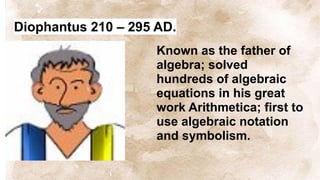
Diophantus 210 – 295 AD.
Known as the father of
algebra; solved
hundreds of algebraic
equations in his great
work Arithmetica; first to
use algebraic notation
and symbolism.
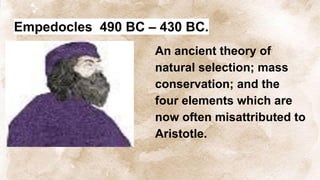
Empedocles 490 BC – 430 BC.
An ancient theory of
natural selection; mass
conservation; and the
four elements which are
now often misattributed to
Aristotle.
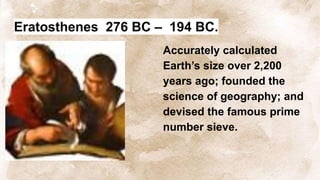
Eratosthenes 276 BC – 194 BC.
Accurately calculated
Earth’s size over 2,200
years ago; founded the
science of geography; and
devised the famous prime
number sieve.
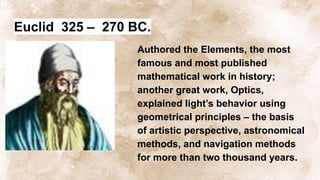
Euclid 325 – 270 BC.
Authored the Elements, the most
famous and most published
mathematical work in history;
another great work, Optics,
explained light’s behavior using
geometrical principles – the basis
of artistic perspective, astronomical
methods, and navigation methods
for more than two thousand years.
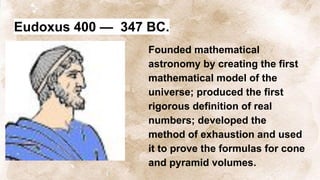
Eudoxus 400 — 347 BC.
Founded mathematical
astronomy by creating the first
mathematical model of the
universe; produced the first
rigorous definition of real
numbers; developed the
method of exhaustion and used
it to prove the formulas for cone
and pyramid volumes.
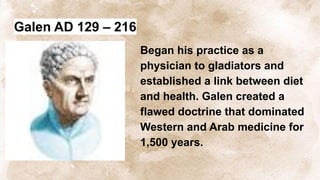
Galen AD 129 – 216
Began his practice as a
physician to gladiators and
established a link between diet
and health. Galen created a
flawed doctrine that dominated
Western and Arab medicine for
1,500 years.
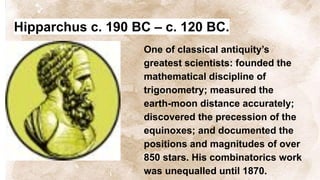
Hipparchus c. 190 BC – c. 120 BC.
One of classical antiquity’s
greatest scientists: founded the
mathematical discipline of
trigonometry; measured the
earth-moon distance accurately;
discovered the precession of the
equinoxes; and documented the
positions and magnitudes of over
850 stars. His combinatorics work
was unequalled until 1870.
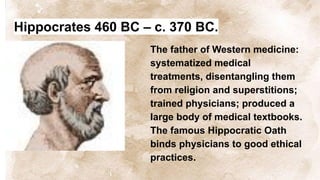
Hippocrates 460 BC – c. 370 BC.
The father of Western medicine:
systematized medical
treatments, disentangling them
from religion and superstitions;
trained physicians; produced a
large body of medical textbooks.
The famous Hippocratic Oath
binds physicians to good ethical
practices.
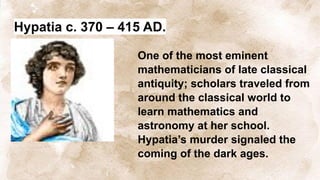
Hypatia c. 370 – 415 AD.
One of the most eminent
mathematicians of late classical
antiquity; scholars traveled from
around the classical world to
learn mathematics and
astronomy at her school.
Hypatia’s murder signaled the
coming of the dark ages.
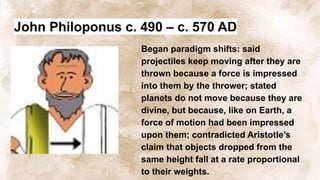
John Philoponus c. 490 – c. 570 AD
Began paradigm shifts: said
projectiles keep moving after they are
thrown because a force is impressed
into them by the thrower; stated
planets do not move because they are
divine, but because, like on Earth, a
force of motion had been impressed
upon them; contradicted Aristotle’s
claim that objects dropped from the
same height fall at a rate proportional
to their weights.
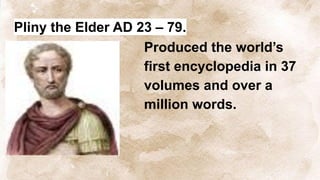
Pliny the Elder AD 23 – 79.
Produced the world’s
first encyclopedia in 37
volumes and over a
million words.
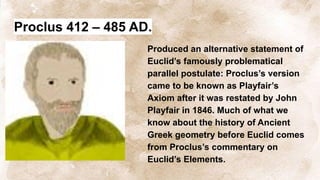
Proclus 412 – 485 AD.
Produced an alternative statement of
Euclid’s famously problematical
parallel postulate: Proclus’s version
came to be known as Playfair’s
Axiom after it was restated by John
Playfair in 1846. Much of what we
know about the history of Ancient
Greek geometry before Euclid comes
from Proclus’s commentary on
Euclid’s Elements.
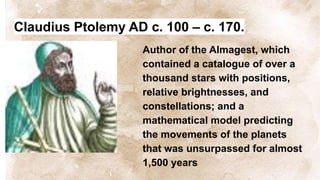
Claudius Ptolemy AD c. 100 – c. 170.
Author of the Almagest, which
contained a catalogue of over a
thousand stars with positions,
relative brightnesses, and
constellations; and a
mathematical model predicting
the movements of the planets
that was unsurpassed for almost
1,500 years
Pythagoras 570 BC – 497 BC.
Believed the universe was
constructed using mathematics
and everything could be
described with numbers;
established a link between
mathematics and music; proved
Pythagoras’s theorem;
discovered irrational numbers;
discovered the Platonic Solids.
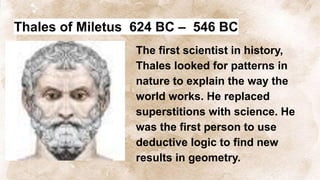
Thales of Miletus 624 BC – 546 BC
The first scientist in history,
Thales looked for patterns in
nature to explain the way the
world works. He replaced
superstitions with science. He
was the first person to use
deductive logic to find new
results in geometry.
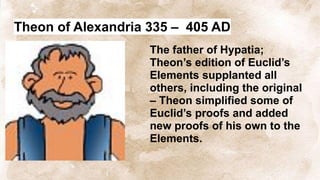
Theon of Alexandria 335 – 405 AD
The father of Hypatia;
Theon’s edition of Euclid’s
Elements supplanted all
others, including the original
– Theon simplified some of
Euclid’s proofs and added
new proofs of his own to the
Elements.
Source
https://www.famousscientists.org/top-scientists-in-antiquity/
Thank you for watching 😊

Top scientists in ancient times

  • 1.
    Top Scientists inAncient Times
  • 2.
    ❖ AD isAFTER Jesus was born ❖ BC is BEFORE Jesus was born ❖ AD comes from Latin Anno Domini meaning "In the year of Our Lord" ❖ BC comes from Before Christ
  • 3.
    Anaximander 610 BC– 546 BC. An ancient scientific revolution: the first person in history to recognize that we live on a planet that is free in space and does not need to sit on something.
  • 4.
    Archimedes 287 BC– 212 BC Founded the sciences of mechanics and hydrostatics, calculated pi precisely, devised the law of exponents, created new geometrical proofs, invented numerous ingenious mechanical devices and more.
  • 5.
    Aristarchus 310 BC– 230 BC. Promoted the idea that the earth follows a circular orbit around the sun eighteen centuries before Nicolaus Copernicus resurrected the idea.
  • 6.
    Aristotle 384 BC– 322 BC. A genius whose philosophical ideas are still taught, but his contributions to physics retarded progress for almost two millennia.
  • 7.
    Brahmagupta AD 597– 668 Established zero as a number and defined its mathematical properties; discovered the formula for solving quadratic equations.
  • 8.
    Democritus 460 —370 BC Devised an atomic theory featuring tiny particles always in motion interacting through collisions; advocated a universe containing an infinity of diverse inhabited worlds governed by natural, mechanistic laws rather than gods; deduced that the light of stars explains the Milky Way’s appearance; discovered that a cone’s volume is one-third that of the cylinder with the same base and height.
  • 9.
    Diophantus 210 –295 AD. Known as the father of algebra; solved hundreds of algebraic equations in his great work Arithmetica; first to use algebraic notation and symbolism.
  • 10.
    Empedocles 490 BC– 430 BC. An ancient theory of natural selection; mass conservation; and the four elements which are now often misattributed to Aristotle.
  • 11.
    Eratosthenes 276 BC– 194 BC. Accurately calculated Earth’s size over 2,200 years ago; founded the science of geography; and devised the famous prime number sieve.
  • 12.
    Euclid 325 –270 BC. Authored the Elements, the most famous and most published mathematical work in history; another great work, Optics, explained light’s behavior using geometrical principles – the basis of artistic perspective, astronomical methods, and navigation methods for more than two thousand years.
  • 13.
    Eudoxus 400 —347 BC. Founded mathematical astronomy by creating the first mathematical model of the universe; produced the first rigorous definition of real numbers; developed the method of exhaustion and used it to prove the formulas for cone and pyramid volumes.
  • 14.
    Galen AD 129– 216 Began his practice as a physician to gladiators and established a link between diet and health. Galen created a flawed doctrine that dominated Western and Arab medicine for 1,500 years.
  • 15.
    Hipparchus c. 190BC – c. 120 BC. One of classical antiquity’s greatest scientists: founded the mathematical discipline of trigonometry; measured the earth-moon distance accurately; discovered the precession of the equinoxes; and documented the positions and magnitudes of over 850 stars. His combinatorics work was unequalled until 1870.
  • 16.
    Hippocrates 460 BC– c. 370 BC. The father of Western medicine: systematized medical treatments, disentangling them from religion and superstitions; trained physicians; produced a large body of medical textbooks. The famous Hippocratic Oath binds physicians to good ethical practices.
  • 17.
    Hypatia c. 370– 415 AD. One of the most eminent mathematicians of late classical antiquity; scholars traveled from around the classical world to learn mathematics and astronomy at her school. Hypatia’s murder signaled the coming of the dark ages.
  • 18.
    John Philoponus c.490 – c. 570 AD Began paradigm shifts: said projectiles keep moving after they are thrown because a force is impressed into them by the thrower; stated planets do not move because they are divine, but because, like on Earth, a force of motion had been impressed upon them; contradicted Aristotle’s claim that objects dropped from the same height fall at a rate proportional to their weights.
  • 19.
    Pliny the ElderAD 23 – 79. Produced the world’s first encyclopedia in 37 volumes and over a million words.
  • 20.
    Proclus 412 –485 AD. Produced an alternative statement of Euclid’s famously problematical parallel postulate: Proclus’s version came to be known as Playfair’s Axiom after it was restated by John Playfair in 1846. Much of what we know about the history of Ancient Greek geometry before Euclid comes from Proclus’s commentary on Euclid’s Elements.
  • 21.
    Claudius Ptolemy ADc. 100 – c. 170. Author of the Almagest, which contained a catalogue of over a thousand stars with positions, relative brightnesses, and constellations; and a mathematical model predicting the movements of the planets that was unsurpassed for almost 1,500 years
  • 22.
    Pythagoras 570 BC– 497 BC. Believed the universe was constructed using mathematics and everything could be described with numbers; established a link between mathematics and music; proved Pythagoras’s theorem; discovered irrational numbers; discovered the Platonic Solids.
  • 23.
    Thales of Miletus624 BC – 546 BC The first scientist in history, Thales looked for patterns in nature to explain the way the world works. He replaced superstitions with science. He was the first person to use deductive logic to find new results in geometry.
  • 24.
    Theon of Alexandria335 – 405 AD The father of Hypatia; Theon’s edition of Euclid’s Elements supplanted all others, including the original – Theon simplified some of Euclid’s proofs and added new proofs of his own to the Elements.
  • 25.
  • 26.
    Thank you forwatching 😊