ERWIN MARLON R. SARIO
Instructor
Contributionof Greeks in the Developmentof Science and Technology
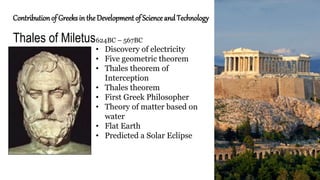
Thales of Miletus624BC – 567BC
• Discovery of electricity
• Five geometric theorem
• Thales theorem of
Interception
• Thales theorem
• First Greek Philosopher
• Theory of matter based on
water
• Flat Earth
• Predicted a Solar Eclipse
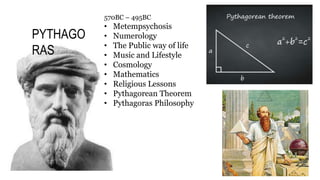
PYTHAGO
RAS
570BC – 495BC
• Metempsychosis
• Numerology
• The Public way of life
• Music and Lifestyle
• Cosmology
• Mathematics
• Religious Lessons
• Pythagorean Theorem
• Pythagoras Philosophy
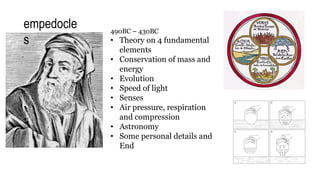
empedocle
s
490BC – 430BC
• Theory on 4 fundamental
elements
• Conservation of mass and
energy
• Evolution
• Speed of light
• Senses
• Air pressure, respiration
and compression
• Astronomy
• Some personal details and
End
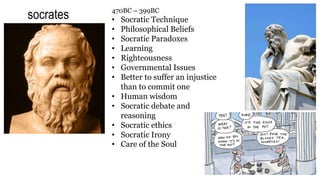
socrates 470BC – 399BC
• Socratic Technique
• Philosophical Beliefs
• Socratic Paradoxes
• Learning
• Righteousness
• Governmental Issues
• Better to suffer an injustice
than to commit one
• Human wisdom
• Socratic debate and
reasoning
• Socratic ethics
• Socratic Irony
• Care of the Soul
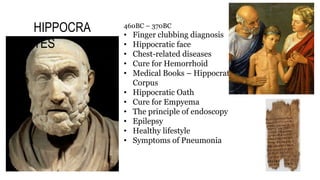
460BC – 370BC
• Finger clubbing diagnosis
• Hippocratic face
• Chest-related diseases
• Cure for Hemorrhoid
• Medical Books – Hippocratic
Corpus
• Hippocratic Oath
• Cure for Empyema
• The principle of endoscopy
• Epilepsy
• Healthy lifestyle
• Symptoms of Pneumonia
HIPPOCRA
TES
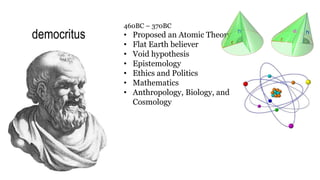
democritus
460BC – 370BC
• Proposed an Atomic Theory
• Flat Earth believer
• Void hypothesis
• Epistemology
• Ethics and Politics
• Mathematics
• Anthropology, Biology, and
Cosmology
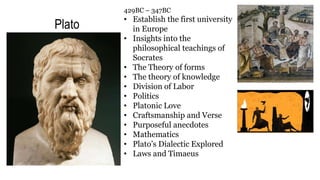
Plato
429BC – 347BC
• Establish the first university
in Europe
• Insights into the
philosophical teachings of
Socrates
• The Theory of forms
• The theory of knowledge
• Division of Labor
• Politics
• Platonic Love
• Craftsmanship and Verse
• Purposeful anecdotes
• Mathematics
• Plato’s Dialectic Explored
• Laws and Timaeus
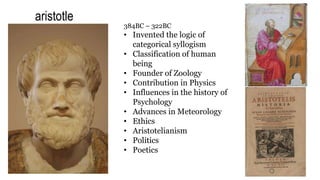
aristotle
384BC – 322BC
• Invented the logic of
categorical syllogism
• Classification of human
being
• Founder of Zoology
• Contribution in Physics
• Influences in the history of
Psychology
• Advances in Meteorology
• Ethics
• Aristotelianism
• Politics
• Poetics
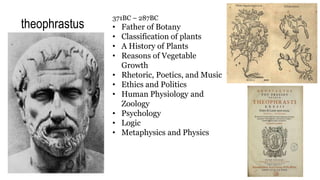
theophrastus
371BC – 287BC
• Father of Botany
• Classification of plants
• A History of Plants
• Reasons of Vegetable
Growth
• Rhetoric, Poetics, and Music
• Ethics and Politics
• Human Physiology and
Zoology
• Psychology
• Logic
• Metaphysics and Physics
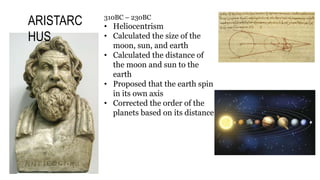
ARISTARC
HUS
310BC – 230BC
• Heliocentrism
• Calculated the size of the
moon, sun, and earth
• Calculated the distance of
the moon and sun to the
earth
• Proposed that the earth spin
in its own axis
• Corrected the order of the
planets based on its distance
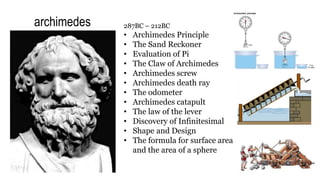
archimedes 287BC – 212BC
• Archimedes Principle
• The Sand Reckoner
• Evaluation of Pi
• The Claw of Archimedes
• Archimedes screw
• Archimedes death ray
• The odometer
• Archimedes catapult
• The law of the lever
• Discovery of Infinitesimal
• Shape and Design
• The formula for surface area
and the area of a sphere
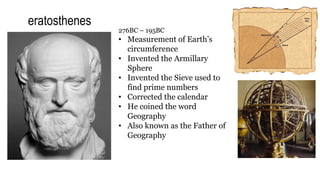
eratosthenes
276BC – 195BC
• Measurement of Earth’s
circumference
• Invented the Armillary
Sphere
• Invented the Sieve used to
find prime numbers
• Corrected the calendar
• He coined the word
Geography
• Also known as the Father of
Geography
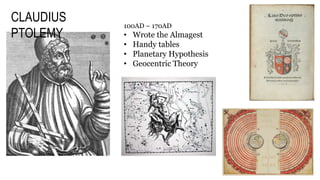
CLAUDIUS
PTOLEMY
100AD – 170AD
• Wrote the Almagest
• Handy tables
• Planetary Hypothesis
• Geocentric Theory
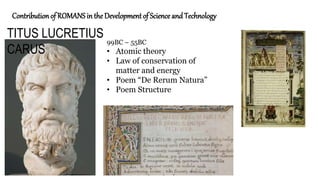
TITUS LUCRETIUS
CARUS
99BC – 55BC
• Atomic theory
• Law of conservation of
matter and energy
• Poem “De Rerum Natura”
• Poem Structure
Contributionof ROMANSin the Development of Science and Technology
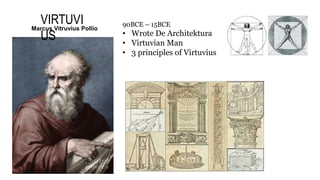
VIRTUVI
US
Marcus Vitruvius Pollio
90BCE – 15BCE
• Wrote De Architektura
• Virtuvian Man
• 3 principles of Virtuvius
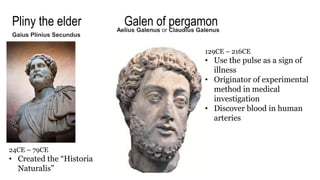
Pliny the elder
Gaius Plinius Secundus
24CE – 79CE
• Created the “Historia
Naturalis”
Galen of pergamon
Aelius Galenus or Claudius Galenus
129CE – 216CE
• Use the pulse as a sign of
illness
• Originator of experimental
method in medical
investigation
• Discover blood in human
arteries
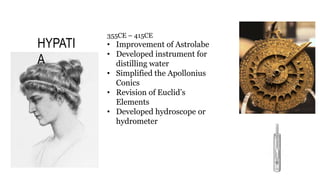
HYPATI
A
355CE – 415CE
• Improvement of Astrolabe
• Developed instrument for
distilling water
• Simplified the Apollonius
Conics
• Revision of Euclid’s
Elements
• Developed hydroscope or
hydrometer
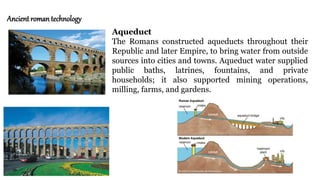
Ancient roman technology
Aqueduct
The Romans constructed aqueducts throughout their
Republic and later Empire, to bring water from outside
sources into cities and towns. Aqueduct water supplied
public baths, latrines, fountains, and private
households; it also supported mining operations,
milling, farms, and gardens.
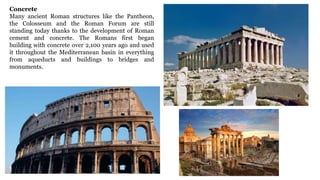
Concrete
Many ancient Roman structures like the Pantheon,
the Colosseum and the Roman Forum are still
standing today thanks to the development of Roman
cement and concrete. The Romans first began
building with concrete over 2,100 years ago and used
it throughout the Mediterranean basin in everything
from aqueducts and buildings to bridges and
monuments.
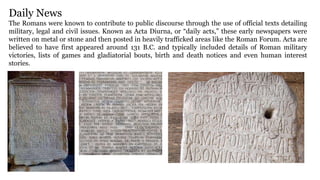
Daily News
The Romans were known to contribute to public discourse through the use of official texts detailing
military, legal and civil issues. Known as Acta Diurna, or “daily acts,” these early newspapers were
written on metal or stone and then posted in heavily trafficked areas like the Roman Forum. Acta are
believed to have first appeared around 131 B.C. and typically included details of Roman military
victories, lists of games and gladiatorial bouts, birth and death notices and even human interest
stories.
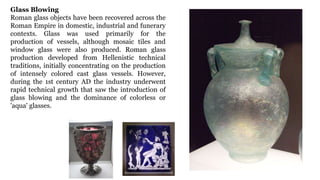
Glass Blowing
Roman glass objects have been recovered across the
Roman Empire in domestic, industrial and funerary
contexts. Glass was used primarily for the
production of vessels, although mosaic tiles and
window glass were also produced. Roman glass
production developed from Hellenistic technical
traditions, initially concentrating on the production
of intensely colored cast glass vessels. However,
during the 1st century AD the industry underwent
rapid technical growth that saw the introduction of
glass blowing and the dominance of colorless or
'aqua' glasses.
Thank you!

Science, Technology, and Society lesson 3.pptx

  • 1.
    ERWIN MARLON R.SARIO Instructor
  • 2.
    Contributionof Greeks inthe Developmentof Science and Technology Thales of Miletus624BC – 567BC • Discovery of electricity • Five geometric theorem • Thales theorem of Interception • Thales theorem • First Greek Philosopher • Theory of matter based on water • Flat Earth • Predicted a Solar Eclipse
  • 3.
    PYTHAGO RAS 570BC – 495BC •Metempsychosis • Numerology • The Public way of life • Music and Lifestyle • Cosmology • Mathematics • Religious Lessons • Pythagorean Theorem • Pythagoras Philosophy
  • 4.
    empedocle s 490BC – 430BC •Theory on 4 fundamental elements • Conservation of mass and energy • Evolution • Speed of light • Senses • Air pressure, respiration and compression • Astronomy • Some personal details and End
  • 5.
    socrates 470BC –399BC • Socratic Technique • Philosophical Beliefs • Socratic Paradoxes • Learning • Righteousness • Governmental Issues • Better to suffer an injustice than to commit one • Human wisdom • Socratic debate and reasoning • Socratic ethics • Socratic Irony • Care of the Soul
  • 6.
    460BC – 370BC •Finger clubbing diagnosis • Hippocratic face • Chest-related diseases • Cure for Hemorrhoid • Medical Books – Hippocratic Corpus • Hippocratic Oath • Cure for Empyema • The principle of endoscopy • Epilepsy • Healthy lifestyle • Symptoms of Pneumonia HIPPOCRA TES
  • 7.
    democritus 460BC – 370BC •Proposed an Atomic Theory • Flat Earth believer • Void hypothesis • Epistemology • Ethics and Politics • Mathematics • Anthropology, Biology, and Cosmology
  • 8.
    Plato 429BC – 347BC •Establish the first university in Europe • Insights into the philosophical teachings of Socrates • The Theory of forms • The theory of knowledge • Division of Labor • Politics • Platonic Love • Craftsmanship and Verse • Purposeful anecdotes • Mathematics • Plato’s Dialectic Explored • Laws and Timaeus
  • 9.
    aristotle 384BC – 322BC •Invented the logic of categorical syllogism • Classification of human being • Founder of Zoology • Contribution in Physics • Influences in the history of Psychology • Advances in Meteorology • Ethics • Aristotelianism • Politics • Poetics
  • 10.
    theophrastus 371BC – 287BC •Father of Botany • Classification of plants • A History of Plants • Reasons of Vegetable Growth • Rhetoric, Poetics, and Music • Ethics and Politics • Human Physiology and Zoology • Psychology • Logic • Metaphysics and Physics
  • 11.
    ARISTARC HUS 310BC – 230BC •Heliocentrism • Calculated the size of the moon, sun, and earth • Calculated the distance of the moon and sun to the earth • Proposed that the earth spin in its own axis • Corrected the order of the planets based on its distance
  • 12.
    archimedes 287BC –212BC • Archimedes Principle • The Sand Reckoner • Evaluation of Pi • The Claw of Archimedes • Archimedes screw • Archimedes death ray • The odometer • Archimedes catapult • The law of the lever • Discovery of Infinitesimal • Shape and Design • The formula for surface area and the area of a sphere
  • 13.
    eratosthenes 276BC – 195BC •Measurement of Earth’s circumference • Invented the Armillary Sphere • Invented the Sieve used to find prime numbers • Corrected the calendar • He coined the word Geography • Also known as the Father of Geography
  • 14.
    CLAUDIUS PTOLEMY 100AD – 170AD •Wrote the Almagest • Handy tables • Planetary Hypothesis • Geocentric Theory
  • 15.
    TITUS LUCRETIUS CARUS 99BC –55BC • Atomic theory • Law of conservation of matter and energy • Poem “De Rerum Natura” • Poem Structure Contributionof ROMANSin the Development of Science and Technology
  • 16.
    VIRTUVI US Marcus Vitruvius Pollio 90BCE– 15BCE • Wrote De Architektura • Virtuvian Man • 3 principles of Virtuvius
  • 17.
    Pliny the elder GaiusPlinius Secundus 24CE – 79CE • Created the “Historia Naturalis” Galen of pergamon Aelius Galenus or Claudius Galenus 129CE – 216CE • Use the pulse as a sign of illness • Originator of experimental method in medical investigation • Discover blood in human arteries
  • 18.
    HYPATI A 355CE – 415CE •Improvement of Astrolabe • Developed instrument for distilling water • Simplified the Apollonius Conics • Revision of Euclid’s Elements • Developed hydroscope or hydrometer
  • 19.
    Ancient roman technology Aqueduct TheRomans constructed aqueducts throughout their Republic and later Empire, to bring water from outside sources into cities and towns. Aqueduct water supplied public baths, latrines, fountains, and private households; it also supported mining operations, milling, farms, and gardens.
  • 20.
    Concrete Many ancient Romanstructures like the Pantheon, the Colosseum and the Roman Forum are still standing today thanks to the development of Roman cement and concrete. The Romans first began building with concrete over 2,100 years ago and used it throughout the Mediterranean basin in everything from aqueducts and buildings to bridges and monuments.
  • 21.
    Daily News The Romanswere known to contribute to public discourse through the use of official texts detailing military, legal and civil issues. Known as Acta Diurna, or “daily acts,” these early newspapers were written on metal or stone and then posted in heavily trafficked areas like the Roman Forum. Acta are believed to have first appeared around 131 B.C. and typically included details of Roman military victories, lists of games and gladiatorial bouts, birth and death notices and even human interest stories.
  • 22.
    Glass Blowing Roman glassobjects have been recovered across the Roman Empire in domestic, industrial and funerary contexts. Glass was used primarily for the production of vessels, although mosaic tiles and window glass were also produced. Roman glass production developed from Hellenistic technical traditions, initially concentrating on the production of intensely colored cast glass vessels. However, during the 1st century AD the industry underwent rapid technical growth that saw the introduction of glass blowing and the dominance of colorless or 'aqua' glasses.
  • 23.