Earth Science
Science
- branch of knowledge or study dealing with a
body of facts or truths systematically arranged
and showing the operation of general laws.
- systematic knowledge of the physical or material
world gained through observation and
experimentation.
- knowledge, as of facts or principle, knowledge
gained by systematic study.
Beginning:
ANCIENT CONTRIBUTORS IN THE
STUDY OF SCIENCE
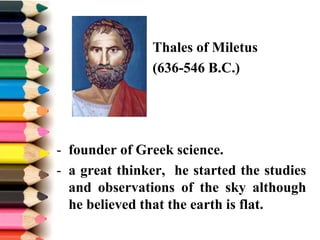
Thales of Miletus
(636-546 B.C.)
- founder of Greek science.
- a great thinker, he started the studies
and observations of the sky although
he believed that the earth is flat.
- he was the first to conclude that the
moon shines from light reflected from
the sun and to accurately predict lunar
and solar eclipses.
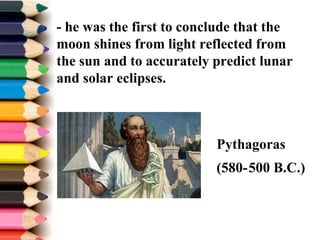
Pythagoras
(580-500 B.C.)
- first to recognize that the morning
and evening stars are one and the
same heavenly body.
- he named it “Aphrodite”, from the
name of the Greek goddess of love
and beauty known now as planet
Venus.
- he was the first to teach that the
earth is spherical and discover the
relationship between the pitch of
the sound and the length of the
vibrating string.
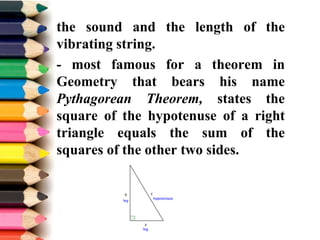
- most famous for a theorem in
Geometry that bears his name
Pythagorean Theorem, states the
square of the hypotenuse of a right
triangle equals the sum of the
squares of the other two sides.
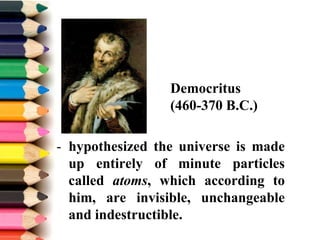
Democritus
(460-370 B.C.)
- hypothesized the universe is made
up entirely of minute particles
called atoms, which according to
him, are invisible, unchangeable
and indestructible.
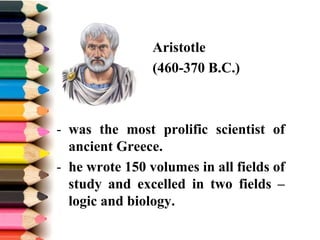
Aristotle
(460-370 B.C.)
- was the most prolific scientist of
ancient Greece.
- he wrote 150 volumes in all fields of
study and excelled in two fields –
logic and biology.
- his systematic treatment of logic is
standard for students until today.
- in biology–he was the first to make
systematic classification of animals.
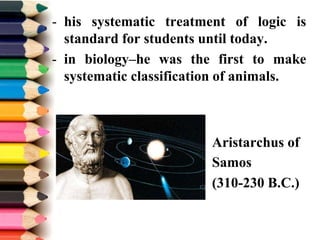
Aristarchus of
Samos
(310-230 B.C.)
- was the first to correctly
hypothesize the the earth turns on
its axis and revolves around the
Sun, anteceding Copernicus by
more than 1500 years.
- he used the method of ratio and
proportion in his calculations of the
sizes of the Sun and the Moon.
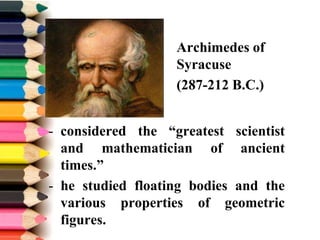
Archimedes of
Syracuse
(287-212 B.C.)
- considered the “greatest scientist
and mathematician of ancient
times.”
- he studied floating bodies and the
various properties of geometric
figures.
- was the first to correctly
hypothesize the earth turns on its
axis and revolves around the Sun,
anteceding Copernicus by more
than 1500 years.
- he used the method of ratio and
proportion in his calculations of the
sizes of the Sun and the Moon.
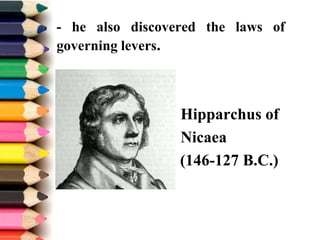
- he also discovered the laws of
governing levers.
- Hipparchus of
- Nicaea
- V (146-127 B.C.)
- one of the greatest Greek
astronomers of antiquity.
- he constructed a very systematic
model of the heavens and made
more accurate determination of the
sizes of the Sun and Moon and
their distances from earth.
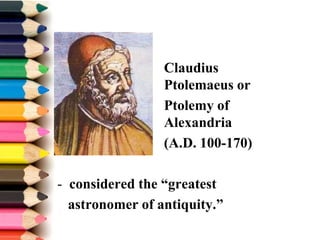
Claudius
Ptolemaeus or
Ptolemy of
Alexandria
(A.D. 100-170)
- considered the “greatest
astronomer of antiquity.”
- he wrote his famous book,
Almagest where he explained
his theory of planetary motion
and described in detail the
motion of the planets around
the Earth.
- he advocated the geocentric
theory which placed the
stationary earth at the center
of the universe with the sun,
the planets, the Moon and the
stars orbiting around it in
perfect circles at equal rates,
except for the planets.
- although proven incorrect 1500
years later by Copernicus,
Kepler and Newton.
- his attempts for accuracy and
precision of details is a model
for subsequent scientists to
emulate.
FOUNDERS OF MODERN SCIENCE
Nicalaus Copernicus (1473-1543)
- Polish astronomer who proposed that
the planets have the Sun as the fixed point
to which their motions are to be referred;
that Earth is a planet which, besides
orbiting the Sun annually, also turns once
daily on its own axis; and that very slow,
long-term changes in the direction of this
axis account for the precession of the
equinoxes.
- This representation of the heavens is
usually called the heliocentric, or
“Sun-centred,” system - derived from the
Greek helios, meaning “Sun.”
Tycho Brahe (1546-1601)
- Danish astronomer whose work in
developing astronomical instruments and
in measuring and fixing the positions
of stars paved the way for future
discoveries.
- His observations - the most
accurate possible before the
invention of the telescope included
a comprehensive study of the solar
system and accurate positions of
more than 777 fixed stars.
Johannes Kepler (1571-1630)
- German astronomer who discovered
three major laws of planetary motion,
conventionally designated as follows:
a. the planets move in
elliptical orbits with the Sun at one
focus
b. the time necessary to traverse any arc
of a planetary orbit is proportional to
the area of the sector between the
central body and that arc (the “area
law”)
c. there is an exact relationship between
the squares of the planets’ periodic
times and the cubes of the radii of their
orbits (the “harmonic law”)
Galileo Galilei (1564-1642)
- Italian natural philosopher, astronomer,
and mathematician who made
fundamental contributions to the
sciences of motion, astronomy,
and strength of materials and to the
development of the scientific method.
- His formulation of (circular) inertia,
the law of falling bodies,
and parabolic trajectories marked the
beginning of a fundamental change in
the study of motion.
- His insistence that the book of nature
was written in the language
of mathematics changed natural
philosophy from a verbal, qualitative
account to a mathematical one in
which experimentation became a
recognized method for discovering the
facts of nature.
- His discoveries with the telescope
revolutionized astronomy and paved the
way for the acceptance of
the Copernican heliocentric system, but
his advocacy of that system eventually
resulted in an Inquisition process against
him.
Roger Bacon (1220-1292)
- English Franciscan philosopher and
educational reformer who was a
major medieval proponent of
experimental science.
- studied mathematics, astronomy,
optics, alchemy, and languages.
- He was the first European to describe in
detail the process of making gunpowder,
and he proposed flying machines and
motorized ships and carriages.
- Displayed a prodigious energy and zeal
in the pursuit of experimental science.
Isaac Newton (1642-1727)
- English physicist and mathematician,
who was the culminating figure of the
scientific revolution of the 17th century.
In optics, his discovery of
the composition of white
light integrated the phenomena
of colours into the science of light and
laid the foundation for modern physical
optics.
- In mechanics, his three laws of motion,
the basic principles of modern physics,
resulted in the formulation of the law of
universal gravitation.
- In mathematics, he was the original
discoverer of the infinitesimal calculus.

EarthScieLesson1.1AncientScientists.ppt

  • 1.
  • 2.
    Science - branch ofknowledge or study dealing with a body of facts or truths systematically arranged and showing the operation of general laws. - systematic knowledge of the physical or material world gained through observation and experimentation. - knowledge, as of facts or principle, knowledge gained by systematic study. Beginning:
  • 3.
    ANCIENT CONTRIBUTORS INTHE STUDY OF SCIENCE
  • 4.
    Thales of Miletus (636-546B.C.) - founder of Greek science. - a great thinker, he started the studies and observations of the sky although he believed that the earth is flat.
  • 5.
    - he wasthe first to conclude that the moon shines from light reflected from the sun and to accurately predict lunar and solar eclipses. Pythagoras (580-500 B.C.)
  • 6.
    - first torecognize that the morning and evening stars are one and the same heavenly body. - he named it “Aphrodite”, from the name of the Greek goddess of love and beauty known now as planet Venus. - he was the first to teach that the earth is spherical and discover the relationship between the pitch of
  • 7.
    the sound andthe length of the vibrating string. - most famous for a theorem in Geometry that bears his name Pythagorean Theorem, states the square of the hypotenuse of a right triangle equals the sum of the squares of the other two sides.
  • 8.
    Democritus (460-370 B.C.) - hypothesizedthe universe is made up entirely of minute particles called atoms, which according to him, are invisible, unchangeable and indestructible.
  • 9.
    Aristotle (460-370 B.C.) - wasthe most prolific scientist of ancient Greece. - he wrote 150 volumes in all fields of study and excelled in two fields – logic and biology.
  • 10.
    - his systematictreatment of logic is standard for students until today. - in biology–he was the first to make systematic classification of animals. Aristarchus of Samos (310-230 B.C.)
  • 11.
    - was thefirst to correctly hypothesize the the earth turns on its axis and revolves around the Sun, anteceding Copernicus by more than 1500 years. - he used the method of ratio and proportion in his calculations of the sizes of the Sun and the Moon.
  • 12.
    Archimedes of Syracuse (287-212 B.C.) -considered the “greatest scientist and mathematician of ancient times.” - he studied floating bodies and the various properties of geometric figures.
  • 13.
    - was thefirst to correctly hypothesize the earth turns on its axis and revolves around the Sun, anteceding Copernicus by more than 1500 years. - he used the method of ratio and proportion in his calculations of the sizes of the Sun and the Moon.
  • 14.
    - he alsodiscovered the laws of governing levers. - Hipparchus of - Nicaea - V (146-127 B.C.)
  • 15.
    - one ofthe greatest Greek astronomers of antiquity. - he constructed a very systematic model of the heavens and made more accurate determination of the sizes of the Sun and Moon and their distances from earth.
  • 16.
    Claudius Ptolemaeus or Ptolemy of Alexandria (A.D.100-170) - considered the “greatest astronomer of antiquity.”
  • 17.
    - he wrotehis famous book, Almagest where he explained his theory of planetary motion and described in detail the motion of the planets around the Earth. - he advocated the geocentric theory which placed the stationary earth at the center
  • 18.
    of the universewith the sun, the planets, the Moon and the stars orbiting around it in perfect circles at equal rates, except for the planets. - although proven incorrect 1500 years later by Copernicus, Kepler and Newton.
  • 19.
    - his attemptsfor accuracy and precision of details is a model for subsequent scientists to emulate.
  • 20.
  • 21.
    Nicalaus Copernicus (1473-1543) -Polish astronomer who proposed that the planets have the Sun as the fixed point to which their motions are to be referred; that Earth is a planet which, besides orbiting the Sun annually, also turns once daily on its own axis; and that very slow, long-term changes in the direction of this axis account for the precession of the equinoxes.
  • 22.
    - This representationof the heavens is usually called the heliocentric, or “Sun-centred,” system - derived from the Greek helios, meaning “Sun.” Tycho Brahe (1546-1601) - Danish astronomer whose work in developing astronomical instruments and in measuring and fixing the positions of stars paved the way for future discoveries.
  • 23.
    - His observations- the most accurate possible before the invention of the telescope included a comprehensive study of the solar system and accurate positions of more than 777 fixed stars. Johannes Kepler (1571-1630) - German astronomer who discovered three major laws of planetary motion, conventionally designated as follows:
  • 24.
    a. the planetsmove in elliptical orbits with the Sun at one focus b. the time necessary to traverse any arc of a planetary orbit is proportional to the area of the sector between the central body and that arc (the “area law”) c. there is an exact relationship between the squares of the planets’ periodic times and the cubes of the radii of their orbits (the “harmonic law”)
  • 25.
    Galileo Galilei (1564-1642) -Italian natural philosopher, astronomer, and mathematician who made fundamental contributions to the sciences of motion, astronomy, and strength of materials and to the development of the scientific method. - His formulation of (circular) inertia, the law of falling bodies, and parabolic trajectories marked the beginning of a fundamental change in the study of motion.
  • 26.
    - His insistencethat the book of nature was written in the language of mathematics changed natural philosophy from a verbal, qualitative account to a mathematical one in which experimentation became a recognized method for discovering the facts of nature.
  • 27.
    - His discoverieswith the telescope revolutionized astronomy and paved the way for the acceptance of the Copernican heliocentric system, but his advocacy of that system eventually resulted in an Inquisition process against him.
  • 28.
    Roger Bacon (1220-1292) -English Franciscan philosopher and educational reformer who was a major medieval proponent of experimental science. - studied mathematics, astronomy, optics, alchemy, and languages. - He was the first European to describe in detail the process of making gunpowder, and he proposed flying machines and motorized ships and carriages.
  • 29.
    - Displayed aprodigious energy and zeal in the pursuit of experimental science. Isaac Newton (1642-1727) - English physicist and mathematician, who was the culminating figure of the scientific revolution of the 17th century. In optics, his discovery of the composition of white light integrated the phenomena of colours into the science of light and
  • 30.
    laid the foundationfor modern physical optics. - In mechanics, his three laws of motion, the basic principles of modern physics, resulted in the formulation of the law of universal gravitation. - In mathematics, he was the original discoverer of the infinitesimal calculus.