This paper introduces a new algorithm for efficiently finding maximal frequent item sets in data mining, addressing the limitations of existing methods that typically find minimal frequent item sets first. The proposed top-down approach reduces time complexity by directly targeting maximal frequent item sets using subset creation. Experimental results demonstrate that this method outperforms the classical Apriori algorithm, particularly in terms of scan times and efficiency.
![Sundarapandian et al. (Eds): CoNeCo,WiMo, NLP, CRYPSIS, ICAIT, ICDIP, ITCSE, CS & IT 07,
pp. 445–452, 2012. © CS & IT-CSCP 2012 DOI : 10.5121/csit.2012.2443
Top Down Approach to find Maximal
Frequent Item Sets using Subset Creation
Jnanamurthy HK, Vishesh HV, Vishruth Jain, Preetham Kumar,
Radhika M. Pai
Department of Information and Communication Technology
Manipal Institute of Technology, Manipal University, Manipal-576104, India
jnanamurthy.hk@gmail.com
ABSTRACT
Association rule has been an area of active research in the field of knowledge discovery. Data
mining researchers had improved upon the quality of association rule mining for business
development by incorporating influential factors like value (utility), quantity of items sold
(weight) and more for the mining of association patterns. In this paper, we propose an efficient
approach to find maximal frequent item set first. Most of the algorithms in literature used to find
minimal frequent item first, then with the help of minimal frequent item sets derive the maximal
frequent item sets. These methods consume more time to find maximal frequent item sets. To
overcome this problem, we propose a navel approach to find maximal frequent item set directly
using the concepts of subsets. The proposed method is found to be efficient in finding maximal
frequent item sets.
KEYWORDS
Data Mining (DM), Frequent Item Set (FIS), Association Rules (AR), Apriori Algorithm
(AA), Maximal Frequent Item First (MFIF).
1. INTRODUCTION
With the popularization of computer and development of Database Technology, more and more
data are stored in large databases. Obviously, it is impossible to find useful information without
using efficient methods. Data Mining (DM)[1] techniques have emerged as a reflection of this
request. Association rules mining, an important research direction aims to find out the
dependence among multiple domains based on a given degree of support and credibility.
Association rules mining process is divided into two steps. The first step is to find the frequent
item-sets whose support degree is larger than the initial support degree from the transaction
database; the second step is to generate the rules of value from the frequent item-sets, and the
acquisition of frequent item-sets is the key step during mining association rules procedure. In
1993, R. Agrawal first promoted an association rule mining algorithm named Apriori
Algorithm[2].This algorithm's basic idea is to identify all the frequent sets whose support is
greater than minimum support. Frequent item generates strong association rule, which must
satisfy minimum support and minimum confidence. An Apriori idea is a brief description of the
core algorithm is that has two key steps: the connecting step and the pruning step [3].](https://image.slidesharecdn.com/csit2443-180205120216/85/Top-Down-Approach-to-find-Maximal-Frequent-Item-Sets-using-Subset-Creation-1-320.jpg)
![Sundarapandian et al. (Eds): CoNeCo,WiMo, NLP, CRYPSIS, ICAIT, ICDIP, ITCSE, CS & IT 07,
pp. 445–452, 2012. © CS & IT-CSCP 2012 DOI : 10.5121/csit.2012.2443
Top Down Approach to find Maximal
Frequent Item Sets using Subset Creation
Jnanamurthy HK, Vishesh HV, Vishruth Jain, Preetham Kumar,
Radhika M. Pai
Department of Information and Communication Technology
Manipal Institute of Technology, Manipal University, Manipal-576104, India
jnanamurthy.hk@gmail.com
ABSTRACT
Association rule has been an area of active research in the field of knowledge discovery. Data
mining researchers had improved upon the quality of association rule mining for business
development by incorporating influential factors like value (utility), quantity of items sold
(weight) and more for the mining of association patterns. In this paper, we propose an efficient
approach to find maximal frequent item set first. Most of the algorithms in literature used to find
minimal frequent item first, then with the help of minimal frequent item sets derive the maximal
frequent item sets. These methods consume more time to find maximal frequent item sets. To
overcome this problem, we propose a navel approach to find maximal frequent item set directly
using the concepts of subsets. The proposed method is found to be efficient in finding maximal
frequent item sets.
KEYWORDS
Data Mining (DM), Frequent Item Set (FIS), Association Rules (AR), Apriori Algorithm
(AA), Maximal Frequent Item First (MFIF).
1. INTRODUCTION
With the popularization of computer and development of Database Technology, more and more
data are stored in large databases. Obviously, it is impossible to find useful information without
using efficient methods. Data Mining (DM)[1] techniques have emerged as a reflection of this
request. Association rules mining, an important research direction aims to find out the
dependence among multiple domains based on a given degree of support and credibility.
Association rules mining process is divided into two steps. The first step is to find the frequent
item-sets whose support degree is larger than the initial support degree from the transaction
database; the second step is to generate the rules of value from the frequent item-sets, and the
acquisition of frequent item-sets is the key step during mining association rules procedure. In
1993, R. Agrawal first promoted an association rule mining algorithm named Apriori
Algorithm[2].This algorithm's basic idea is to identify all the frequent sets whose support is
greater than minimum support. Frequent item generates strong association rule, which must
satisfy minimum support and minimum confidence. An Apriori idea is a brief description of the
core algorithm is that has two key steps: the connecting step and the pruning step [3].](https://image.slidesharecdn.com/csit2443-180205120216/75/Top-Down-Approach-to-find-Maximal-Frequent-Item-Sets-using-Subset-Creation-1-2048.jpg)
![446 Computer Science & Information Technology ( CS & IT )
• Connecting step: In order to identify the L(k) (a frequent k set), a candidate k-items
(C(k)) can be generated by L(k)-1 and its connections, which elements of L(k)-1 can be
connected.
• Pruning step: C(k) is a superset of L(k) whose members may or may not be frequent, but
all the frequent sets are included in C(k). If scanning database, each count of a candidate
in C(k) can be determined, also L(k) (frequent candidates whose count is not less than the
minimum support count). However, C(k) may be large, its calculation amount also be
lots. For compression of C(k) the Apriori may be used: any non-frequent (k-1) items can
not be subsets of frequent k-items. Therefore, if (k-1) items of a candidate k-items is not
in L(k), then the candidate cannot be frequent, which can be deleted from C(k).
Subsequent researchers have given a lot of improvement for the AA. However, all of these
improved algorithms have the following problems in varying degrees. The first problem is that
algorithms need more time complexity to produce the candidate frequent item-sets. And the
second is that algorithms have to scan the transaction database many times to do the pattern-
matching for candidate frequent item-sets. These two issues are both the hotspots and difficulties
during current research on mining association rules. In our paper, we promote a faster and more
efficient algorithm based on the classical AA.
2. BASIC CONCEPTS
Data Mining is a method that extracts some kind of information knowledge which cannot be
discovered easily, but contains certain regularity from the massive primary data [4]. Let I be a set
of items and D a database of transactions. Every transaction is a set of distinct items (item set)
from I. An item set with k items is referred to as a k-item set. The support of an item set X,
denoted as σ(X), is the total number of transactions in which that item set occurs as a subset. A
second formal definition for the support of an item set X is given by Agrawal. An item set X has a
support of s if s% of transactions in D contains X as a subset. This second formal definition is
somewhat more rigorous, as it emphasizes that the maximum support of an item set cannot
exceed the total number of transactions in D. An item set is called frequent if its support is greater
than a user-defined minimum support value. A frequent k-item set X is maximal if no other k’-item
set (where k < k’) contains X as a subset.
An association rule is an expression X ⇒Y, where X and Y are disjoint item sets. An important
note is that an association rule must not be considered not only as an implication, but rather as a
coexistence of the two item sets. The support of an association rule is given by the support of the
X ∪Y item set. The confidence of an association rule is the conditional Probability that a
transaction contains Y, given that it contains X. The confidence is computed using the formula c(X
⇒Y) = σ (X∪Y) /σ(X). Minimum confidence of a rule is a user defined value. An association rule is
strong if it has a support greater than minimum support value and confidence greater than the
minimum confidence value.
3. THEORETICAL BACKGROUND
Association rules: Association rules are statements of the form {X1,X2….Xn}→Y , meaning
that if we find all of X1,X2….Xn in the market basket, then we have a good chance of finding
Y. We normally would search only for rules that had confidence above a certain threshold. We
may also ask that the confidence be significantly higher than it would be if items were placed at
random into baskets.](https://image.slidesharecdn.com/csit2443-180205120216/85/Top-Down-Approach-to-find-Maximal-Frequent-Item-Sets-using-Subset-Creation-2-320.jpg)
![Computer Science & Information Technology ( CS & IT ) 447
Frequent item sets: In many (but not all) situations, we only care about association rules or
causalities involving sets of items that appear frequently in baskets. For example, we cannot run a
good marketing strategy involving items that no one buys anyway. Thus, much data mining starts
with the assumption that we only care about sets of items with high support; i.e., they appear
together in many baskets. We then find association rules or causalities only involving a high-
support set of items i.e., {X1. . .Xn ,Y } must appear in at least a certain percent of the baskets,
called the support threshold.
What is the use of learning association rules?
• With the development of e-commerce and logistics, online shopping plays an
increasingly important role in people's life. Some well-known e-commerce site gets lots
of benefits from mining association rules. These online shopping sites use mining
association rules to get useful information from the huge database, and then set the
commodity in a bundle that the customer intends to purchase together. And there are also
some shopping sites which use them to set the appropriate cross-selling, where the
customer who bought one product will see other related commodities advertised. [5]
• Also we are familiar with Amazon; they use association mining to recommend you the
items based on the current item you are browsing/buying.
• Another application is the Search engines where after you type in a word, it searches for
frequently associated words that the user types after that particular word. [6]
4. OUR CONTRIBUTIONS
Fig.1 shows activity diagram of MFIF method to find maximal frequent item first. Instead of
finding minimal frequent item set first, we developed a new efficient method to find maximal
frequent item set first.
Procedure:
Step1: Count the number of items present in each transaction and put in an array a[ ].
Step2: Find the transactions having maximum items (max) in the array a[ ].
Step3: If Count (max (a[ ]) ) ≥ min_sup then transfer those transactions to an another array
arr[ ][ ],else find subsets.
Step4: Compare each transaction in arr[ ][ ] with other transactions.
Step5: Take a Counter C and increase the counter if we found similar item sets in arr[ ][ ].
Step6: If {C ≥ min_sup} then item set will be the most frequent item set.
Step7: if C<min_sup then find the subsets of all transactions and store it in an array sub[ ][ ].
Step8: max = max-1.
Step9: add the transactions of sub[ ][ ] to arr[ ][ ].
Step10: Repeat from step3 until frequent item set is found.](https://image.slidesharecdn.com/csit2443-180205120216/85/Top-Down-Approach-to-find-Maximal-Frequent-Item-Sets-using-Subset-Creation-3-320.jpg)
![448 Computer Science & Information Technology ( CS & IT )
Figure 1: Procedure to find maximal frequent item sets.
5. PROPOSED METHOD
In this section we are presenting the proposed method to find maximal frequent item sets. The
working procedure is divided into 2 algorithms. The first is MFIF algorithm and the second is
SUBSET FORMATION algorithm.
MFIF ALGORITHM
Precondition:: i=0, max=0, Count=0;
a [ ]← Count ( I ) in each T;
// I represents Items //
for (1 to n transaction)
if( a[i]>max)
max=a[i]
endif
endfor
MOVE:
if count(max) ≥ min_sup
move max item set to new_arr[ ][ ]
endif
FIND:
for all transaction in new_arr[ ] [ ]
Compare each I with (I-1) Items;
If( I=(I-1) )
Count++;
endif
endfor
if(Count ≥ min_sup)
Li ←All Item sets with min_sup;
else](https://image.slidesharecdn.com/csit2443-180205120216/85/Top-Down-Approach-to-find-Maximal-Frequent-Item-Sets-using-Subset-Creation-4-320.jpg)
![Computer Science & Information Technology ( CS & IT ) 449
max=max-1;
endif
Create subsets of all transactions in
new_arr[ ][ ] and store in sub_arr[ ][ ].
goto MOVE;
fin_arr[ ][ ]=new_arr[ ][ ]+sub_arr[ ][ ];
goto FIND;
SUBSET FORMATION ALGORITHM
for all transaction in new_arr[i][j]
temp[k]=j;
k++;
endfor
Initialize l=l+i*4
for all l less than or equal to k+i*4
l++;
endfor
for all m items
item[l][m]=new_arr[u][v];
item[l][temp[w]]=0;
w++;
v=0;
endfor
Repeat until all the subsets are formed.
6. EXPERIMENTAL ANALYSIS
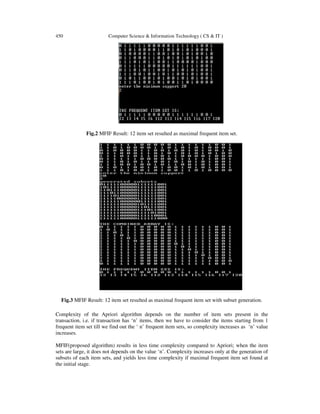
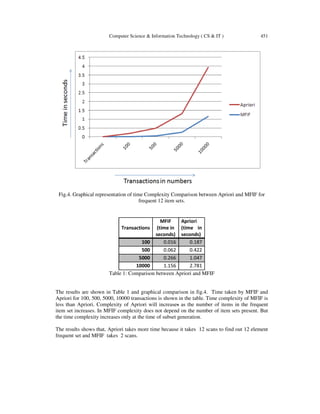
Fig.2 and Fig.3 shows the results of MFIF. The proposed method takes less time to find maximal
frequent item set. Fig.2 consists of 10 transactions of 20 items as input, in which two transactions
have 12 items and the values are similar; it meets 20 percent of minimum support, hence 12 item
set results as most maximal frequent item set. The experiment is done till 10000 transactions.
Another example, fig.3 consists of 10 transactions of 20 items as input, here only one transaction
has 13 items, and count of 13 item set transactions will be 1, which does not meet the minimum
support. So subset formation is done. Subsets will be generated of 12 items from the transaction
of 13 item set, later the generated subsets and other transactions which have 12 items will move
and combine in one array and compare the subsets .If count value is greater than minimum
support, then that set will be the Maximal frequent item set.](https://image.slidesharecdn.com/csit2443-180205120216/85/Top-Down-Approach-to-find-Maximal-Frequent-Item-Sets-using-Subset-Creation-5-320.jpg)
![452 Computer Science & Information Technology ( CS & IT )
7. ADVANTAGES
• Too much memory space is not required for generation of subsets, because at a time only
one level of element subsets are generated; as shown above only 12 element subsets are
generated.
• Any element frequent set can be got in a single scan by subset creation method, which
will help in applying any search method to traverse and get maximal frequent item set,
and it helps in reducing the scans drastically.
8. LIMITATIONS
• For scanning we assume that maximal frequent item set will have at least 50 present of
the total number of items present.
• Extra time is taken by the subset generation algorithm to calculate, but less time is taken
in comparing the transactions as its just comparing whole transaction is equal.
• If items in Maximal frequent item set are less, then MFIF algorithm takes more time than
Apriori to calculate.
9. CONCLUSION
In data mining, association rule learning is a popular and well researched method for discovering
interesting relations between objects in large databases. An efficient way to discover the maximal
frequent set can be very important in some kinds of data mining problems .The maximal frequent
set provides an effective representation of all the frequent item sets. Discovering maximal
frequent item sets implies immediate discovery of all frequent item sets. This paper presents a
new algorithm that can efficiently discover the maximal frequent set. The top-down searching
strategy is adopted in this algorithm. This approach can be very significant and effective to find
maximal frequent item set.
REFERENCES
[1] Arun K Pujari. Data mining concepts and techniques. Universities Press, 2001.
[2] R. Agrawal and R. Srikant. Fast algorithms for mining association rules in large databases. In
Proceedings of the 20th international conference on Very Large Data Bases (VLDB'94), pages 478-
499. Morgan Kaufmann, September 1994.
[3] Chengyu and Xiong Ying. Research and improvement of apriori algorithm for association rules. In
Intelligent Systems and Applications (ISA), 2010 2nd
International Workshop on, pages 1 -4, may
2010.
[4] Wei Yong-qing, Yang Ren-hua, and Liu Pei-yu. An improved apriori algorithm for association rules
of mining. In IT in Medicine Education, 2009. ITIME '09. IEEE International Symposium on,
volume 1, pages 942 -946, aug. 2009..
[5] Guo Hongli and Li Juntao. The application of mining association rules in online shopping. In
Computational Intelligence and Design (ISCID), 2011 Fourth International Symposium on, volume
2, pages 208 -210, oct. 2011.
[6] Lu Nan, Zhou Chun-Guang, and Cui Lai-Zhong. The application of association rules algorithm on
web search engine. In Computational Intelligence and Security, 2009. CIS '09. International
Conference on, volume 2, pages 102 -108, dec. 2009.](https://image.slidesharecdn.com/csit2443-180205120216/85/Top-Down-Approach-to-find-Maximal-Frequent-Item-Sets-using-Subset-Creation-8-320.jpg)


