TOOTH
WHITENING/BRIGHTENING
PROCEDURES
The lightening of the color of a tooth
through the application of a chemical agent
to oxidize the organic pigmentation in the
tooth is referred to as bleaching.
Degradation of high molecular weight
complex organic molecules that reflect
specific wave length of light responsible for
the color of the stain into lower molecular
weight and less complex molecules that
reflect less light is called lightning.
Bleaching is used as sole treatment of choice
or in conjunction with other treatment
modalities to brighten a whole smile.
HISTORY
Bleaching was unsuccessfully used in the
middle ages
Modern bleaching technique began in
1918.Abbot used the combination of
superoxol and heat.
1958—Prarson—intra pulpal bleach
1967--Nutting and Por—walking bleach
1978—superoxol +heat + light
1989—Haywood .& Hayman (night guard
vital bleaching,10% carbimide peroxide)
1996—laser tooth whitening officially
started with the approval of ion laser
technology Argon and CO2 lasers to be
used with a potential system of chemicals
BLEACHING MATERIALS
Oxidizing agents
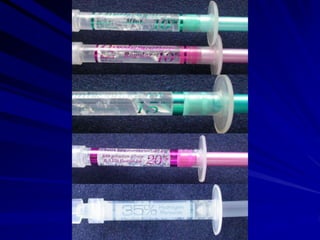
Hydrogen peroxide bleaching solution and gels.
Ph : highly acidic
Conc 3-3.5%
Carbamide peroxide based bleaching agents
also called
Urea hydrogen peroxide,
Carbamyl peroxide,
Perhydrol urea
Conc : 3-45%
Ph :5-6.5
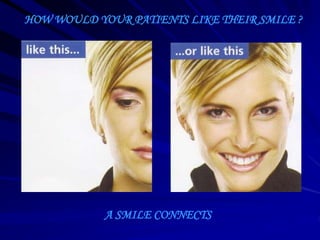
HOW WOULD YOUR PATIENTS LIKE THEIR SMILE ?
A SMILE CONNECTS
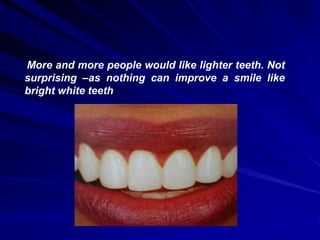
More and more people would like lighter teeth. Not
surprising –as nothing can improve a smile like
bright white teeth
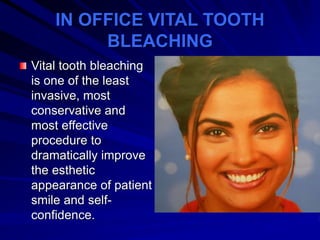
IN OFFICE VITAL TOOTH
BLEACHING
Vital tooth bleaching
is one of the least
invasive, most
conservative and
most effective
procedure to
dramatically improve
the esthetic
appearance of patient
smile and self-
confidence.
Light enamel discolorations
Mild tetracycline discolorations
Endemic fluorosis discolorations
Age related discolorations
Indications
Severe dark discoloration
Severe enamel loss
Hypersensitive teeth
Presence of caries
Large/poor coronal restoration
Contraindications
Familiarize the patient with
– Probable cause of discoloration
– Procedure to be followed
– Expected out come
– Possibility of future re-discoloration
Take radiographs
– Detect all carious lesions
– Defective restorations and proximity of pulp
horns
Procedural steps
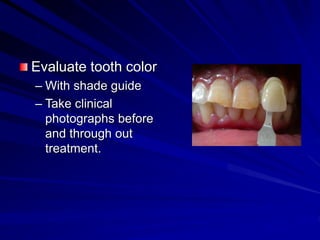
Evaluate tooth color
– With shade guide
– Take clinical
photographs before
and through out
treatment.
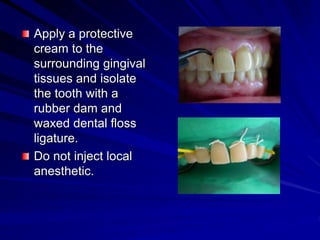
Apply a protective
cream to the
surrounding gingival
tissues and isolate
the tooth with a
rubber dam and
waxed dental floss
ligature.
Do not inject local
anesthetic.
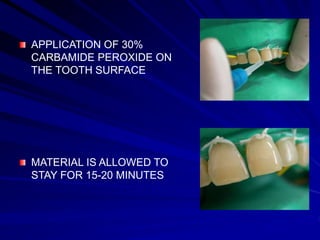
APPLICATION OF 30%
CARBAMIDE PEROXIDE ON
THE TOOTH SURFACE
MATERIAL IS ALLOWED TO
STAY FOR 15-20 MINUTES
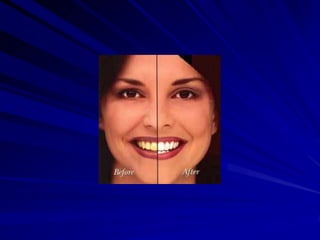
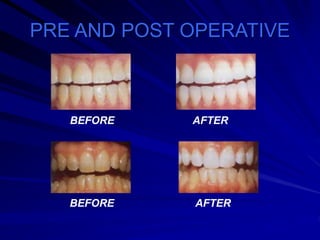
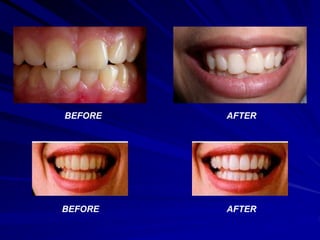
PRE AND POST OPERATIVE
BEFORE
BEFORE
AFTER
AFTER
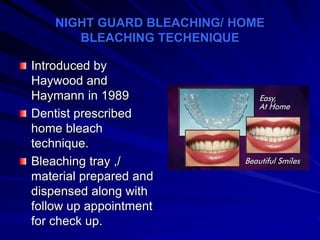
NIGHT GUARD BLEACHING/ HOME
BLEACHING TECHENIQUE
Introduced by
Haywood and
Haymann in 1989
Dentist prescribed
home bleach
technique.
Bleaching tray ,/
material prepared and
dispensed along with
follow up appointment
for check up.
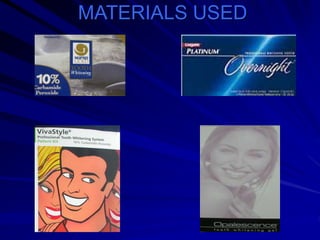
MATERIALS USED
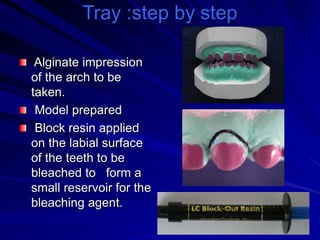
Tray :step by step
Alginate impression
of the arch to be
taken.
Model prepared
Block resin applied
on the labial surface
of the teeth to be
bleached to form a
small reservoir for the
bleaching agent.
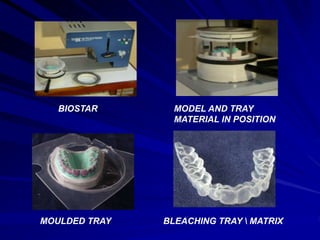
BIOSTAR MODEL AND TRAY
MATERIAL IN POSITION
MOULDED TRAY BLEACHING TRAY  MATRIX
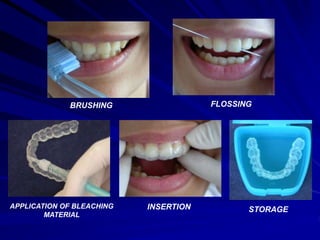
BRUSHING FLOSSING
APPLICATION OF BLEACHING
MATERIAL
INSERTION STORAGE
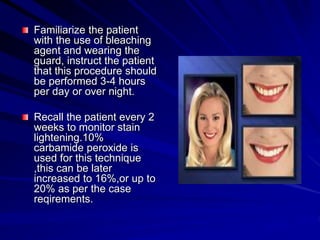
Familiarize the patient
with the use of bleaching
agent and wearing the
guard, instruct the patient
that this procedure should
be performed 3-4 hours
per day or over night.
Recall the patient every 2
weeks to monitor stain
lightening.10%
carbamide peroxide is
used for this technique
,this can be later
increased to 16%,or up to
20% as per the case
reqirements.
AFTER
AFTER
BEFORE
BEFORE
Vivastyle paint on
THE PROFESSIONAL VARNISH SYSTEM
FOR WHITENING TEETH
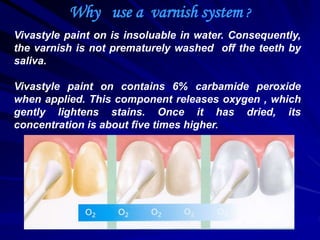
Vivastyle paint on is insoluable in water. Consequently,
the varnish is not prematurely washed off the teeth by
saliva.
Vivastyle paint on contains 6% carbamide peroxide
when applied. This component releases oxygen , which
gently lightens stains. Once it has dried, its
concentration is about five times higher.
Why use a varnish system ?
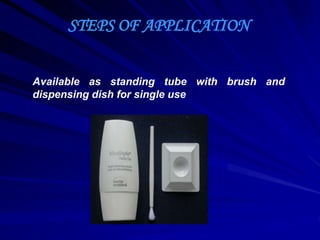
STEPS OF APPLICATION
Available as standing tube with brush and
dispensing dish for single use
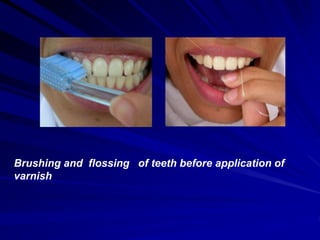
Brushing and flossing of teeth before application of
varnish
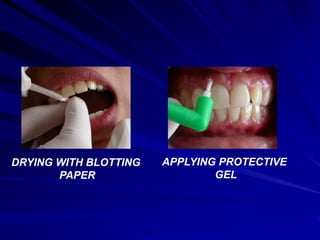
DRYING WITH BLOTTING
PAPER
APPLYING PROTECTIVE
GEL
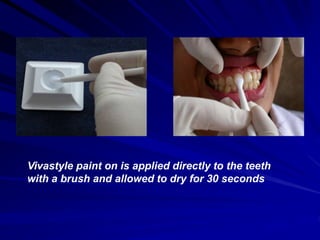
Vivastyle paint on is applied directly to the teeth
with a brush and allowed to dry for 30 seconds
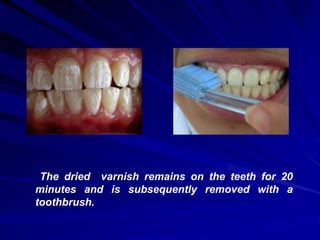
The dried varnish remains on the teeth for 20
minutes and is subsequently removed with a
toothbrush.
APPLICATION OPTIONS
Once daily for 20 min. over a period of 14 days.
Twice daily for 20 min. over a period of 7 days
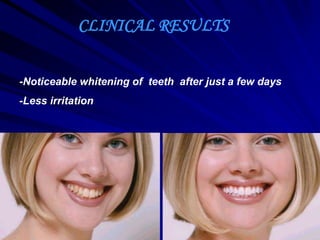
CLINICAL RESULTS
-Noticeable whitening of teeth after just a few days
-Less irritation
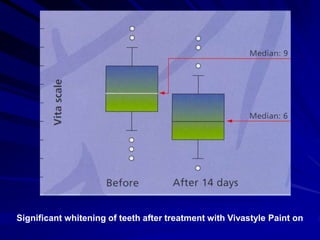
Significant whitening of teeth after treatment with Vivastyle Paint on
Advantages
professional tooth whitening without a tray, as
– Patients find tray application uncomfortable
– Patients are looking for a more cost-effective
alternative
smooth integration into daily schedule
gentle application
touching up of previously whitened teeth
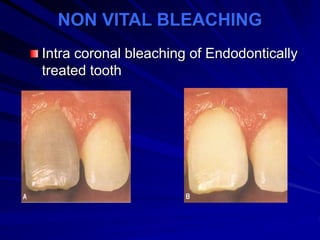
NON VITAL BLEACHING
Intra coronal bleaching of Endodontically
treated tooth
Radiographically assess the status of the
periapical tissues and the quality of
endodontic obturation.Endodontic failures
or questionable obturation ,should always
be retreated prior to bleaching.
Technique
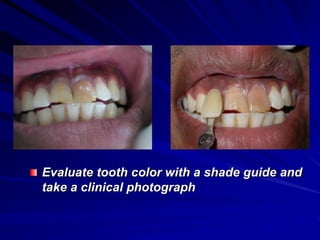
Evaluate tooth color with a shade guide and
take a clinical photograph
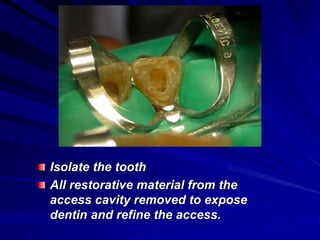
Isolate the tooth
All restorative material from the
access cavity removed to expose
dentin and refine the access.
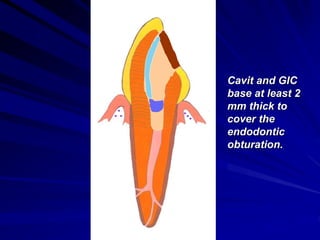
Cavit and GIC
base at least 2
mm thick to
cover the
endodontic
obturation.
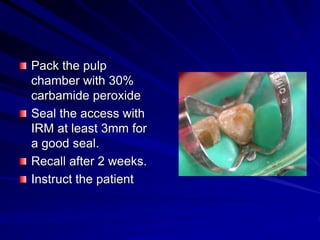
Pack the pulp
chamber with 30%
carbamide peroxide
Seal the access with
IRM at least 3mm for
a good seal.
Recall after 2 weeks.
Instruct the patient
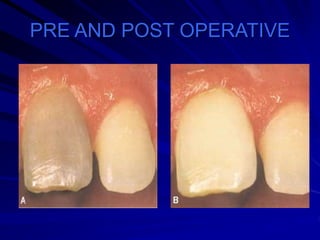
PRE AND POST OPERATIVE
Diamonds are forever, Skyce
is just for cosmetics.
MEDICAL EXPERTISE ON COSMETIC
PROCEDURES
Dentists of today are finding that more and more
people who consult them are no longer really patients.
They are individuals who desire perfectly aligned,
sparking white teeth, and who may even ask for tooth
jewellery. These cosmetic procedures have to be
accomplished by professionals with professionals
products.
Vivadent has developed the skyce system of tooth
jewellery, which enables dentists to satisfy this cosmetic
demand according to dental requirements.
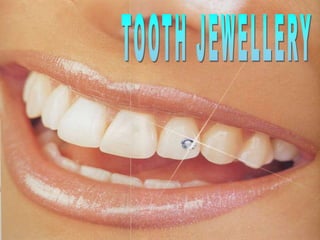
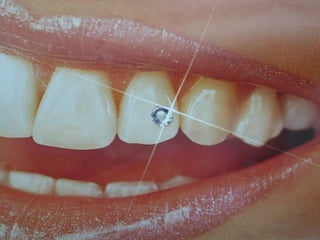
STUNNING JEWELLERY ON HEALTHY
TEETH
Patients want a sparking smile and dentists
want teeth to be healthy. Dentists are committed to
maintaining the health of teeth at all costs.
The dental jewellery is bonded onto the tooth in
the same way as an orthodontic bracket.
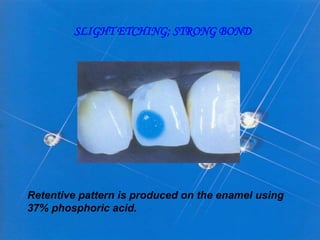
SLIGHT ETCHING; STRONG BOND
Retentive pattern is produced on the enamel using
37% phosphoric acid.
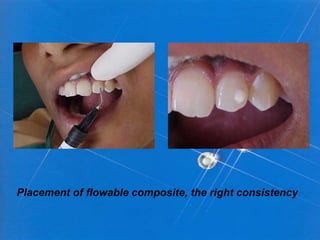
Placement of flowable composite, the right consistency
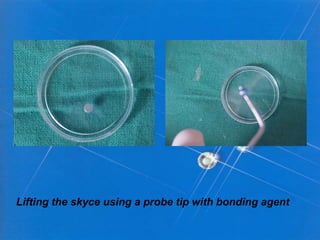
Lifting the skyce using a probe tip with bonding agent
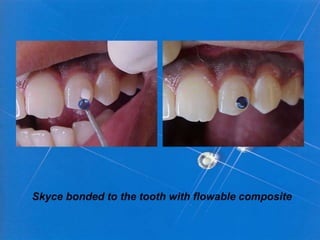
Skyce bonded to the tooth with flowable composite
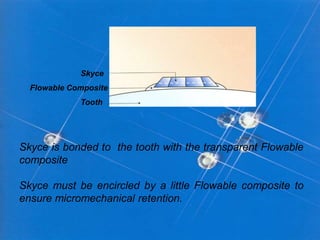
Skyce is bonded to the tooth with the transparent Flowable
composite
Skyce must be encircled by a little Flowable composite to
ensure micromechanical retention.
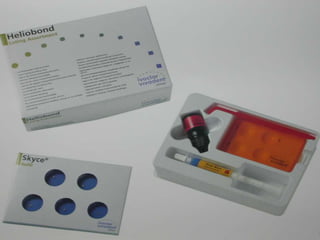
Skyce
Flowable Composite
Tooth
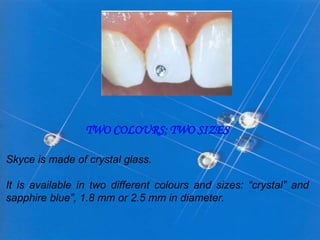
TWO COLOURS; TWO SIZES
Skyce is made of crystal glass.
It is available in two different colours and sizes: “crystal” and
sapphire blue”, 1.8 mm or 2.5 mm in diameter.
TOOTH BLEACHING - 58 slides.ppt

TOOTH BLEACHING - 58 slides.ppt

  • 2.
    TOOTH WHITENING/BRIGHTENING PROCEDURES The lightening ofthe color of a tooth through the application of a chemical agent to oxidize the organic pigmentation in the tooth is referred to as bleaching.
  • 3.
    Degradation of highmolecular weight complex organic molecules that reflect specific wave length of light responsible for the color of the stain into lower molecular weight and less complex molecules that reflect less light is called lightning. Bleaching is used as sole treatment of choice or in conjunction with other treatment modalities to brighten a whole smile.
  • 4.
    HISTORY Bleaching was unsuccessfullyused in the middle ages Modern bleaching technique began in 1918.Abbot used the combination of superoxol and heat. 1958—Prarson—intra pulpal bleach 1967--Nutting and Por—walking bleach
  • 5.
    1978—superoxol +heat +light 1989—Haywood .& Hayman (night guard vital bleaching,10% carbimide peroxide) 1996—laser tooth whitening officially started with the approval of ion laser technology Argon and CO2 lasers to be used with a potential system of chemicals
  • 6.
    BLEACHING MATERIALS Oxidizing agents Hydrogenperoxide bleaching solution and gels. Ph : highly acidic Conc 3-3.5% Carbamide peroxide based bleaching agents also called Urea hydrogen peroxide, Carbamyl peroxide, Perhydrol urea Conc : 3-45% Ph :5-6.5
  • 7.
    HOW WOULD YOURPATIENTS LIKE THEIR SMILE ? A SMILE CONNECTS
  • 8.
    More and morepeople would like lighter teeth. Not surprising –as nothing can improve a smile like bright white teeth
  • 9.
    IN OFFICE VITALTOOTH BLEACHING Vital tooth bleaching is one of the least invasive, most conservative and most effective procedure to dramatically improve the esthetic appearance of patient smile and self- confidence.
  • 10.
    Light enamel discolorations Mildtetracycline discolorations Endemic fluorosis discolorations Age related discolorations Indications
  • 11.
    Severe dark discoloration Severeenamel loss Hypersensitive teeth Presence of caries Large/poor coronal restoration Contraindications
  • 12.
    Familiarize the patientwith – Probable cause of discoloration – Procedure to be followed – Expected out come – Possibility of future re-discoloration Take radiographs – Detect all carious lesions – Defective restorations and proximity of pulp horns Procedural steps
  • 13.
    Evaluate tooth color –With shade guide – Take clinical photographs before and through out treatment.
  • 14.
    Apply a protective creamto the surrounding gingival tissues and isolate the tooth with a rubber dam and waxed dental floss ligature. Do not inject local anesthetic.
  • 15.
    APPLICATION OF 30% CARBAMIDEPEROXIDE ON THE TOOTH SURFACE MATERIAL IS ALLOWED TO STAY FOR 15-20 MINUTES
  • 17.
    PRE AND POSTOPERATIVE BEFORE BEFORE AFTER AFTER
  • 18.
    NIGHT GUARD BLEACHING/HOME BLEACHING TECHENIQUE Introduced by Haywood and Haymann in 1989 Dentist prescribed home bleach technique. Bleaching tray ,/ material prepared and dispensed along with follow up appointment for check up.
  • 19.
  • 21.
    Tray :step bystep Alginate impression of the arch to be taken. Model prepared Block resin applied on the labial surface of the teeth to be bleached to form a small reservoir for the bleaching agent.
  • 22.
    BIOSTAR MODEL ANDTRAY MATERIAL IN POSITION MOULDED TRAY BLEACHING TRAY MATRIX
  • 23.
    BRUSHING FLOSSING APPLICATION OFBLEACHING MATERIAL INSERTION STORAGE
  • 25.
    Familiarize the patient withthe use of bleaching agent and wearing the guard, instruct the patient that this procedure should be performed 3-4 hours per day or over night. Recall the patient every 2 weeks to monitor stain lightening.10% carbamide peroxide is used for this technique ,this can be later increased to 16%,or up to 20% as per the case reqirements.
  • 26.
  • 27.
    Vivastyle paint on THEPROFESSIONAL VARNISH SYSTEM FOR WHITENING TEETH
  • 28.
    Vivastyle paint onis insoluable in water. Consequently, the varnish is not prematurely washed off the teeth by saliva. Vivastyle paint on contains 6% carbamide peroxide when applied. This component releases oxygen , which gently lightens stains. Once it has dried, its concentration is about five times higher. Why use a varnish system ?
  • 29.
    STEPS OF APPLICATION Availableas standing tube with brush and dispensing dish for single use
  • 30.
    Brushing and flossingof teeth before application of varnish
  • 31.
  • 32.
    Vivastyle paint onis applied directly to the teeth with a brush and allowed to dry for 30 seconds
  • 33.
    The dried varnishremains on the teeth for 20 minutes and is subsequently removed with a toothbrush.
  • 34.
    APPLICATION OPTIONS Once dailyfor 20 min. over a period of 14 days. Twice daily for 20 min. over a period of 7 days
  • 35.
    CLINICAL RESULTS -Noticeable whiteningof teeth after just a few days -Less irritation
  • 36.
    Significant whitening ofteeth after treatment with Vivastyle Paint on
  • 37.
    Advantages professional tooth whiteningwithout a tray, as – Patients find tray application uncomfortable – Patients are looking for a more cost-effective alternative smooth integration into daily schedule gentle application touching up of previously whitened teeth
  • 38.
    NON VITAL BLEACHING Intracoronal bleaching of Endodontically treated tooth
  • 39.
    Radiographically assess thestatus of the periapical tissues and the quality of endodontic obturation.Endodontic failures or questionable obturation ,should always be retreated prior to bleaching. Technique
  • 40.
    Evaluate tooth colorwith a shade guide and take a clinical photograph
  • 41.
    Isolate the tooth Allrestorative material from the access cavity removed to expose dentin and refine the access.
  • 42.
    Cavit and GIC baseat least 2 mm thick to cover the endodontic obturation.
  • 43.
    Pack the pulp chamberwith 30% carbamide peroxide Seal the access with IRM at least 3mm for a good seal. Recall after 2 weeks. Instruct the patient
  • 44.
    PRE AND POSTOPERATIVE
  • 46.
    Diamonds are forever,Skyce is just for cosmetics.
  • 47.
    MEDICAL EXPERTISE ONCOSMETIC PROCEDURES Dentists of today are finding that more and more people who consult them are no longer really patients. They are individuals who desire perfectly aligned, sparking white teeth, and who may even ask for tooth jewellery. These cosmetic procedures have to be accomplished by professionals with professionals products. Vivadent has developed the skyce system of tooth jewellery, which enables dentists to satisfy this cosmetic demand according to dental requirements.
  • 48.
    STUNNING JEWELLERY ONHEALTHY TEETH Patients want a sparking smile and dentists want teeth to be healthy. Dentists are committed to maintaining the health of teeth at all costs. The dental jewellery is bonded onto the tooth in the same way as an orthodontic bracket.
  • 50.
    SLIGHT ETCHING; STRONGBOND Retentive pattern is produced on the enamel using 37% phosphoric acid.
  • 51.
    Placement of flowablecomposite, the right consistency
  • 52.
    Lifting the skyceusing a probe tip with bonding agent
  • 53.
    Skyce bonded tothe tooth with flowable composite
  • 54.
    Skyce is bondedto the tooth with the transparent Flowable composite Skyce must be encircled by a little Flowable composite to ensure micromechanical retention. Skyce Flowable Composite Tooth
  • 55.
    TWO COLOURS; TWOSIZES Skyce is made of crystal glass. It is available in two different colours and sizes: “crystal” and sapphire blue”, 1.8 mm or 2.5 mm in diameter.