
Tool-Support for Interdisciplinary and Collaborative User
                                        Interface Specification


IADIS 2008 Amsterdam – Workgroup HCI University of Konstanz – Thomas Memmel, Florian Geyer, Johannes Rinn and Harald Reiterer
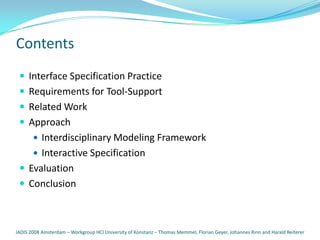
Contents
  Interface Specification Practice
  Requirements for Tool-Support
  Related Work
  Approach
        Interdisciplinary Modeling Framework
        Interactive Specification
  Evaluation
  Conclusion


IADIS 2008 Amsterdam – Workgroup HCI University of Konstanz – Thomas Memmel, Florian Geyer, Johannes Rinn and Harald Reiterer
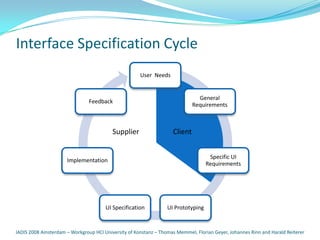
Interface Specification Cycle
                                                     User Needs


                                                                               General
                               Feedback
                                                                             Requirements


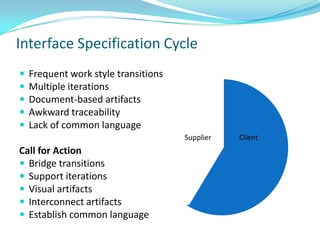
                                         Supplier                   Client


                                                                                   Specific UI
                      Implementation
                                                                                  Requirements


                                      UI Specification           UI Prototyping


IADIS 2008 Amsterdam – Workgroup HCI University of Konstanz – Thomas Memmel, Florian Geyer, Johannes Rinn and Harald Reiterer
Interface Specification Cycle
   Frequent work style transitions
   Multiple iterations
   Document-based artifacts
   Awkward traceability
   Lack of common language
                                      Supplier   Client
Call for Action
 Bridge transitions
 Support iterations
 Visual artifacts
 Interconnect artifacts
 Establish common language
State of the Art
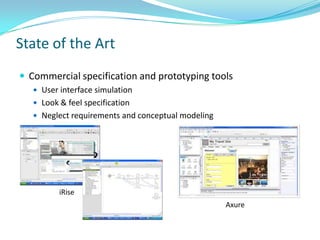
 Commercial specification and prototyping tools
    User interface simulation
    Look & feel specification
    Neglect requirements and conceptual modeling


          iRise
                                                    Axure
Related Research
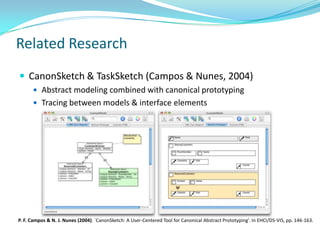
 CanonSketch & TaskSketch (Campos & Nunes, 2004)
       Abstract modeling combined with canonical prototyping
       Tracing between models & interface elements


P. F. Campos & N. J. Nunes (2004). `CanonSketch: A User-Centered Tool for Canonical Abstract Prototyping'. In EHCI/DS-VIS, pp. 146-163.
Related Research
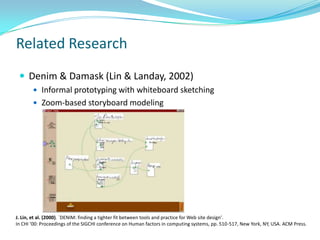
  Denim & Damask (Lin & Landay, 2002)
        Informal prototyping with whiteboard sketching
        Zoom-based storyboard modeling


J. Lin, et al. (2000). `DENIM: finding a tighter fit between tools and practice for Web site design'.
In CHI '00: Proceedings of the SIGCHI conference on Human factors in computing systems, pp. 510-517, New York, NY, USA. ACM Press.
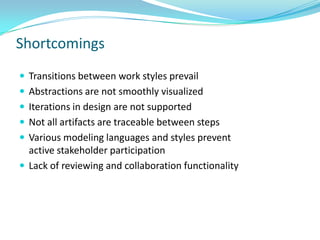
Shortcomings
 Transitions between work styles prevail
 Abstractions are not smoothly visualized
 Iterations in design are not supported
 Not all artifacts are traceable between steps
 Various modeling languages and styles prevent
  active stakeholder participation
 Lack of reviewing and collaboration functionality
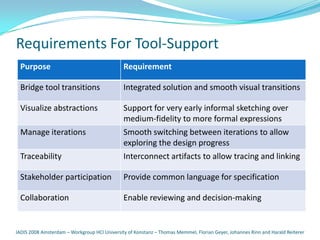
Requirements For Tool-Support
 Purpose                                      Requirement

 Bridge tool transitions                      Integrated solution and smooth visual transitions

 Visualize abstractions                       Support for very early informal sketching over
                                              medium-fidelity to more formal expressions
 Manage iterations                            Smooth switching between iterations to allow
                                              exploring the design progress
 Traceability                                 Interconnect artifacts to allow tracing and linking

 Stakeholder participation                    Provide common language for specification

 Collaboration                                Enable reviewing and decision-making


IADIS 2008 Amsterdam – Workgroup HCI University of Konstanz – Thomas Memmel, Florian Geyer, Johannes Rinn and Harald Reiterer
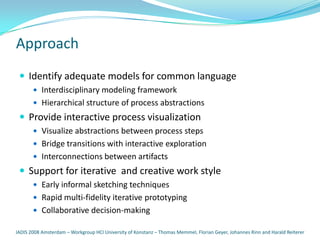
Approach
  Identify adequate models for common language
        Interdisciplinary modeling framework
        Hierarchical structure of process abstractions
  Provide interactive process visualization
        Visualize abstractions between process steps
        Bridge transitions with interactive exploration
        Interconnections between artifacts
  Support for iterative and creative work style
        Early informal sketching techniques
        Rapid multi-fidelity iterative prototyping
        Collaborative decision-making

IADIS 2008 Amsterdam – Workgroup HCI University of Konstanz – Thomas Memmel, Florian Geyer, Johannes Rinn and Harald Reiterer
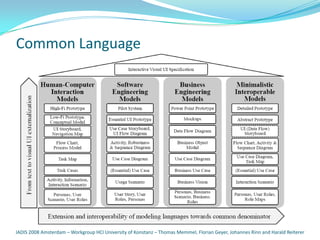
Common Language


IADIS 2008 Amsterdam – Workgroup HCI University of Konstanz – Thomas Memmel, Florian Geyer, Johannes Rinn and Harald Reiterer
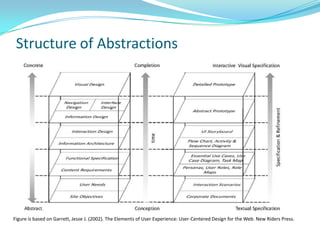
Structure of Abstractions


Figure is based on Garrett, Jesse J. (2002). The Elements of User Experience: User-Centered Design for the Web. New Riders Press.
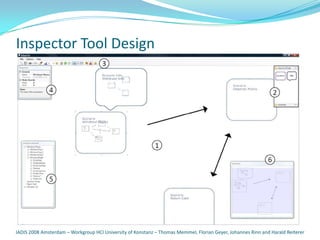
Inspector Tool Design


IADIS 2008 Amsterdam – Workgroup HCI University of Konstanz – Thomas Memmel, Florian Geyer, Johannes Rinn and Harald Reiterer
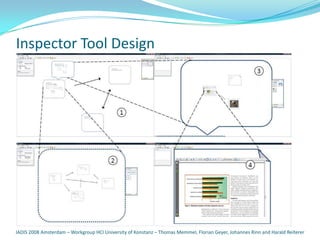
Inspector Tool Design


IADIS 2008 Amsterdam – Workgroup HCI University of Konstanz – Thomas Memmel, Florian Geyer, Johannes Rinn and Harald Reiterer
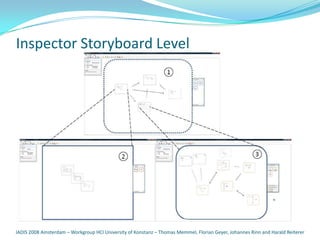
Inspector Storyboard Level


IADIS 2008 Amsterdam – Workgroup HCI University of Konstanz – Thomas Memmel, Florian Geyer, Johannes Rinn and Harald Reiterer
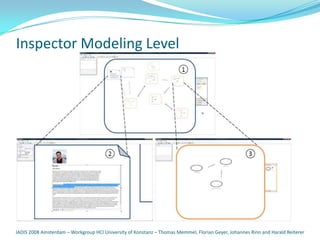
Inspector Modeling Level


IADIS 2008 Amsterdam – Workgroup HCI University of Konstanz – Thomas Memmel, Florian Geyer, Johannes Rinn and Harald Reiterer
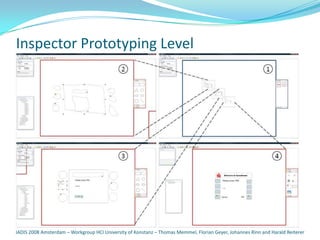
Inspector Prototyping Level


IADIS 2008 Amsterdam – Workgroup HCI University of Konstanz – Thomas Memmel, Florian Geyer, Johannes Rinn and Harald Reiterer
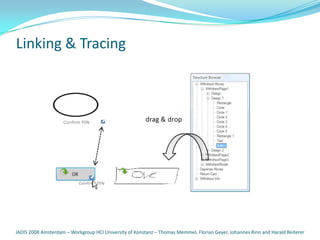
Linking & Tracing


IADIS 2008 Amsterdam – Workgroup HCI University of Konstanz – Thomas Memmel, Florian Geyer, Johannes Rinn and Harald Reiterer
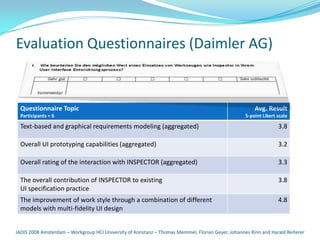
Evaluation Questionnaires (Daimler AG)


 Questionnaire Topic                                                                                   Avg. Result
 Participants = 6                                                                                  5-point Likert scale

 Text-based and graphical requirements modeling (aggregated)                                                      3.8

 Overall UI prototyping capabilities (aggregated)                                                                 3.2

 Overall rating of the interaction with INSPECTOR (aggregated)                                                    3.3

 The overall contribution of INSPECTOR to existing                                                                3.8
 UI specification practice
 The improvement of work style through a combination of different                                                 4.8
 models with multi-fidelity UI design


IADIS 2008 Amsterdam – Workgroup HCI University of Konstanz – Thomas Memmel, Florian Geyer, Johannes Rinn and Harald Reiterer
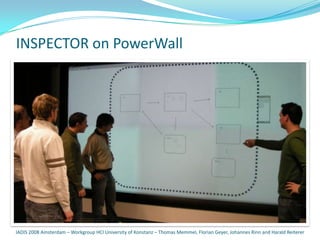
INSPECTOR on PowerWall


IADIS 2008 Amsterdam – Workgroup HCI University of Konstanz – Thomas Memmel, Florian Geyer, Johannes Rinn and Harald Reiterer
Diary Study
  Long term evaluation of INSPECTOR in a lecture project
        3 groups of students
        Period of 3 weeks
        Asynchronous modeling and design tasks
        Discussion and review in team sessions


IADIS 2008 Amsterdam – Workgroup HCI University of Konstanz – Thomas Memmel, Florian Geyer, Johannes Rinn and Harald Reiterer
Diary Study
  Diary questions on
        Types of models used
        Additional needed tools
        Usability issues
        User experience
        General opinion
  Average results on all questions (based on a 5 point Likert
     scale)
        1st week: 1.75pts (std. 0.46)
        2nd week: 3pts (std. 0.00)
        3rd week 4.25pts (std. 0.46)


IADIS 2008 Amsterdam – Workgroup HCI University of Konstanz – Thomas Memmel, Florian Geyer, Johannes Rinn and Harald Reiterer
Conclusion
  Model-based tool for UI specification
  Novel approach towards a common language
   for UI-related modeling
  Idea of interactive UI specifications
  First empirical studies prove:

     The idea to interconnect a thoughtful selection of models with different
     levels of UI design contributes to UI specification processes in client
     organizations.

  Future work
     Interface components for creativity support
        Distributed data model for asynchronous specification


IADIS 2008 Amsterdam – Workgroup HCI University of Konstanz – Thomas Memmel, Florian Geyer, Johannes Rinn and Harald Reiterer
Thank You!


IADIS 2008 Amsterdam – Workgroup HCI University of Konstanz – Thomas Memmel, Florian Geyer, Johannes Rinn and Harald Reiterer

Tool-Support for Interdisciplinary and Collaborative User Interface Specification

  • 1.
    Tool-Support for Interdisciplinaryand Collaborative User Interface Specification IADIS 2008 Amsterdam – Workgroup HCI University of Konstanz – Thomas Memmel, Florian Geyer, Johannes Rinn and Harald Reiterer
  • 2.
    Contents  InterfaceSpecification Practice  Requirements for Tool-Support  Related Work  Approach  Interdisciplinary Modeling Framework  Interactive Specification  Evaluation  Conclusion IADIS 2008 Amsterdam – Workgroup HCI University of Konstanz – Thomas Memmel, Florian Geyer, Johannes Rinn and Harald Reiterer
  • 3.
    Interface Specification Cycle User Needs General Feedback Requirements Supplier Client Specific UI Implementation Requirements UI Specification UI Prototyping IADIS 2008 Amsterdam – Workgroup HCI University of Konstanz – Thomas Memmel, Florian Geyer, Johannes Rinn and Harald Reiterer
  • 4.
    Interface Specification Cycle  Frequent work style transitions  Multiple iterations  Document-based artifacts  Awkward traceability  Lack of common language Supplier Client Call for Action  Bridge transitions  Support iterations  Visual artifacts  Interconnect artifacts  Establish common language
  • 5.
    State of theArt  Commercial specification and prototyping tools  User interface simulation  Look & feel specification  Neglect requirements and conceptual modeling iRise Axure
  • 6.
    Related Research  CanonSketch& TaskSketch (Campos & Nunes, 2004)  Abstract modeling combined with canonical prototyping  Tracing between models & interface elements P. F. Campos & N. J. Nunes (2004). `CanonSketch: A User-Centered Tool for Canonical Abstract Prototyping'. In EHCI/DS-VIS, pp. 146-163.
  • 7.
    Related Research Denim & Damask (Lin & Landay, 2002)  Informal prototyping with whiteboard sketching  Zoom-based storyboard modeling J. Lin, et al. (2000). `DENIM: finding a tighter fit between tools and practice for Web site design'. In CHI '00: Proceedings of the SIGCHI conference on Human factors in computing systems, pp. 510-517, New York, NY, USA. ACM Press.
  • 8.
    Shortcomings  Transitions betweenwork styles prevail  Abstractions are not smoothly visualized  Iterations in design are not supported  Not all artifacts are traceable between steps  Various modeling languages and styles prevent active stakeholder participation  Lack of reviewing and collaboration functionality
  • 9.
    Requirements For Tool-Support Purpose Requirement Bridge tool transitions Integrated solution and smooth visual transitions Visualize abstractions Support for very early informal sketching over medium-fidelity to more formal expressions Manage iterations Smooth switching between iterations to allow exploring the design progress Traceability Interconnect artifacts to allow tracing and linking Stakeholder participation Provide common language for specification Collaboration Enable reviewing and decision-making IADIS 2008 Amsterdam – Workgroup HCI University of Konstanz – Thomas Memmel, Florian Geyer, Johannes Rinn and Harald Reiterer
  • 10.
    Approach  Identifyadequate models for common language  Interdisciplinary modeling framework  Hierarchical structure of process abstractions  Provide interactive process visualization  Visualize abstractions between process steps  Bridge transitions with interactive exploration  Interconnections between artifacts  Support for iterative and creative work style  Early informal sketching techniques  Rapid multi-fidelity iterative prototyping  Collaborative decision-making IADIS 2008 Amsterdam – Workgroup HCI University of Konstanz – Thomas Memmel, Florian Geyer, Johannes Rinn and Harald Reiterer
  • 11.
    Common Language IADIS 2008Amsterdam – Workgroup HCI University of Konstanz – Thomas Memmel, Florian Geyer, Johannes Rinn and Harald Reiterer
  • 12.
    Structure of Abstractions Figureis based on Garrett, Jesse J. (2002). The Elements of User Experience: User-Centered Design for the Web. New Riders Press.
  • 13.
    Inspector Tool Design IADIS2008 Amsterdam – Workgroup HCI University of Konstanz – Thomas Memmel, Florian Geyer, Johannes Rinn and Harald Reiterer
  • 14.
    Inspector Tool Design IADIS2008 Amsterdam – Workgroup HCI University of Konstanz – Thomas Memmel, Florian Geyer, Johannes Rinn and Harald Reiterer
  • 15.
    Inspector Storyboard Level IADIS2008 Amsterdam – Workgroup HCI University of Konstanz – Thomas Memmel, Florian Geyer, Johannes Rinn and Harald Reiterer
  • 16.
    Inspector Modeling Level IADIS2008 Amsterdam – Workgroup HCI University of Konstanz – Thomas Memmel, Florian Geyer, Johannes Rinn and Harald Reiterer
  • 17.
    Inspector Prototyping Level IADIS2008 Amsterdam – Workgroup HCI University of Konstanz – Thomas Memmel, Florian Geyer, Johannes Rinn and Harald Reiterer
  • 18.
    Linking & Tracing IADIS2008 Amsterdam – Workgroup HCI University of Konstanz – Thomas Memmel, Florian Geyer, Johannes Rinn and Harald Reiterer
  • 19.
    Evaluation Questionnaires (DaimlerAG) Questionnaire Topic Avg. Result Participants = 6 5-point Likert scale Text-based and graphical requirements modeling (aggregated) 3.8 Overall UI prototyping capabilities (aggregated) 3.2 Overall rating of the interaction with INSPECTOR (aggregated) 3.3 The overall contribution of INSPECTOR to existing 3.8 UI specification practice The improvement of work style through a combination of different 4.8 models with multi-fidelity UI design IADIS 2008 Amsterdam – Workgroup HCI University of Konstanz – Thomas Memmel, Florian Geyer, Johannes Rinn and Harald Reiterer
  • 20.
    INSPECTOR on PowerWall IADIS2008 Amsterdam – Workgroup HCI University of Konstanz – Thomas Memmel, Florian Geyer, Johannes Rinn and Harald Reiterer
  • 21.
    Diary Study Long term evaluation of INSPECTOR in a lecture project  3 groups of students  Period of 3 weeks  Asynchronous modeling and design tasks  Discussion and review in team sessions IADIS 2008 Amsterdam – Workgroup HCI University of Konstanz – Thomas Memmel, Florian Geyer, Johannes Rinn and Harald Reiterer
  • 22.
    Diary Study Diary questions on  Types of models used  Additional needed tools  Usability issues  User experience  General opinion  Average results on all questions (based on a 5 point Likert scale)  1st week: 1.75pts (std. 0.46)  2nd week: 3pts (std. 0.00)  3rd week 4.25pts (std. 0.46) IADIS 2008 Amsterdam – Workgroup HCI University of Konstanz – Thomas Memmel, Florian Geyer, Johannes Rinn and Harald Reiterer
  • 23.
    Conclusion  Model-basedtool for UI specification  Novel approach towards a common language for UI-related modeling  Idea of interactive UI specifications  First empirical studies prove: The idea to interconnect a thoughtful selection of models with different levels of UI design contributes to UI specification processes in client organizations.  Future work  Interface components for creativity support  Distributed data model for asynchronous specification IADIS 2008 Amsterdam – Workgroup HCI University of Konstanz – Thomas Memmel, Florian Geyer, Johannes Rinn and Harald Reiterer
  • 24.
    Thank You! IADIS 2008Amsterdam – Workgroup HCI University of Konstanz – Thomas Memmel, Florian Geyer, Johannes Rinn and Harald Reiterer