Software Engineering Ontology and
Software Testing
GTU PG SCHOOL BISAG ,Gandhinagar
Presented by:
Khushbu Patel (141060753012)
Outlines
 Introduction
 software engineering ontology modelling notations
 Testing Methodologies
 Conclusion
 References
Introduction
 Software engineering is the “application of a
systematic, disciplined, and quantifiable
approach to the development, operation, and
maintenance of software”.
 The term “Ontology” derives from its usage in
philosophy where it is defined as the study of
“being” or “existence”- all kinds of entities,
abstracts and concretes that make up the
world.
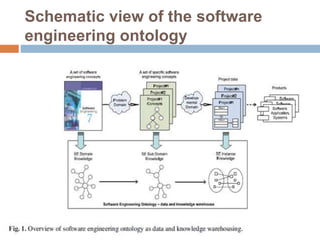
Schematic view of the software
engineering ontology
The software Engineering ontology
consists of
 The software requirements ontology
 The software design ontology
 The coding ontology
 The software testing ontology
SOFTWARE ENGINEERING ONTOLOGY
MODELLING
NOTATIONS
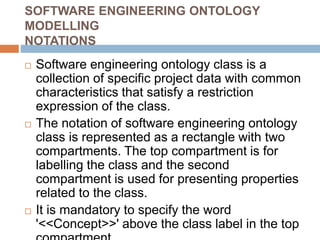
 Software engineering ontology class is a
collection of specific project data with common
characteristics that satisfy a restriction
expression of the class.
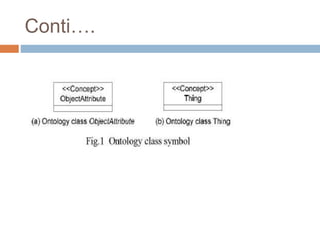
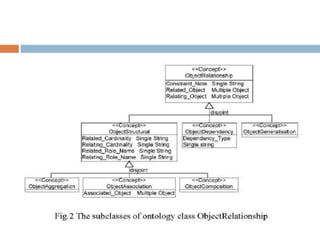
 The notation of software engineering ontology
class is represented as a rectangle with two
compartments. The top compartment is for
labelling the class and the second
compartment is used for presenting properties
related to the class.
 It is mandatory to specify the word
'<<Concept>>' above the class label in the top
Conti….
Testing Methodologies
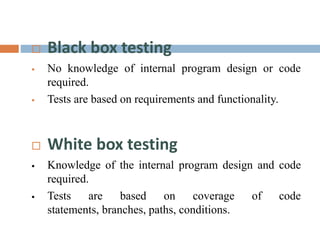
 Black box testing
 White box testing
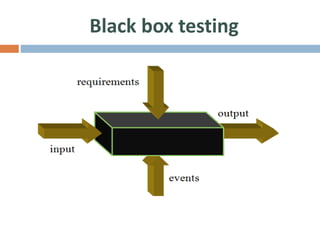
 Black box testing
 No knowledge of internal program design or code
required.
 Tests are based on requirements and functionality.
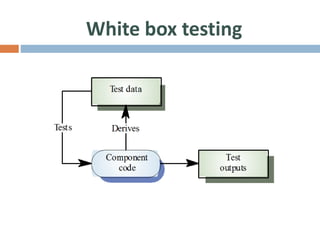
 White box testing
 Knowledge of the internal program design and code
required.
 Tests are based on coverage of code
statements, branches, paths, conditions.
Black box testing
White box testing
Conclusion
 Ontologies are expected to increasingly appear
in various areas as promising tools to improve
communication among people and to achieve
interoperability among systems. They also act
as improving agents for humans or software by
reusing a known data model or knowledge. All
these tasks deal with interoperability issues and
can be applied in different domains.
References
 “Ontology Modelling Notations for Software Engineering Knowledge
Representation” Pornpit Wongthongthaml, Elizabeth ChangI and
Tharam Dillon, IEEE International Conference on Digital Ecosystems
and Technologies,2007.
 “A Software Engineering Ontology as Software Engineering
Knowledge
Representation”, P. Wongthongtham, N. Kasisopha, E. Chang, T.
Dillon, 2008 International Conference on Convergence and Hybrid
Information Technology
 “ Software Testing Techniques” International Journal of Advanced
Research in Computer Science and Software Engineering ,2012.
THANK YOU
?

Software engineering ontology and software testing

  • 1.
    Software Engineering Ontologyand Software Testing GTU PG SCHOOL BISAG ,Gandhinagar Presented by: Khushbu Patel (141060753012)
  • 2.
    Outlines  Introduction  softwareengineering ontology modelling notations  Testing Methodologies  Conclusion  References
  • 3.
    Introduction  Software engineeringis the “application of a systematic, disciplined, and quantifiable approach to the development, operation, and maintenance of software”.  The term “Ontology” derives from its usage in philosophy where it is defined as the study of “being” or “existence”- all kinds of entities, abstracts and concretes that make up the world.
  • 4.
    Schematic view ofthe software engineering ontology
  • 5.
    The software Engineeringontology consists of  The software requirements ontology  The software design ontology  The coding ontology  The software testing ontology
  • 6.
    SOFTWARE ENGINEERING ONTOLOGY MODELLING NOTATIONS Software engineering ontology class is a collection of specific project data with common characteristics that satisfy a restriction expression of the class.  The notation of software engineering ontology class is represented as a rectangle with two compartments. The top compartment is for labelling the class and the second compartment is used for presenting properties related to the class.  It is mandatory to specify the word '<<Concept>>' above the class label in the top
  • 7.
  • 9.
    Testing Methodologies  Blackbox testing  White box testing
  • 10.
     Black boxtesting  No knowledge of internal program design or code required.  Tests are based on requirements and functionality.  White box testing  Knowledge of the internal program design and code required.  Tests are based on coverage of code statements, branches, paths, conditions.
  • 11.
  • 12.
  • 13.
    Conclusion  Ontologies areexpected to increasingly appear in various areas as promising tools to improve communication among people and to achieve interoperability among systems. They also act as improving agents for humans or software by reusing a known data model or knowledge. All these tasks deal with interoperability issues and can be applied in different domains.
  • 14.
    References  “Ontology ModellingNotations for Software Engineering Knowledge Representation” Pornpit Wongthongthaml, Elizabeth ChangI and Tharam Dillon, IEEE International Conference on Digital Ecosystems and Technologies,2007.  “A Software Engineering Ontology as Software Engineering Knowledge Representation”, P. Wongthongtham, N. Kasisopha, E. Chang, T. Dillon, 2008 International Conference on Convergence and Hybrid Information Technology  “ Software Testing Techniques” International Journal of Advanced Research in Computer Science and Software Engineering ,2012.
  • 15.