Tools & Techniques for
Data Collection…
Dr D P Singh School of Research
Methodology, TISS
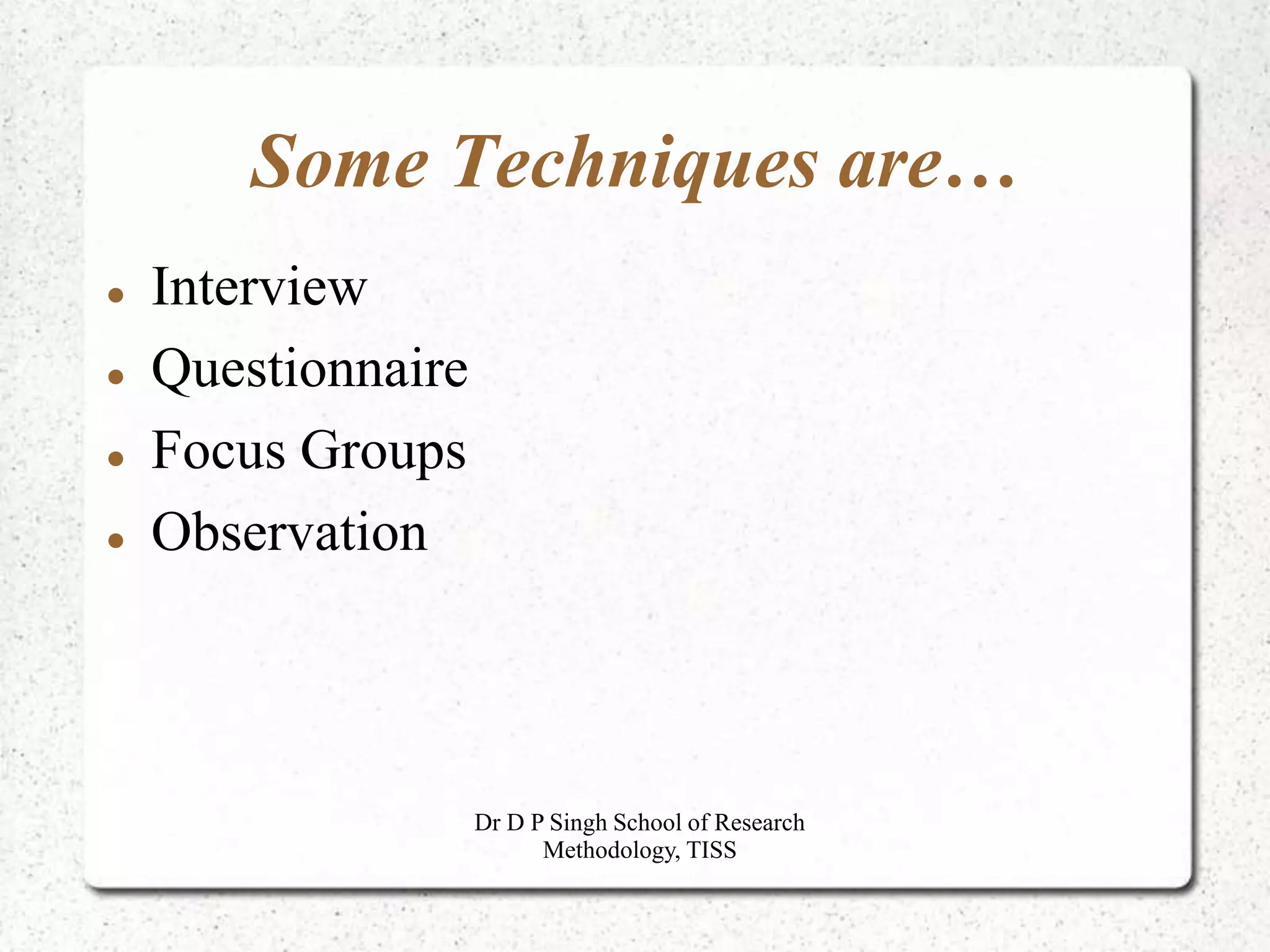
Some Techniques are…
 Interview
 Questionnaire
 Focus Groups
 Observation
Dr D P Singh School of Research
Methodology, TISS
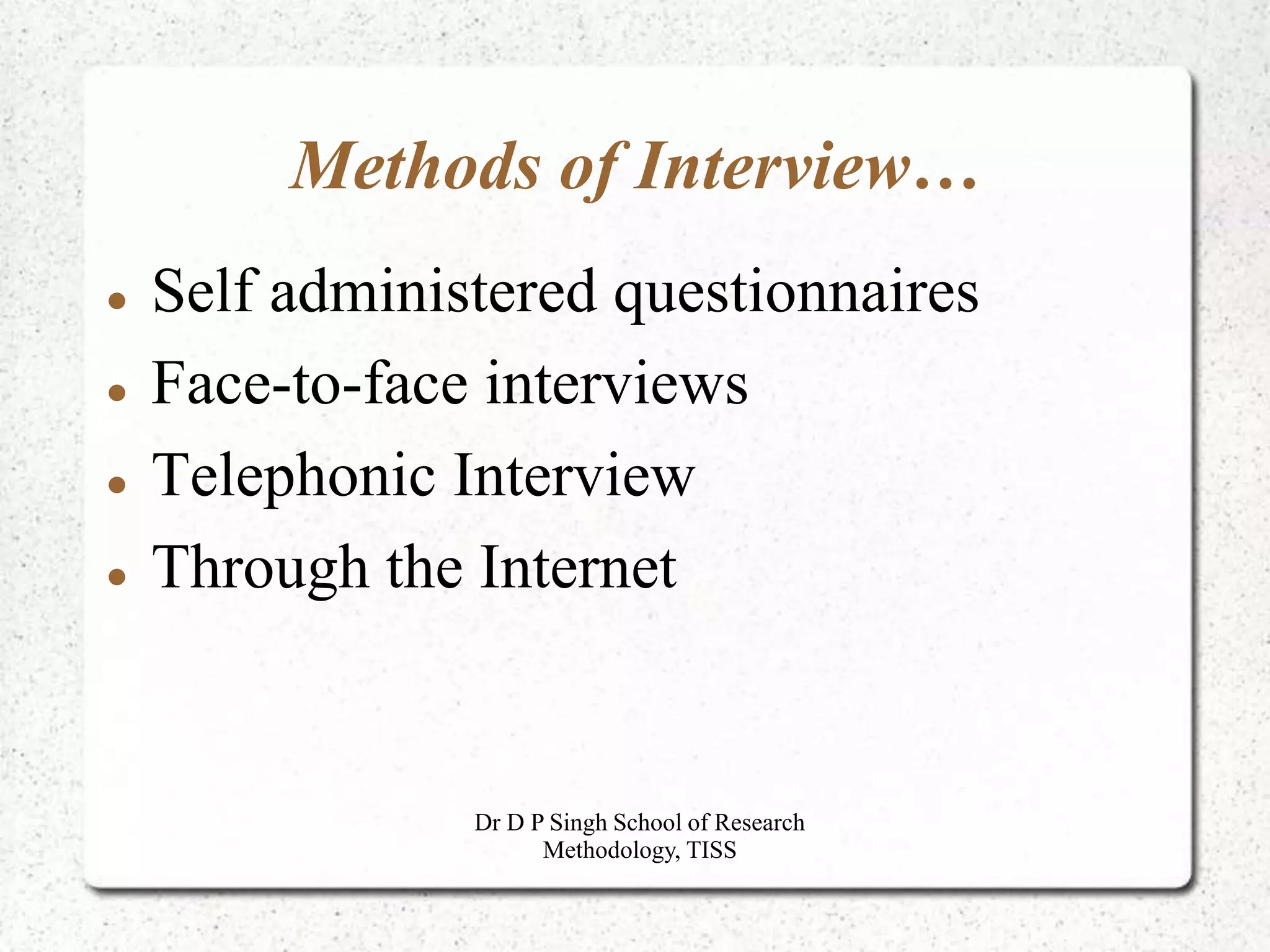
Methods of Interview…
 Self administered questionnaires
 Face-to-face interviews
 Telephonic Interview
 Through the Internet
Dr D P Singh School of Research
Methodology, TISS
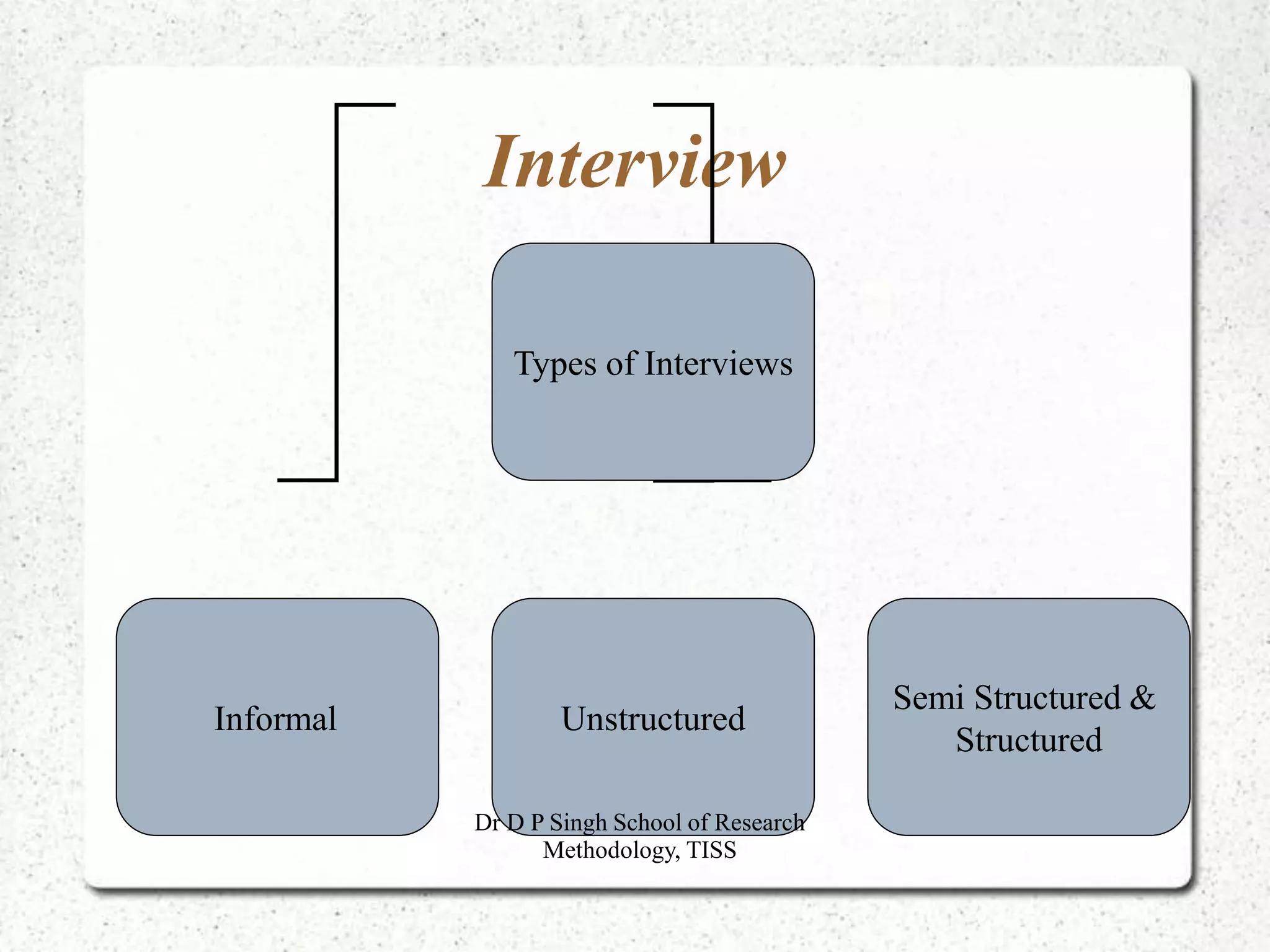
Interview
Types of Interviews
Informal Unstructured
Semi Structured &
Structured
Dr D P Singh School of Research
Methodology, TISS
Interviewing
 Unstructured Interviewing-
 Get people to open up and express
themselves in their own terms at their own pace.
 Excellent for building initial rapport before
moving to more formal interviews
 Often no formal written tool is used
Dr D P Singh School of Research
Methodology, TISS
Interview
 Semi-structured Interviewing-
 An Interview Guide used- This is a written list
of questions and topics and need to be covered
in a particular order.
 Structured interviewing-people are asked
to respond to as nearly identical a set of
stimuli as possible.
 Interview Schedule used with a written list of
questions used with the question order and
structure being followed exactly for each
interview.
Dr D P Singh School of Research
Methodology, TISS
Different Components…
 The Interviewer
 The Interview Schedule/Interview Guide
 The Researched/Respondent
Dr D P Singh School of Research
Methodology, TISS
The Skill of Interviewing
 Assure people of anonymity and
confidentiality
 Explain that you simply want to know what
they think, and what their observations are
 Encourage them to interrupt you during the
interview with anything they think is
important.
 Always ask for permission to record personal
interviews and to take notes.
Dr D P Singh School of Research
Methodology, TISS
Framing the Questions…
 Questions must be unambiguous and clear.
 The vocabulary or words used must be appropriate to the
respondents.
 There must be a clear purpose for every question.
 Use of open and closed ended questions
 open ended questions –respondent gives own answer (used
for qualitative data, sensitive information)
 Closed ended questions-choice of answers, respondent picks
the most appropriate one.
 Never use loaded or double-barreled questions.
 Always pre test
 See if the questions elicit the information needed to test the
hypothesis or answer research questions
Dr D P Singh School of Research
Methodology, TISS
Sequencing the Questions…
 Ask general questions or about some facts
before personal questions
 Get respondents involved in the interview
 Intersperse fact-based questions throughout
the interview to avoid long lists of fact-based
questions
Dr D P Singh School of Research
Methodology, TISS
Sequencing the Questions
 Ask questions about the present before
questions about the past or future.
 The last questions might be to allow
respondents to provide any other information
they prefer to add and their impressions of
the interview
Dr D P Singh School of Research
Methodology, TISS
Skills in Interviewing
 Probing
 Silent Probe
 Echo Probe
 ‘Uh-huh’ Probe
 ‘Tell Me-More’ Probe
 Long-Question Probe
Dr D P Singh School of Research
Methodology, TISS
Carrying the Interview
 Ask one question at a time.
 Attempt to remain as neutral as possible.
Encourage responses
 Be careful about the appearance when note
taking.
 Provide transition between major topics
 Don't lose control of the interview
Dr D P Singh School of Research
Methodology, TISS
After the Interview…
 Verify if the tape recorder, if used, worked
throughout the interview.
 Make any notes on your written notes
 Write down any observations made during
the interview
Dr D P Singh School of Research
Methodology, TISS
Points to Note….
 Importance of Language
 Pace of the Study
 “Being Yourself”
 The “little things”!!
 Using a Tape Recorder (recording equipment
etc)
 Taking Notes
Dr D P Singh School of Research
Methodology, TISS
“Response Effects”
 Response effects refer to measurable differences in the
interview data that are predictable from the characteristics of
respondents, interviewers and/or the environment.
 Age, sex, culture, comfort level of the respondents impact
responses
 The “Deference” Effect
 “Threatening” Questions
 “Social Desirability” Effect
 Accuracy of responses-(inability to recall, misleading)
Dr D P Singh School of Research
Methodology, TISS
Types of Interviews
 Face to face
 Telephone
Dr D P Singh School of Research
Methodology, TISS
Advantages of Face to Face
Interviews
 Can be used for all types of people- illiterate, bedridden,
old etc
 It is possible to clarify if the person does not understand
the meaning (noting such questions where explanation
was needed)
 Use of different techniques is possible-open ended
questions, visual aids, graphs, etc.
 Long interviews are better in a face to face situation
 Can get only one question at a time so cannot flip through
the next page to see what’s coming
 Possible to observe the body language
Dr D P Singh School of Research
Methodology, TISS
Disadvantages of Face to face
Interviews
 They are intrusive and reactive
 Costly in terms of time and money
 Limits the sample size for a single
investigator as you have to finish the data
collection in a short time (should not exceed
a year)
 Training is needed for multiple investigators
and there can be some error
Dr D P Singh School of Research
Methodology, TISS
Telephone Interviews
Advantages:
-Have the impersonal quality of the questionnaire.
- Inexpensive, need less time and energy
- Can reach everyone who has a phone
- Less influence of the interviewer’s personality
Disadvantages:
- Not useful for people without a telephone connection
- Cannot be a long schedule
- Data can be false if investigators are not monitored
properly Dr D P Singh School of Research
Methodology, TISS
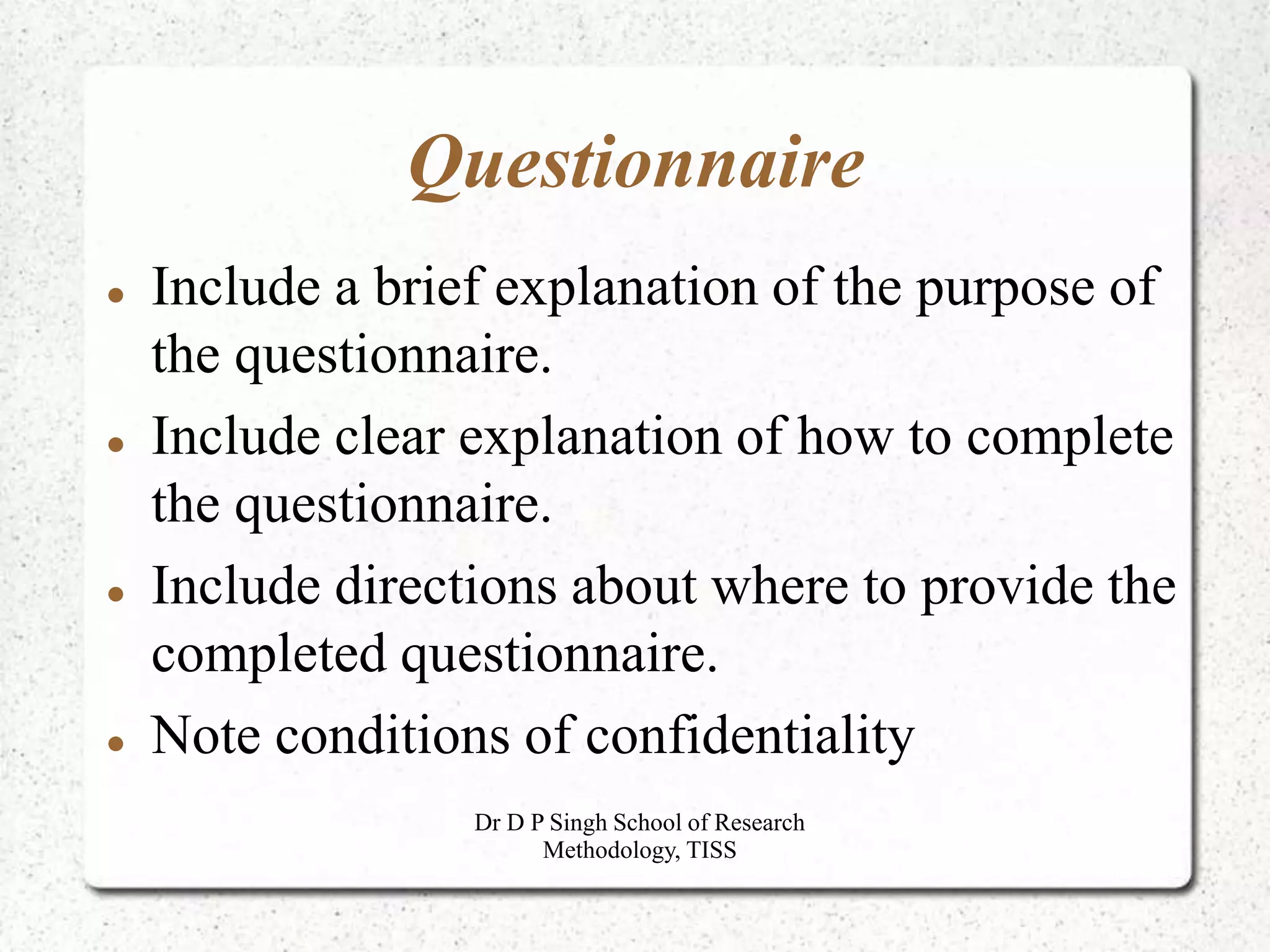
Questionnaire
 Include a brief explanation of the purpose of
the questionnaire.
 Include clear explanation of how to complete
the questionnaire.
 Include directions about where to provide the
completed questionnaire.
 Note conditions of confidentiality
Dr D P Singh School of Research
Methodology, TISS
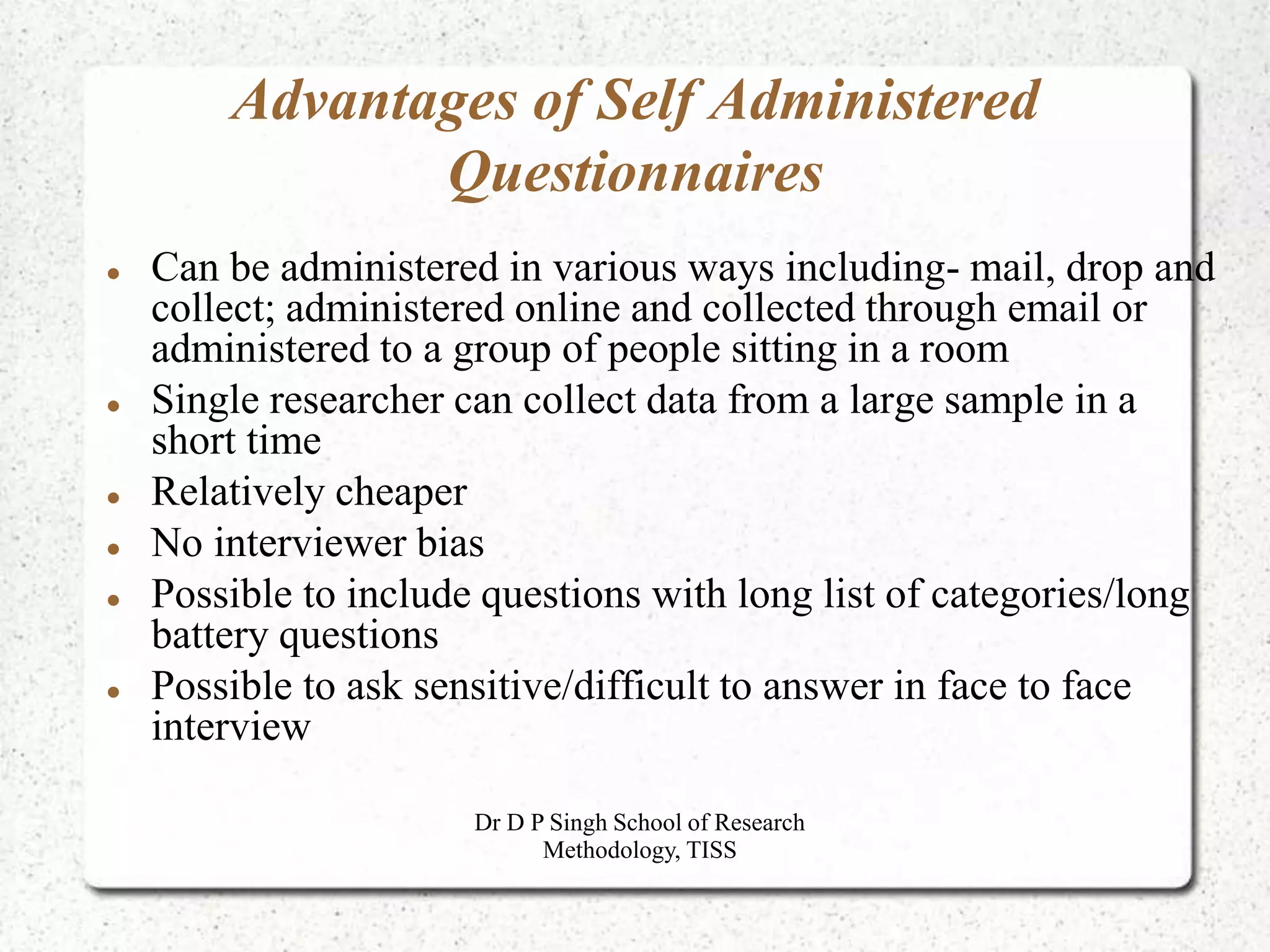
Advantages of Self Administered
Questionnaires
 Can be administered in various ways including- mail, drop and
collect; administered online and collected through email or
administered to a group of people sitting in a room
 Single researcher can collect data from a large sample in a
short time
 Relatively cheaper
 No interviewer bias
 Possible to include questions with long list of categories/long
battery questions
 Possible to ask sensitive/difficult to answer in face to face
interview
Dr D P Singh School of Research
Methodology, TISS
Disadvantages of Self Administered
Questionnaires
 No control over how people interpret the
questions
 Response rate can be poor
 Prone to serious sampling problems
 The sequence may not be followed/cannot
avoid flipping through
 Not useful for illiterate or visually impaired
population Dr D P Singh School of Research
Methodology, TISS
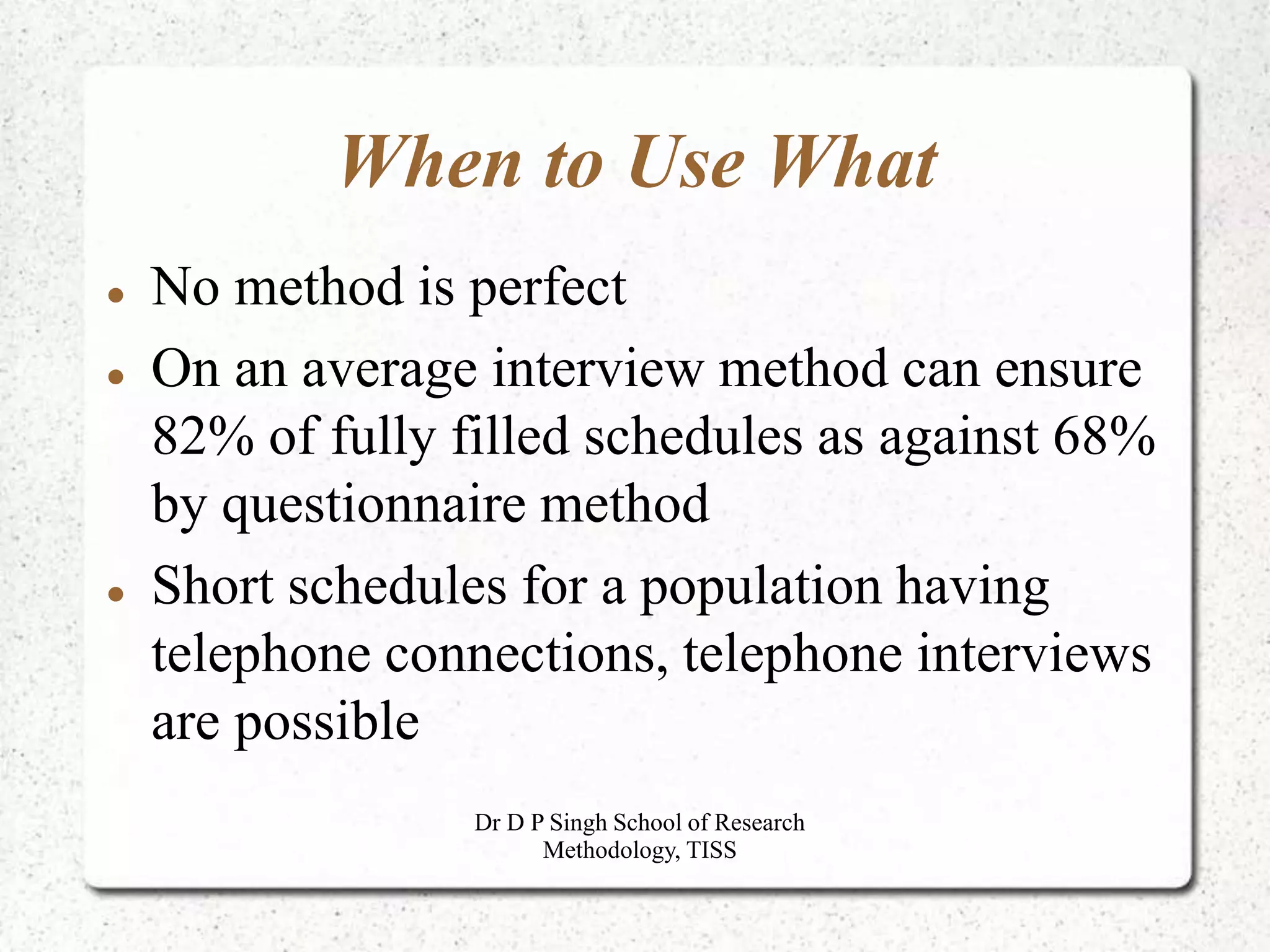
When to Use What
 No method is perfect
 On an average interview method can ensure
82% of fully filled schedules as against 68%
by questionnaire method
 Short schedules for a population having
telephone connections, telephone interviews
are possible
Dr D P Singh School of Research
Methodology, TISS
Dillman’s Total Design Method to Improve
Response of Mail and Telephone Surveying
 Mailed questionnaires must look professional (size and
colour of the paper, font size, layout)
 Front and back covers- No question on either covers-
interesting title, name and return address
 Question order – start with questions related to the
topic and end with questions on personal data
 Formatting- Careful use of font and case, spacing
Dr D P Singh School of Research
Methodology, TISS
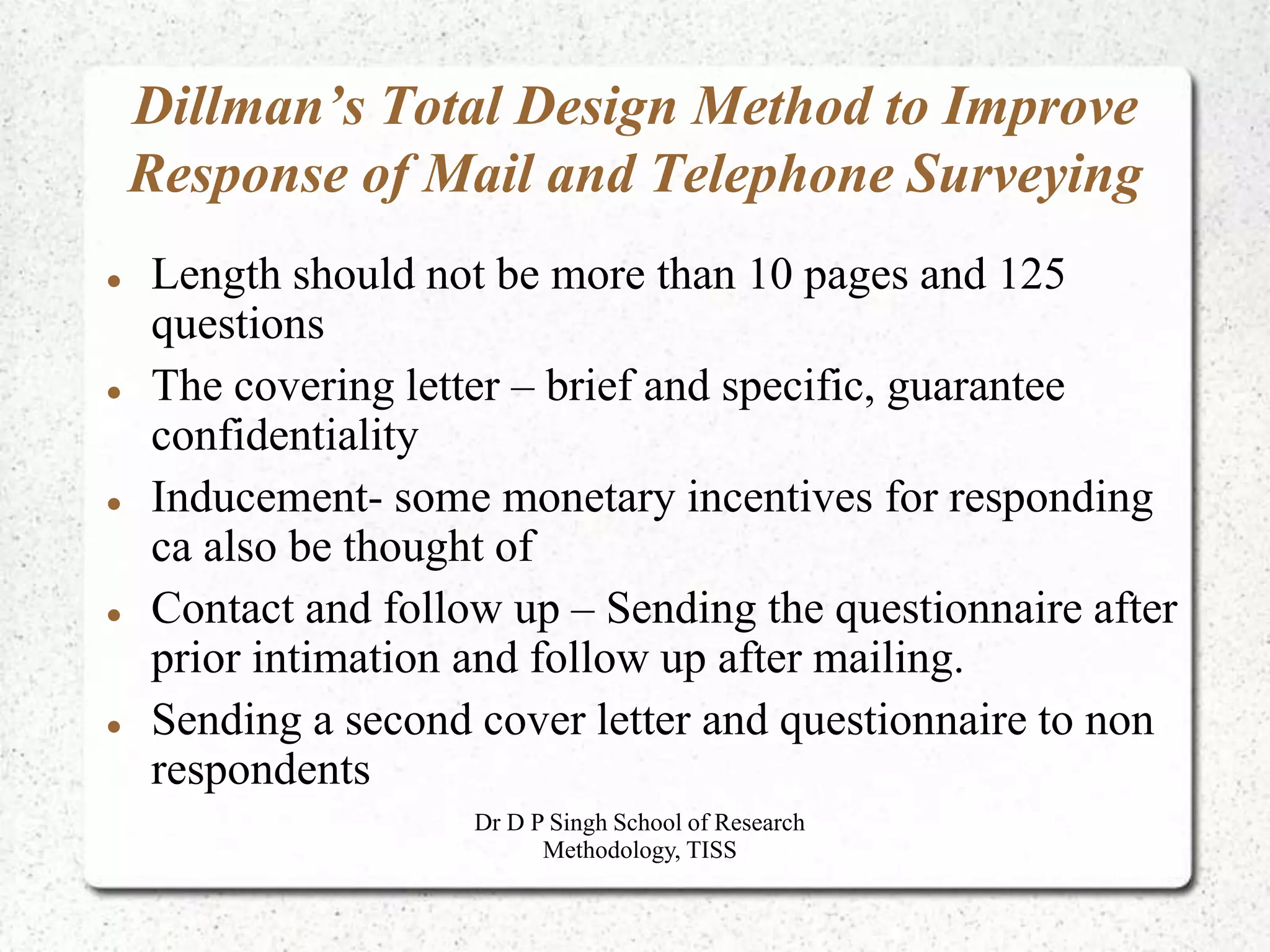
Dillman’s Total Design Method to Improve
Response of Mail and Telephone Surveying
 Length should not be more than 10 pages and 125
questions
 The covering letter – brief and specific, guarantee
confidentiality
 Inducement- some monetary incentives for responding
ca also be thought of
 Contact and follow up – Sending the questionnaire after
prior intimation and follow up after mailing.
 Sending a second cover letter and questionnaire to non
respondents
Dr D P Singh School of Research
Methodology, TISS
Focus Groups
 Interview through the group process
 Focus groups typically have 6-12 members, plus a
moderator
 Discussion ‘Focused’ around a specific topic or theme
 Homogenous group preferred
 To the extent possible, participants should not know
one another
 Focus groups have to be supportive and non-
judgemental
Dr D P Singh School of Research
Methodology, TISS
Focus Group Discussion
 Develop five to six questions
 Major goal of facilitation is collecting useful
information to meet goal of meeting.
Carefully word each question before that question is
addressed by the group.
 Facilitate discussion around the answers to each
question, one at a time.
 After each question is answered, carefully reflect back
a summary of what you heard
 Ensure even participation.
 Closing the session
Dr D P Singh School of Research
Methodology, TISS
Observation
 Observation is a data collection strategy involving the
systematic collection and examination of verbal and
non verbal behaviours as they occur in a variety of
contexts” It includes both human activities and the
physical settings in which such activities take place.
 Observation methods are also used to extend or validate
data collected by other data collection methods.
Dr D P Singh School of Research
Methodology, TISS
Observation
 Observation also has relevance in research studies
where the respondents are unable to communicate for a
variety of reasons for e.g. either they are infants or they
could be adults who may not be able to articulate
complex emotions or certain life situations in an in-
depth manner.
 Even in studies with direct interviews, researchers use
observational techniques to note body language and
other gestures to get an insight into the words spoken
by the persons being interviewed.
Dr D P Singh School of Research
Methodology, TISS
Observation…
 The purpose of observational research is to
record group activities, conversation and
interaction as they happen and to ascertain
the meanings of such events to participants”.
 Observation may take place either in
laboratory settings, designed by the
researcher or in field settings that are the
natural habitat of selected activities.
Dr D P Singh School of Research
Methodology, TISS
Types of Observational Research
Three types of observational research-
 a)“Descriptive” observation generates a large quantum
of data as it involves the description of all details by an
observer
 b) “Focused” observation as the name indicates entails
looking at only specific pertinent material relevant to
the area of study
 c)“Selective” observation would mean identifying
specific areas from a more general category.
Dr D P Singh School of Research
Methodology, TISS
Types of Observation
 Observation-in-person (participant observation and
non participant observation)
 Video recordings.
 Structured or Unstructured.
In majority of research, efforts are usually made to
observe participants in as natural a setting as possible.
Dr D P Singh School of Research
Methodology, TISS
Participant Observation
 Usually involves field work
 It a strategic method that lets you collect any kind of
data –qualitative as well as quantitative, narrative or
numbers.
 It can be in the form of life histories, attending rituals,
talking about sensitive issues, It is about immersing
yourself I a culture, process and documenting it.
 Can be ethically problematic if not done properly
Dr D P Singh School of Research
Methodology, TISS
Two Different Roles as Participant Observer
 Complete Participant- Becoming a member
of the group without disclosing your role as a
researcher
 Participant Observer- Can be an insider who
observes and records some aspects of life
around him/her or can be an outsider who
participates in some aspects of life and
records whatever is possible
Dr D P Singh School of Research
Methodology, TISS
Advantages
 It makes it possible to collect different types
of data
 It reduces the problems of reactivity or
change in behaviour because they are being
studied
 It helps to formulate sensible questions
 Gives an intuitive understanding of a culture
Dr D P Singh School of Research
Methodology, TISS
Non participant Observer
 Direct observation
 Video recording and then analysing
Dr D P Singh School of Research
Methodology, TISS
Data Collection from Secondary
Data
 Books
 Reports
 Published compilation
 Computerized records
Researcher can search through collection of information
with a research question and variables in mind
Reassemble the information in new ways to address the
research question
Dr D P Singh School of Research
Methodology, TISS
Sources of Data Collection from Secondary
Data
 Any topic on which information has been
collected and is publicly available can be
selected
 Existing statistics can also provide data for
the study such as govt. records, census data,
 Assembly proceedings, biographical
information
Dr D P Singh School of Research
Methodology, TISS

Tools_of_data_collectionnew.ppt

  • 1.
    Tools & Techniquesfor Data Collection… Dr D P Singh School of Research Methodology, TISS
  • 2.
    Some Techniques are… Interview  Questionnaire  Focus Groups  Observation Dr D P Singh School of Research Methodology, TISS
  • 3.
    Methods of Interview… Self administered questionnaires  Face-to-face interviews  Telephonic Interview  Through the Internet Dr D P Singh School of Research Methodology, TISS
  • 4.
    Interview Types of Interviews InformalUnstructured Semi Structured & Structured Dr D P Singh School of Research Methodology, TISS
  • 5.
    Interviewing  Unstructured Interviewing- Get people to open up and express themselves in their own terms at their own pace.  Excellent for building initial rapport before moving to more formal interviews  Often no formal written tool is used Dr D P Singh School of Research Methodology, TISS
  • 6.
    Interview  Semi-structured Interviewing- An Interview Guide used- This is a written list of questions and topics and need to be covered in a particular order.  Structured interviewing-people are asked to respond to as nearly identical a set of stimuli as possible.  Interview Schedule used with a written list of questions used with the question order and structure being followed exactly for each interview. Dr D P Singh School of Research Methodology, TISS
  • 7.
    Different Components…  TheInterviewer  The Interview Schedule/Interview Guide  The Researched/Respondent Dr D P Singh School of Research Methodology, TISS
  • 8.
    The Skill ofInterviewing  Assure people of anonymity and confidentiality  Explain that you simply want to know what they think, and what their observations are  Encourage them to interrupt you during the interview with anything they think is important.  Always ask for permission to record personal interviews and to take notes. Dr D P Singh School of Research Methodology, TISS
  • 9.
    Framing the Questions… Questions must be unambiguous and clear.  The vocabulary or words used must be appropriate to the respondents.  There must be a clear purpose for every question.  Use of open and closed ended questions  open ended questions –respondent gives own answer (used for qualitative data, sensitive information)  Closed ended questions-choice of answers, respondent picks the most appropriate one.  Never use loaded or double-barreled questions.  Always pre test  See if the questions elicit the information needed to test the hypothesis or answer research questions Dr D P Singh School of Research Methodology, TISS
  • 10.
    Sequencing the Questions… Ask general questions or about some facts before personal questions  Get respondents involved in the interview  Intersperse fact-based questions throughout the interview to avoid long lists of fact-based questions Dr D P Singh School of Research Methodology, TISS
  • 11.
    Sequencing the Questions Ask questions about the present before questions about the past or future.  The last questions might be to allow respondents to provide any other information they prefer to add and their impressions of the interview Dr D P Singh School of Research Methodology, TISS
  • 12.
    Skills in Interviewing Probing  Silent Probe  Echo Probe  ‘Uh-huh’ Probe  ‘Tell Me-More’ Probe  Long-Question Probe Dr D P Singh School of Research Methodology, TISS
  • 13.
    Carrying the Interview Ask one question at a time.  Attempt to remain as neutral as possible. Encourage responses  Be careful about the appearance when note taking.  Provide transition between major topics  Don't lose control of the interview Dr D P Singh School of Research Methodology, TISS
  • 14.
    After the Interview… Verify if the tape recorder, if used, worked throughout the interview.  Make any notes on your written notes  Write down any observations made during the interview Dr D P Singh School of Research Methodology, TISS
  • 15.
    Points to Note…. Importance of Language  Pace of the Study  “Being Yourself”  The “little things”!!  Using a Tape Recorder (recording equipment etc)  Taking Notes Dr D P Singh School of Research Methodology, TISS
  • 16.
    “Response Effects”  Responseeffects refer to measurable differences in the interview data that are predictable from the characteristics of respondents, interviewers and/or the environment.  Age, sex, culture, comfort level of the respondents impact responses  The “Deference” Effect  “Threatening” Questions  “Social Desirability” Effect  Accuracy of responses-(inability to recall, misleading) Dr D P Singh School of Research Methodology, TISS
  • 17.
    Types of Interviews Face to face  Telephone Dr D P Singh School of Research Methodology, TISS
  • 18.
    Advantages of Faceto Face Interviews  Can be used for all types of people- illiterate, bedridden, old etc  It is possible to clarify if the person does not understand the meaning (noting such questions where explanation was needed)  Use of different techniques is possible-open ended questions, visual aids, graphs, etc.  Long interviews are better in a face to face situation  Can get only one question at a time so cannot flip through the next page to see what’s coming  Possible to observe the body language Dr D P Singh School of Research Methodology, TISS
  • 19.
    Disadvantages of Faceto face Interviews  They are intrusive and reactive  Costly in terms of time and money  Limits the sample size for a single investigator as you have to finish the data collection in a short time (should not exceed a year)  Training is needed for multiple investigators and there can be some error Dr D P Singh School of Research Methodology, TISS
  • 20.
    Telephone Interviews Advantages: -Have theimpersonal quality of the questionnaire. - Inexpensive, need less time and energy - Can reach everyone who has a phone - Less influence of the interviewer’s personality Disadvantages: - Not useful for people without a telephone connection - Cannot be a long schedule - Data can be false if investigators are not monitored properly Dr D P Singh School of Research Methodology, TISS
  • 21.
    Questionnaire  Include abrief explanation of the purpose of the questionnaire.  Include clear explanation of how to complete the questionnaire.  Include directions about where to provide the completed questionnaire.  Note conditions of confidentiality Dr D P Singh School of Research Methodology, TISS
  • 22.
    Advantages of SelfAdministered Questionnaires  Can be administered in various ways including- mail, drop and collect; administered online and collected through email or administered to a group of people sitting in a room  Single researcher can collect data from a large sample in a short time  Relatively cheaper  No interviewer bias  Possible to include questions with long list of categories/long battery questions  Possible to ask sensitive/difficult to answer in face to face interview Dr D P Singh School of Research Methodology, TISS
  • 23.
    Disadvantages of SelfAdministered Questionnaires  No control over how people interpret the questions  Response rate can be poor  Prone to serious sampling problems  The sequence may not be followed/cannot avoid flipping through  Not useful for illiterate or visually impaired population Dr D P Singh School of Research Methodology, TISS
  • 24.
    When to UseWhat  No method is perfect  On an average interview method can ensure 82% of fully filled schedules as against 68% by questionnaire method  Short schedules for a population having telephone connections, telephone interviews are possible Dr D P Singh School of Research Methodology, TISS
  • 25.
    Dillman’s Total DesignMethod to Improve Response of Mail and Telephone Surveying  Mailed questionnaires must look professional (size and colour of the paper, font size, layout)  Front and back covers- No question on either covers- interesting title, name and return address  Question order – start with questions related to the topic and end with questions on personal data  Formatting- Careful use of font and case, spacing Dr D P Singh School of Research Methodology, TISS
  • 26.
    Dillman’s Total DesignMethod to Improve Response of Mail and Telephone Surveying  Length should not be more than 10 pages and 125 questions  The covering letter – brief and specific, guarantee confidentiality  Inducement- some monetary incentives for responding ca also be thought of  Contact and follow up – Sending the questionnaire after prior intimation and follow up after mailing.  Sending a second cover letter and questionnaire to non respondents Dr D P Singh School of Research Methodology, TISS
  • 27.
    Focus Groups  Interviewthrough the group process  Focus groups typically have 6-12 members, plus a moderator  Discussion ‘Focused’ around a specific topic or theme  Homogenous group preferred  To the extent possible, participants should not know one another  Focus groups have to be supportive and non- judgemental Dr D P Singh School of Research Methodology, TISS
  • 28.
    Focus Group Discussion Develop five to six questions  Major goal of facilitation is collecting useful information to meet goal of meeting. Carefully word each question before that question is addressed by the group.  Facilitate discussion around the answers to each question, one at a time.  After each question is answered, carefully reflect back a summary of what you heard  Ensure even participation.  Closing the session Dr D P Singh School of Research Methodology, TISS
  • 29.
    Observation  Observation isa data collection strategy involving the systematic collection and examination of verbal and non verbal behaviours as they occur in a variety of contexts” It includes both human activities and the physical settings in which such activities take place.  Observation methods are also used to extend or validate data collected by other data collection methods. Dr D P Singh School of Research Methodology, TISS
  • 30.
    Observation  Observation alsohas relevance in research studies where the respondents are unable to communicate for a variety of reasons for e.g. either they are infants or they could be adults who may not be able to articulate complex emotions or certain life situations in an in- depth manner.  Even in studies with direct interviews, researchers use observational techniques to note body language and other gestures to get an insight into the words spoken by the persons being interviewed. Dr D P Singh School of Research Methodology, TISS
  • 31.
    Observation…  The purposeof observational research is to record group activities, conversation and interaction as they happen and to ascertain the meanings of such events to participants”.  Observation may take place either in laboratory settings, designed by the researcher or in field settings that are the natural habitat of selected activities. Dr D P Singh School of Research Methodology, TISS
  • 32.
    Types of ObservationalResearch Three types of observational research-  a)“Descriptive” observation generates a large quantum of data as it involves the description of all details by an observer  b) “Focused” observation as the name indicates entails looking at only specific pertinent material relevant to the area of study  c)“Selective” observation would mean identifying specific areas from a more general category. Dr D P Singh School of Research Methodology, TISS
  • 33.
    Types of Observation Observation-in-person (participant observation and non participant observation)  Video recordings.  Structured or Unstructured. In majority of research, efforts are usually made to observe participants in as natural a setting as possible. Dr D P Singh School of Research Methodology, TISS
  • 34.
    Participant Observation  Usuallyinvolves field work  It a strategic method that lets you collect any kind of data –qualitative as well as quantitative, narrative or numbers.  It can be in the form of life histories, attending rituals, talking about sensitive issues, It is about immersing yourself I a culture, process and documenting it.  Can be ethically problematic if not done properly Dr D P Singh School of Research Methodology, TISS
  • 35.
    Two Different Rolesas Participant Observer  Complete Participant- Becoming a member of the group without disclosing your role as a researcher  Participant Observer- Can be an insider who observes and records some aspects of life around him/her or can be an outsider who participates in some aspects of life and records whatever is possible Dr D P Singh School of Research Methodology, TISS
  • 36.
    Advantages  It makesit possible to collect different types of data  It reduces the problems of reactivity or change in behaviour because they are being studied  It helps to formulate sensible questions  Gives an intuitive understanding of a culture Dr D P Singh School of Research Methodology, TISS
  • 37.
    Non participant Observer Direct observation  Video recording and then analysing Dr D P Singh School of Research Methodology, TISS
  • 38.
    Data Collection fromSecondary Data  Books  Reports  Published compilation  Computerized records Researcher can search through collection of information with a research question and variables in mind Reassemble the information in new ways to address the research question Dr D P Singh School of Research Methodology, TISS
  • 39.
    Sources of DataCollection from Secondary Data  Any topic on which information has been collected and is publicly available can be selected  Existing statistics can also provide data for the study such as govt. records, census data,  Assembly proceedings, biographical information Dr D P Singh School of Research Methodology, TISS