TOOLS AND EQUIPMENT
FOR WOOD, METAL,
AND BAMBOO CRAFT
Common Measurement
Tools
to ensure accuracy and consistency of
a project, e.g. width and length
• Combination square: uses include a
ruler, marking gauge, level, and try
square for inside and outside
measurements.
• Framing square: L-shaped metal
measuring device, used for framing and
laying out stairs.
• Speed square: shaped like a triangle
but functions as a square, uses include
laying out stairs and rafters, measuring
and marking miter cuts.
• Retractable steel tape measure
(combination tape): used for making
straight measurements
• Level: consists of a bar of
wood/aluminum with transparent
tubes, used to determine if an object
is level.
• Caliper: device that measures
diameter or thickness of an object
Common Cutting
Tools
used for cutting material
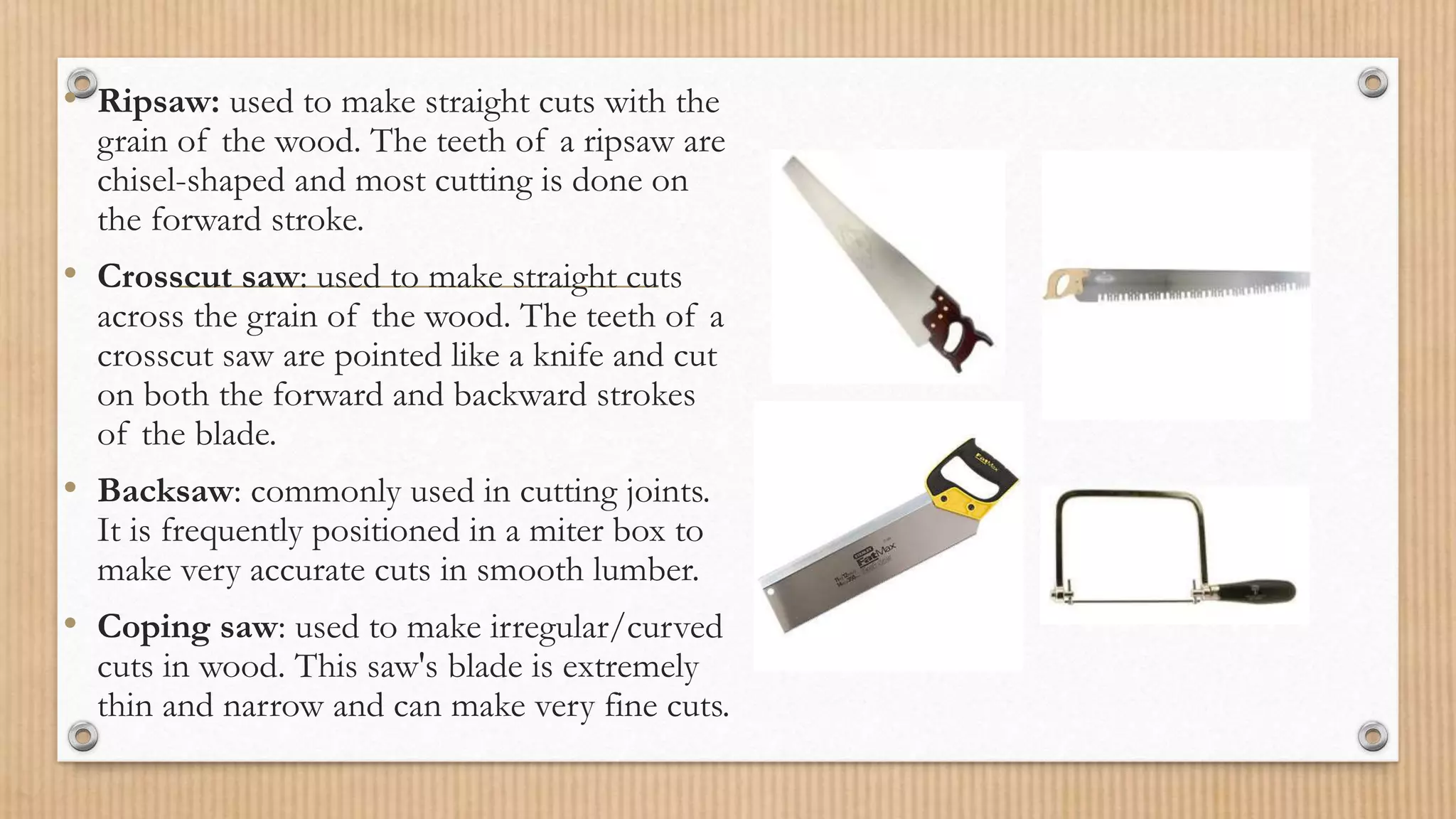
• Ripsaw: used to make straight cuts with the
grain of the wood. The teeth of a ripsaw are
chisel-shaped and most cutting is done on
the forward stroke.
• Crosscut saw: used to make straight cuts
across the grain of the wood. The teeth of a
crosscut saw are pointed like a knife and cut
on both the forward and backward strokes
of the blade.
• Backsaw: commonly used in cutting joints.
It is frequently positioned in a miter box to
make very accurate cuts in smooth lumber.
• Coping saw: used to make irregular/curved
cuts in wood. This saw's blade is extremely
thin and narrow and can make very fine cuts.
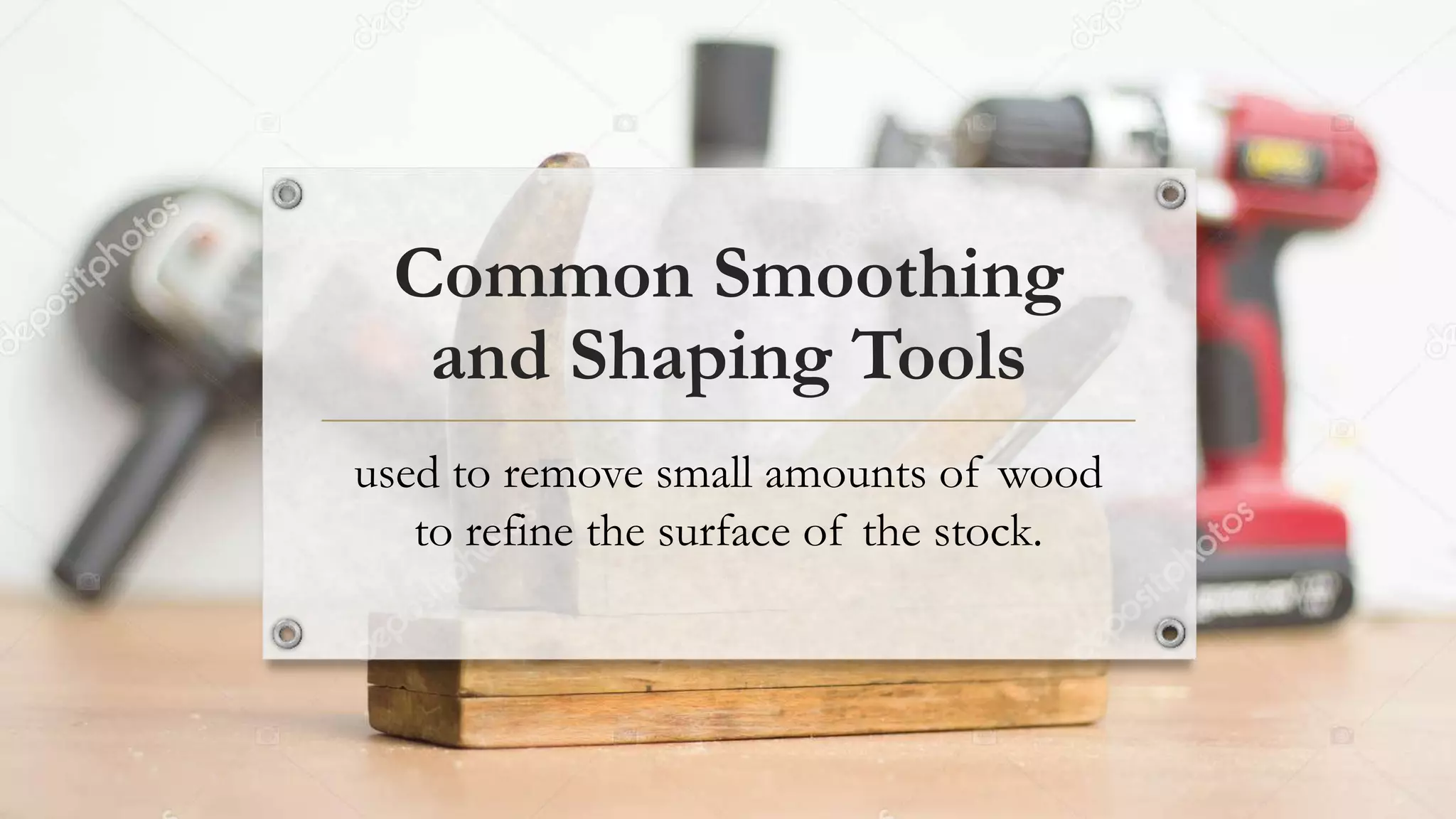
Common Smoothing
and Shaping Tools
used to remove small amounts of wood
to refine the surface of the stock.
• Planes: designed for working on edges,
ends and faces of boards. Used for
trimming boards to size, beveling and
chamfering edges, and squaring uneven
stock.
Jointer Plane and Fore Plane: best for
smoothing long edges and surfaces.
Smooth Plane
Block Plane
Jack Plane: all-purpose smoothing tool,
also used for working on rough
surfaces and removing marks
• Chisels: tools that can remove
thick/thin shavings of wood, used when
inaccessible to saws/planes, used for
cutting precise grooves for making joints.
Chisels has a blade with a flat side and a
beveled edge.
• Mallet: used to strike the handle
rather than a hammer to avoid
damaging the chisel.
• Files and Rasps: useful for
forming and smoothing irregular
shapes; classified by shape,
length, teeth design, and teeth
coarseness.
Common Drilling and
Boring Tools
tools used to cut holes in wood
"drilling" used for cutting holes 1/4 inches or smaller; "boring"
used for cutting holes larger than 1/4 inches.
• Hand drill: generally used for
cutting holes 1/4 inches or smaller;
consists of a handle, rank, and
chunk for holding twist drills.
• Brace: generally used for cutting
holes larger than 1/4 inches;
consists of a head, handle, ratchet,
and chunk.
Common Tools and
Materials for Fastening
• Clamps: used in a number of different
applications to hold items in place or
secure items
• Nails: come in a wide variety of shapes
and sizes.
• Screws: used to provide more
holding power than nails and when
a project requires disassembly.
• Claw hammer: consisting of a
metal head and a wood/plastic
handle; used to drive nails into
wood and remove nails
• Screwdrivers: consisting of a
handle, metal blade and tip; used to
drive screws.
Common Hand Tools
for
METALWORKING
Common Marking
Tools
• Scratch awl: used with a straight edge to
scratch straight lines in metal; consists of a
pointed metal shaft attached to a
wood/plastic handle.
• Dividers: used for scribing arcs and circles
on metal; used to transfer dimensions
from one scale/object to another item.
• Soapstone: soft, gray rock, is cut into thin
pieces and used like a pencil to mark
metal.
• Center punch: pencil-shaped tool used to
make a small dent in metal for marking the
center of a hole and starting a twist drill
bit.
Common Cutting
Tools
• Hacksaw: most useful cutting tools for metal.
Two types of blade
Solid (all-hard) blade / High Speed Steel blades: good for long term use; used
for cutting tool steel, cast iron, and larger pieces of mild steel.
High Carbon Steel blades: short term hard use; used typically used for cutting
channel iron, tubing copper and aluminum.
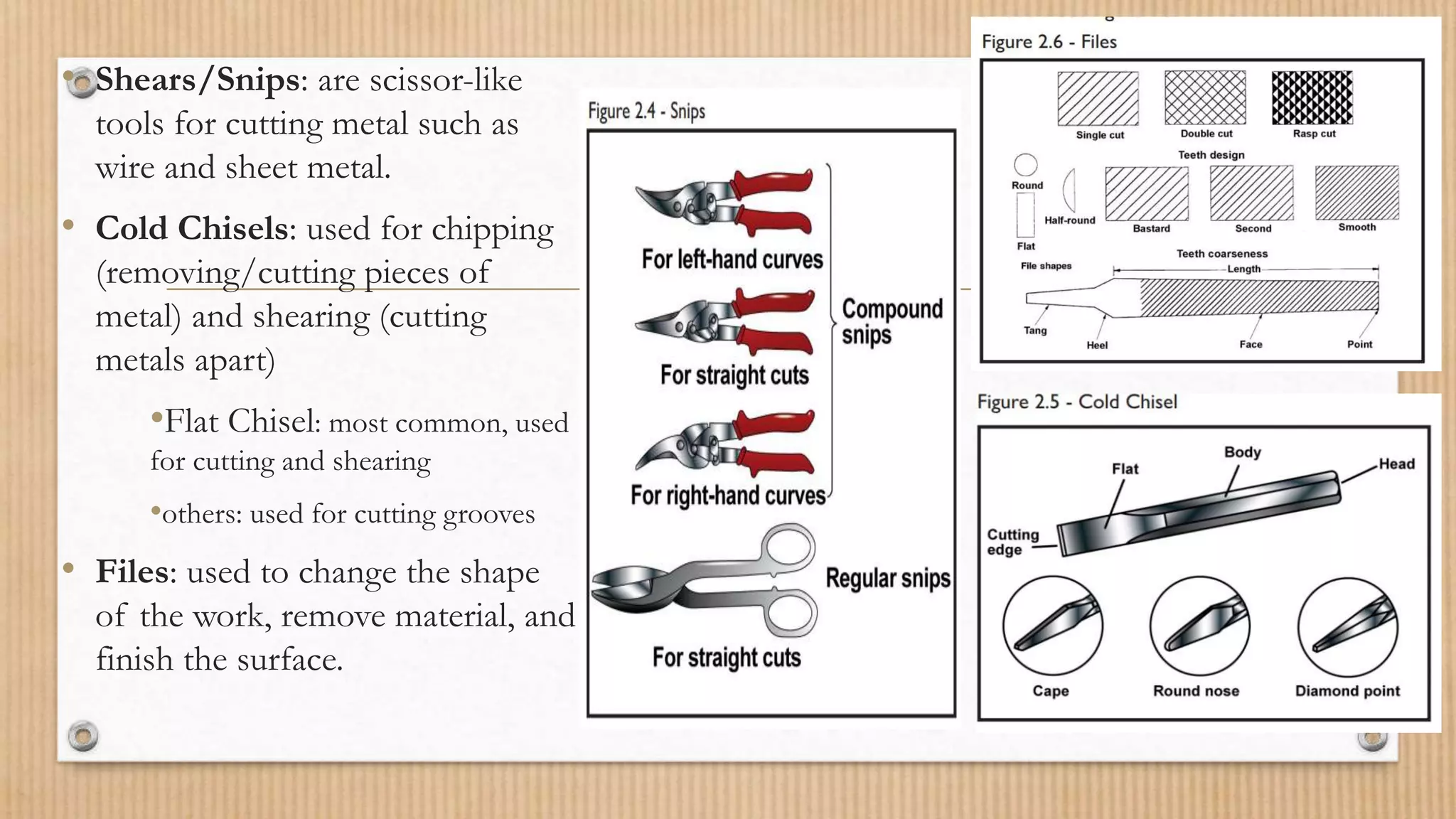
• Shears/Snips: are scissor-like
tools for cutting metal such as
wire and sheet metal.
• Cold Chisels: used for chipping
(removing/cutting pieces of
metal) and shearing (cutting
metals apart)
•Flat Chisel: most common, used
for cutting and shearing
•others: used for cutting grooves
• Files: used to change the shape
of the work, remove material, and
finish the surface.
Other Common
Tools
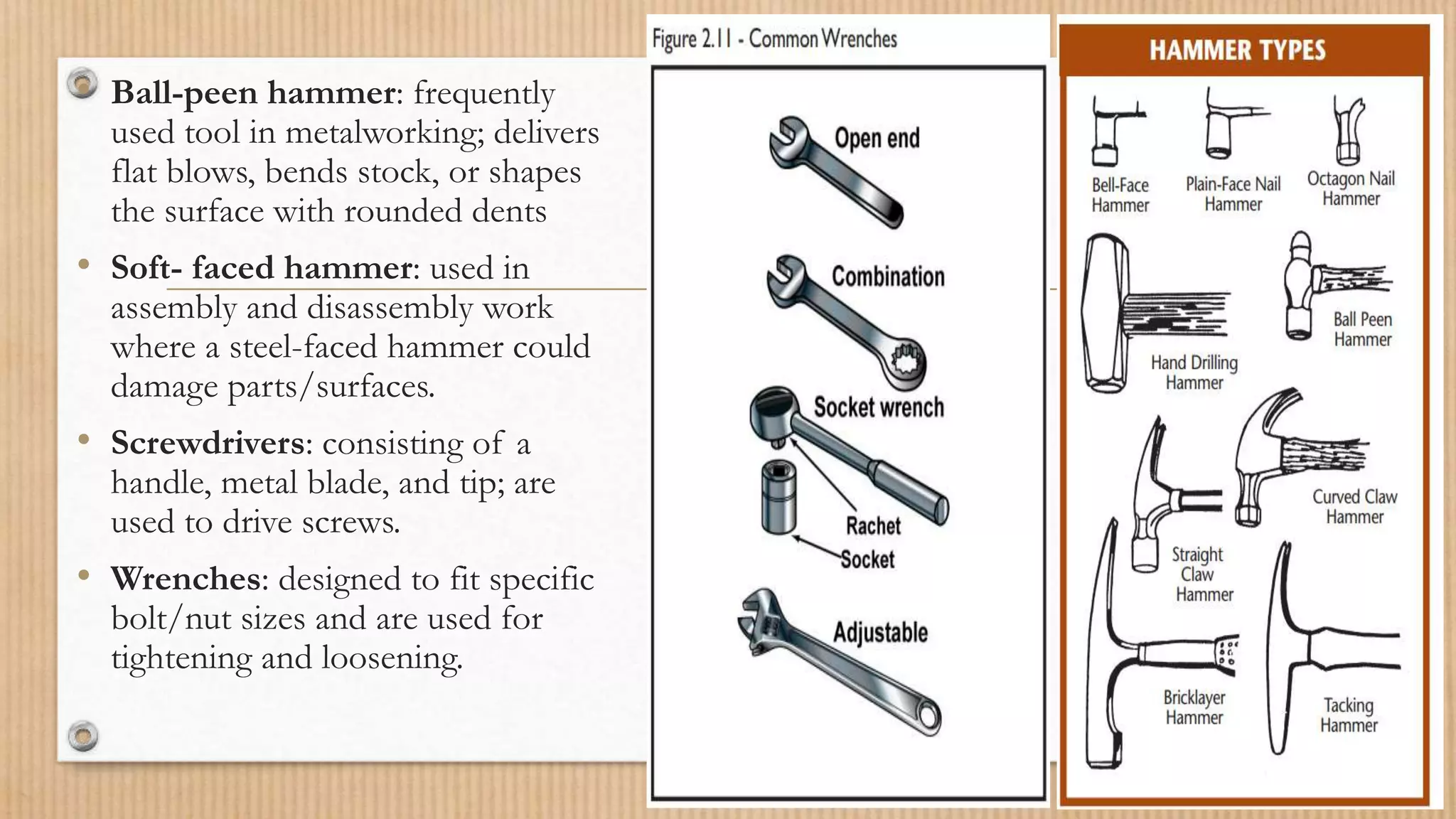
• Ball-peen hammer: frequently
used tool in metalworking; delivers
flat blows, bends stock, or shapes
the surface with rounded dents
• Soft- faced hammer: used in
assembly and disassembly work
where a steel-faced hammer could
damage parts/surfaces.
• Screwdrivers: consisting of a
handle, metal blade, and tip; are
used to drive screws.
• Wrenches: designed to fit specific
bolt/nut sizes and are used for
tightening and loosening.
Common
Power Tools
• Portable Drills: used to do various
woodworking, can easily be taken to
the job site; used to loosen and
tighten the chuck, also as drilling
and boring, and removing screws
and operating hole saws.
• Portable Circular Saws: commonly
used for making rip cuts, cross-cuts,
bevel cuts, and angle cuts for
mitering.
• Reciprocating Saws: used to make
relief cuts, irregular cuts, cross-cuts,
and pocket cuts.
• Band saws: used for making straight
and irregular cuts, arcs, curves, and
bevels.
• Table saws: works
similarly to a
portable circular
saw, bit much larger
and is anchored to
the floor, equipped
with a tilting
table/tilting arbor,
which can be
adjusted for making
angle cuts.
• Shapers: stationary
power tool that is
used for shaping
edges, making
moldings, and
cutting joints.
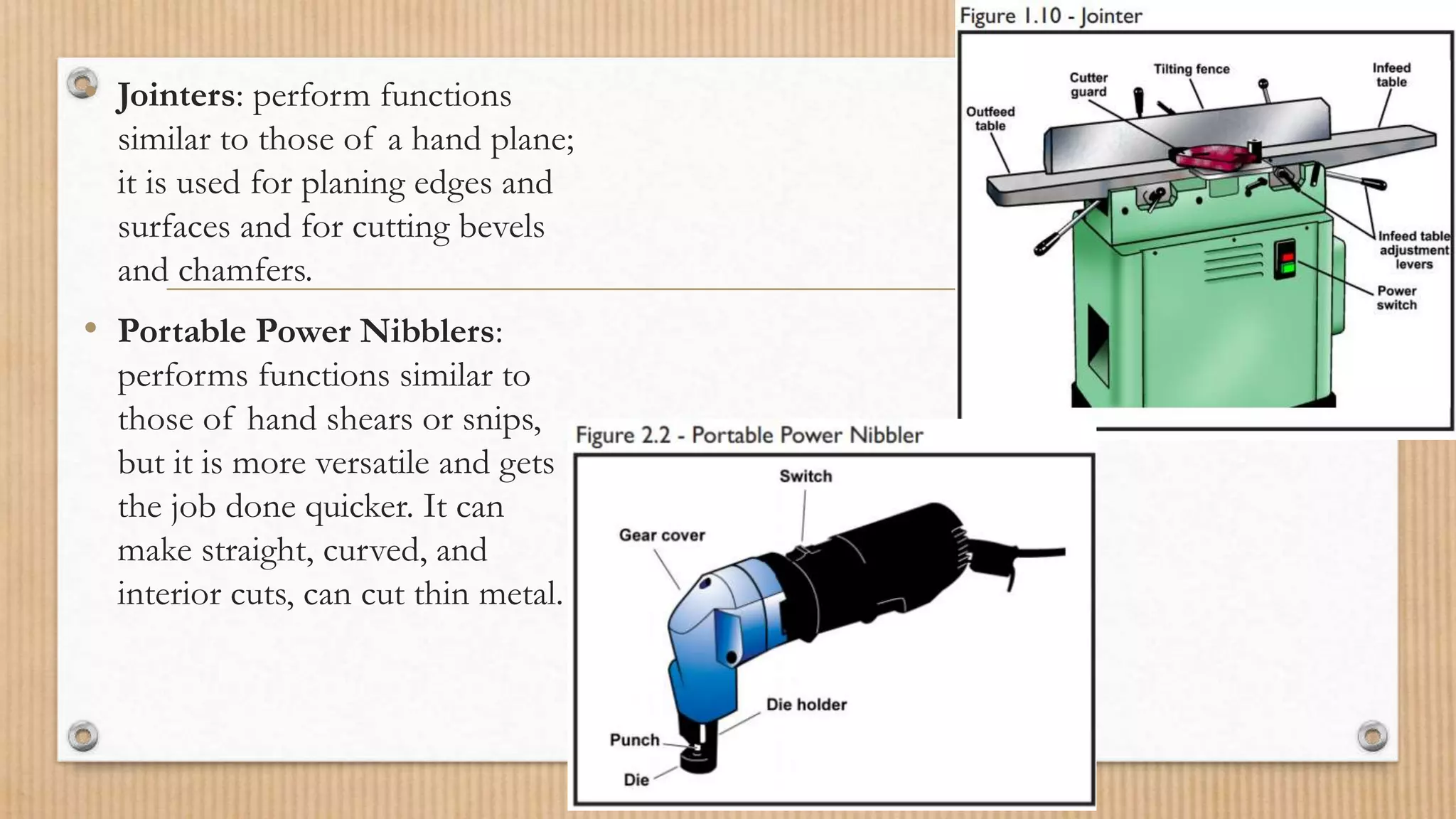
• Jointers: perform functions
similar to those of a hand plane;
it is used for planing edges and
surfaces and for cutting bevels
and chamfers.
• Portable Power Nibblers:
performs functions similar to
those of hand shears or snips,
but it is more versatile and gets
the job done quicker. It can
make straight, curved, and
interior cuts, can cut thin metal.
• Cold Circular Cutoff Saws: has a flat, round blade and is used for cutting metal
to length, making straight tool for grinding, shaping, and cleaning metal.
• Portable Grinder: useful for performing resurfacing work, such as removal of rust
and paint.
• Bench Grinders: does work
similar to a portable grinder, but it
is a stationary machine mounted
on a bench used for sharpening
and reconditioning tools and for
shaping cleaning metal.
• Sheet Metal Brakes: used for
making angle and radius bends,
seaming, flattening, and punching.
• Drill Press: common uses are
drilling/boring and countersinking.
THE END

TOOLS AND EQUIPMENT FOR WOOD, METAL, AND BAMBOO CRAFT​

  • 1.
    TOOLS AND EQUIPMENT FORWOOD, METAL, AND BAMBOO CRAFT
  • 2.
    Common Measurement Tools to ensureaccuracy and consistency of a project, e.g. width and length
  • 3.
    • Combination square:uses include a ruler, marking gauge, level, and try square for inside and outside measurements. • Framing square: L-shaped metal measuring device, used for framing and laying out stairs. • Speed square: shaped like a triangle but functions as a square, uses include laying out stairs and rafters, measuring and marking miter cuts.
  • 4.
    • Retractable steeltape measure (combination tape): used for making straight measurements • Level: consists of a bar of wood/aluminum with transparent tubes, used to determine if an object is level. • Caliper: device that measures diameter or thickness of an object
  • 5.
  • 6.
    • Ripsaw: usedto make straight cuts with the grain of the wood. The teeth of a ripsaw are chisel-shaped and most cutting is done on the forward stroke. • Crosscut saw: used to make straight cuts across the grain of the wood. The teeth of a crosscut saw are pointed like a knife and cut on both the forward and backward strokes of the blade. • Backsaw: commonly used in cutting joints. It is frequently positioned in a miter box to make very accurate cuts in smooth lumber. • Coping saw: used to make irregular/curved cuts in wood. This saw's blade is extremely thin and narrow and can make very fine cuts.
  • 7.
    Common Smoothing and ShapingTools used to remove small amounts of wood to refine the surface of the stock.
  • 8.
    • Planes: designedfor working on edges, ends and faces of boards. Used for trimming boards to size, beveling and chamfering edges, and squaring uneven stock. Jointer Plane and Fore Plane: best for smoothing long edges and surfaces. Smooth Plane Block Plane Jack Plane: all-purpose smoothing tool, also used for working on rough surfaces and removing marks • Chisels: tools that can remove thick/thin shavings of wood, used when inaccessible to saws/planes, used for cutting precise grooves for making joints. Chisels has a blade with a flat side and a beveled edge.
  • 9.
    • Mallet: usedto strike the handle rather than a hammer to avoid damaging the chisel. • Files and Rasps: useful for forming and smoothing irregular shapes; classified by shape, length, teeth design, and teeth coarseness.
  • 10.
    Common Drilling and BoringTools tools used to cut holes in wood "drilling" used for cutting holes 1/4 inches or smaller; "boring" used for cutting holes larger than 1/4 inches.
  • 11.
    • Hand drill:generally used for cutting holes 1/4 inches or smaller; consists of a handle, rank, and chunk for holding twist drills. • Brace: generally used for cutting holes larger than 1/4 inches; consists of a head, handle, ratchet, and chunk.
  • 12.
  • 13.
    • Clamps: usedin a number of different applications to hold items in place or secure items • Nails: come in a wide variety of shapes and sizes.
  • 14.
    • Screws: usedto provide more holding power than nails and when a project requires disassembly. • Claw hammer: consisting of a metal head and a wood/plastic handle; used to drive nails into wood and remove nails • Screwdrivers: consisting of a handle, metal blade and tip; used to drive screws.
  • 15.
  • 16.
  • 17.
    • Scratch awl:used with a straight edge to scratch straight lines in metal; consists of a pointed metal shaft attached to a wood/plastic handle. • Dividers: used for scribing arcs and circles on metal; used to transfer dimensions from one scale/object to another item. • Soapstone: soft, gray rock, is cut into thin pieces and used like a pencil to mark metal. • Center punch: pencil-shaped tool used to make a small dent in metal for marking the center of a hole and starting a twist drill bit.
  • 18.
  • 19.
    • Hacksaw: mostuseful cutting tools for metal. Two types of blade Solid (all-hard) blade / High Speed Steel blades: good for long term use; used for cutting tool steel, cast iron, and larger pieces of mild steel. High Carbon Steel blades: short term hard use; used typically used for cutting channel iron, tubing copper and aluminum.
  • 20.
    • Shears/Snips: arescissor-like tools for cutting metal such as wire and sheet metal. • Cold Chisels: used for chipping (removing/cutting pieces of metal) and shearing (cutting metals apart) •Flat Chisel: most common, used for cutting and shearing •others: used for cutting grooves • Files: used to change the shape of the work, remove material, and finish the surface.
  • 21.
  • 22.
    • Ball-peen hammer:frequently used tool in metalworking; delivers flat blows, bends stock, or shapes the surface with rounded dents • Soft- faced hammer: used in assembly and disassembly work where a steel-faced hammer could damage parts/surfaces. • Screwdrivers: consisting of a handle, metal blade, and tip; are used to drive screws. • Wrenches: designed to fit specific bolt/nut sizes and are used for tightening and loosening.
  • 23.
  • 24.
    • Portable Drills:used to do various woodworking, can easily be taken to the job site; used to loosen and tighten the chuck, also as drilling and boring, and removing screws and operating hole saws. • Portable Circular Saws: commonly used for making rip cuts, cross-cuts, bevel cuts, and angle cuts for mitering.
  • 25.
    • Reciprocating Saws:used to make relief cuts, irregular cuts, cross-cuts, and pocket cuts. • Band saws: used for making straight and irregular cuts, arcs, curves, and bevels.
  • 26.
    • Table saws:works similarly to a portable circular saw, bit much larger and is anchored to the floor, equipped with a tilting table/tilting arbor, which can be adjusted for making angle cuts. • Shapers: stationary power tool that is used for shaping edges, making moldings, and cutting joints.
  • 27.
    • Jointers: performfunctions similar to those of a hand plane; it is used for planing edges and surfaces and for cutting bevels and chamfers. • Portable Power Nibblers: performs functions similar to those of hand shears or snips, but it is more versatile and gets the job done quicker. It can make straight, curved, and interior cuts, can cut thin metal.
  • 28.
    • Cold CircularCutoff Saws: has a flat, round blade and is used for cutting metal to length, making straight tool for grinding, shaping, and cleaning metal. • Portable Grinder: useful for performing resurfacing work, such as removal of rust and paint.
  • 29.
    • Bench Grinders:does work similar to a portable grinder, but it is a stationary machine mounted on a bench used for sharpening and reconditioning tools and for shaping cleaning metal. • Sheet Metal Brakes: used for making angle and radius bends, seaming, flattening, and punching. • Drill Press: common uses are drilling/boring and countersinking.
  • 30.