GOOD MORNING
TONGUETONGUE
&&
PALATEPALATE
PALATE
Dr. Dipal Mawani
PG
Department of Prosthodontics
• Tongue
• Introduction
• Embryology
• Functions
• Parts of the tongue
• Muscles of the tongue
• Papilla
• Taste buds & taste discrimination
• Blood & nerve supply
• Applied anatomy
• Prosthodontic considerations
• Deglutition
• Palate
• Introduction
• Hard palate
• Soft palate
• Muscles of palate
• Blood supply
• Nerve supply
• Passavants ridge
• Movement and function of soft palate
• Prosthodontic consideration
• Conclusion
• References
Introduction
• Tongue is a solid conical muscular organ, covered
partially by mucous membrane and lies partly in the oral
cavity and partly in the pharynx.
Embryology
• Each pharyngeal arch arises
as a mesodermal thickening in
the lateral wall of the foregut.
• First (Mandibular) arch
• Second (Hyoid) arch
• Third arch
• Fourth arch
• Sixth arch
Functions
• It acts as an organ of taste, and helps in mastication,
deglutition and speech.
• In some lower animals (e.g. dog) it is used for thermo-
regulation by panting.
• Clinically, it acts as a diagnostic aids in various systemic
conditions.
ANATOMY OF TONGUE:
FRENULUM
DEEP
LINGUAL
VEIN
PLICA
FIMBRIATA
DORSAL SURFACE:
VENTRAL SURFACE:
pharyngeal (post sulcal) part
• There are underlying lymphoid nodules which are
embedded in the submucosa and collectively termed the
lingual tonsil.
Muscles of the Tongue
Muscles of the Tongue:
A middle fibrous septum divides the tongue into
right and left halves. Each half contains four
intrinsic and four extrinsic muscles.
….the former entirely within it and altering its shape.
….the latter extending outside the tongue and moving
it bodily.
The intrinsic muscles are
superior longitudinal,
inferior longitudinal,
transverse and
vertical.
The extrinsic musculature consists
genioglossus,
hyoglossus,
Styloglossus
palatoglossus.
Originate &
insert within
the tongue
Originate outside
the tongue &
insert within
the tongue
EXTRINSIC MUSCLES:
Genioglossus
Actions –
i. Genioglossus brings about the forward traction of the
tongue to protrude its apex from the mouth.
ii. Acting bilaterally, the two muscles depress the central
part of the tongue, making it concave from side to side.
iii. Acting unilaterally, the tongue diverges to the opposite
side.
• Hyoglossus:
Action - Hyoglossus depresses the tongue, makes the
dorsum convex, helps to retract the protruded tongue .
• Chondroglossus:
Sometimes described as a part of hyoglossus, the muscle is
separated from it by some fibres of Genioglossus, which
pass to the side of the pharynx.
It ascends to merge into the intrinsic musculature between
the hyoglossus and genioglossus muscles.
• Styloglossus:
Action- pulls
tongue upwards
& backwards
• Platoglossus:
Actions
It Elevates the Root
of the Tongue &
approximates the
Palatoglossal arch to
its contralateral
fellow, thus shunting
off the oral cavity
from the Oropharynx
INTRINSIC MUSCLE
Superior longitudinal—
Action - shortens tongue
- dorsum concave
Inferior longitudinal
Action- shortens the tongue
- dorsum convex
Transverse muscles—
Action— narrow & elongated
Vertical muscle
Action- broad & flattened
CIRCUMVALLATE PAPILLAE
Large in sizeLarge in size
1-2 mm diameter1-2 mm diameter
8-12 in number8-12 in number
Situated immediately in front of Sulcus TerminalisSituated immediately in front of Sulcus Terminalis
Each papilla is a cylindrical projection surrounded by aEach papilla is a cylindrical projection surrounded by a
circular sulcus,circular sulcus,
the walls of which are raised above the surface.the walls of which are raised above the surface.
in size
1-2 mm diameter
8-12 in number
Situated immediately in front of Sulcus
Termina
Taste buds:
FFUNGIFORM PAPILLAE:
 Numerous near the tip and margins of tongueNumerous near the tip and margins of tongue
 Smaller than vallate but larger than filiformSmaller than vallate but larger than filiform
 Each consists of a narrow pedicle and a large roundedEach consists of a narrow pedicle and a large rounded
headhead
 Distinguished by bright red colorDistinguished by bright red color
FILLIFORM PAPILLAE:
 Cover the pre-sulcal area of dorsum of tongueCover the pre-sulcal area of dorsum of tongue
 Give characteristic velvety appearanceGive characteristic velvety appearance
 SmallestSmallest
 Most numerousMost numerous
 Each is pointed and covered with keratinEach is pointed and covered with keratin
 Apex is often split into filamentous processesApex is often split into filamentous processes..
FFOLIATE PAPILLA:
Lie bilaterallyLie bilaterally
Red in colorRed in color
Leaf like mucosal ridgesLeaf like mucosal ridges
Bear numerous taste budsBear numerous taste buds
MECHANISM OF TASTE PERCEPTION
Adsorption of molecule onto membrane receptor of taste buds
Activation of cascade
Change in membrane polarization
Release of transmitter substance
Afferent fibers' of glossopharyngel nerve
Generation of taste stimuli
Mediated by transducing & gustaducin
VASCULAR SUPPLY
Arterial supply:Arterial supply:
lingual artery which is branch oflingual artery which is branch of
external carotid arteryexternal carotid artery
Root of tongue-also by tonsillar &Root of tongue-also by tonsillar &
ascending pharyngeal arteryascending pharyngeal artery
Venous drainage:
Deep lingual vein—largest &
principal route joins with
sublingual vein which joins
facial vein and internal jugular
vein
Lymphatic drainage
TIP— bilaterally— submental
nodes
ANTERIOR 23rd— unilaterally—
submandibular nodes
POSTERIOR 13rd— bilaterally
— juguloomohyoid nodes.
JUGULO-OMOHYOID NODES
known as Lymph nodes of the
tongue
INNERVATION OF THE TONGUE
MOTOR
SENSORY
TASTE
HISTOLOGY OF TONGUE:
Applied Aspects of tongue
too large (macroglossia) seen in
Downs syndrome &
Beckwith-Wiedemann syndrome
too small (microglossia).
Very rarely the tongue may be absent (aglossia).
• The apical part of the tongue may be anchored to the floor of
the mouth by an overdeveloped frenulum. This condition is
called ankyloglossia or tongue-tie. It interferes with speech.
• Remnants of the thyroglossal duct may form cysts at the base
of the tongue.
• The tongue may
be bifid because of
non-fusion of the two
lingual swellings.
• Fissured tongue/Scrotal tongue: seen as grooves that
vary in depth & are noted along lateral & dorsal aspects
of the tongue seen in Down syndrome & Melkersson-
Rosenthal syndrome
• Median Rhomboid Glossitis:
Presents in the posterior midline of the dorsum of the
tongue ,just anterior to the V-shaped grouping of the
circumvalate papilla. This is due to failure of fusion of lingual
swellings with tuberculum impar.
• Benign migratory glossitis:
It is a psoriasiform mucositis of the tongue.
• Hairy tongue:
A condition of hypertrophy of filiform papillae.
•The under surface of the tongue is a good site (along with
the bulbar conjunctiva) for observation of jaundice
•In scarlet fever the atrophy of the lingual mucosa causes
the peculiar redness of the strawberry tongue.
•Pernicious anemia & vitamin deficiencies cause
characteristic changes such as magenta tongue & beefy
red tongue.
Injury to the hypoglossal nerve produces paralysis of the muscles
of the tongue on the side of lesion.
• If the lesion is infranuclear, there is gradual atrophy of the
affected half of the tongue (hemiatrophy).Seen typically in
motor neuron disease and in syringobulbia.
• Supranuclear lesions of the hypoglossal nerve produce
paralysis without wasting. This is best seen in pseudobulbar
palsy where the tongue is stiff, small and moves very
sluggishly resulting in defective articulation.
• Palpation:
The patient is asked to protrude the tongue onto the gauze.
Aided by the gauze the dentist can hold the tongue using a
mirror to examine it. Palpation should be done both left to
right & right to left & should be done quickly.
The targeted areas are the lateral borders & the region of
vallate papilla
• ‘Tongue function test’ to determine high lingual frenal
attachment. Normally the patient should be able to touch
the upper lip with the tip of the tongue without dislodging
the lower denture and thus the lingual frenum should be
relived when found necessary.
• A patient requiring lingual frenectomy, the denture should
be made before surgery is performed, where in the
denture acts as a stent to prevent future relapse
Prosthodontic aspect of tongue
-REST POSITION OF TONGUE
-EFFECTS OF TONGUE IN COMPLETE DENTURE
role of impression making in alveolingual sulcus
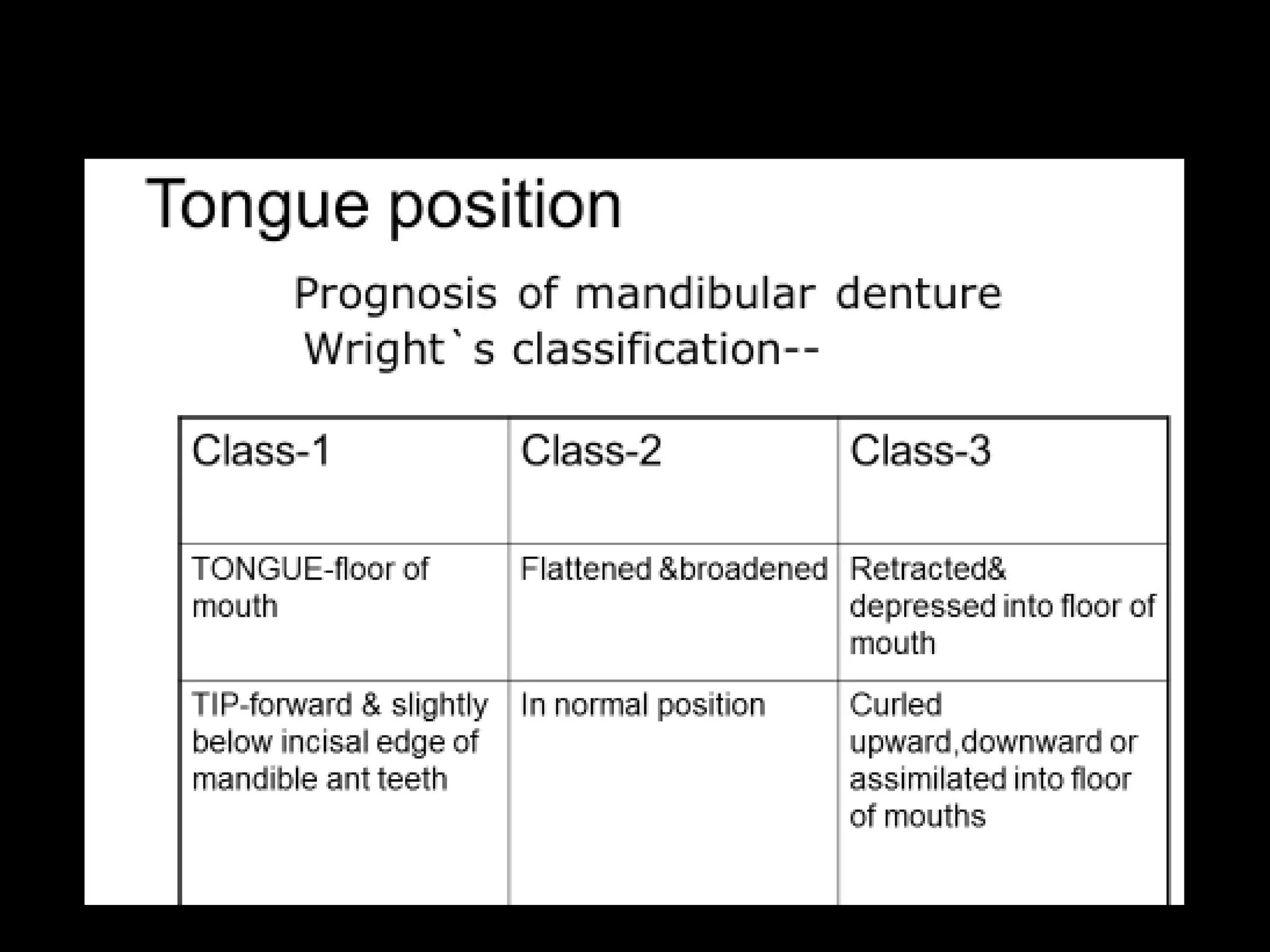
tongue position
tongue size
tongue space
-EFFECTS OF TONGUE ON SPEECH
-EFFECTS OF TONGUE ON MASTICATION
-ATTENTION DURING DENTURE DESIGN
Rest position of tongue
• Dorsum—rest against roof of mouth
• Tip—rest against lingual surface of lower ant teeth
• Lateral borders—against lingual borders of posterior
teeth
Role in impression making of alveolingual
sulcus
• A) anterior part
• It is mainly influenced by the genioglossus muscle, the
lingual frenum and to a lesser extent by the anterior
portion of the sublingual gland
• The lingual border of the impression in this region should
extend down to make contact with the floor of the mouth,
when the tip of the tongue touches the upper lip
b)Middle part
 This curvature is due to the prominence of the mylohyoidThis curvature is due to the prominence of the mylohyoid
ridge and the action of mylohyoid muscleridge and the action of mylohyoid muscle
 When the middle of the lingual flange is made to slope towardWhen the middle of the lingual flange is made to slope toward
the tongue, it can extend below the level of the mylohyoidthe tongue, it can extend below the level of the mylohyoid
ridgeridge
 In this way, the tongue rests on top of the flange and aids inIn this way, the tongue rests on top of the flange and aids in
stabilizing the lower denture on the residual ridgestabilizing the lower denture on the residual ridge
c)Posterior part
 Flange can turn laterally toward the ramus to fill the fossa andFlange can turn laterally toward the ramus to fill the fossa and
complete the typical s shaped lingual flangecomplete the typical s shaped lingual flange
 Floor of the mouth exhibits an active phase and a resting phaseFloor of the mouth exhibits an active phase and a resting phase
each with a differing lingual vestibular leveleach with a differing lingual vestibular level
 Between these 2 levels, the lingual flange of the denture mustBetween these 2 levels, the lingual flange of the denture must
be terminatedbe terminated
Tongue size
small - facilitate impression making but
jeopardize lingual
seal
large- problem in impression making
- denture instability
- tongue biting
Tongue space
• Artificial teeth must be arranged in neutral zone—
where inward pressure of cheeks & lips =
outward pressure of tongue
If tongue is cramped by denture
lateral pressure exerted
instability in denture when tongue moves
Effect of tongue on speech
• Voice principally produced—larynx, while tongue by
constantly changing its shape & position of contact with
teeth, alveolar process—gives its sound form & its
qualities
• Role in speech-
Vowels are Produced by the extrinsic muscles of the
tongue Which produce different configuration of the
resonating chamber for each vowel.
Consonants are produced by the intrinsic muscles of
the tongue so that the tongue is separated from the
teeth, gums or palate by a blast of expired air.
• Dental sounds(th)—
– Tip of tongue slightly bw upper & lower ant
teeth
– 3mm space-normal
– <3mm-ant teeth too far forward
-excessive vertical overlap
->6mm-ant teeth too far lingual
• Alveolar sounds(t,d,n,s,z)—
tip of tongue - ant most part of palate
t d(if teeth far lingual)
d t(if teeth far anterior)
Effects of tongue on Mastication
• Tip of tongue-
-incise piece of food
-if incising not required-shallow concavity at centre-
food is placed
-transfer backwards along concave surface
• Middle of tongue-
-rises & forces food laterally b/w occlusal
surface of teeth
- teeth divide food & tongue collect- forms BOLUS
-food reaches backwards-tongue & palate passes-
pharynx-oesophagus
Attention during denture design
• Occlusal plane of lower denture- low so that lateral
borders rest upon it
• Teeth never inside alveolar ridge
• Palate of upper denturethinaccording to strength of
material used
• Lingual cusp of lower posterior teeth should not
overhang tongue
Tongue in Geriatric Patients
• There is a tendency for the taste buds to
diminish in old aged
• when the person is edentulous for several
months without replacement of teeth the
tongue will be hypertrophied.
• Swallowing is initiated reflexly when food or liquid stimulates
sensory nerves in the oropharynx.
• In man, 600 swallows are reported to occur in each 24-
hour period, but of these, only some 150 relate to feeding.
The remaining swallows, which occur less frequently at night,
are unconscious 'empty' swallows that appear to relate
primarily to the clearance of saliva from the mouth.
ANATOMY OF SWALLOWING
(DEGLUTITION)
ANATOMY OF SWALLOWING (DEGLUTITION)
Swallows have been divided into three phases, usually
described as
the first or oral/Buccal- voluntary
the second or pharyngeal-Involuntary
the third or oesophageal phases-Involuntary
• ORAL PHASE:
The oral phase is voluntary bolus of food is moved from
the oral cavity up to or through the fauces.
Transport of the bolus through the mouth is accomplished
by first forming a shallow midline gutter along the tongue to
accommodate the bolus, and then by elevating the tongue and
the floor of that midline gutter from before backwards.
The gutter is probably formed by the co-contraction of the
styloglossi and the genioglossi.
At this stage a posterior oral seal exists which is associated
with elevation of the posterior tongue.
Elevation is accompanied by a relaxation of the posterior
oral seal and a forward movement of the posterior
tongue which is followed by bilateral contraction of the
palatoglossi.
pharyngeal stage:
the tongue raises
against the palate,
the nasopharynx is
closed off, the
larynx raises, the
epiglottis seals of
the larynx & the
bolus is passed
into the
oesophagus
• In this second stage, the three pharyngeal constrictor
muscles undergo sequential contraction which is usually
interpreted as the driving force which propels the bolus
towards the oesophagus
OESOPHAGEAL PHASE:
• OESOPHAGEAL PHASE: The third or oesophageal
stage involves the relaxation of cricopharyngeus (the
upper oesophageal sphincter) to allow the bolus to enter
the oesophagus. Once in the oesophagus, the bolus is
propelled by sequential waves of contractions of the
oesophageal musculature down to the lower
oesophageal sphincter, which opens momentarily to
allow the bolus to enter the stomach.
PALATE
• pa
INTRODUCTION
• Palate: roof of the oral cavity.
• It has two parts – an anterior(bony) hard palate
– a posterior(muscular) soft palate
Hard Palate
 Lies in the roof of the oral cavity
 Forms the floor of the nasal cavity
 Formed by:
– Palatine processes of maxillae in front
– Horizontal plates of palatine bones behind
• Bounded by alveolar arches
 Posteriorly, continuous with soft palate
 Its undersurface covered by mucoperiosteum
 Shows transverse folds in the anterior parts
SOFT PALATE
movable muscular fold
suspended from post border
of hard palate
Separates nasopharynx from
oropharynx
 Attached to the posterior border of the hard palate
 Covered on its upper and lower surfaces by mucous
membrane
 Composed of:
– Muscle fibers
– An aponeurosis
– Lymphoid tissue
– Glands
– Blood vessels
– Nerves
Palatine Aponeurosis
 Fibrous sheath
 Attached to posterior border of hard palate
 Is flattened tendon of tensor velli palatini
 Splits to enclose musculus uvulae
 Gives origin & insertion to palatine muscles
Palatine aponeurosis
Near median plane,Near median plane,
the aponeurosis splitsthe aponeurosis splits
to enclose theto enclose the
musculus uvulaemusculus uvulae..
 Tensor veli palatini
– Origin: spine of
sphenoid;,scapho
id fossa, auditory
tube
– Insertion: forms
palatine
aponeurosis
which is attached
to
– (a) Posterior
border of hard
palate
– (b)Inf surface of
palate behind
palatine crest
– Action: Tenses
soft palate,opens
auditory tube
MUSCLES
Spine ofSpine of
SphenoidSphenoid
bonebone
Soft palateSoft palate
UvulaUvula
MusculusMusculus
UvulaeUvulae
PalatinePalatine
aponeurosiaponeurosi
ss
PterygoidPterygoid
hamulushamulus
TensorTensor
veliveli
palatinipalatini
Muscles
• Levator veli palatini
– Origin:petrous temporal
bone, auditory tube.
– Insertion: palatine
aponeurosis
– Action: Raises soft palate
also dilates auditory tube
Muscles
• Musculus
uvulae
– Origin:
posterior
nasal spine
– Palatine
aponeurosis
– Insertion:
mucosa of
uvula
– Action:
Elevates uvula
uvula
Muscles
• Palatopharyngeus
• 2 fasciculi
– Origin: Ant Fasciculus(Post
border of hard palate)
– Post fasciculus(palatine
aponeurosis)
– Insertion: posterior border of
thyroid cartilage
– Action: Elevates wall of the
pharynx
palatopharyngeous
Muscles
• Palatoglossus
– Origin: palatine
aponeurosis
– Insertion: side of tongue
– Action: pulls root of tongue
upward, narrowing
oropharyngeal isthmus
Blood supply
Greater palatine branch of the
maxillary artery
Ascending palatine, branch of the
facial artery
Palatine branch of Ascending
pharyngeal, branch of the external
carotid artery
VEINS;
Pterygoid and tonsillar plexus of
veins
Lymphatics
Upper deep
cervical&retropharyngeal
Sensory Nerve Supply
• General Sensory:Mostly by the
maxillary nerve through its
branches:
– Greater palatine nerve
– Lesser palatine nerve
• Special Sensory:For taste
sensations: lesser palatine
nerves-greater petrosal nerve
-geniculate ganglion- facial nerve
nucleus of solitary tract.
Secretomotor: greater petrosal
nerves.
Motor Nerve Supply
• All the muscles, except tensor veli palatini, are supplied
by the:
– Pharyngeal plexus
• Tensor veli palatini supplied by the:
– Nerve to medial pterygoid, a branch of the
mandibular division of the trigeminal nerve
Passavants Ridge
• Upper fibres of palatopharyngeus
• Raises a ridge
• Morphology
• Best developed in cleft palate
Movements & functions of Soft
palate
• Controls 2 gates
• Isolates mouth from Oropharynx during chewing
• Separates Oropharynx from nasopharynx
• Vary degree of closure of pharyngeal isthmus to modify
quality of voice
• During coughing and sneezing
Clinical Notes
• Cleft palate:
– Unilateral
– Bilateral
– Median
Pharyngeal
isthmus
• Paralysis of the soft
palate
– The pharyngeal isthmus can
not be closed during
swallowing and speech
– Nasal regurgitation
– Nasal twang
– Flattening of Palatoglossal
arch
PROSTHODONTIC
CONSIDERATIONS
Classification of soft palate:
PALATAL THROAT FORMSPALATAL THROAT FORMS
11) CLASS 1
12) CLASS 2
13) CLASS 3
It is the area between the anterior and posterior
vibrating line found medially from one tuberosity to
other.
Cupid bow appearance.
POST PALATAL SEAL
An imaginary line across the posterior
part of the palate marking the division between the
movable and
immovable tissues of the soft palate. This can be
identified when
the movable tissues are functioning
-GPT 8*
* J. Prosthet Dent.2005Jul;94(1):10-92
VIBRATING LINE
Swenson described it as a
vibrating area.
Silverman describes the anterior
and posterior flexion line.
Johnson and Stratton described
them as the ah line (posterior flexion
line); blow line (anterior flexion line)
VIBRATING LINE
Anterior vibrating line
Is an imaginary line located at the
junction of the attached tissue overlying
the hard palate and the movable tissue
of the immediately adjacent soft palate.
Posterior vibrating line
It is an imaginary line at the junction of
the aponeurosis of the tensor veli
palatini muscle and the muscular
portion of the soft palate.
VIBRATING LINE
FUNCTION:
To maintain contact with the anterior
portion of the soft palate during functional
movements of the stomatognathic system.
WHY IS IT NECESSARY:
The distal border is then least advantageous for
providing a seal for retention. The labial and
buccal denture borders are generally well sealed
by the draping of the soft tissues over them, but
there is no lip or cheek to drape over the posterior
border of a denture
• Conclusion:
Tongue and Deglutition mechanism forms the
integral part of the oral cavity.
Better knowledge of the same will help us to
render our services in a better way .
Reference:
• Gray’s Anatomy-39th
Edition
• Clinical Anatomy-Richard S.Snell
• Grants Atlas of Anatomy
• Essentials of Human Anatomy-A.K.Datta
• Text Book of Human Anatomy B.D.Chaurasia
• Principals of Human Anat & Physio-Gerard
• Text Book of Human Histology-I.B.Singh
• Text Book of Human Embryology-I.B.Singh
• Shafer’s Text Book of oral pathology-5th
edt
• Prosthodontic related books- Winkler, Bouchers, sharry,
zarb-Bolender, Heartwell,
Thank You

tongue and palate

  • 1.
  • 2.
  • 3.
    • Tongue • Introduction •Embryology • Functions • Parts of the tongue • Muscles of the tongue • Papilla • Taste buds & taste discrimination • Blood & nerve supply • Applied anatomy • Prosthodontic considerations • Deglutition
  • 4.
    • Palate • Introduction •Hard palate • Soft palate • Muscles of palate • Blood supply • Nerve supply • Passavants ridge • Movement and function of soft palate • Prosthodontic consideration • Conclusion • References
  • 5.
    Introduction • Tongue isa solid conical muscular organ, covered partially by mucous membrane and lies partly in the oral cavity and partly in the pharynx.
  • 6.
    Embryology • Each pharyngealarch arises as a mesodermal thickening in the lateral wall of the foregut. • First (Mandibular) arch • Second (Hyoid) arch • Third arch • Fourth arch • Sixth arch
  • 10.
    Functions • It actsas an organ of taste, and helps in mastication, deglutition and speech. • In some lower animals (e.g. dog) it is used for thermo- regulation by panting. • Clinically, it acts as a diagnostic aids in various systemic conditions.
  • 11.
  • 12.
  • 13.
  • 14.
    pharyngeal (post sulcal)part • There are underlying lymphoid nodules which are embedded in the submucosa and collectively termed the lingual tonsil.
  • 15.
  • 16.
    Muscles of theTongue: A middle fibrous septum divides the tongue into right and left halves. Each half contains four intrinsic and four extrinsic muscles. ….the former entirely within it and altering its shape. ….the latter extending outside the tongue and moving it bodily.
  • 17.
    The intrinsic musclesare superior longitudinal, inferior longitudinal, transverse and vertical. The extrinsic musculature consists genioglossus, hyoglossus, Styloglossus palatoglossus. Originate & insert within the tongue Originate outside the tongue & insert within the tongue
  • 18.
  • 19.
    Actions – i. Genioglossusbrings about the forward traction of the tongue to protrude its apex from the mouth. ii. Acting bilaterally, the two muscles depress the central part of the tongue, making it concave from side to side. iii. Acting unilaterally, the tongue diverges to the opposite side.
  • 20.
    • Hyoglossus: Action -Hyoglossus depresses the tongue, makes the dorsum convex, helps to retract the protruded tongue .
  • 21.
    • Chondroglossus: Sometimes describedas a part of hyoglossus, the muscle is separated from it by some fibres of Genioglossus, which pass to the side of the pharynx. It ascends to merge into the intrinsic musculature between the hyoglossus and genioglossus muscles.
  • 22.
  • 23.
    • Platoglossus: Actions It Elevatesthe Root of the Tongue & approximates the Palatoglossal arch to its contralateral fellow, thus shunting off the oral cavity from the Oropharynx
  • 24.
    INTRINSIC MUSCLE Superior longitudinal— Action- shortens tongue - dorsum concave Inferior longitudinal Action- shortens the tongue - dorsum convex Transverse muscles— Action— narrow & elongated Vertical muscle Action- broad & flattened
  • 25.
    CIRCUMVALLATE PAPILLAE Large insizeLarge in size 1-2 mm diameter1-2 mm diameter 8-12 in number8-12 in number Situated immediately in front of Sulcus TerminalisSituated immediately in front of Sulcus Terminalis Each papilla is a cylindrical projection surrounded by aEach papilla is a cylindrical projection surrounded by a circular sulcus,circular sulcus, the walls of which are raised above the surface.the walls of which are raised above the surface. in size 1-2 mm diameter 8-12 in number Situated immediately in front of Sulcus Termina Taste buds:
  • 26.
    FFUNGIFORM PAPILLAE:  Numerousnear the tip and margins of tongueNumerous near the tip and margins of tongue  Smaller than vallate but larger than filiformSmaller than vallate but larger than filiform  Each consists of a narrow pedicle and a large roundedEach consists of a narrow pedicle and a large rounded headhead  Distinguished by bright red colorDistinguished by bright red color
  • 27.
    FILLIFORM PAPILLAE:  Coverthe pre-sulcal area of dorsum of tongueCover the pre-sulcal area of dorsum of tongue  Give characteristic velvety appearanceGive characteristic velvety appearance  SmallestSmallest  Most numerousMost numerous  Each is pointed and covered with keratinEach is pointed and covered with keratin  Apex is often split into filamentous processesApex is often split into filamentous processes..
  • 28.
    FFOLIATE PAPILLA: Lie bilaterallyLiebilaterally Red in colorRed in color Leaf like mucosal ridgesLeaf like mucosal ridges Bear numerous taste budsBear numerous taste buds
  • 29.
    MECHANISM OF TASTEPERCEPTION Adsorption of molecule onto membrane receptor of taste buds Activation of cascade Change in membrane polarization Release of transmitter substance Afferent fibers' of glossopharyngel nerve Generation of taste stimuli Mediated by transducing & gustaducin
  • 30.
    VASCULAR SUPPLY Arterial supply:Arterialsupply: lingual artery which is branch oflingual artery which is branch of external carotid arteryexternal carotid artery Root of tongue-also by tonsillar &Root of tongue-also by tonsillar & ascending pharyngeal arteryascending pharyngeal artery Venous drainage: Deep lingual vein—largest & principal route joins with sublingual vein which joins facial vein and internal jugular vein
  • 31.
    Lymphatic drainage TIP— bilaterally—submental nodes ANTERIOR 23rd— unilaterally— submandibular nodes POSTERIOR 13rd— bilaterally — juguloomohyoid nodes. JUGULO-OMOHYOID NODES known as Lymph nodes of the tongue
  • 32.
    INNERVATION OF THETONGUE MOTOR SENSORY TASTE
  • 33.
  • 34.
    Applied Aspects oftongue too large (macroglossia) seen in Downs syndrome & Beckwith-Wiedemann syndrome too small (microglossia). Very rarely the tongue may be absent (aglossia).
  • 35.
    • The apicalpart of the tongue may be anchored to the floor of the mouth by an overdeveloped frenulum. This condition is called ankyloglossia or tongue-tie. It interferes with speech. • Remnants of the thyroglossal duct may form cysts at the base of the tongue.
  • 36.
    • The tonguemay be bifid because of non-fusion of the two lingual swellings. • Fissured tongue/Scrotal tongue: seen as grooves that vary in depth & are noted along lateral & dorsal aspects of the tongue seen in Down syndrome & Melkersson- Rosenthal syndrome
  • 37.
    • Median RhomboidGlossitis: Presents in the posterior midline of the dorsum of the tongue ,just anterior to the V-shaped grouping of the circumvalate papilla. This is due to failure of fusion of lingual swellings with tuberculum impar. • Benign migratory glossitis: It is a psoriasiform mucositis of the tongue. • Hairy tongue: A condition of hypertrophy of filiform papillae.
  • 38.
    •The under surfaceof the tongue is a good site (along with the bulbar conjunctiva) for observation of jaundice •In scarlet fever the atrophy of the lingual mucosa causes the peculiar redness of the strawberry tongue. •Pernicious anemia & vitamin deficiencies cause characteristic changes such as magenta tongue & beefy red tongue.
  • 39.
    Injury to thehypoglossal nerve produces paralysis of the muscles of the tongue on the side of lesion. • If the lesion is infranuclear, there is gradual atrophy of the affected half of the tongue (hemiatrophy).Seen typically in motor neuron disease and in syringobulbia. • Supranuclear lesions of the hypoglossal nerve produce paralysis without wasting. This is best seen in pseudobulbar palsy where the tongue is stiff, small and moves very sluggishly resulting in defective articulation.
  • 40.
    • Palpation: The patientis asked to protrude the tongue onto the gauze. Aided by the gauze the dentist can hold the tongue using a mirror to examine it. Palpation should be done both left to right & right to left & should be done quickly. The targeted areas are the lateral borders & the region of vallate papilla
  • 41.
    • ‘Tongue functiontest’ to determine high lingual frenal attachment. Normally the patient should be able to touch the upper lip with the tip of the tongue without dislodging the lower denture and thus the lingual frenum should be relived when found necessary. • A patient requiring lingual frenectomy, the denture should be made before surgery is performed, where in the denture acts as a stent to prevent future relapse
  • 42.
    Prosthodontic aspect oftongue -REST POSITION OF TONGUE -EFFECTS OF TONGUE IN COMPLETE DENTURE role of impression making in alveolingual sulcus tongue position tongue size tongue space -EFFECTS OF TONGUE ON SPEECH -EFFECTS OF TONGUE ON MASTICATION -ATTENTION DURING DENTURE DESIGN
  • 43.
    Rest position oftongue • Dorsum—rest against roof of mouth • Tip—rest against lingual surface of lower ant teeth • Lateral borders—against lingual borders of posterior teeth
  • 44.
    Role in impressionmaking of alveolingual sulcus • A) anterior part • It is mainly influenced by the genioglossus muscle, the lingual frenum and to a lesser extent by the anterior portion of the sublingual gland • The lingual border of the impression in this region should extend down to make contact with the floor of the mouth, when the tip of the tongue touches the upper lip
  • 45.
    b)Middle part  Thiscurvature is due to the prominence of the mylohyoidThis curvature is due to the prominence of the mylohyoid ridge and the action of mylohyoid muscleridge and the action of mylohyoid muscle  When the middle of the lingual flange is made to slope towardWhen the middle of the lingual flange is made to slope toward the tongue, it can extend below the level of the mylohyoidthe tongue, it can extend below the level of the mylohyoid ridgeridge  In this way, the tongue rests on top of the flange and aids inIn this way, the tongue rests on top of the flange and aids in stabilizing the lower denture on the residual ridgestabilizing the lower denture on the residual ridge
  • 46.
    c)Posterior part  Flangecan turn laterally toward the ramus to fill the fossa andFlange can turn laterally toward the ramus to fill the fossa and complete the typical s shaped lingual flangecomplete the typical s shaped lingual flange  Floor of the mouth exhibits an active phase and a resting phaseFloor of the mouth exhibits an active phase and a resting phase each with a differing lingual vestibular leveleach with a differing lingual vestibular level  Between these 2 levels, the lingual flange of the denture mustBetween these 2 levels, the lingual flange of the denture must be terminatedbe terminated
  • 48.
    Tongue size small -facilitate impression making but jeopardize lingual seal large- problem in impression making - denture instability - tongue biting
  • 49.
    Tongue space • Artificialteeth must be arranged in neutral zone— where inward pressure of cheeks & lips = outward pressure of tongue If tongue is cramped by denture lateral pressure exerted instability in denture when tongue moves
  • 50.
    Effect of tongueon speech • Voice principally produced—larynx, while tongue by constantly changing its shape & position of contact with teeth, alveolar process—gives its sound form & its qualities
  • 51.
    • Role inspeech- Vowels are Produced by the extrinsic muscles of the tongue Which produce different configuration of the resonating chamber for each vowel. Consonants are produced by the intrinsic muscles of the tongue so that the tongue is separated from the teeth, gums or palate by a blast of expired air.
  • 52.
    • Dental sounds(th)— –Tip of tongue slightly bw upper & lower ant teeth – 3mm space-normal – <3mm-ant teeth too far forward -excessive vertical overlap ->6mm-ant teeth too far lingual
  • 53.
    • Alveolar sounds(t,d,n,s,z)— tipof tongue - ant most part of palate t d(if teeth far lingual) d t(if teeth far anterior)
  • 54.
    Effects of tongueon Mastication • Tip of tongue- -incise piece of food -if incising not required-shallow concavity at centre- food is placed -transfer backwards along concave surface • Middle of tongue- -rises & forces food laterally b/w occlusal surface of teeth - teeth divide food & tongue collect- forms BOLUS -food reaches backwards-tongue & palate passes- pharynx-oesophagus
  • 55.
    Attention during denturedesign • Occlusal plane of lower denture- low so that lateral borders rest upon it • Teeth never inside alveolar ridge • Palate of upper denturethinaccording to strength of material used • Lingual cusp of lower posterior teeth should not overhang tongue
  • 56.
    Tongue in GeriatricPatients • There is a tendency for the taste buds to diminish in old aged • when the person is edentulous for several months without replacement of teeth the tongue will be hypertrophied.
  • 57.
    • Swallowing isinitiated reflexly when food or liquid stimulates sensory nerves in the oropharynx. • In man, 600 swallows are reported to occur in each 24- hour period, but of these, only some 150 relate to feeding. The remaining swallows, which occur less frequently at night, are unconscious 'empty' swallows that appear to relate primarily to the clearance of saliva from the mouth. ANATOMY OF SWALLOWING (DEGLUTITION) ANATOMY OF SWALLOWING (DEGLUTITION)
  • 61.
    Swallows have beendivided into three phases, usually described as the first or oral/Buccal- voluntary the second or pharyngeal-Involuntary the third or oesophageal phases-Involuntary
  • 62.
    • ORAL PHASE: Theoral phase is voluntary bolus of food is moved from the oral cavity up to or through the fauces. Transport of the bolus through the mouth is accomplished by first forming a shallow midline gutter along the tongue to accommodate the bolus, and then by elevating the tongue and the floor of that midline gutter from before backwards. The gutter is probably formed by the co-contraction of the styloglossi and the genioglossi.
  • 63.
    At this stagea posterior oral seal exists which is associated with elevation of the posterior tongue. Elevation is accompanied by a relaxation of the posterior oral seal and a forward movement of the posterior tongue which is followed by bilateral contraction of the palatoglossi.
  • 64.
    pharyngeal stage: the tongueraises against the palate, the nasopharynx is closed off, the larynx raises, the epiglottis seals of the larynx & the bolus is passed into the oesophagus
  • 65.
    • In thissecond stage, the three pharyngeal constrictor muscles undergo sequential contraction which is usually interpreted as the driving force which propels the bolus towards the oesophagus
  • 66.
  • 67.
    • OESOPHAGEAL PHASE:The third or oesophageal stage involves the relaxation of cricopharyngeus (the upper oesophageal sphincter) to allow the bolus to enter the oesophagus. Once in the oesophagus, the bolus is propelled by sequential waves of contractions of the oesophageal musculature down to the lower oesophageal sphincter, which opens momentarily to allow the bolus to enter the stomach.
  • 68.
  • 69.
    INTRODUCTION • Palate: roofof the oral cavity. • It has two parts – an anterior(bony) hard palate – a posterior(muscular) soft palate
  • 70.
    Hard Palate  Liesin the roof of the oral cavity  Forms the floor of the nasal cavity  Formed by: – Palatine processes of maxillae in front – Horizontal plates of palatine bones behind • Bounded by alveolar arches
  • 71.
     Posteriorly, continuouswith soft palate  Its undersurface covered by mucoperiosteum  Shows transverse folds in the anterior parts
  • 72.
  • 73.
    movable muscular fold suspendedfrom post border of hard palate Separates nasopharynx from oropharynx
  • 74.
     Attached tothe posterior border of the hard palate  Covered on its upper and lower surfaces by mucous membrane  Composed of: – Muscle fibers – An aponeurosis – Lymphoid tissue – Glands – Blood vessels – Nerves
  • 75.
    Palatine Aponeurosis  Fibroussheath  Attached to posterior border of hard palate  Is flattened tendon of tensor velli palatini  Splits to enclose musculus uvulae  Gives origin & insertion to palatine muscles
  • 76.
    Palatine aponeurosis Near medianplane,Near median plane, the aponeurosis splitsthe aponeurosis splits to enclose theto enclose the musculus uvulaemusculus uvulae..
  • 77.
     Tensor velipalatini – Origin: spine of sphenoid;,scapho id fossa, auditory tube – Insertion: forms palatine aponeurosis which is attached to – (a) Posterior border of hard palate – (b)Inf surface of palate behind palatine crest – Action: Tenses soft palate,opens auditory tube MUSCLES Spine ofSpine of SphenoidSphenoid bonebone Soft palateSoft palate UvulaUvula MusculusMusculus UvulaeUvulae PalatinePalatine aponeurosiaponeurosi ss PterygoidPterygoid hamulushamulus TensorTensor veliveli palatinipalatini
  • 78.
    Muscles • Levator velipalatini – Origin:petrous temporal bone, auditory tube. – Insertion: palatine aponeurosis – Action: Raises soft palate also dilates auditory tube
  • 79.
    Muscles • Musculus uvulae – Origin: posterior nasalspine – Palatine aponeurosis – Insertion: mucosa of uvula – Action: Elevates uvula uvula
  • 80.
    Muscles • Palatopharyngeus • 2fasciculi – Origin: Ant Fasciculus(Post border of hard palate) – Post fasciculus(palatine aponeurosis) – Insertion: posterior border of thyroid cartilage – Action: Elevates wall of the pharynx palatopharyngeous
  • 81.
    Muscles • Palatoglossus – Origin:palatine aponeurosis – Insertion: side of tongue – Action: pulls root of tongue upward, narrowing oropharyngeal isthmus
  • 82.
    Blood supply Greater palatinebranch of the maxillary artery Ascending palatine, branch of the facial artery Palatine branch of Ascending pharyngeal, branch of the external carotid artery VEINS; Pterygoid and tonsillar plexus of veins Lymphatics Upper deep cervical&retropharyngeal
  • 83.
    Sensory Nerve Supply •General Sensory:Mostly by the maxillary nerve through its branches: – Greater palatine nerve – Lesser palatine nerve • Special Sensory:For taste sensations: lesser palatine nerves-greater petrosal nerve -geniculate ganglion- facial nerve nucleus of solitary tract. Secretomotor: greater petrosal nerves.
  • 84.
    Motor Nerve Supply •All the muscles, except tensor veli palatini, are supplied by the: – Pharyngeal plexus • Tensor veli palatini supplied by the: – Nerve to medial pterygoid, a branch of the mandibular division of the trigeminal nerve
  • 85.
    Passavants Ridge • Upperfibres of palatopharyngeus • Raises a ridge • Morphology • Best developed in cleft palate
  • 86.
    Movements & functionsof Soft palate • Controls 2 gates • Isolates mouth from Oropharynx during chewing • Separates Oropharynx from nasopharynx • Vary degree of closure of pharyngeal isthmus to modify quality of voice • During coughing and sneezing
  • 87.
    Clinical Notes • Cleftpalate: – Unilateral – Bilateral – Median Pharyngeal isthmus
  • 89.
    • Paralysis ofthe soft palate – The pharyngeal isthmus can not be closed during swallowing and speech – Nasal regurgitation – Nasal twang – Flattening of Palatoglossal arch
  • 90.
  • 91.
  • 93.
    PALATAL THROAT FORMSPALATALTHROAT FORMS 11) CLASS 1
  • 94.
  • 95.
  • 96.
    It is thearea between the anterior and posterior vibrating line found medially from one tuberosity to other. Cupid bow appearance. POST PALATAL SEAL
  • 97.
    An imaginary lineacross the posterior part of the palate marking the division between the movable and immovable tissues of the soft palate. This can be identified when the movable tissues are functioning -GPT 8* * J. Prosthet Dent.2005Jul;94(1):10-92 VIBRATING LINE
  • 98.
    Swenson described itas a vibrating area. Silverman describes the anterior and posterior flexion line. Johnson and Stratton described them as the ah line (posterior flexion line); blow line (anterior flexion line) VIBRATING LINE
  • 99.
    Anterior vibrating line Isan imaginary line located at the junction of the attached tissue overlying the hard palate and the movable tissue of the immediately adjacent soft palate. Posterior vibrating line It is an imaginary line at the junction of the aponeurosis of the tensor veli palatini muscle and the muscular portion of the soft palate. VIBRATING LINE
  • 100.
    FUNCTION: To maintain contactwith the anterior portion of the soft palate during functional movements of the stomatognathic system.
  • 101.
    WHY IS ITNECESSARY: The distal border is then least advantageous for providing a seal for retention. The labial and buccal denture borders are generally well sealed by the draping of the soft tissues over them, but there is no lip or cheek to drape over the posterior border of a denture
  • 102.
    • Conclusion: Tongue andDeglutition mechanism forms the integral part of the oral cavity. Better knowledge of the same will help us to render our services in a better way .
  • 103.
    Reference: • Gray’s Anatomy-39th Edition •Clinical Anatomy-Richard S.Snell • Grants Atlas of Anatomy • Essentials of Human Anatomy-A.K.Datta • Text Book of Human Anatomy B.D.Chaurasia • Principals of Human Anat & Physio-Gerard • Text Book of Human Histology-I.B.Singh • Text Book of Human Embryology-I.B.Singh • Shafer’s Text Book of oral pathology-5th edt • Prosthodontic related books- Winkler, Bouchers, sharry, zarb-Bolender, Heartwell,
  • 104.

Editor's Notes

  • #8 The medial-most parts of the mandibular arches proliferate to form two lingual swellings which is separated in the middle by tuberculum impar Immediately behind the tuberculum impar, the epithelium proliferates to form a downgrowth (thyroglossal duct) from which the thyroid gland develops.
  • #9 The site of this downgrowth is subsequently marked by a depression called the foramen caecum. Another, midline swelling is seen in relation to the medial ends of the second, third and fourth arches. This swelling is called the hypobranchial eminence.
  • #10 The posterior one-third of the tongue is formed from the cranial part of the hypobranchial eminence (copula) . The posterior one ­third of the tongue is thus formed by third arch mesoderm. The posterior-most part of the tongue is derived from the fourth arch.
  • #12 EXTERNAL FEATURES- ROOT,TIP AND BODY. DORSAL SURFACE DIVIDED INTO 2-ORAL ND PHARYNGEAL(LYMPHOID) ORAL INTO 2-SUPERIOR AND INFERIOR SURFACE
  • #13 The features of the mucous membrane of the oral and pharyngeal parts of the tongue are different. ORAL (PRESULCAL) PART It has an apex touching the incisor teeth, a margin in contact with the GINGIVA and teeth, and a superior surface (dorsum) related to the hard and soft palates. Different Papilla are spread over this oral Part.
  • #14 The mucosa on the inferior (ventral) surface is smooth, purplish : it is connected to the oral floor anteriorly by the lingual frenulum. The deep lingual vein, which is visible, lies lateral to the frenulum on either side.
  • #15 It constitutes the base and lies posterior to the palatoglossal arches. The pharyngeal part of the tongue is devoid of papillae, and exhibits low elevations.
  • #34 MOTOR— All intrinsic &amp; extrinsic muscles except palatoglossus supplied by Hypoglossal nerve Palatoglossus is supplied by cranial part of accessary nerve through pharyngeal plexus SENSORY— anterior 2\3rd—lingual nerve posterior 1\3rd &amp; vallate papillae— glossopharyngeal nerve Posteriormost part—vagus nerve through internal laryngeal branch TASTE— Anterior 2\3rd - chorda tympani Posterior 1\3rd &amp;vallate papillae - Glossopharyngeal nerve Posteriormost part - vagus nerve through internal laryngeal branch
  • #36 PIERRE ROBIN-GLOSSOPTOSIS,RETROGNATHIA,CLEFT PALATE BECKWITH WIEDEMAN-OMPHALOCELE, HYPOGLYCEMIA, MACROGLOSSIA, GIGANTISM
  • #38 MELKERSSON ROSENTHAL SYNDROME-FACIAL PALSY,CHELITIS GRANULOMATOSA,FISSURED TONGUE.
  • #40 Scarlet fever-beta haemolytic streptococci
  • #45 MILUS MARION=MM
  • #68 This complex action requires a brief cessation of respiratory movements and closure of the airway at two levels. At the upper level, a seal is produced by activation of the superior pharyngeal constrictor and contraction of a subset of palatopharyngeal fibres forming a variable, ridge-like, structure (Passavant&amp;apos;s ridge) to which the soft palate is elevated. It involves the pharynx changing from being an air channel (between the posterior nares and laryngeal inlet) to being a food channel (from the fauces to the upper end of the oesophagus). At the lower level, in the normal adult, the seal of the airway at the laryngeal inlet is produced by closure of the glottis. The inlet is further protected by raising and tipping the laryngeal inlet forward under the bulge of the posterior tongue and by the flexing of the epiglottis over the laryngeal inlet as the bolus passes over it.
  • #81 Shapes uvula.
  • #82 Enters pharynx by passing over the upper concave margin of sup constrictor
  • #96 Based on degree of flexure soft palate make with hard palate Class1 –horizontal,littlte muscle activity n more tissue coverage Class 3-acute angle n least tissue coverage(70)degree Class 2- lies sumwhere between 1 n 3(45)degree