By: Marlini Komuna
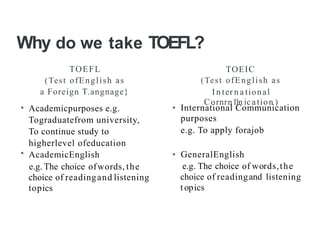
Why TOEFL?
do we
TOEFL
take
TOEIC
(Test ofEnglish as
I n ter n a tional
Cornrn1
1n ication )
(Test ofEnglish as
a Foreign T.angnage}
Academicpurposes e.g.
Tograduatefrom university,
To continue study to
higherlevel ofeducation
AcademicEnglish
e.g. The choice ofwords, the
choice of readingand listening
topics
• • International Communication
purposes
e.g. To apply forajob
• • GeneralEnglish
e.g. The choice of words,the
choice of readingand listening
t opics
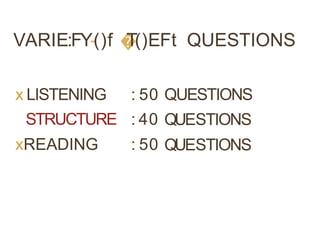
VARIE:FY-()f �
T()EFt QUESTIONS
x LISTENING
STRUCTURE
xREADING
:
:
:
50
40
50
QUESTIONS
QUESTIONS
QUESTIONS
STRUCTURE AND
WRITTEN EXPRESSION
Time: 25 Minutes
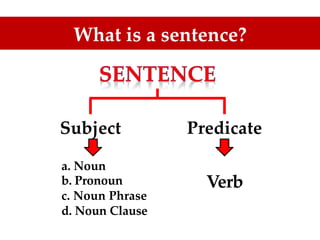
What is a sentence?
Subject Predicate
a. Noun
b. Pronoun
c. Noun Phrase
d. Noun Clause
Verb
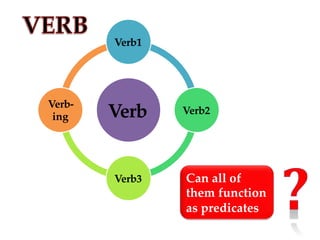
Verb1
Verb-
ing Verb Verb2
Can all of
them function
as predicates
Verb3
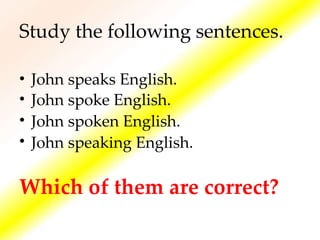
Study the following sentences.
•
•
•
•
John
John
John
John
speaks English.
spoke English.
spoken English.
speaking English.
Which of them are correct?
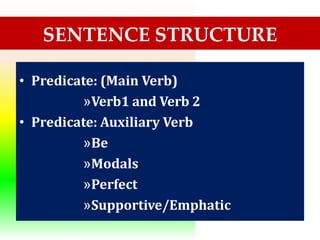
SENTENCE STRUCTURE
• Predicate: (Main Verb)
»Verb1 and Verb 2
• Predicate: Auxiliary Verb
»Be
»Modals
»Perfect
»Supportive/Emphatic
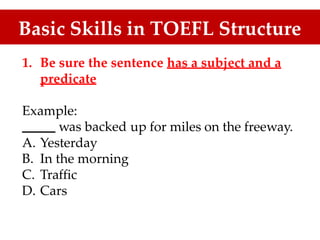
Basic Skills in TOEFL Structure
1. Be sure the sentence has a subject and a
predicate
Example:
was backed up for miles on the freeway.
A.
B.
C.
D.
Yesterday
In the morning
Traffic
Cars
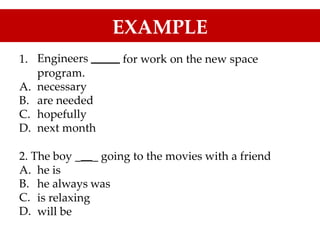
EXAMPLE
1. Engineers for work on the new space
program.
necessary
are needed
hopefully
next month
A.
B.
C.
D.
2. The boy _ _ going to the movies with a friend
A.
B.
C.
D.
he
he
is
always was
is relaxing
will be
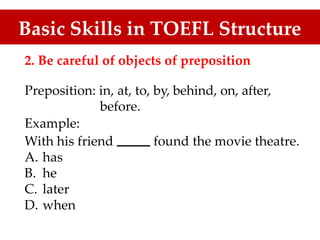
Basic Skills in TOEFL Structure
2. Be careful of objects of preposition
Preposition: in, at, to,
before.
Example:
by, behind, on, after,
With his friend found the movie theatre.
A.
B.
C.
D.
has
he
later
when
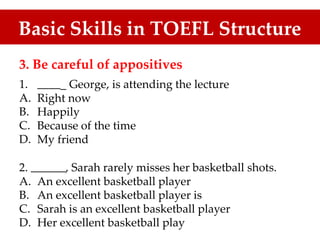
Basic Skills in TOEFL Structure
3. Be careful of appositives
1.
A.
B.
C.
D.
_ George, is attending the lecture
Right now
Happily
Because of the time
My friend
2. , Sarah rarely misses her basketball shots.
A.
B.
C.
D.
An excellent basketball player
An excellent basketball player is
Sarah is an excellent basketball player
Her excellent basketball play
Basic Skills in TOEFL Structure
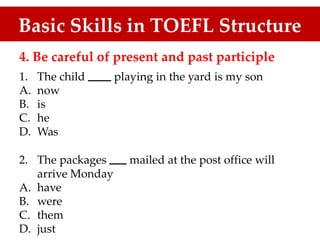
4. Be careful of present and past participle
1.
A.
B.
C.
D.
The child
now
is
he
Was
playing in the yard is my son
2. The packages mailed at the post office will
arrive Monday
have
were
them
just
A.
B.
C.
D.
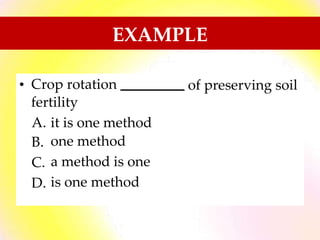
EXAMPLE
• Crop rotation of preserving soil
fertility
A.
B.
C.
D.
it is one method
one method
a method is one
is one method
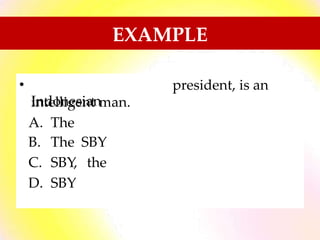
EXAMPLE
•
Indonesian
president, is an
intelligent man.
A.
B.
C.
D.
The
The SBY
SBY, the
SBY
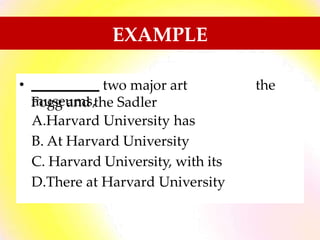
EXAMPLE
• two major art
museums,
the
Fogg and the Sadler
A.Harvard University has
B. At Harvard University
C. Harvard University, with its
D.There at Harvard University
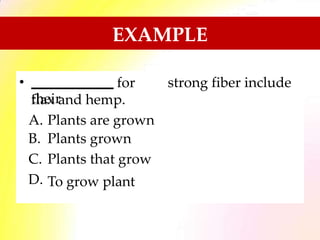
EXAMPLE
• for
their
strong fiber include
flax and hemp.
A.
B.
C.
D.
Plants
Plants
Plants
are grown
grown
that grow
To grow plant
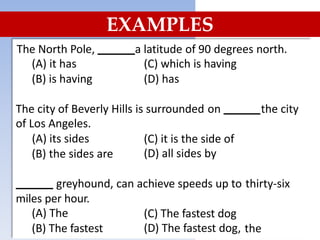
EXAMPLES
The North Pole,
(A) it has
(B) is having
a latitude of 90 degrees north.
(C) which is having
(D) has
The city of Beverly
of Los Angeles.
(A) its sides
Hills is surrounded on the city
(C) it is the side of
(D) all sides by
(B) the sides are
greyhound, can achieve speeds up to thirty-six
miles per hour.
(A) The
(B) The fastest
(C) The fastest dog
(D) The fastest dog, the
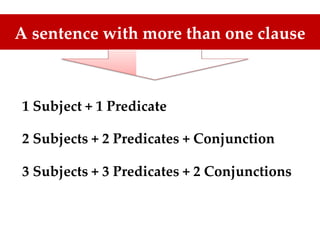
A sentence with more than one clause
1 Subject + 1 Predicate
2 Subjects + 2 Predicates + Conjunction
3 Subjects + 3 Predicates + 2 Conjunctions
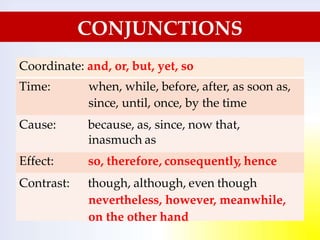
CONJUNCTIONS
Coordinate: and, or, but, yet, so
Time: when, while, before, after, as soon as,
since, until, once, by the time
Cause: because, as, since, now that,
inasmuch as
Effect: so, therefore, consequently, hence
Contrast: though, although, even though
nevertheless, however, meanwhile,
on the other hand
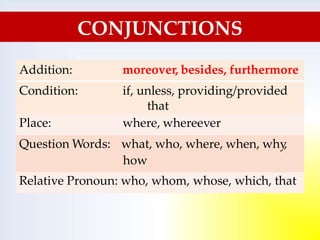
CONJUNCTIONS
Addition: moreover, besides, furthermore
Condition: if, unless, providing/provided
that
Place: where, whereever
Question Words: what, who, where, when, why
,
how
Relative Pronoun: who, whom, whose, which, that
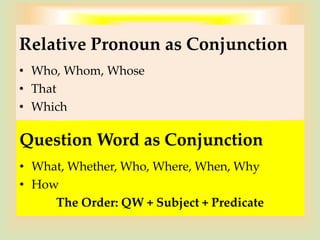
Relative Pronoun as Conjunction
• Who, Whom, Whose
• That
• Which
Question Word as Conjunction
• What, Whether, Who, Where, When, Why
• How
The Order: QW + Subject + Predicate
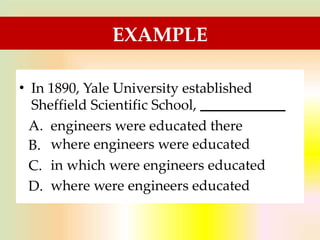
EXAMPLE
• In 1890, Yale University established
Sheffield Scientific School,
A.
B.
C.
D.
engineers were educated there
where engineers were educated
in which were engineers educated
where were engineers educated
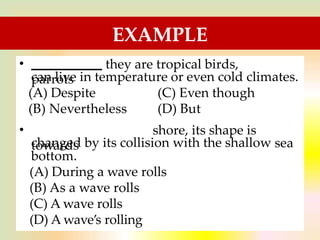
EXAMPLE
• they are tropical birds,
parrots
can live in temperature or even cold climates.
(A) Despite
(B) Nevertheless
(C) Even though
(D) But
•
towards
shore, its shape is
changed by its collision with the shallow
bottom.
sea
(A) During a wave rolls
(B) As a wave rolls
(C) A wave rolls
(D) A wave’s rolling
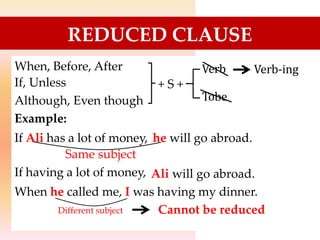
REDUCED CLAUSE
When, Before, After
If, Unless
Although, Even though
Example:
Verb Verb-ing
+ S +
Tobe
If Ali has a lot of money,
Same subject
If having a lot of money,
he will go abroad.
Ali will go abroad.
When he called me, I was having my dinner.
Cannot be reduced
Different subject
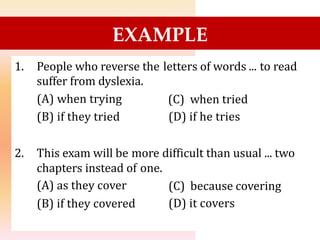
EXAMPLE
1. People who reverse the
suffer from dyslexia.
(A) when trying
(B) if they tried
letters of words ... to read
(C) when tried
(D) if he tries
2. This exam will be more difficult than usual ... two
chapters instead of
(A) as they cover
(B) if they covered
one.
(C) because covering
(D) it covers
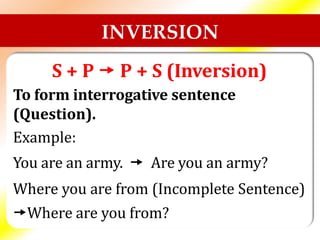
INVERSION
S + P  P + S (Inversion)
To form interrogative sentence
(Question).
Example:
You are an army.  Are you an army?
Where you are from (Incomplete Sentence)
Where are you from?
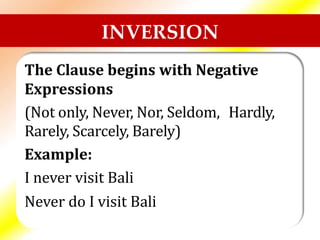
INVERSION
The Clause begins with Negative
Expressions
(Not only, Never, Nor, Seldom,
Rarely, Scarcely, Barely)
Example:
I never visit Bali
Never do I visit Bali
Hardly,
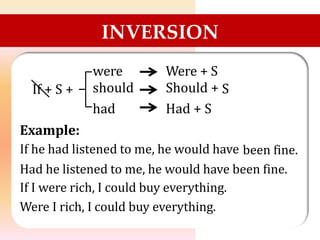
INVERSION
were
should
had
Were + S
Should +
Had + S
S
If + S +
Example:
If he had listened to me, he would have been fine.
Had he listened to me, he would have been fine.
If I were rich, I could buy everything.
Were I rich, I could buy everything.
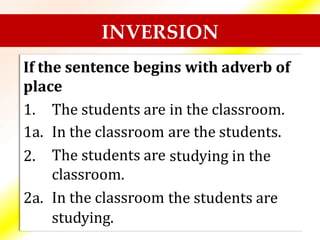
INVERSION
If the sentence begins with adverb of
place
1.
1a.
2.
The students are
In the classroom
The students are
classroom.
In the classroom
studying.
in the classroom.
are the students.
studying in the
2a. the students are
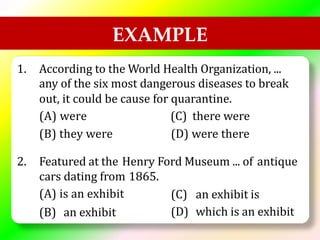
EXAMPLE
1. According to the World Health Organization, ...
any of the six most dangerous diseases to break
out, it could be
(A) were
(B) they were
cause for quarantine.
(C) there were
(D) were there
2. Featured at the Henry Ford Museum ... of antique
cars dating from
(A) is an exhibit
1865.
(C)
(D)
an exhibit is
which is an exhibit
(B) an exhibit
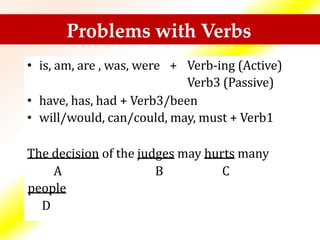
Problems with Verbs
• is, am, are , was, were + Verb-ing (Active)
Verb3 (Passive)
•
•
have, has, had + Verb3/been
will/would, can/could, may, must + Verb1
The decision of the judges may hurts many
A
people
D
B C
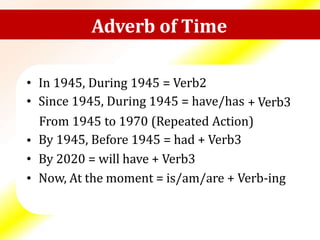
Adverb of Time
•
•
In 1945, During 1945 = Verb2
Since 1945, During 1945 = have/has + Verb3
From 1945 to 1970 (Repeated Action)
By 1945, Before 1945 = had + Verb3
By 2020 = will have + Verb3
Now, At the moment = is/am/are + Verb-ing
•
•
•
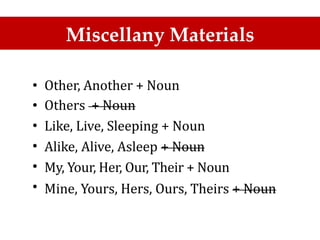
Miscellany Materials
•
•
•
•
•
•
Other, Another + Noun
Others + Noun
Like, Live, Sleeping + Noun
Alike, Alive, Asleep + Noun
My, Your, Her, Our, Their + Noun
Mine, Yours, Hers, Ours, Theirs + Noun

TOEFL -STRUCTURE-WRITTEN-EXPRESSION.pptx

  • 1.
  • 2.
    Why TOEFL? do we TOEFL take TOEIC (TestofEnglish as I n ter n a tional Cornrn1 1n ication ) (Test ofEnglish as a Foreign T.angnage} Academicpurposes e.g. Tograduatefrom university, To continue study to higherlevel ofeducation AcademicEnglish e.g. The choice ofwords, the choice of readingand listening topics • • International Communication purposes e.g. To apply forajob • • GeneralEnglish e.g. The choice of words,the choice of readingand listening t opics
  • 3.
    VARIE:FY-()f � T()EFt QUESTIONS xLISTENING STRUCTURE xREADING : : : 50 40 50 QUESTIONS QUESTIONS QUESTIONS
  • 4.
  • 5.
    What is asentence? Subject Predicate a. Noun b. Pronoun c. Noun Phrase d. Noun Clause Verb
  • 6.
    Verb1 Verb- ing Verb Verb2 Canall of them function as predicates Verb3
  • 7.
    Study the followingsentences. • • • • John John John John speaks English. spoke English. spoken English. speaking English. Which of them are correct?
  • 8.
    SENTENCE STRUCTURE • Predicate:(Main Verb) »Verb1 and Verb 2 • Predicate: Auxiliary Verb »Be »Modals »Perfect »Supportive/Emphatic
  • 9.
    Basic Skills inTOEFL Structure 1. Be sure the sentence has a subject and a predicate Example: was backed up for miles on the freeway. A. B. C. D. Yesterday In the morning Traffic Cars
  • 10.
    EXAMPLE 1. Engineers forwork on the new space program. necessary are needed hopefully next month A. B. C. D. 2. The boy _ _ going to the movies with a friend A. B. C. D. he he is always was is relaxing will be
  • 11.
    Basic Skills inTOEFL Structure 2. Be careful of objects of preposition Preposition: in, at, to, before. Example: by, behind, on, after, With his friend found the movie theatre. A. B. C. D. has he later when
  • 12.
    Basic Skills inTOEFL Structure 3. Be careful of appositives 1. A. B. C. D. _ George, is attending the lecture Right now Happily Because of the time My friend 2. , Sarah rarely misses her basketball shots. A. B. C. D. An excellent basketball player An excellent basketball player is Sarah is an excellent basketball player Her excellent basketball play
  • 13.
    Basic Skills inTOEFL Structure 4. Be careful of present and past participle 1. A. B. C. D. The child now is he Was playing in the yard is my son 2. The packages mailed at the post office will arrive Monday have were them just A. B. C. D.
  • 14.
    EXAMPLE • Crop rotationof preserving soil fertility A. B. C. D. it is one method one method a method is one is one method
  • 15.
    EXAMPLE • Indonesian president, is an intelligentman. A. B. C. D. The The SBY SBY, the SBY
  • 16.
    EXAMPLE • two majorart museums, the Fogg and the Sadler A.Harvard University has B. At Harvard University C. Harvard University, with its D.There at Harvard University
  • 17.
    EXAMPLE • for their strong fiberinclude flax and hemp. A. B. C. D. Plants Plants Plants are grown grown that grow To grow plant
  • 18.
    EXAMPLES The North Pole, (A)it has (B) is having a latitude of 90 degrees north. (C) which is having (D) has The city of Beverly of Los Angeles. (A) its sides Hills is surrounded on the city (C) it is the side of (D) all sides by (B) the sides are greyhound, can achieve speeds up to thirty-six miles per hour. (A) The (B) The fastest (C) The fastest dog (D) The fastest dog, the
  • 19.
    A sentence withmore than one clause 1 Subject + 1 Predicate 2 Subjects + 2 Predicates + Conjunction 3 Subjects + 3 Predicates + 2 Conjunctions
  • 20.
    CONJUNCTIONS Coordinate: and, or,but, yet, so Time: when, while, before, after, as soon as, since, until, once, by the time Cause: because, as, since, now that, inasmuch as Effect: so, therefore, consequently, hence Contrast: though, although, even though nevertheless, however, meanwhile, on the other hand
  • 21.
    CONJUNCTIONS Addition: moreover, besides,furthermore Condition: if, unless, providing/provided that Place: where, whereever Question Words: what, who, where, when, why , how Relative Pronoun: who, whom, whose, which, that
  • 22.
    Relative Pronoun asConjunction • Who, Whom, Whose • That • Which Question Word as Conjunction • What, Whether, Who, Where, When, Why • How The Order: QW + Subject + Predicate
  • 23.
    EXAMPLE • In 1890,Yale University established Sheffield Scientific School, A. B. C. D. engineers were educated there where engineers were educated in which were engineers educated where were engineers educated
  • 24.
    EXAMPLE • they aretropical birds, parrots can live in temperature or even cold climates. (A) Despite (B) Nevertheless (C) Even though (D) But • towards shore, its shape is changed by its collision with the shallow bottom. sea (A) During a wave rolls (B) As a wave rolls (C) A wave rolls (D) A wave’s rolling
  • 25.
    REDUCED CLAUSE When, Before,After If, Unless Although, Even though Example: Verb Verb-ing + S + Tobe If Ali has a lot of money, Same subject If having a lot of money, he will go abroad. Ali will go abroad. When he called me, I was having my dinner. Cannot be reduced Different subject
  • 26.
    EXAMPLE 1. People whoreverse the suffer from dyslexia. (A) when trying (B) if they tried letters of words ... to read (C) when tried (D) if he tries 2. This exam will be more difficult than usual ... two chapters instead of (A) as they cover (B) if they covered one. (C) because covering (D) it covers
  • 27.
    INVERSION S + P P + S (Inversion) To form interrogative sentence (Question). Example: You are an army.  Are you an army? Where you are from (Incomplete Sentence) Where are you from?
  • 28.
    INVERSION The Clause beginswith Negative Expressions (Not only, Never, Nor, Seldom, Rarely, Scarcely, Barely) Example: I never visit Bali Never do I visit Bali Hardly,
  • 29.
    INVERSION were should had Were + S Should+ Had + S S If + S + Example: If he had listened to me, he would have been fine. Had he listened to me, he would have been fine. If I were rich, I could buy everything. Were I rich, I could buy everything.
  • 30.
    INVERSION If the sentencebegins with adverb of place 1. 1a. 2. The students are In the classroom The students are classroom. In the classroom studying. in the classroom. are the students. studying in the 2a. the students are
  • 31.
    EXAMPLE 1. According tothe World Health Organization, ... any of the six most dangerous diseases to break out, it could be (A) were (B) they were cause for quarantine. (C) there were (D) were there 2. Featured at the Henry Ford Museum ... of antique cars dating from (A) is an exhibit 1865. (C) (D) an exhibit is which is an exhibit (B) an exhibit
  • 32.
    Problems with Verbs •is, am, are , was, were + Verb-ing (Active) Verb3 (Passive) • • have, has, had + Verb3/been will/would, can/could, may, must + Verb1 The decision of the judges may hurts many A people D B C
  • 33.
    Adverb of Time • • In1945, During 1945 = Verb2 Since 1945, During 1945 = have/has + Verb3 From 1945 to 1970 (Repeated Action) By 1945, Before 1945 = had + Verb3 By 2020 = will have + Verb3 Now, At the moment = is/am/are + Verb-ing • • •
  • 34.
    Miscellany Materials • • • • • • Other, Another+ Noun Others + Noun Like, Live, Sleeping + Noun Alike, Alive, Asleep + Noun My, Your, Her, Our, Their + Noun Mine, Yours, Hers, Ours, Theirs + Noun