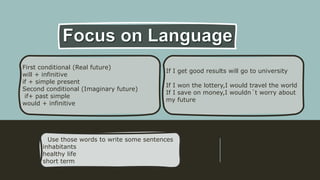
First conditional (Real future)
will + infinitive
if + simple present
Second conditional (Imaginary future)
if+ past simple
would + infinitive
Use those words to write some sentences
inhabitants
healthy life
short term
If I get good results will go to university
If I won the lottery,I would travel the world
If I save on money,I wouldn´t worry about
my future
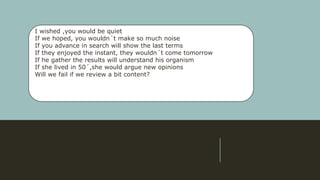
I wished ,you would be quiet
If we hoped, you wouldn´t make so much noise
If you advance in search will show the last terms
If they enjoyed the instant, they wouldn´t come tomorrow
If he gather the results will understand his organism
If she lived in 50´,she would argue new opinions
Will we fail if we review a bit content?
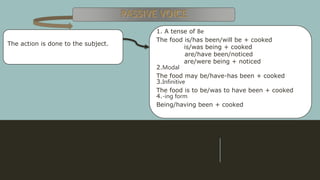
The action is done to the subject.
1. A tense of Be
The food is/has been/will be + cooked
is/was being + cooked
are/have been/noticed
are/were being + noticed
2.Modal
The food may be/have-has been + cooked
3.Infinitive
The food is to be/was to have been + cooked
4.-ing form
Being/having been + cooked
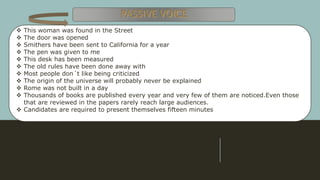
 This woman was found in the Street
 The door was opened
 Smithers have been sent to California for a year
 The pen was given to me
 This desk has been measured
 The old rules have been done away with
 Most people don´t like being criticized
 The origin of the universe will probably never be explained
 Rome was not built in a day
 Thousands of books are published every year and very few of them are noticed.Even those
that are reviewed in the papers rarely reach large audiences.
 Candidates are required to present themselves fifteen minutes
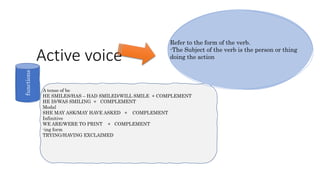
Active voice
A tense of be
HE SMILES/HAS – HAD SMILED/WILL SMILE + COMPLEMENT
HE IS/WAS SMILING + COMPLEMENT
Modal
SHE MAY ASK/MAY HAVE ASKED + COMPLEMENT
Infinitive
WE ARE/WERE TO PRINT + COMPLEMENT
-ing form
TRYING/HAVING EXCLAIMED
Refer to the form of the verb.
-The Subject of the verb is the person or thing
doing the action
functions
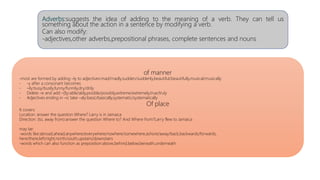
Adverbs:suggests the idea of adding to the meaning of a verb. They can tell us
something about the action in a sentence by modifying a verb.
Can also modify:
-adjectives,other adverbs,prepositional phrases, complete sentences and nouns
of manner
-most are formed by adding –ly to adjectives:mad/madly,sudden/suddenly,beautiful/beautifully,musical/musically
- -y after a consonant becomes
- –ily:busy/busily,funny/funnily,dry/drily
- Delete –e and add –(l)y:able/ably,posible/possibly,extreme/extremely,true/truly
- Adjectives ending in –ic take –aly:basic/basically,systematic/systematically
Of place
It covers:
Location: answer the question Where? Larry is in Jamaica
Direction: (to, away from):answer the question Where to? And Where from?Larry flew to Jamaica
may be:
-words like:abroad,ahead,anywhere/everywhere/nowhere/somewhere,ashore/away/back,backwards/forwards,
here/there,left/right,north/south,upstairs/downstairs
-words which can also function as preposition:above,behind,below,beneath,underneath
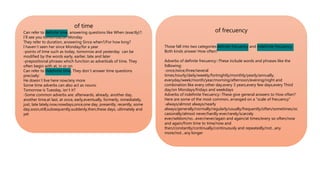
of time
Can refer to definite time, answering questions like When (exactly)?:
I´ll see you tomorrow/on Monday
They refer to duration, answering Since when?/For how long?
I haven´t seen her since Monday/for a year
-points of time such as today, tomorrow and yesterday can be
modified by the words early, earlier, late and later
-prepositional phrases which function as adverbials of time. They
often begin with at, in or on
Can refer to indefinite time, They don´t answer time questions
precisely:
He doesn´t live here now/any more
Some time adverbs can also act as nouns:
Tomorrow is Tuesday, isn´t it?
-Some common adverbs are: afterwards, already, another day,
another time,at last, at once, early,eventually, formerly, inmediately,
just, late lately,now,nowdays,once,one day, presently, recently, some
day,soon,still,subsequently,suddenly,then,these days, ultimately and
yet
of frecuency
Those fall into two categories:definite frecuency and indefinite frecuency.
Both kinds answer How often?
Adverbs of definite frecuency:-These include words and phrases like the
following:
-once,twice,three/several
times,hourly/daily/weekly/fortnightly/monthly/yearly/annually,
everyday/week/month/year/morning/afternoon/evening/night and
combination like every other day,every 3 years,every few days,every Third
day/on Mondays/fridays and weekdays
Adverbs of indefinite frecuency:-These give general answers to How often?
Here are some of the most common, arranged on a “scale of frecuency”
-always/almost always/nearly
always/generally/normally/regularly/usually/frequently/often/sometimes/oc
casionally/almost never/hardly ever/rarely/scarcely
ever/seldom/no…ever/never/again and again/at times/every so often/now
and again/from time to time/now and
then/constantly/continually/continuously and repeatedly/not…any
more/not…any longer
of degree
Broadly answer the question :To what extent?”.Some of the most common are:almost,altogether,barely,a
bit,enough,fairly,hardly,nearly,quite,rather,somewhat and too.
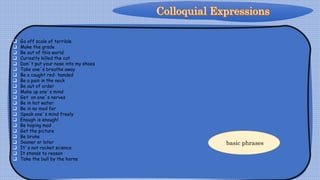
 Go off scale of terrible
 Make the grade
 Be out of this world
 Curiosity killed the cat
 Don´t put your nose into my shoes
 Take one´s breathe away
 Be a caught red- handed
 Be a pain in the neck
 Be out of order
 Make up one´s mind
 Get on one´s nerves
 Be in hot water
 Be in no mod for
 Speak one´s mind freely
 Enough is enough!
 Be hoping mad
 Get the picture
 Be broke
 Sooner or later
 It´s not rocket science
 It stands to reason
 Take the bull by the horns
basic phrases

11th grade.topics

  • 1.
    First conditional (Realfuture) will + infinitive if + simple present Second conditional (Imaginary future) if+ past simple would + infinitive Use those words to write some sentences inhabitants healthy life short term If I get good results will go to university If I won the lottery,I would travel the world If I save on money,I wouldn´t worry about my future
  • 2.
    I wished ,youwould be quiet If we hoped, you wouldn´t make so much noise If you advance in search will show the last terms If they enjoyed the instant, they wouldn´t come tomorrow If he gather the results will understand his organism If she lived in 50´,she would argue new opinions Will we fail if we review a bit content?
  • 3.
    The action isdone to the subject. 1. A tense of Be The food is/has been/will be + cooked is/was being + cooked are/have been/noticed are/were being + noticed 2.Modal The food may be/have-has been + cooked 3.Infinitive The food is to be/was to have been + cooked 4.-ing form Being/having been + cooked
  • 4.
     This womanwas found in the Street  The door was opened  Smithers have been sent to California for a year  The pen was given to me  This desk has been measured  The old rules have been done away with  Most people don´t like being criticized  The origin of the universe will probably never be explained  Rome was not built in a day  Thousands of books are published every year and very few of them are noticed.Even those that are reviewed in the papers rarely reach large audiences.  Candidates are required to present themselves fifteen minutes
  • 5.
    Active voice A tenseof be HE SMILES/HAS – HAD SMILED/WILL SMILE + COMPLEMENT HE IS/WAS SMILING + COMPLEMENT Modal SHE MAY ASK/MAY HAVE ASKED + COMPLEMENT Infinitive WE ARE/WERE TO PRINT + COMPLEMENT -ing form TRYING/HAVING EXCLAIMED Refer to the form of the verb. -The Subject of the verb is the person or thing doing the action functions
  • 6.
    Adverbs:suggests the ideaof adding to the meaning of a verb. They can tell us something about the action in a sentence by modifying a verb. Can also modify: -adjectives,other adverbs,prepositional phrases, complete sentences and nouns of manner -most are formed by adding –ly to adjectives:mad/madly,sudden/suddenly,beautiful/beautifully,musical/musically - -y after a consonant becomes - –ily:busy/busily,funny/funnily,dry/drily - Delete –e and add –(l)y:able/ably,posible/possibly,extreme/extremely,true/truly - Adjectives ending in –ic take –aly:basic/basically,systematic/systematically Of place It covers: Location: answer the question Where? Larry is in Jamaica Direction: (to, away from):answer the question Where to? And Where from?Larry flew to Jamaica may be: -words like:abroad,ahead,anywhere/everywhere/nowhere/somewhere,ashore/away/back,backwards/forwards, here/there,left/right,north/south,upstairs/downstairs -words which can also function as preposition:above,behind,below,beneath,underneath
  • 7.
    of time Can referto definite time, answering questions like When (exactly)?: I´ll see you tomorrow/on Monday They refer to duration, answering Since when?/For how long? I haven´t seen her since Monday/for a year -points of time such as today, tomorrow and yesterday can be modified by the words early, earlier, late and later -prepositional phrases which function as adverbials of time. They often begin with at, in or on Can refer to indefinite time, They don´t answer time questions precisely: He doesn´t live here now/any more Some time adverbs can also act as nouns: Tomorrow is Tuesday, isn´t it? -Some common adverbs are: afterwards, already, another day, another time,at last, at once, early,eventually, formerly, inmediately, just, late lately,now,nowdays,once,one day, presently, recently, some day,soon,still,subsequently,suddenly,then,these days, ultimately and yet of frecuency Those fall into two categories:definite frecuency and indefinite frecuency. Both kinds answer How often? Adverbs of definite frecuency:-These include words and phrases like the following: -once,twice,three/several times,hourly/daily/weekly/fortnightly/monthly/yearly/annually, everyday/week/month/year/morning/afternoon/evening/night and combination like every other day,every 3 years,every few days,every Third day/on Mondays/fridays and weekdays Adverbs of indefinite frecuency:-These give general answers to How often? Here are some of the most common, arranged on a “scale of frecuency” -always/almost always/nearly always/generally/normally/regularly/usually/frequently/often/sometimes/oc casionally/almost never/hardly ever/rarely/scarcely ever/seldom/no…ever/never/again and again/at times/every so often/now and again/from time to time/now and then/constantly/continually/continuously and repeatedly/not…any more/not…any longer
  • 8.
    of degree Broadly answerthe question :To what extent?”.Some of the most common are:almost,altogether,barely,a bit,enough,fairly,hardly,nearly,quite,rather,somewhat and too.
  • 9.
     Go offscale of terrible  Make the grade  Be out of this world  Curiosity killed the cat  Don´t put your nose into my shoes  Take one´s breathe away  Be a caught red- handed  Be a pain in the neck  Be out of order  Make up one´s mind  Get on one´s nerves  Be in hot water  Be in no mod for  Speak one´s mind freely  Enough is enough!  Be hoping mad  Get the picture  Be broke  Sooner or later  It´s not rocket science  It stands to reason  Take the bull by the horns basic phrases