Miss Marlini Komuna
Business English 2
Business Strategy
Corporate Culture
Corporate Culture
• The beliefs and values shared by people who
work in an organisation
– How people behave with each other
– How people behave with customers/clients
– How people view their relationship with stakeholders
– People’s responses to energy use, community
involvement, absence, work ethic, etc.
– How the organisation behaves to its employees –
training, professional development, etc.
Corporate Culture
May be driven by:
Vision – where the organisation wants to go in
the future
Mission Statement – summary
of the beliefs of the organisation and where it
is now
Corporate Culture
• May be reflected in:
– Attitude and behaviour of the leadership
– Attitude to the role of individuals in the workplace –
open plan offices, team based working, etc.
– Logo of the organisation
– The image it presents to the outside world
– Its attitude to change
What corporate culture do you think the
following businesses have managed to
develop?
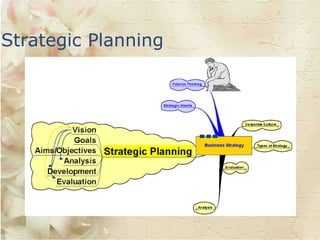
Strategic Planning
Taking time to think and reflect may be more important than many businesses
allow time for!
Strategic Planning
The Vision
Communicating to all staff where the organisation is going
and where
it intends to be in the future
Allows the firm to set goals
Aims and Objectives:
Aims – long term target
Objectives – the way in which you are going to achieve the
aim
.
Strategic Planning
Example:
Aim may be for a chocolate manufacturer to break into
a new overseas market
Objectives:
Develop relationships with overseas suppliers
Identify network of retail outlets
Conduct market research to identify consumer needs
Find location for overseas sales team HQ
Strategic Planning
Once the direction is identified:
Analyse position
Develop and introduce strategy
Evaluate:
Evaluation is constant and the results of
the evaluation feed back
into the vision
Analysis
SWOT
• Strengths – identifying existing organisational
strengths
• Weaknesses – identifying existing
organisational weaknesses
• Opportunities – what market opportunities
might there be
for the organisation to exploit?
• Threats – where might the threats
to the future success come from?
PEST
Political: local, national and international political
developments – how will they affect the organisation and
in what way/s?
Economic: what are the main economic issues – both
nationally and internationally – that might affect the
organisation?
Social: what are the developing social trends that may
impact on how the organisation operates and what will
they mean for future planning?
Technological: changing technology can impact on
competitive advantage very quickly!
Examples
• Growth of China and India as manufacturing centres
• Concern over treatment of workers and the environment
in less developed countries who may be suppliers
• The future direction of the interest rate, consumer
spending, etc.
• The changing age structure of the population
• The popularity of ‘fads’ like the Atkins Diet
• The move towards greater political regulation of business
• The effect of more bureaucracy in the labour market
Types of Strategy
• Competitive Advantage – something which
gives the organisation some advantage over its
rivals
• Cost advantage – A strategy to seek out and
secure a cost advantage
of some kind - lower average costs, lower labour
costs, etc.
Types of Strategy
TYPES OF STRATEGY
• Market Dominance:
• Achieved through:
– Internal growth
– Acquisitions – mergers and takeovers
• New product development: to keep ahead
of rivals and set the pace
• Contraction/Expansion – focus on what you
are good at (core competencies) or seek to expand into
a range of markets?
• Price Leadership – through dominating the
industry – others follow your price lead
• Global – seeking to expand
global operations
• Reengineering – thinking outside the box –
looking at news ways of doing things to leverage
the organisation’s performance
– Internal business level strategies –
• Downsizing – selling off unwanted parts of the
business – similar
to contraction
• Delayering – flattening the management
structure, removing bureaucracy, speed up
decision making
• Restructuring – complete re-think
of the way the business is organised
THANK YOU FOR YOUR ATTENTIVE
ATENTIONS
NOW LET’S PRACTICE …….

Business-strategy.pptx

  • 1.
  • 2.
  • 3.
  • 4.
    Corporate Culture • Thebeliefs and values shared by people who work in an organisation – How people behave with each other – How people behave with customers/clients – How people view their relationship with stakeholders – People’s responses to energy use, community involvement, absence, work ethic, etc. – How the organisation behaves to its employees – training, professional development, etc.
  • 5.
    Corporate Culture May bedriven by: Vision – where the organisation wants to go in the future Mission Statement – summary of the beliefs of the organisation and where it is now
  • 6.
    Corporate Culture • Maybe reflected in: – Attitude and behaviour of the leadership – Attitude to the role of individuals in the workplace – open plan offices, team based working, etc. – Logo of the organisation – The image it presents to the outside world – Its attitude to change
  • 7.
    What corporate culturedo you think the following businesses have managed to develop?
  • 8.
  • 9.
    Taking time tothink and reflect may be more important than many businesses allow time for!
  • 10.
    Strategic Planning The Vision Communicatingto all staff where the organisation is going and where it intends to be in the future Allows the firm to set goals Aims and Objectives: Aims – long term target Objectives – the way in which you are going to achieve the aim .
  • 11.
    Strategic Planning Example: Aim maybe for a chocolate manufacturer to break into a new overseas market Objectives: Develop relationships with overseas suppliers Identify network of retail outlets Conduct market research to identify consumer needs Find location for overseas sales team HQ
  • 12.
    Strategic Planning Once thedirection is identified: Analyse position Develop and introduce strategy Evaluate: Evaluation is constant and the results of the evaluation feed back into the vision
  • 13.
  • 14.
    SWOT • Strengths –identifying existing organisational strengths • Weaknesses – identifying existing organisational weaknesses • Opportunities – what market opportunities might there be for the organisation to exploit? • Threats – where might the threats to the future success come from?
  • 15.
    PEST Political: local, nationaland international political developments – how will they affect the organisation and in what way/s? Economic: what are the main economic issues – both nationally and internationally – that might affect the organisation? Social: what are the developing social trends that may impact on how the organisation operates and what will they mean for future planning? Technological: changing technology can impact on competitive advantage very quickly!
  • 16.
    Examples • Growth ofChina and India as manufacturing centres • Concern over treatment of workers and the environment in less developed countries who may be suppliers • The future direction of the interest rate, consumer spending, etc. • The changing age structure of the population • The popularity of ‘fads’ like the Atkins Diet • The move towards greater political regulation of business • The effect of more bureaucracy in the labour market
  • 17.
  • 18.
    • Competitive Advantage– something which gives the organisation some advantage over its rivals • Cost advantage – A strategy to seek out and secure a cost advantage of some kind - lower average costs, lower labour costs, etc. Types of Strategy
  • 19.
    TYPES OF STRATEGY •Market Dominance: • Achieved through: – Internal growth – Acquisitions – mergers and takeovers • New product development: to keep ahead of rivals and set the pace • Contraction/Expansion – focus on what you are good at (core competencies) or seek to expand into a range of markets?
  • 20.
    • Price Leadership– through dominating the industry – others follow your price lead • Global – seeking to expand global operations • Reengineering – thinking outside the box – looking at news ways of doing things to leverage the organisation’s performance
  • 21.
    – Internal businesslevel strategies – • Downsizing – selling off unwanted parts of the business – similar to contraction • Delayering – flattening the management structure, removing bureaucracy, speed up decision making • Restructuring – complete re-think of the way the business is organised
  • 22.
    THANK YOU FORYOUR ATTENTIVE ATENTIONS NOW LET’S PRACTICE …….