Team Initiated Problem Solving Sustaining Communities of Practice School-wide Positive Behaviour Support  Queensland, Australia Conference 2011 Presented by Anne W. Todd University of Oregon [email_address] www.uoecs.org   www.pbis.org Newton, J. S., Todd, A. W., Algozzine, K., Horner, R. H., & Algozzine, B.  (2009). The Team Initiated Problem Solving (TIPS) Training Manual. Educational and Community Supports, University of Oregon, unpublished training manual.
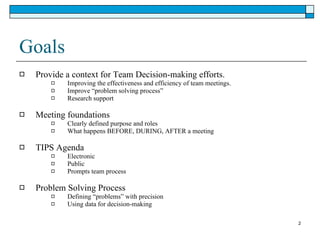
Goals Provide a context for Team Decision-making efforts. Improving the effectiveness and efficiency of team meetings. Improve “problem solving process” Research support Meeting foundations Clearly defined purpose and roles What happens BEFORE, DURING, AFTER a meeting TIPS Agenda Electronic Public Prompts team process Problem Solving Process Defining “problems” with precision Using data for decision-making
Main Messages Having data is necessary but insufficient Building effective  team process  (roles/ protocol) is essential. Use an electronic  Agenda  that prompts problem solving Problem solving starts with  precise problem statements Use data-based  decision rules  to build, implement and modify solutions.
People aren’t tired from solving problems – they’re are tired from solving the same problems over and over.
Collect and Use Data Review  Status and  Identify  Problems Develop and Refine Hypotheses Discuss and Select Solutions Develop and Implement Action Plan Evaluate and Revise Action Plan Problem Solving Foundations Team Initiated Problem Solving (TIPS) Model
TIPS Study: Todd et al., School A School B School C School D Foundation Score Baseline  Coaching  TIPS % DORA Foundations Score
TIPS Study: Todd, et al .  School A School D School C Baseline  Coaching  TIPS Thoroughness of  decision-making % DORA Thoroughness Score
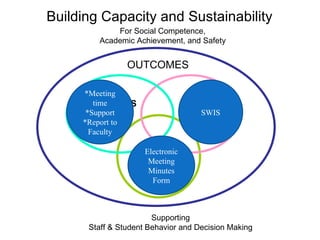
SYSTEMS PRACTICES DATA Supporting Staff & Student Behavior and Decision Making Building Capacity and Sustainability OUTCOMES For Social Competence, Academic Achievement, and Safety SWIS Electronic Meeting Minutes Form *Meeting time *Support *Report to Faculty
Improving Decision-Making via  Problem  S olving Problem Problem Solving Solution Information/ Data Action Planning & Evaluation
Problem-Solving  Meeting Foundations Structure of meetings lays foundation for efficiency & effectiveness
Foundations Elements Define roles Use electronic meeting minutes
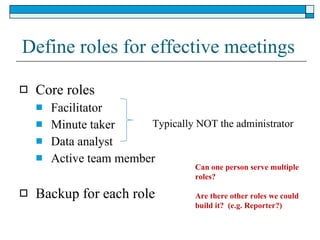
Define roles for effective meetings Core roles Facilitator Minute taker Data analyst Active team member Backup for each role Can one person serve multiple roles? Are there other roles we could build it?  (e.g. Reporter?) Typically NOT the administrator
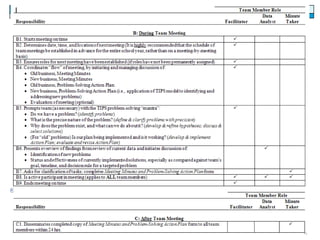
Defining Roles What happens BEFORE a meeting What happens DURING a meeting What happens AFTER a meeting
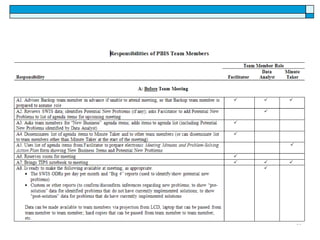
Before the Meeting…Who does each Room reserved “ New” items solicited for agenda Agenda produced  Data reviewed before the meeting; Suggest possible new issues Lead team through  discussion of effects of in-process solutions on “old” problems Meeting minutes distributed within 24 hours of meeting. Computer reserved; access to SWIS online database assured LCD projector reserved & set up to project data (or team has some other strategy for ensuring team members can review data at meeting) Team members have individual TIPS Notebooks to bring to meeting Facilitator Facilitator Facilitator Data Analyst Facilitator Minute Taker Minute Taker Minute Taker All Team Members
At Close of and After Meeting… Meeting Minutes and Problem-Solving Action Plan completed Copy of Meeting Minutes & Problem-Solving Action Plan distributed to each member within 24 hrs . Minute Taker Minute Taker
Newton, J. S., Todd, A. W., Algozzine, K., Horner, R. H., & Algozzine, B.  (2009). The Team Initiated Problem Solving (TIPS) Training Manual.  Educational and Community Supports, University of Oregon.  Unpublished training manual. Any tasks assigned get copied to the meeting minutes of the next meeting as a follow up item Meeting Agenda Item:  Meeting Foundations  Tasks:  What, by whom, by when
Meeting Foundations
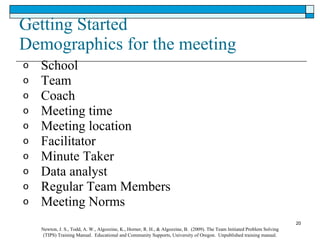
Getting Started Demographics for the meeting School  Team Coach Meeting time Meeting location Facilitator Minute Taker   Data analyst Regular Team Members Meeting Norms Newton, J. S., Todd, A. W., Algozzine, K., Horner, R. H., & Algozzine, B.  (2009). The Team Initiated Problem Solving (TIPS) Training Manual.  Educational and Community Supports, University of Oregon.  Unpublished training manual.
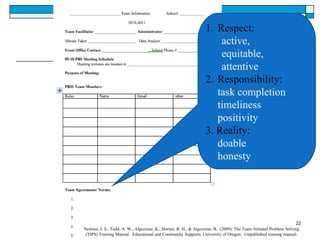
Meeting Norms/Agreements examples Respect Active participation/listening Be equitable Be attentive  focus on the task; avoid side talk/multi-tasking Offer creative & comprehensive ideas Responsibility Complete tasks between meetings Be on time Apply a positive framework to discussion Reality Agree to ‘doable’ tasks Be honest and share what we think and feel. Newton, J. S., Todd, A. W., Algozzine, K., Horner, R. H., & Algozzine, B.  (2009). The Team Initiated Problem Solving (TIPS) Training Manual.  Educational and Community Supports, University of Oregon.  Unpublished training manual.
Respect: active, equitable, attentive Responsibility: task completion timeliness positivity 3. Reality: doable honesty Newton, J. S., Todd, A. W., Algozzine, K., Horner, R. H., & Algozzine, B.  (2009). The Team Initiated Problem Solving (TIPS) Training Manual.  Educational and Community Supports, University of Oregon.  Unpublished training manual.
Inform facilitator of absence/tardy before meeting Avoid side talk Remind each other to stay focused Start and end on time Be an active participant  Newton, J. S., Todd, A. W., Algozzine, K., Horner, R. H., & Algozzine, B.  (2009). The Team Initiated Problem Solving (TIPS) Training Manual.  Educational and Community Supports, University of Oregon.  Unpublished training manual.
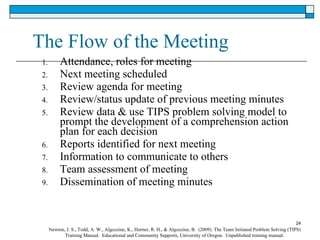
The Flow of the Meeting Attendance, roles for meeting Next meeting scheduled Review agenda for meeting Review/status update of previous meeting minutes  Review data & use TIPS problem solving model to prompt the development of a comprehension action plan for each decision Reports identified for next meeting Information to communicate to others Team assessment of meeting  Dissemination of meeting minutes Newton, J. S., Todd, A. W., Algozzine, K., Horner, R. H., & Algozzine, B.  (2009). The Team Initiated Problem Solving (TIPS) Training Manual.  Educational and Community Supports, University of Oregon.  Unpublished training manual.
Using Meeting Minutes Documentation of  Logistics of meeting (date, time, location, roles) Agenda items for today’s meeting ( and next meeting) Discussion items, decisions made, tasks and timelines assigned Problem statements, solutions/decisions/tasks, people assigned to implement with timelines assigned, and an evaluation plan to determine the effect on student behavior  Reviewing Meeting minutes  An effective strategy for getting a snapshot of what happened at the previous meeting and what needs to be reviewed during the upcoming meeting What was the issue/problem?, What were we going to do?, Who was going to do it and by When?, and How are we measuring progress toward the goal? Visual tracking of focus topics during and after meetings Prevents side conversations Prevents repetition  Encourages completion of tasks
Organizing for an effective  problem solving conversation Problem Solution Out of Time Use Data  A key to collective problem solving is to provide a visual context that allows everyone to follow and contribute
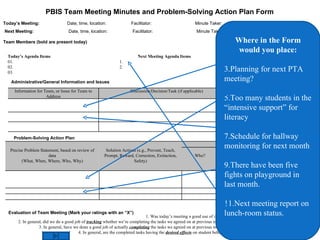
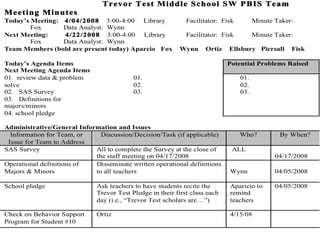
PBIS Team Meeting Minutes and Problem-Solving Action Plan Form Today’s Meeting:  Date, time, location:  Facilitator:  Minute Taker: Data Analyst:  Next Meeting: Date, time, location:  Facilitator:  Minute Taker: Data Analyst:  Team Members (bold are present today) Administrative/General Information and Issues Problem-Solving Action Plan Evaluation of Team Meeting (Mark your ratings with an “X”) Where in the Form would you place: Planning for next PTA meeting? Too many students in the “intensive support” for literacy Schedule for hallway monitoring for next month There have been five fights on playground in last month. Next meeting report on lunch-room status. Today’s Agenda Items  Next Meeting Agenda Items 01.  02.  03.  Information for Team, or Issue for Team to Address Discussion/Decision/Task (if applicable) Who? By When? Implementation and Evaluation Precise Problem Statement, based on review of data (What, When, Where, Who, Why) Solution Actions (e.g., Prevent, Teach, Prompt, Reward, Correction, Extinction, Safety) Who? By When? Goal, Timeline,  Decision Rule, & Updates Our Rating Yes So-So No 1. Was today’s meeting a good use of our time? 2. In general, did we do a good job of  tracking  whether we’re completing the tasks we agreed on at previous meetings? 3. In general, have we done a good job of actually  completing  the tasks we agreed on at previous meetings? 4. In general, are the completed tasks having the  desired effects  on student behavior?
Minors-what would we like to do about communicating the minors with families? There is inconsistency among staff, not all teachers use the minors as a teaching tool in the same way. Is this a problem? What should be do? Discussion: Perhaps we create a little blurb that goes out to families that teachers will use when sending them home. Sending them home creates a problematic situation, can be an issue with communication with families. Perhaps we need to just say to staff a general reminder about what is going on with the minors for families of multiple students or friends, etc. We will wait until next year to re-train staff and discuss how to use WHOAS and how to communicate them with parents. What is relevant to write down? Information for Team, or Issue for Team to Address Discussion/Decision/Task (if applicable) Who? By When? Minor incident reports Re-examine the process being used to document and communicate about minor incidents team 2-15-10 team meeting Take proposal to staff Team 2-15-10 staff meeting
Fac: ‘we have a PTO meeting in 2 weeks and we need to get organized. last time not very many parents came and said that childcare was necessary’ TM 1: ‘ Tina’s daughter is a babysitter, oh and did you hear what happened to her last weekend?’ TM2: ‘ oh it was awful, and I heard…..’ Fac: ‘back to PTO planning, how can we increase attendance?’ What needs to be documented? Meeting Minute Simulation A General Item Tasks By Who By When PTO meeting – two weeks (date) Attendance? Childcare?
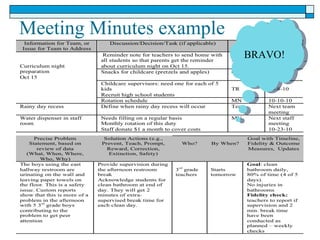
Meeting Minutes example  BRAVO!
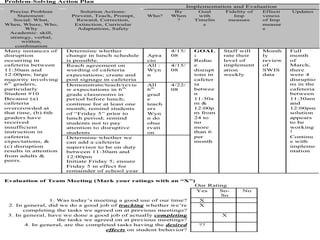
Meeting Minutes example  Given these meeting minutes, what needs to happen before next meeting?
Meeting Minutes example
Meeting Minute Simulation  Clarifying/cleaning up meeting minutes after the meeting Good content! Orienting new students is a general/ administrative item Who will do it by when? Newton, J. S., Todd, A. W., Algozzine, K., Horner, R. H., & Algozzine, B.  (2009). The Team Initiated Problem Solving (TIPS) Training Manual.  Educational and Community Supports, University of Oregon, unpublished training manual. 33
Meeting Minute Simulation  Clarifying/cleaning up meeting minutes after the meeting Great information & fits better as a general/ administrative item Newton, J. S., Todd, A. W., Algozzine, K., Horner, R. H., & Algozzine, B.  (2009). The Team Initiated Problem Solving (TIPS) Training Manual.  Educational and Community Supports, University of Oregon, unpublished manual. 34
 
 
Important Structural Components Regular meetings & regular attendance & regular time The “right” people The right roles Facilitator Minute Taker Data Analyst Active Team Members Accomplishments – Products of successful meeting Meeting Minutes (record of decisions & tasks concerning administrative/general issues) Problem-Solving Action Plan (record of decisions & tasks concerning problems identified by team)
Main Ideas Decisions are more likely to be effective and efficient when they are based on data. The quality of decision-making depends most on the first step (defining the problem to be solved) Define problems with precision and clarity
Main Ideas Data help us ask the right questions…they do not provide the answers:  Use data to Identify problems Refine problems Define the questions that lead to solutions Data help place the “problem” in the context rather than in the students.
Main Idea The process a team uses to problem solve is important: Roles :  Facilitator; Recorder; Data analyst; Active member Organization Agenda; Old business (did we do what we said we would do); New business; Action plan for decisions. What happens BEFORE a meeting What happens DURING a meeting What happen AFTER a meeting
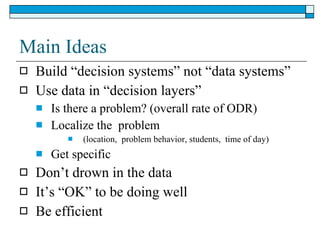
Main Ideas Build “decision systems” not “data systems” Use data in “decision layers” Is there a problem? (overall rate of ODR) Localize the  problem  (location,  problem behavior, students,  time of day)  Get specific Don’t drown in the data It’s “OK” to be doing well Be efficient
Problem Solving Starting with a clearly defined problem is essential Use data to: Identify a problem Define the problem with precision Guide development of an appropriate solution Assess fidelity of implementation of the solution Assess impact of the solution on student outcomes
Collect and Use Data Develop Hypothesis Discuss and Select Solutions Develop and Implement Action Plan Evaluate and Revise Action Plan . Problem Solving   Meeting   Foundations Team Initiated Problem Solving (TIPS) Model Identify  Problems Newton, J. S., Todd, A. W., Algozzine, K., Horner, R. H., & Algozzine, B.  (2009). The Team Initiated Problem Solving (TIPS) Training Manual. Educational and Community Supports, University of Oregon, unpublished training manual.
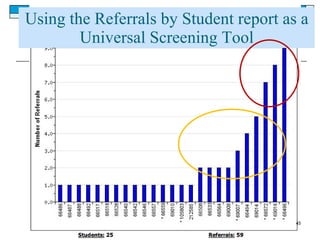
Organizing SWIS Data for Decision-making Universal Screening Tool Proportion of students with  0-1 Office Discipline Referrals (ODRs) 2-5 ODRs 6+ ODRs Progress Monitoring Tool  Compare data across time Prevent previous problem patterns  Define Problems with precision that lead to solvable problems Newton, J. S., Todd, A. W., Algozzine, K., Horner, R. H., & Algozzine, B.  (2009). The Team Initiated Problem Solving (TIPS) Training Manual. Educational and Community Supports, University of Oregon, unpublished training manual.
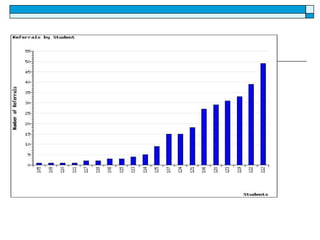
Using the Referrals by Student report as a Universal Screening Tool
~80% of Students ~15%  ~5%  0-1 office discipline referral 6+ office discipline referrals 2-5 office discipline referrals Using office discipline referrals as a metric for universal screening of student social behavior Newton, J. S., Todd, A. W., Algozzine, K., Horner, R. H., & Algozzine, B.  (2009). The Team Initiated Problem Solving (TIPS) Training Manual. Educational and Community Supports, University of Oregon, unpublished training manual.
Cumulative Mean ODRs Cumulative Mean ODRs Per Month  for 325+ Elementary Schools 08-09 Jennifer Frank, Kent McIntosh, Seth May
Using ODRs to Identify Problems Build a picture for the pattern of office referrals in your school. Compare the picture with a national average Compare the picture with previous years Compare the picture with social standards of faculty, families, students. Goal Identify problems empirically Identify problems early Identify problems in a manner that leads to problem solving not just whining  Newton, J. S., Todd, A. W., Algozzine, K., Horner, R. H., & Algozzine, B.  (2009). The Team Initiated Problem Solving (TIPS) Training Manual. Educational and Community Supports, University of Oregon, unpublished training manual.
Identifying problems/issues What data to monitor ODR per day per month OSS, ISS, Attendance, Teacher report Team Checklist/ SET (are we doing what we planned to do?) What question to answer Do we have a problem? What questions to ask of Level, Trend, Peaks How do our data compare with last year? How do our data compare with national/regional norms? How do our data compare with our preferred/expected status? If a problem is identified, then ask What are the data we need to make a good decision?
Using Data to Refine Problem Statement The statement of a problem is important for team-based problem solving.  Everyone must be working on the same problem with the same assumptions. Problems often are framed in a “Primary” form, that creates concern, but that is not useful for problem-solving.  Frame primary problems based on initial review of data Use more detailed review of data to build “Solvable Problem Statements.”
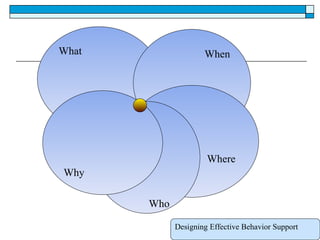
Precise Problem Statements (What are the data we need for a decision?) Precise problem statements include information about the Big Five questions: What  is problem, and how often is it happening Where  is it happening Who  is engaged in the behavior When  the problem is most likely Why  the problem is sustaining
Primary versus Precision Statements Primary Statements Too many referrals September has more suspensions than last year Gang behavior is increasing The cafeteria is out of control Student disrespect is out of control Precision Statements There are more ODRs for aggression on the playground than last year. These are most likely to occur during first recess, with a large number of students, and the aggression is related to getting access to the new playground equipment.
Primary versus Precision Statements Primary Statements Too many referrals September has more suspensions than last year Gang behavior is increasing The cafeteria is out of control Student disrespect is out of control Precision Statements There are more ODRs for aggression   on the playground than  last year. These are most likely to occur during  first recess , with a  large number of students , and the aggression is related  to getting access to the new playground equipment .
Precise or Primary Statement? Children are using inappropriate language with a high frequency in the presence of both adults and other children.  This is creating a sense of disrespect and incivility in the school. ODRs during December are higher than in any other month.
Precise or Primary Statement? James D. is hitting others in the cafeteria during lunch, and his hitting is maintained by peer attention. Boys are engaging in sexual harassment. Three 5 th  grade boys are name calling and touching girls inappropriately during recess in an apparent attempt to obtain attention.
Precise or Primary Statement? Minor disrespect and disruption are increasing over time, and are most likely during the last 15 minutes of our block periods when students are engaged in independent seat work.  This pattern is most common in 7 th  and 8 th  grades, involves many students, and appears to be maintained by escape from work (but may also be maintained by peer attention… we are not sure).
Examples: Primary to Precise Gang-like behavior is increasing Texting during school is becoming more negative Bullying (verbal and physical aggression) on the playground is increasing during “first recess,”  is being done mostly by four 4 th  grade boys, and seems to be  maintained by social praise from the bystander peer group. A large number of students in each grade level (6, 7, 8)  are using texting to spread rumors, and harass peers.  Texting occurs both during the school day, and after school, and appears to be maintained by attention from others.
Examples: Primary to Precise Carly is having reading difficulties 50% of 2 nd  graders are not meeting math benchmarks  Carly is reading 20 cwpm (goal is 60), skips or guesses at words she doesn’t know, mostly during language arts 2 nd  graders, who entered school after Oct 31, do not know whole numbers 75-100 and are not accurately adding two digit numbers because of lack of skills
Your Turn Identify a “Primary” problem Transform it into a “Precise” problem statement
Organizing Data for Decision-making Compare data across time Moving from counts to count/month
Total Office Discipline Referrals Total Office Discipline Referrals as of January 10
 
Making Data into Information Look first at your patterns (tell the story) Level, Trend Peaks Match data to current perceptions Compare your data With national median With last year With what your faculty/students/ families want
SWIS summary 2009-10  (Majors Only) 4,019 schools; 2,063,408 students; 1,622,229 ODRs Grade Range Number of Schools Mean Enrollment per school Median  ODRs per 100 per school day K-6 2565 452 .22 6-9 713 648 .50 9-12 266 897 .68 K-(8-12) 474 423 .42
Elementary School with 150 Students Compare with National Median 150 / 100  = 1.50  1.50 X  .22  =  .33 Newton, J. S., Todd, A. W., Algozzine, K., Horner, R. H., & Algozzine, B.  (2009). The Team Initiated Problem Solving (TIPS) Training Manual. Educational and Community Supports, University of Oregon, unpublished training manual.  Questions to Ask of the Data What is? What is typical? What is possible? What is needed?
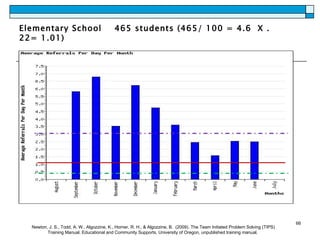
Elementary School  465 students (465/ 100 = 4.6  X .22= 1.01) Newton, J. S., Todd, A. W., Algozzine, K., Horner, R. H., & Algozzine, B.  (2009). The Team Initiated Problem Solving (TIPS) Training Manual. Educational and Community Supports, University of Oregon, unpublished training manual.
Elementary School  1500 Students  (1500/100 =105 X  .22= 3.3) Newton, J. S., Todd, A. W., Algozzine, K., Horner, R. H., & Algozzine, B.  (2009). The Team Initiated Problem Solving (TIPS) Training Manual. Educational and Community Supports, University of Oregon, unpublished training manual.
Middle School  765 students  (765/100 = 7.6 X .50= 3.8)
Describe the narrative for this school
 
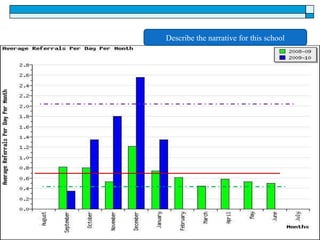
Describe the narrative for this school
What are the data you are most likely to need to move from a Primary to a Precise statement? What   problem behaviors are most common? ODR per Problem Behavior Where  are problem behaviors most likely? ODR per Location When   are problem behaviors most likely? ODR per time of day Who  is engaged in problem behavior? ODR per student Why  are problem behaviors sustaining? Custom graph
What When Where Who Why Designing Effective Behavior Support
Cost Benefits of Problem Solving with Precise Problem Statements An Example Elementary Playground Problems
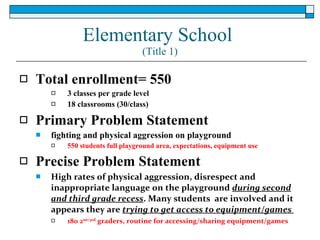
Elementary School  (Title 1) Total enrollment= 550 3 classes per grade level 18 classrooms (30/class) Primary Problem Statement fighting and physical aggression on playground 550 students full playground area, expectations, equipment use Precise Problem Statement High rates of physical aggression, disrespect and inappropriate language on the playground  during second and third grade recess . Many students  are involved and it appears they are  trying to get access to equipment/games  180 2 ne/3rd  graders, routine for accessing/sharing equipment/games
Problem Statement We have high rates of physical aggression, disrespect and inappropriate language on the playground Costs: Planning: Supervisor Meeting costs 12 people 60 min 3-4 people about 2 hours each for planning details One hour of administrative time to schedule Total time = 21 hours Implementation:  All supervisors spend a full day away from regular duties All students spend 45 minutes of classroom instruction time All teachers spend 45 classroom instructional minutes   Total time  supervisor time= ~ 18 hours instructional time = ~ 90 min per grade level Newton, J. S., Todd, A. W., Algozzine, K., Horner, R. H., & Algozzine, B.  (2009). The Team Initiated Problem Solving (TIPS) Training Manual. Educational and Community Supports, University of Oregon, unpublished training manual.
Problem Statement We have high rates of physical aggression, disrespect and inappropriate language on the playground during  second and third grade  recess.  Benefits Resulting from defining the problem with more precision: Narrowed focus from whole school to 2 nd  & 3 rd  grade teachers, supervisors and students.  Total planning time = ~ 11 hours Total implementation time = ~ 9  hours K, 1 st , 4 th , 5 th  grade teachers, supervisors and students  maintained their regular schedule recouping 90 min instructional time per grade level Newton, J. S., Todd, A. W., Algozzine, K., Horner, R. H., & Algozzine, B.  (2009). The Team Initiated Problem Solving (TIPS) Training Manual. Educational and Community Supports, University of Oregon, unpublished training manual.
Problem Statement We have high rates of physical aggression, disrespect and inappropriate language on the playground during second and third grade recess.  Many students  are involved and it appears they are trying to get access to equipment/games  Benefits resulting from defining the  problem with  more  precision: Solution implementation decisions are more specific, function-based and have contextual fit (focused on equipment/games) Provides opportunities for better instruction  Prevents further planning and loss of instructional time Newton, J. S., Todd, A. W., Algozzine, K., Horner, R. H., & Algozzine, B.  (2009). The Team Initiated Problem Solving (TIPS) Training Manual. Educational and Community Supports, University of Oregon, unpublished training manual.
Savings in Planning & Implementation Time Moving from Primary Problem Statements  to Precision Problem Statement hours
What
Where
When
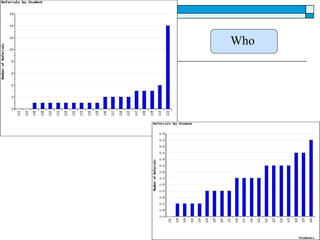
Who
Why ?:  The hardest question What is perceived as maintaining the problem behavior? Always assess motivation AFTER you have defined who, what, where? Look for the “primary” motivation if there are multiple options.
Why do Carl, Eric and Elliot keep engaging in disruption during morning work periods? Why
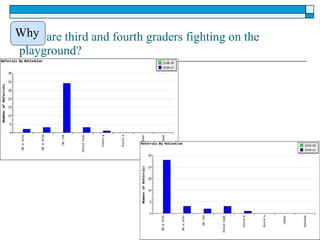
Why are third and fourth graders fighting on the playground? Why
Using Data to Build Solutions Prevention : How can we avoid the problem context? Who, When, Where Schedule change, curriculum change, etc Teaching:  How can we define, teach, and monitor what we want? Teach appropriate behavior Use problem behavior as negative example Recognition : How can we build in systematic reward for desired behavior? Extinction : How can we prevent problem behavior from being rewarded? Consequences : What are efficient, consistent consequences for problem behavior? How will we collect and use data to evaluate (a) implementation fidelity, and (b) impact on student outcomes?
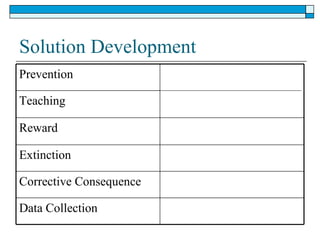
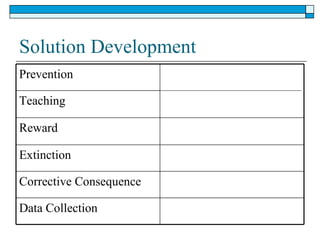
Solution Development Prevention Teaching Reward Extinction Corrective Consequence Data Collection
Solution Development Focus on prevention first.  How could we reduce the situations that lead to these behaviors? How do we ensure that students know what they SHOULD be doing when these situations arise? How do we ensure that appropriate behavior is recognized? How to we work to ensure that problem behavior is NOT being rewarded. Are corrective consequences needed? How will we know (a) if we are doing what we plan, and (b) if what we plan is working to benefit students? Prevention Teaching Reward Extinction Corrective Consequence Data Collection
Examples Trevor Test Phoenix Elementary Langley Sandhill
Trevor Test Middle School 565 students Grades 6,7,8
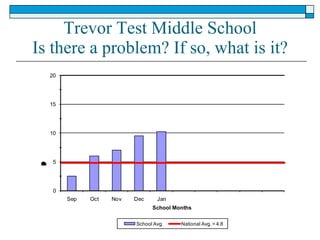
Trevor Test Middle School Is there a problem? If so, what is it?
Trevor Test Middle School Identified Problem Identified problem for last 4 mos., Major ODRs per day higher than national avg. increasing trend across all 5 mos.
Activity Define & Clarify problem identified by Trevor Test PBS Team Produce the SWIS “Big 4” for the previous 3-month period (solve  current  problem with  current  data) Draw logical inferences about problem Confirm/disconfirm inferences via analysis of SWIS Custom Reports
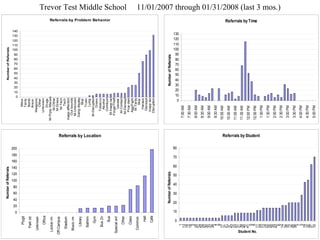
Trevor Test Middle School  11/01/2007 through 01/31/2008 (last 3 mos.)
Perceived motivation for inappropriate language and disruption in the cafeteria (all students)
Trevor Test  Logical Inferences Based on Big 4 Most Disruptions occur in Cafeteria Most Disruptions occur in Cafeteria between 11:30 AM and 12:00 PM Most instances Inappropriate Language occur in Cafeteria between 11:30 AM and 12:00 AM
Precise Problem Statement & Hypothesis Development Many students from all grade levels are engaging in  disruption, inappropriate language and harassment  in cafeteria and hallway during lunch, and the behavior is maintained by peer attention A smaller number of students engage in  skipping and noncompliance/defiance  in classes, (mostly in rooms 13, 14 and 18), and these behaviors appear to be maintained by escape.
Solution Development: For disruption in hall and cafeteria Prevention *Teach behavioral expectations in cafeteria *Maintain current lunch schedule, but shift classes to balance numbers. Teaching Reward Establish “Friday Five”: Extra 5 min of lunch on Friday for five good days. Extinction Encourage all students to work for “Friday Five”… make reward for problem behavior less likely Corrective Consequence Active supervision, and continued early consequence (ODR) Data Collection Maintain ODR record and  supervisor  weekly report
 
 
Phoenix Elementary Using Data For Decision-Making
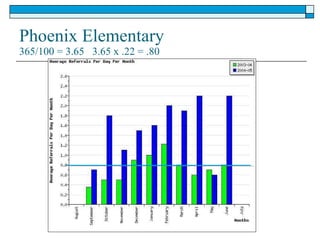
You are the PBS team for Phoenix Elementary. 365 students K-5 Do you have a problem? Where? With Whom? What other information might you want? Given what you know, what considerations would you have for possible action?
Phoenix Elementary 365/100 = 3.65  3.65 x .22 = .80
Phoenix Elementary  Problem Behaviors
Phoenix Elementary Locations Year One Year Two
Phoenix Elementary - Time
Phoenix Elementary Referrals Per Student (2 + Referrals)
Problem Statement Do we have a problem? Build a precise problem statement
Solution Development Prevention Teaching Reward Extinction Corrective Consequence Data Collection
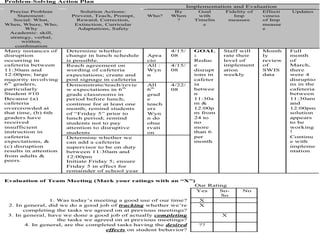
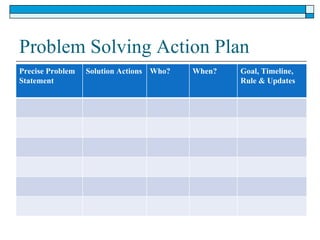
Problem Solving Action Plan Precise Problem Statement Solution Actions Who? When? Goal, Timeline, Rule & Updates
Activity Consider the ODR patterns for your school Do you have a problem?  What is it? Possible solutions? Action Planning?
Solution Development Prevention Teaching Reward Extinction Corrective Consequence Data Collection
Langley Elementary School 478 Students K-5
 
 
Precision Statement/Hypothesis What Where When Who Why What other info needed? Possible Solutions?
Solution Development Prevention Teaching Reward Extinction Corrective Consequence Data Collection
Problem Solving Action Plan Precise Problem Statement Solution Actions Who? When? Goal, Timeline, Rule & Updates
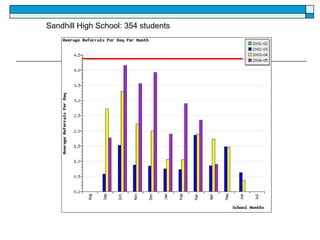
Sandhill High school 354 students
Sandhill High School: 354 students
Sandhill  - Problem Behavior
Sandhill - Location
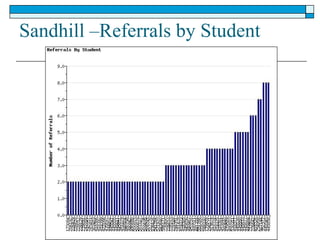
Sandhill –Referrals by Student
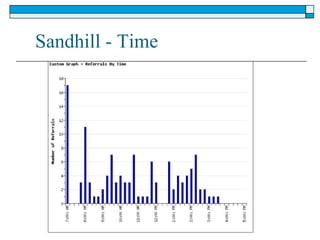
Sandhill - Time
Precision Statement/Hypothesis What Where When Who Why What other info needed? Possible Solutions?
Solution Development Prevention Teaching Reward Extinction Corrective Consequence Data Collection
Problem Solving Action Plan Precise Problem Statement Solution Actions Who? When? Goal, Timeline, Rule & Updates
Collect and Use Data Review  Status and  Identify  Problems Develop and Refine Hypotheses Discuss and Select Solutions Develop and Implement Action Plan Evaluate and Revise Action Plan Problem Solving Foundations Team Initiated Problem Solving (TIPS) Model

Todd tips

  • 1.
    Team Initiated ProblemSolving Sustaining Communities of Practice School-wide Positive Behaviour Support Queensland, Australia Conference 2011 Presented by Anne W. Todd University of Oregon [email_address] www.uoecs.org www.pbis.org Newton, J. S., Todd, A. W., Algozzine, K., Horner, R. H., & Algozzine, B. (2009). The Team Initiated Problem Solving (TIPS) Training Manual. Educational and Community Supports, University of Oregon, unpublished training manual.
  • 2.
    Goals Provide acontext for Team Decision-making efforts. Improving the effectiveness and efficiency of team meetings. Improve “problem solving process” Research support Meeting foundations Clearly defined purpose and roles What happens BEFORE, DURING, AFTER a meeting TIPS Agenda Electronic Public Prompts team process Problem Solving Process Defining “problems” with precision Using data for decision-making
  • 3.
    Main Messages Havingdata is necessary but insufficient Building effective team process (roles/ protocol) is essential. Use an electronic Agenda that prompts problem solving Problem solving starts with precise problem statements Use data-based decision rules to build, implement and modify solutions.
  • 4.
    People aren’t tiredfrom solving problems – they’re are tired from solving the same problems over and over.
  • 5.
    Collect and UseData Review Status and Identify Problems Develop and Refine Hypotheses Discuss and Select Solutions Develop and Implement Action Plan Evaluate and Revise Action Plan Problem Solving Foundations Team Initiated Problem Solving (TIPS) Model
  • 6.
    TIPS Study: Toddet al., School A School B School C School D Foundation Score Baseline Coaching TIPS % DORA Foundations Score
  • 7.
    TIPS Study: Todd,et al . School A School D School C Baseline Coaching TIPS Thoroughness of decision-making % DORA Thoroughness Score
  • 8.
    SYSTEMS PRACTICES DATASupporting Staff & Student Behavior and Decision Making Building Capacity and Sustainability OUTCOMES For Social Competence, Academic Achievement, and Safety SWIS Electronic Meeting Minutes Form *Meeting time *Support *Report to Faculty
  • 9.
    Improving Decision-Making via Problem S olving Problem Problem Solving Solution Information/ Data Action Planning & Evaluation
  • 10.
    Problem-Solving MeetingFoundations Structure of meetings lays foundation for efficiency & effectiveness
  • 11.
    Foundations Elements Defineroles Use electronic meeting minutes
  • 12.
    Define roles foreffective meetings Core roles Facilitator Minute taker Data analyst Active team member Backup for each role Can one person serve multiple roles? Are there other roles we could build it? (e.g. Reporter?) Typically NOT the administrator
  • 13.
    Defining Roles Whathappens BEFORE a meeting What happens DURING a meeting What happens AFTER a meeting
  • 16.
    Before the Meeting…Whodoes each Room reserved “ New” items solicited for agenda Agenda produced Data reviewed before the meeting; Suggest possible new issues Lead team through discussion of effects of in-process solutions on “old” problems Meeting minutes distributed within 24 hours of meeting. Computer reserved; access to SWIS online database assured LCD projector reserved & set up to project data (or team has some other strategy for ensuring team members can review data at meeting) Team members have individual TIPS Notebooks to bring to meeting Facilitator Facilitator Facilitator Data Analyst Facilitator Minute Taker Minute Taker Minute Taker All Team Members
  • 17.
    At Close ofand After Meeting… Meeting Minutes and Problem-Solving Action Plan completed Copy of Meeting Minutes & Problem-Solving Action Plan distributed to each member within 24 hrs . Minute Taker Minute Taker
  • 18.
    Newton, J. S.,Todd, A. W., Algozzine, K., Horner, R. H., & Algozzine, B. (2009). The Team Initiated Problem Solving (TIPS) Training Manual. Educational and Community Supports, University of Oregon. Unpublished training manual. Any tasks assigned get copied to the meeting minutes of the next meeting as a follow up item Meeting Agenda Item: Meeting Foundations Tasks: What, by whom, by when
  • 19.
  • 20.
    Getting Started Demographicsfor the meeting School Team Coach Meeting time Meeting location Facilitator Minute Taker Data analyst Regular Team Members Meeting Norms Newton, J. S., Todd, A. W., Algozzine, K., Horner, R. H., & Algozzine, B. (2009). The Team Initiated Problem Solving (TIPS) Training Manual. Educational and Community Supports, University of Oregon. Unpublished training manual.
  • 21.
    Meeting Norms/Agreements examplesRespect Active participation/listening Be equitable Be attentive focus on the task; avoid side talk/multi-tasking Offer creative & comprehensive ideas Responsibility Complete tasks between meetings Be on time Apply a positive framework to discussion Reality Agree to ‘doable’ tasks Be honest and share what we think and feel. Newton, J. S., Todd, A. W., Algozzine, K., Horner, R. H., & Algozzine, B. (2009). The Team Initiated Problem Solving (TIPS) Training Manual. Educational and Community Supports, University of Oregon. Unpublished training manual.
  • 22.
    Respect: active, equitable,attentive Responsibility: task completion timeliness positivity 3. Reality: doable honesty Newton, J. S., Todd, A. W., Algozzine, K., Horner, R. H., & Algozzine, B. (2009). The Team Initiated Problem Solving (TIPS) Training Manual. Educational and Community Supports, University of Oregon. Unpublished training manual.
  • 23.
    Inform facilitator ofabsence/tardy before meeting Avoid side talk Remind each other to stay focused Start and end on time Be an active participant Newton, J. S., Todd, A. W., Algozzine, K., Horner, R. H., & Algozzine, B. (2009). The Team Initiated Problem Solving (TIPS) Training Manual. Educational and Community Supports, University of Oregon. Unpublished training manual.
  • 24.
    The Flow ofthe Meeting Attendance, roles for meeting Next meeting scheduled Review agenda for meeting Review/status update of previous meeting minutes Review data & use TIPS problem solving model to prompt the development of a comprehension action plan for each decision Reports identified for next meeting Information to communicate to others Team assessment of meeting Dissemination of meeting minutes Newton, J. S., Todd, A. W., Algozzine, K., Horner, R. H., & Algozzine, B. (2009). The Team Initiated Problem Solving (TIPS) Training Manual. Educational and Community Supports, University of Oregon. Unpublished training manual.
  • 25.
    Using Meeting MinutesDocumentation of Logistics of meeting (date, time, location, roles) Agenda items for today’s meeting ( and next meeting) Discussion items, decisions made, tasks and timelines assigned Problem statements, solutions/decisions/tasks, people assigned to implement with timelines assigned, and an evaluation plan to determine the effect on student behavior Reviewing Meeting minutes An effective strategy for getting a snapshot of what happened at the previous meeting and what needs to be reviewed during the upcoming meeting What was the issue/problem?, What were we going to do?, Who was going to do it and by When?, and How are we measuring progress toward the goal? Visual tracking of focus topics during and after meetings Prevents side conversations Prevents repetition Encourages completion of tasks
  • 26.
    Organizing for aneffective problem solving conversation Problem Solution Out of Time Use Data A key to collective problem solving is to provide a visual context that allows everyone to follow and contribute
  • 27.
    PBIS Team MeetingMinutes and Problem-Solving Action Plan Form Today’s Meeting: Date, time, location: Facilitator: Minute Taker: Data Analyst: Next Meeting: Date, time, location: Facilitator: Minute Taker: Data Analyst: Team Members (bold are present today) Administrative/General Information and Issues Problem-Solving Action Plan Evaluation of Team Meeting (Mark your ratings with an “X”) Where in the Form would you place: Planning for next PTA meeting? Too many students in the “intensive support” for literacy Schedule for hallway monitoring for next month There have been five fights on playground in last month. Next meeting report on lunch-room status. Today’s Agenda Items Next Meeting Agenda Items 01. 02. 03. Information for Team, or Issue for Team to Address Discussion/Decision/Task (if applicable) Who? By When? Implementation and Evaluation Precise Problem Statement, based on review of data (What, When, Where, Who, Why) Solution Actions (e.g., Prevent, Teach, Prompt, Reward, Correction, Extinction, Safety) Who? By When? Goal, Timeline, Decision Rule, & Updates Our Rating Yes So-So No 1. Was today’s meeting a good use of our time? 2. In general, did we do a good job of tracking whether we’re completing the tasks we agreed on at previous meetings? 3. In general, have we done a good job of actually completing the tasks we agreed on at previous meetings? 4. In general, are the completed tasks having the desired effects on student behavior?
  • 28.
    Minors-what would welike to do about communicating the minors with families? There is inconsistency among staff, not all teachers use the minors as a teaching tool in the same way. Is this a problem? What should be do? Discussion: Perhaps we create a little blurb that goes out to families that teachers will use when sending them home. Sending them home creates a problematic situation, can be an issue with communication with families. Perhaps we need to just say to staff a general reminder about what is going on with the minors for families of multiple students or friends, etc. We will wait until next year to re-train staff and discuss how to use WHOAS and how to communicate them with parents. What is relevant to write down? Information for Team, or Issue for Team to Address Discussion/Decision/Task (if applicable) Who? By When? Minor incident reports Re-examine the process being used to document and communicate about minor incidents team 2-15-10 team meeting Take proposal to staff Team 2-15-10 staff meeting
  • 29.
    Fac: ‘we havea PTO meeting in 2 weeks and we need to get organized. last time not very many parents came and said that childcare was necessary’ TM 1: ‘ Tina’s daughter is a babysitter, oh and did you hear what happened to her last weekend?’ TM2: ‘ oh it was awful, and I heard…..’ Fac: ‘back to PTO planning, how can we increase attendance?’ What needs to be documented? Meeting Minute Simulation A General Item Tasks By Who By When PTO meeting – two weeks (date) Attendance? Childcare?
  • 30.
  • 31.
    Meeting Minutes example Given these meeting minutes, what needs to happen before next meeting?
  • 32.
  • 33.
    Meeting Minute Simulation Clarifying/cleaning up meeting minutes after the meeting Good content! Orienting new students is a general/ administrative item Who will do it by when? Newton, J. S., Todd, A. W., Algozzine, K., Horner, R. H., & Algozzine, B. (2009). The Team Initiated Problem Solving (TIPS) Training Manual. Educational and Community Supports, University of Oregon, unpublished training manual. 33
  • 34.
    Meeting Minute Simulation Clarifying/cleaning up meeting minutes after the meeting Great information & fits better as a general/ administrative item Newton, J. S., Todd, A. W., Algozzine, K., Horner, R. H., & Algozzine, B. (2009). The Team Initiated Problem Solving (TIPS) Training Manual. Educational and Community Supports, University of Oregon, unpublished manual. 34
  • 35.
  • 36.
  • 37.
    Important Structural ComponentsRegular meetings & regular attendance & regular time The “right” people The right roles Facilitator Minute Taker Data Analyst Active Team Members Accomplishments – Products of successful meeting Meeting Minutes (record of decisions & tasks concerning administrative/general issues) Problem-Solving Action Plan (record of decisions & tasks concerning problems identified by team)
  • 38.
    Main Ideas Decisionsare more likely to be effective and efficient when they are based on data. The quality of decision-making depends most on the first step (defining the problem to be solved) Define problems with precision and clarity
  • 39.
    Main Ideas Datahelp us ask the right questions…they do not provide the answers: Use data to Identify problems Refine problems Define the questions that lead to solutions Data help place the “problem” in the context rather than in the students.
  • 40.
    Main Idea Theprocess a team uses to problem solve is important: Roles : Facilitator; Recorder; Data analyst; Active member Organization Agenda; Old business (did we do what we said we would do); New business; Action plan for decisions. What happens BEFORE a meeting What happens DURING a meeting What happen AFTER a meeting
  • 41.
    Main Ideas Build“decision systems” not “data systems” Use data in “decision layers” Is there a problem? (overall rate of ODR) Localize the problem (location, problem behavior, students, time of day) Get specific Don’t drown in the data It’s “OK” to be doing well Be efficient
  • 42.
    Problem Solving Startingwith a clearly defined problem is essential Use data to: Identify a problem Define the problem with precision Guide development of an appropriate solution Assess fidelity of implementation of the solution Assess impact of the solution on student outcomes
  • 43.
    Collect and UseData Develop Hypothesis Discuss and Select Solutions Develop and Implement Action Plan Evaluate and Revise Action Plan . Problem Solving Meeting Foundations Team Initiated Problem Solving (TIPS) Model Identify Problems Newton, J. S., Todd, A. W., Algozzine, K., Horner, R. H., & Algozzine, B. (2009). The Team Initiated Problem Solving (TIPS) Training Manual. Educational and Community Supports, University of Oregon, unpublished training manual.
  • 44.
    Organizing SWIS Datafor Decision-making Universal Screening Tool Proportion of students with 0-1 Office Discipline Referrals (ODRs) 2-5 ODRs 6+ ODRs Progress Monitoring Tool Compare data across time Prevent previous problem patterns Define Problems with precision that lead to solvable problems Newton, J. S., Todd, A. W., Algozzine, K., Horner, R. H., & Algozzine, B. (2009). The Team Initiated Problem Solving (TIPS) Training Manual. Educational and Community Supports, University of Oregon, unpublished training manual.
  • 45.
    Using the Referralsby Student report as a Universal Screening Tool
  • 46.
    ~80% of Students~15% ~5% 0-1 office discipline referral 6+ office discipline referrals 2-5 office discipline referrals Using office discipline referrals as a metric for universal screening of student social behavior Newton, J. S., Todd, A. W., Algozzine, K., Horner, R. H., & Algozzine, B. (2009). The Team Initiated Problem Solving (TIPS) Training Manual. Educational and Community Supports, University of Oregon, unpublished training manual.
  • 47.
    Cumulative Mean ODRsCumulative Mean ODRs Per Month for 325+ Elementary Schools 08-09 Jennifer Frank, Kent McIntosh, Seth May
  • 48.
    Using ODRs toIdentify Problems Build a picture for the pattern of office referrals in your school. Compare the picture with a national average Compare the picture with previous years Compare the picture with social standards of faculty, families, students. Goal Identify problems empirically Identify problems early Identify problems in a manner that leads to problem solving not just whining Newton, J. S., Todd, A. W., Algozzine, K., Horner, R. H., & Algozzine, B. (2009). The Team Initiated Problem Solving (TIPS) Training Manual. Educational and Community Supports, University of Oregon, unpublished training manual.
  • 49.
    Identifying problems/issues Whatdata to monitor ODR per day per month OSS, ISS, Attendance, Teacher report Team Checklist/ SET (are we doing what we planned to do?) What question to answer Do we have a problem? What questions to ask of Level, Trend, Peaks How do our data compare with last year? How do our data compare with national/regional norms? How do our data compare with our preferred/expected status? If a problem is identified, then ask What are the data we need to make a good decision?
  • 50.
    Using Data toRefine Problem Statement The statement of a problem is important for team-based problem solving. Everyone must be working on the same problem with the same assumptions. Problems often are framed in a “Primary” form, that creates concern, but that is not useful for problem-solving. Frame primary problems based on initial review of data Use more detailed review of data to build “Solvable Problem Statements.”
  • 51.
    Precise Problem Statements(What are the data we need for a decision?) Precise problem statements include information about the Big Five questions: What is problem, and how often is it happening Where is it happening Who is engaged in the behavior When the problem is most likely Why the problem is sustaining
  • 52.
    Primary versus PrecisionStatements Primary Statements Too many referrals September has more suspensions than last year Gang behavior is increasing The cafeteria is out of control Student disrespect is out of control Precision Statements There are more ODRs for aggression on the playground than last year. These are most likely to occur during first recess, with a large number of students, and the aggression is related to getting access to the new playground equipment.
  • 53.
    Primary versus PrecisionStatements Primary Statements Too many referrals September has more suspensions than last year Gang behavior is increasing The cafeteria is out of control Student disrespect is out of control Precision Statements There are more ODRs for aggression on the playground than last year. These are most likely to occur during first recess , with a large number of students , and the aggression is related to getting access to the new playground equipment .
  • 54.
    Precise or PrimaryStatement? Children are using inappropriate language with a high frequency in the presence of both adults and other children. This is creating a sense of disrespect and incivility in the school. ODRs during December are higher than in any other month.
  • 55.
    Precise or PrimaryStatement? James D. is hitting others in the cafeteria during lunch, and his hitting is maintained by peer attention. Boys are engaging in sexual harassment. Three 5 th grade boys are name calling and touching girls inappropriately during recess in an apparent attempt to obtain attention.
  • 56.
    Precise or PrimaryStatement? Minor disrespect and disruption are increasing over time, and are most likely during the last 15 minutes of our block periods when students are engaged in independent seat work. This pattern is most common in 7 th and 8 th grades, involves many students, and appears to be maintained by escape from work (but may also be maintained by peer attention… we are not sure).
  • 57.
    Examples: Primary toPrecise Gang-like behavior is increasing Texting during school is becoming more negative Bullying (verbal and physical aggression) on the playground is increasing during “first recess,” is being done mostly by four 4 th grade boys, and seems to be maintained by social praise from the bystander peer group. A large number of students in each grade level (6, 7, 8) are using texting to spread rumors, and harass peers. Texting occurs both during the school day, and after school, and appears to be maintained by attention from others.
  • 58.
    Examples: Primary toPrecise Carly is having reading difficulties 50% of 2 nd graders are not meeting math benchmarks Carly is reading 20 cwpm (goal is 60), skips or guesses at words she doesn’t know, mostly during language arts 2 nd graders, who entered school after Oct 31, do not know whole numbers 75-100 and are not accurately adding two digit numbers because of lack of skills
  • 59.
    Your Turn Identifya “Primary” problem Transform it into a “Precise” problem statement
  • 60.
    Organizing Data forDecision-making Compare data across time Moving from counts to count/month
  • 61.
    Total Office DisciplineReferrals Total Office Discipline Referrals as of January 10
  • 62.
  • 63.
    Making Data intoInformation Look first at your patterns (tell the story) Level, Trend Peaks Match data to current perceptions Compare your data With national median With last year With what your faculty/students/ families want
  • 64.
    SWIS summary 2009-10 (Majors Only) 4,019 schools; 2,063,408 students; 1,622,229 ODRs Grade Range Number of Schools Mean Enrollment per school Median ODRs per 100 per school day K-6 2565 452 .22 6-9 713 648 .50 9-12 266 897 .68 K-(8-12) 474 423 .42
  • 65.
    Elementary School with150 Students Compare with National Median 150 / 100 = 1.50 1.50 X .22 = .33 Newton, J. S., Todd, A. W., Algozzine, K., Horner, R. H., & Algozzine, B. (2009). The Team Initiated Problem Solving (TIPS) Training Manual. Educational and Community Supports, University of Oregon, unpublished training manual. Questions to Ask of the Data What is? What is typical? What is possible? What is needed?
  • 66.
    Elementary School 465 students (465/ 100 = 4.6 X .22= 1.01) Newton, J. S., Todd, A. W., Algozzine, K., Horner, R. H., & Algozzine, B. (2009). The Team Initiated Problem Solving (TIPS) Training Manual. Educational and Community Supports, University of Oregon, unpublished training manual.
  • 67.
    Elementary School 1500 Students (1500/100 =105 X .22= 3.3) Newton, J. S., Todd, A. W., Algozzine, K., Horner, R. H., & Algozzine, B. (2009). The Team Initiated Problem Solving (TIPS) Training Manual. Educational and Community Supports, University of Oregon, unpublished training manual.
  • 68.
    Middle School 765 students (765/100 = 7.6 X .50= 3.8)
  • 69.
    Describe the narrativefor this school
  • 70.
  • 71.
    Describe the narrativefor this school
  • 72.
    Describe the narrativefor this school
  • 73.
    What are thedata you are most likely to need to move from a Primary to a Precise statement? What problem behaviors are most common? ODR per Problem Behavior Where are problem behaviors most likely? ODR per Location When are problem behaviors most likely? ODR per time of day Who is engaged in problem behavior? ODR per student Why are problem behaviors sustaining? Custom graph
  • 74.
    What When WhereWho Why Designing Effective Behavior Support
  • 75.
    Cost Benefits ofProblem Solving with Precise Problem Statements An Example Elementary Playground Problems
  • 76.
    Elementary School (Title 1) Total enrollment= 550 3 classes per grade level 18 classrooms (30/class) Primary Problem Statement fighting and physical aggression on playground 550 students full playground area, expectations, equipment use Precise Problem Statement High rates of physical aggression, disrespect and inappropriate language on the playground during second and third grade recess . Many students are involved and it appears they are trying to get access to equipment/games 180 2 ne/3rd graders, routine for accessing/sharing equipment/games
  • 77.
    Problem Statement Wehave high rates of physical aggression, disrespect and inappropriate language on the playground Costs: Planning: Supervisor Meeting costs 12 people 60 min 3-4 people about 2 hours each for planning details One hour of administrative time to schedule Total time = 21 hours Implementation: All supervisors spend a full day away from regular duties All students spend 45 minutes of classroom instruction time All teachers spend 45 classroom instructional minutes Total time supervisor time= ~ 18 hours instructional time = ~ 90 min per grade level Newton, J. S., Todd, A. W., Algozzine, K., Horner, R. H., & Algozzine, B. (2009). The Team Initiated Problem Solving (TIPS) Training Manual. Educational and Community Supports, University of Oregon, unpublished training manual.
  • 78.
    Problem Statement Wehave high rates of physical aggression, disrespect and inappropriate language on the playground during second and third grade recess. Benefits Resulting from defining the problem with more precision: Narrowed focus from whole school to 2 nd & 3 rd grade teachers, supervisors and students. Total planning time = ~ 11 hours Total implementation time = ~ 9 hours K, 1 st , 4 th , 5 th grade teachers, supervisors and students maintained their regular schedule recouping 90 min instructional time per grade level Newton, J. S., Todd, A. W., Algozzine, K., Horner, R. H., & Algozzine, B. (2009). The Team Initiated Problem Solving (TIPS) Training Manual. Educational and Community Supports, University of Oregon, unpublished training manual.
  • 79.
    Problem Statement Wehave high rates of physical aggression, disrespect and inappropriate language on the playground during second and third grade recess. Many students are involved and it appears they are trying to get access to equipment/games Benefits resulting from defining the problem with more precision: Solution implementation decisions are more specific, function-based and have contextual fit (focused on equipment/games) Provides opportunities for better instruction Prevents further planning and loss of instructional time Newton, J. S., Todd, A. W., Algozzine, K., Horner, R. H., & Algozzine, B. (2009). The Team Initiated Problem Solving (TIPS) Training Manual. Educational and Community Supports, University of Oregon, unpublished training manual.
  • 80.
    Savings in Planning& Implementation Time Moving from Primary Problem Statements to Precision Problem Statement hours
  • 81.
  • 82.
  • 83.
  • 84.
  • 85.
    Why ?: The hardest question What is perceived as maintaining the problem behavior? Always assess motivation AFTER you have defined who, what, where? Look for the “primary” motivation if there are multiple options.
  • 86.
    Why do Carl,Eric and Elliot keep engaging in disruption during morning work periods? Why
  • 87.
    Why are thirdand fourth graders fighting on the playground? Why
  • 88.
    Using Data toBuild Solutions Prevention : How can we avoid the problem context? Who, When, Where Schedule change, curriculum change, etc Teaching: How can we define, teach, and monitor what we want? Teach appropriate behavior Use problem behavior as negative example Recognition : How can we build in systematic reward for desired behavior? Extinction : How can we prevent problem behavior from being rewarded? Consequences : What are efficient, consistent consequences for problem behavior? How will we collect and use data to evaluate (a) implementation fidelity, and (b) impact on student outcomes?
  • 89.
    Solution Development PreventionTeaching Reward Extinction Corrective Consequence Data Collection
  • 90.
    Solution Development Focuson prevention first. How could we reduce the situations that lead to these behaviors? How do we ensure that students know what they SHOULD be doing when these situations arise? How do we ensure that appropriate behavior is recognized? How to we work to ensure that problem behavior is NOT being rewarded. Are corrective consequences needed? How will we know (a) if we are doing what we plan, and (b) if what we plan is working to benefit students? Prevention Teaching Reward Extinction Corrective Consequence Data Collection
  • 91.
    Examples Trevor TestPhoenix Elementary Langley Sandhill
  • 92.
    Trevor Test MiddleSchool 565 students Grades 6,7,8
  • 93.
    Trevor Test MiddleSchool Is there a problem? If so, what is it?
  • 94.
    Trevor Test MiddleSchool Identified Problem Identified problem for last 4 mos., Major ODRs per day higher than national avg. increasing trend across all 5 mos.
  • 95.
    Activity Define &Clarify problem identified by Trevor Test PBS Team Produce the SWIS “Big 4” for the previous 3-month period (solve current problem with current data) Draw logical inferences about problem Confirm/disconfirm inferences via analysis of SWIS Custom Reports
  • 96.
    Trevor Test MiddleSchool 11/01/2007 through 01/31/2008 (last 3 mos.)
  • 97.
    Perceived motivation forinappropriate language and disruption in the cafeteria (all students)
  • 98.
    Trevor Test Logical Inferences Based on Big 4 Most Disruptions occur in Cafeteria Most Disruptions occur in Cafeteria between 11:30 AM and 12:00 PM Most instances Inappropriate Language occur in Cafeteria between 11:30 AM and 12:00 AM
  • 99.
    Precise Problem Statement& Hypothesis Development Many students from all grade levels are engaging in disruption, inappropriate language and harassment in cafeteria and hallway during lunch, and the behavior is maintained by peer attention A smaller number of students engage in skipping and noncompliance/defiance in classes, (mostly in rooms 13, 14 and 18), and these behaviors appear to be maintained by escape.
  • 100.
    Solution Development: Fordisruption in hall and cafeteria Prevention *Teach behavioral expectations in cafeteria *Maintain current lunch schedule, but shift classes to balance numbers. Teaching Reward Establish “Friday Five”: Extra 5 min of lunch on Friday for five good days. Extinction Encourage all students to work for “Friday Five”… make reward for problem behavior less likely Corrective Consequence Active supervision, and continued early consequence (ODR) Data Collection Maintain ODR record and supervisor weekly report
  • 101.
  • 102.
  • 103.
    Phoenix Elementary UsingData For Decision-Making
  • 104.
    You are thePBS team for Phoenix Elementary. 365 students K-5 Do you have a problem? Where? With Whom? What other information might you want? Given what you know, what considerations would you have for possible action?
  • 105.
    Phoenix Elementary 365/100= 3.65 3.65 x .22 = .80
  • 106.
    Phoenix Elementary Problem Behaviors
  • 107.
  • 108.
  • 109.
    Phoenix Elementary ReferralsPer Student (2 + Referrals)
  • 110.
    Problem Statement Dowe have a problem? Build a precise problem statement
  • 111.
    Solution Development PreventionTeaching Reward Extinction Corrective Consequence Data Collection
  • 112.
    Problem Solving ActionPlan Precise Problem Statement Solution Actions Who? When? Goal, Timeline, Rule & Updates
  • 113.
    Activity Consider theODR patterns for your school Do you have a problem? What is it? Possible solutions? Action Planning?
  • 114.
    Solution Development PreventionTeaching Reward Extinction Corrective Consequence Data Collection
  • 115.
    Langley Elementary School478 Students K-5
  • 116.
  • 117.
  • 118.
    Precision Statement/Hypothesis WhatWhere When Who Why What other info needed? Possible Solutions?
  • 119.
    Solution Development PreventionTeaching Reward Extinction Corrective Consequence Data Collection
  • 120.
    Problem Solving ActionPlan Precise Problem Statement Solution Actions Who? When? Goal, Timeline, Rule & Updates
  • 121.
  • 122.
  • 123.
    Sandhill -Problem Behavior
  • 124.
  • 125.
  • 126.
  • 127.
    Precision Statement/Hypothesis WhatWhere When Who Why What other info needed? Possible Solutions?
  • 128.
    Solution Development PreventionTeaching Reward Extinction Corrective Consequence Data Collection
  • 129.
    Problem Solving ActionPlan Precise Problem Statement Solution Actions Who? When? Goal, Timeline, Rule & Updates
  • 130.
    Collect and UseData Review Status and Identify Problems Develop and Refine Hypotheses Discuss and Select Solutions Develop and Implement Action Plan Evaluate and Revise Action Plan Problem Solving Foundations Team Initiated Problem Solving (TIPS) Model

Editor's Notes

  • #5 It isn’t whether you have a problem, it’s whether you have the same problem again next year. Admiration of the problems is contagious!
  • #9 Building Capacity and Sustainability using the TIPS model to: 1. Conduct effective, efficient meetings when using SWIS data for problem solving and decision making. 2. Implement and evaluate solutions that result in positive effects on student achievement, social behavior and safety. a. The Information system is the use of the School Wide Information System. The data are current, accurate, believable b. The Practices include the use of the meeting minute form and the problem solving process c. The System is the implementation of Meeting Foundations, the TIPS model, and the documentation of decisions, action plans, and evaluation plans
  • #10 Steps in the problem solving model.
  • #11 07/05/11 Newton, J. S., Todd, A. W., Algozzine, K., Horner, R. H., & Algozzine, B. 2008
  • #19 Review items that need clarification Any tasks assigned get copied to the meeting minutes of the next meeting as a follow up item
  • #20 Example of meeting foundation checklist items getting transferred to the meeting minutes for future tracking of completion. 07/05/11
  • #21 These demographics get defined during team Meeting Foundations activity.
  • #22 Another set of examples for meeting norms
  • #23 This is a basic version of team member information. It would be ideal to have something like this for each team in the building/district. This information is helpful when new members join the team and when a team member needs to refer to this information. Completing this is one of the tasks on the Meeting Foundations Checklist, and will be a task to complete during the morning activity. 07/05/11
  • #24 This is a basic version of team member information. It would be ideal to have something like this for each team in the building/district. This information is helpful when new members join the team and when a team member needs to refer to this information. Completing this is one of the tasks on the Meeting Foundations Checklist, and will be a task to complete during the morning activity. 07/05/11
  • #25 General flow of meeting items. Always start with previous meeting minutes, review status, adjust agenda items to fit meeting needs
  • #28 This slide is animated to teach the different parts of the meeting minute form each click adds the next section Most schools have the title at the top and write/type as the meeting progresses Make a point that we don’t need to document everything that happened (i.e., NM rolled her eyes KJ entered the room, SW continued to repeat the same issue, we took at 5 minute bathroom break)
  • #29 07/05/11
  • #31 Show as a positive example Point out discriminations of different items ( administrative/general or problem solving). Review goal, fidelity check etc. 07/05/11 Newton, J. S., Todd, A. W., Algozzine, K., Horner, R. H., & Algozzine, B. 2008
  • #32 Show as a positive example Point out discriminations of different items ( administrative/general or problem solving). Review goal, fidelity check etc. Have participants review the Meeting Minute example and discuss what needs to happen before the next meeting. Next slide are these minutes without animated bubble 07/05/11 Newton, J. S., Todd, A. W., Algozzine, K., Horner, R. H., & Algozzine, B. 2008
  • #33 Show as a positive example Point out discriminations of different items ( administrative/general or problem solving). Review goal, fidelity check etc. Have participants review the Meeting Minute example and discuss what needs to happen before the next meeting. Next slide are these minutes without animated bubble 07/05/11 Newton, J. S., Todd, A. W., Algozzine, K., Horner, R. H., & Algozzine, B. 2008
  • #34 Good information, it is however, a general administrative type item and goes in that part of the meeting minute form 07/05/11 Newton, J. S., Todd, A. W., Algozzine, K., Horner, R. H., & Algozzine, B. 2008
  • #35 Great content, wrong place for this item. This is a general administrative item 07/05/11 Newton, J. S., Todd, A. W., Algozzine, K., Horner, R. H., & Algozzine, B. 2008
  • #38 07/05/11 Newton, J. S., Todd, A. W., Algozzine, K., Horner, R. H., & Algozzine, B. 2008
  • #44 The TIPS model The larger outer circle is the system of Meeting Foundations that supports the use of the problem solving model Meeting Foundations were taught earlier in the training The inner circles provide the strategies for using data to identify and solve problems This slide provides a visual as to what you are teaching… for the next set of slides, you are focusing on ‘identifying the problem’ 07/05/11 Newton, J. S., Todd, A. W., Algozzine, K., Horner, R. H., & Algozzine, B. 2008
  • #45 Use SWIS data to determine problems within the three tier framework. SWIS was developed to be a progress monitoring tool and is used as a universal screening tool, a progress monitoring tool, and formatted to define problems with precision
  • #46 Student with 2-5 are candidates for more support in behavior, academic, or both areas. 07/05/11 Newton, J. S., Todd, A. W., Algozzine, K., Horner, R. H., & Algozzine, B. 2008
  • #47 Label the level of support, not the student. For example: A student might need Tier II support for reading and doing well in all other areas/subjects A student might need Tier II support for reading and social behavior, Tier III support for writing, and doing well in all other areas/subjects 07/05/11 Newton, J. S., Todd, A. W., Algozzine, K., Horner, R. H., & Algozzine, B. 2008
  • #49 Let the data tell the story 07/05/11 Newton, J. S., Todd, A. W., Algozzine, K., Horner, R. H., & Algozzine, B. 2008
  • #65 *Median scores are a more accurate reflection of the average score for all schools.
  • #66 We want to review the trend, peaks in problems, and compare our average with the national summary data median per day per 100 students. (red line = median, purple line= 75 th percentile, bluish line 25 th percentile) 07/05/11 Newton, J. S., Todd, A. W., Algozzine, K., Horner, R. H., & Algozzine, B. 2008
  • #67 The next three slides represent the exact same data set so that you can illustrate how size and age range of school makes a difference on what the story is. With each of these three examples, the peaks and trend are the same, however, due to enrollment differences and age range of school, the median score is different….. Schools will have different problems and different goals for solving those problems. 07/05/11 Newton, J. S., Todd, A. W., Algozzine, K., Horner, R. H., & Algozzine, B. 2008
  • #78 The following three slides outline the planning and implementation costs for the problem as defined. This slide has elements of type of problem behavior and location Next slide adds, whom Third slide adds hypothesis. With each level of precision planning and implementation costs decrease. Adding information about the hypothesis keeps problem from getting worse. 07/05/11 Newton, J. S., Todd, A. W., Algozzine, K., Horner, R. H., & Algozzine, B. 2008