


1
Print Planning & Buying
The Basics
8.6.13
Prepared by The Media Kitchen
Agenda
Print Strategy Development
Evaluating Publications
Negotiating
Corporate Deals
Placement Types
Cross-Platform
2
Print Strategy Development
A Strategy is Important for Effective
Print Planning
• Prioritizes target audiences
• Narrows consideration set to specific
categories
• Guides the evaluation of print properties
4
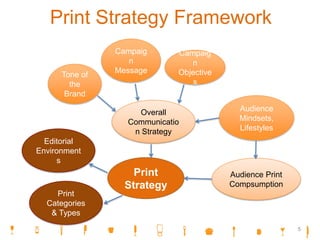
Print Strategy Framework
Audience
Mindsets,
Lifestyles
Print
Strategy
Overall
Communicatio
n Strategy
Audience Print
Compsumption
Editorial
Environment
s
Print
Categories
& Types
Tone of
the
Brand
Campaig
n
Message
Campaig
n
Objective
s
5
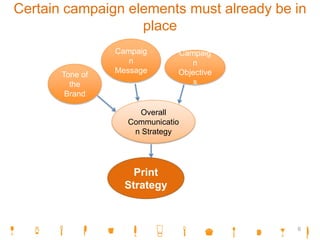
Certain campaign elements must already be in
place
Print
Strategy
Tone of
the
Brand
Campaig
n
Message
Campaig
n
Objective
s
Overall
Communicatio
n Strategy
6
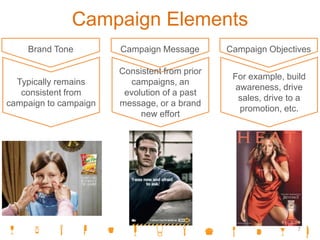
Campaign Elements
Brand Tone
Typically remains
consistent from
campaign to campaign
Campaign Message
Consistent from prior
campaigns, an
evolution of a past
message, or a brand
new effort
Campaign Objectives
For example, build
awareness, drive
sales, drive to a
promotion, etc.
7
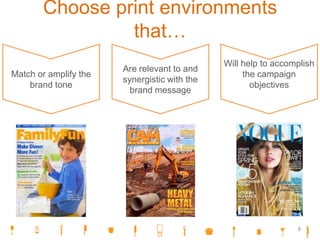
Choose print environments
that…
Match or amplify the
brand tone
Are relevant to and
synergistic with the
brand message
Will help to accomplish
the campaign
objectives
8
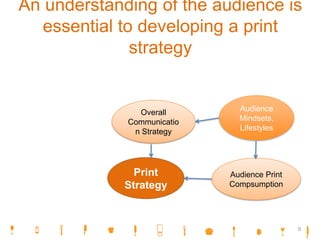
An understanding of the audience is
essential to developing a print
strategy
Audience
Mindsets,
Lifestyles
Print
Strategy
Overall
Communicatio
n Strategy
Audience Print
Compsumption
9
Audience Research Tools
• Syndicated research: MRI, Simmons, etc.
• Qualitative research: Focus groups, interviews
• Publisher-provided: Often, publishers do their own
audience research (be careful to distinguish the
sales pitch from the facts!)
10
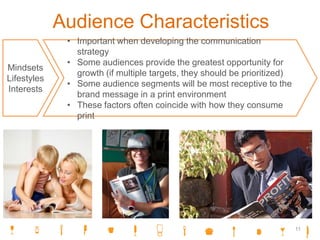
Audience Characteristics
Mindsets
Lifestyles
Interests
• Important when developing the communication
strategy
• Some audiences provide the greatest opportunity for
growth (if multiple targets, they should be prioritized)
• Some audience segments will be most receptive to the
brand message in a print environment
• These factors often coincide with how they consume
print
11
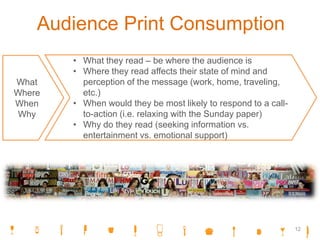
Audience Print Consumption
What
Where
When
Why
• What they read – be where the audience is
• Where they read affects their state of mind and
perception of the message (work, home, traveling,
etc.)
• When would they be most likely to respond to a call-
to-action (i.e. relaxing with the Sunday paper)
• Why do they read (seeking information vs.
entertainment vs. emotional support)
12
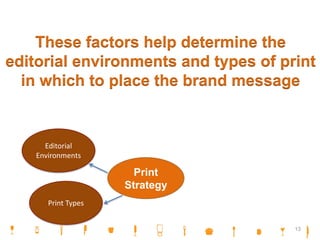
Editorial
Environments
Print Types
These factors help determine the
editorial environments and types of print
in which to place the brand message
Print
Strategy
13
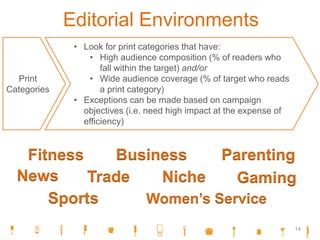
Editorial Environments
Print
Categories
• Look for print categories that have:
• High audience composition (% of readers who
fall within the target) and/or
• Wide audience coverage (% of target who reads
a print category)
• Exceptions can be made based on campaign
objectives (i.e. need high impact at the expense of
efficiency)
Business Parenting
News
Women’s Service
Gaming
Sports
Fitness
Trade Niche
14
Importance of Editorial
Environments
Receptivity
• Allows you to reach the audience when they will
be more receptive to the brand message
• i.e. Someone reading about the financial
climate might be more receptive to an ad for a
financial planning company
Targeting
• Increases the possibility that you’re reaching
people who care about the brand category
• i.e. If someone reads health magazines,
there’s a better chance they will ne interested
in a health food product
Element of
Surprise
• Unexpected environments can help the message
resonate
• i.e. An ad for a weight loss program in Cooking
with Paula Deen
15
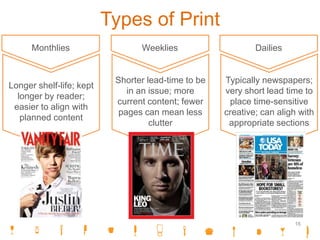
Types of Print
Monthlies
Longer shelf-life; kept
longer by reader;
easier to align with
planned content
Weeklies
Shorter lead-time to be
in an issue; more
current content; fewer
pages can mean less
clutter
Dailies
Typically newspapers;
very short lead time to
place time-sensitive
creative; can aligh with
appropriate sections
16
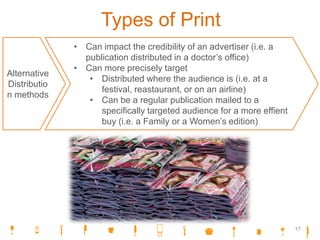
Types of Print
Alternative
Distributio
n methods
• Can impact the credibility of an advertiser (i.e. a
publication distributed in a doctor’s office)
• Can more precisely target
• Distributed where the audience is (i.e. at a
festival, reastaurant, or on an airline)
• Can be a regular publication mailed to a
specifically targeted audience for a more effient
buy (i.e. a Family or a Women’s edition)
17
Evaluating Print Properties
Much of the information you’ll need
to evaluate publications can be
pulled from online data sources
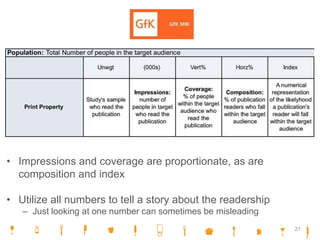
• Impressions and coverage are proportionate, as are
composition and index
• Utilize all numbers to tell a story about the readership
– Just looking at one number can sometimes be misleading
21
• Median age: the middle age in the range of ages
reading the publication
– Clients often ask for this information during presentations, so
it’s important to have it handy
• Find the optimal balance of Reach/Frequency to
evaluate full print schedules:
– Reach: the % of the target audience who will see the ad
– Frequency: the number of times they will see the ad
• The right balance is based on an understanding of the audience and
client priorities
• Should be included when recommending a plan to the client
22
• Use the FASFAX report to calculate the Circulation Vitality of a
magazine
• You will find:
– The % of circulation that is subscription vs. newsstand
– The total circulation for the year
– The change in circulation from year to year
• It’s an indication of the health of the publication
• Can be leveraged during negotiations
23
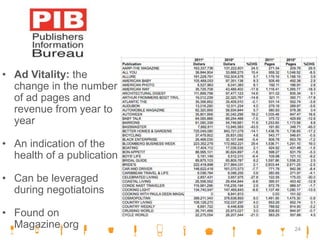
• Ad Vitality: the
change in the number
of ad pages and
revenue from year to
year
• An indication of the
health of a publication
• Can be leveraged
during negotiatoins
• Found on
Magazine.org 24
Use to:
• Learn about publications within specific categories
• Look up sales contact info
• Find publication details:
– Gross Open Rates
– Current Ratebase
– Current Circulation
– Closing Dates: Date by which the publication needs to receive an
IO in order to place an ad in an issue
– On-sale Dates: Date the issue is released onto newsstands
(subscriptions are usually mailed prior to this date)
25
Information Needed from
Publisher
Request for Proposal
Ratebase: Guaranteed circulation per issue
Gross Open Rate: The publicly listed cost for an ad
Proposed Rate: The cost at which the publication is willing to sell an
ad (Often fluctuates based on number of pages bought)
Discount: The percent difference between the Gross Open Rate and
the Proposed Rate
Total Audience: The number of people who read an issue;
calculated as the total circulation x readers per copy
Target Audience: The number of people within a specific
demographic and/or psychographic who read an issue
Editorial Calendar: Description of planned editorial for each issue.
Although this may change throughout the year, it gives an idea of
the kind of content planned
Frequency: Number of issues per year
27
There are numerous factors to
consider when reviewing proposals
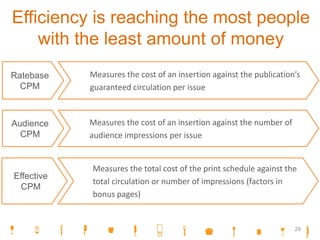
Efficiency is reaching the most people
with the least amount of money
Ratebase
CPM
Measures the cost of an insertion against the publication’s
guaranteed circulation per issue
Audience
CPM
Measures the cost of an insertion against the number of
audience impressions per issue
Effective
CPM
Measures the total cost of the print schedule against the
total circulation or number of impressions (factors in
bonus pages)
29
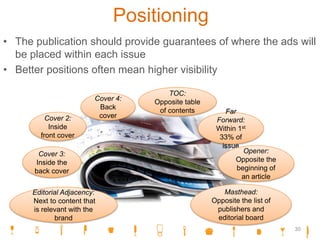
Positioning
• The publication should provide guarantees of where the ads will
be placed within each issue
• Better positions often mean higher visibility
Cover 4:
Back
cover
Cover 3:
Inside the
back cover
Far
Forward:
Within 1st
33% of
issue
TOC:
Opposite table
of contents
Cover 2:
Inside
front cover
Editorial Adjacency:
Next to content that
is relevant with the
brand
Opener:
Opposite the
beginning of
an article
Masthead:
Opposite the list of
publishers and
editorial board
30
Bonus pages
• A great way to bring down the effective CPM
• If counted into the Effective CPM:
– Should not be considered added value (they become part of
the effective page rate)
– Should abide by the same positioning and other
requirements, just like paid pages
31
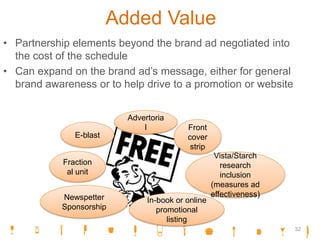
Added Value
• Partnership elements beyond the brand ad negotiated into
the cost of the schedule
• Can expand on the brand ad’s message, either for general
brand awareness or to help drive to a promotion or website
E-blast
Fraction
al unit
In-book or online
promotional
listing
Newspetter
Sponsorship
Front
cover
strip
Advertoria
l
Vista/Starch
research
inclusion
(measures ad
effectiveness)
32
Ability to Meet Requirements
• Clients often have specific requirements
publications must be able to accommodate, for
example:
– Separation from a competitive advertiser
– Flexible with closing dates
33
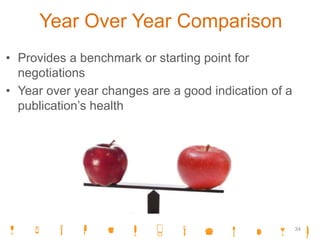
Year Over Year Comparison
• Provides a benchmark or starting point for
negotiations
• Year over year changes are a good indication of a
publication’s health
34
Negotiating
Rarely is a proposal perfect
when first submitted, so it’s
important to negotiate
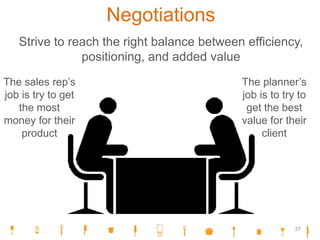
Negotiations
The planner’s
job is to try to
get the best
value for their
client
The sales rep’s
job is try to get
the most
money for their
product
Strive to reach the right balance between efficiency,
positioning, and added value
37
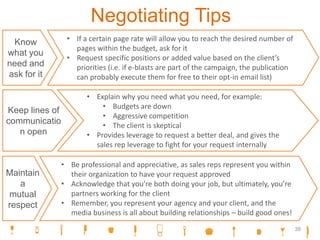
Negotiating Tips
Know
what you
need and
ask for it
• If a certain page rate will allow you to reach the desired number of
pages within the budget, ask for it
• Request specific positions or added value based on the client’s
priorities (i.e. if e-blasts are part of the campaign, the publication
can probably execute them for free to their opt-in email list)
Keep lines of
communicatio
n open
• Explain why you need what you need, for example:
• Budgets are down
• Aggressive competition
• The client is skeptical
• Provides leverage to request a better deal, and gives the
sales rep leverage to fight for your request internally
Maintain
a
mutual
respect
• Be professional and appreciative, as sales reps represent you within
their organization to have your request approved
• Acknowledge that you’re both doing your job, but ultimately, you’re
partners working for the client
• Remember, you represent your agency and your client, and the
media business is all about building relationships – build good ones!
38
Corporate Deals
Corporate proposals are structured
differently from single-book
proposals
They vary by publishing house, but
they all leverage incentives
Corporate Proposals
• Work with one contact who represents all publications
under a publisher’s umbrella to negotiate each
partnership
• Positioning and added value negotiations vary by
publisher
– Some are negotiated by the corporate rep, while others are
negotiated with each individual publication
41
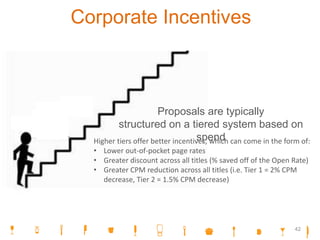
Corporate Incentives
Proposals are typically
structured on a tiered system based on
spendHigher tiers offer better incentives, which can come in the form of:
• Lower out-of-pocket page rates
• Greater discount across all titles (% saved off of the Open Rate)
• Greater CPM reduction across all titles (i.e. Tier 1 = 2% CPM
decrease, Tier 2 = 1.5% CPM decrease)
42
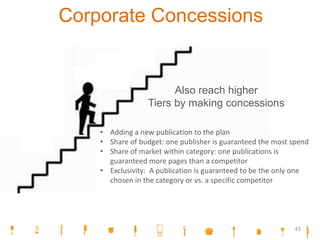
Corporate Concessions
Proposals are typically
structured on a tiered
system
Also reach higher
Tiers by making concessions
• Adding a new publication to the plan
• Share of budget: one publisher is guaranteed the most spend
• Share of market within category: one publications is
guaranteed more pages than a competitor
• Exclusivity: A publication is guaranteed to be the only one
chosen in the category or vs. a specific competitor
43
Corporate Proposals – Things to Note
44
Placement Types
Print buys are not limited to
brand ads
Beyond the Brand Ad
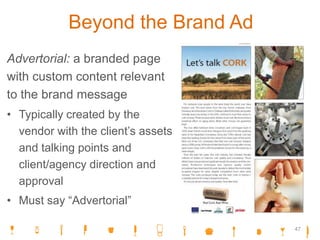
Advertorial: a branded page
with custom content relevant
to the brand message
• Typically created by the
vendor with the client’s assets
and talking points and
client/agency direction and
approval
• Must say “Advertorial”
47
Beyond the Brand Ad
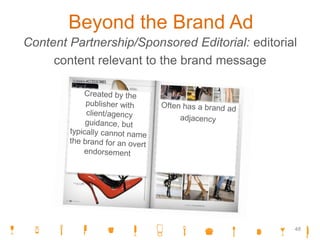
Content Partnership/Sponsored Editorial: editorial
content relevant to the brand message
48
Beyond the Brand Ad
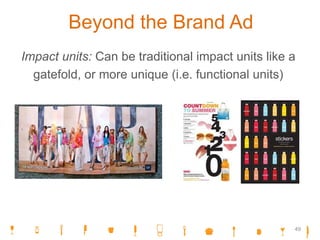
Impact units: Can be traditional impact units like a
gatefold, or more unique (i.e. functional units)
49
Beyond the Brand Ad
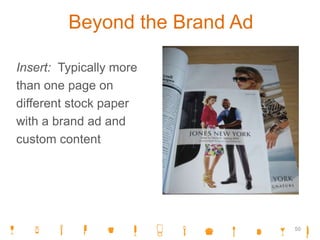
Insert: Typically more
than one page on
different stock paper
with a brand ad and
custom content
50
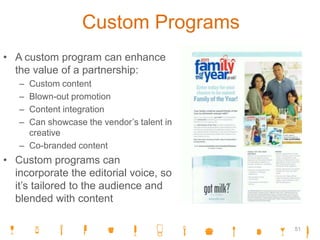
Custom Programs
• A custom program can enhance
the value of a partnership:
– Custom content
– Blown-out promotion
– Content integration
– Can showcase the vendor’s talent in
creative
– Co-branded content
• Custom programs can
incorporate the editorial voice, so
it’s tailored to the audience and
blended with content
51
Leveraging Cross-Platform
It can be smart to leverage a media
partner’s multiple outlets, if it makes
sense for the brand
Cross-Platform Buys
• Many media companies own television, print, online,
and/or radio properties
• Opportunity to develop an extensive custom program
that will run across media platforms for maximum
exposure
54
Benefits of Cross-Platform Buys
• Leverage in negotiations
– Bundled for a more efficient buy
– Increased added value to support the initiative
– Better positioning
• Greater Impact
– The messaging is reinforced via numerous outlets
– Allows for unique and creative custom executions or
promotions
– Each medium can reference or drive to other platforms
55
56
Thank You!
Presentation created by:
Erin Silvetti
esilvetti@mediakitchen.tv

TMKu: Print Planning and Buying

  • 1.
    1 Print Planning &Buying The Basics 8.6.13 Prepared by The Media Kitchen
  • 2.
    Agenda Print Strategy Development EvaluatingPublications Negotiating Corporate Deals Placement Types Cross-Platform 2
  • 3.
  • 4.
    A Strategy isImportant for Effective Print Planning • Prioritizes target audiences • Narrows consideration set to specific categories • Guides the evaluation of print properties 4
  • 5.
    Print Strategy Framework Audience Mindsets, Lifestyles Print Strategy Overall Communicatio nStrategy Audience Print Compsumption Editorial Environment s Print Categories & Types Tone of the Brand Campaig n Message Campaig n Objective s 5
  • 6.
    Certain campaign elementsmust already be in place Print Strategy Tone of the Brand Campaig n Message Campaig n Objective s Overall Communicatio n Strategy 6
  • 7.
    Campaign Elements Brand Tone Typicallyremains consistent from campaign to campaign Campaign Message Consistent from prior campaigns, an evolution of a past message, or a brand new effort Campaign Objectives For example, build awareness, drive sales, drive to a promotion, etc. 7
  • 8.
    Choose print environments that… Matchor amplify the brand tone Are relevant to and synergistic with the brand message Will help to accomplish the campaign objectives 8
  • 9.
    An understanding ofthe audience is essential to developing a print strategy Audience Mindsets, Lifestyles Print Strategy Overall Communicatio n Strategy Audience Print Compsumption 9
  • 10.
    Audience Research Tools •Syndicated research: MRI, Simmons, etc. • Qualitative research: Focus groups, interviews • Publisher-provided: Often, publishers do their own audience research (be careful to distinguish the sales pitch from the facts!) 10
  • 11.
    Audience Characteristics Mindsets Lifestyles Interests • Importantwhen developing the communication strategy • Some audiences provide the greatest opportunity for growth (if multiple targets, they should be prioritized) • Some audience segments will be most receptive to the brand message in a print environment • These factors often coincide with how they consume print 11
  • 12.
    Audience Print Consumption What Where When Why •What they read – be where the audience is • Where they read affects their state of mind and perception of the message (work, home, traveling, etc.) • When would they be most likely to respond to a call- to-action (i.e. relaxing with the Sunday paper) • Why do they read (seeking information vs. entertainment vs. emotional support) 12
  • 13.
    Editorial Environments Print Types These factorshelp determine the editorial environments and types of print in which to place the brand message Print Strategy 13
  • 14.
    Editorial Environments Print Categories • Lookfor print categories that have: • High audience composition (% of readers who fall within the target) and/or • Wide audience coverage (% of target who reads a print category) • Exceptions can be made based on campaign objectives (i.e. need high impact at the expense of efficiency) Business Parenting News Women’s Service Gaming Sports Fitness Trade Niche 14
  • 15.
    Importance of Editorial Environments Receptivity •Allows you to reach the audience when they will be more receptive to the brand message • i.e. Someone reading about the financial climate might be more receptive to an ad for a financial planning company Targeting • Increases the possibility that you’re reaching people who care about the brand category • i.e. If someone reads health magazines, there’s a better chance they will ne interested in a health food product Element of Surprise • Unexpected environments can help the message resonate • i.e. An ad for a weight loss program in Cooking with Paula Deen 15
  • 16.
    Types of Print Monthlies Longershelf-life; kept longer by reader; easier to align with planned content Weeklies Shorter lead-time to be in an issue; more current content; fewer pages can mean less clutter Dailies Typically newspapers; very short lead time to place time-sensitive creative; can aligh with appropriate sections 16
  • 17.
    Types of Print Alternative Distributio nmethods • Can impact the credibility of an advertiser (i.e. a publication distributed in a doctor’s office) • Can more precisely target • Distributed where the audience is (i.e. at a festival, reastaurant, or on an airline) • Can be a regular publication mailed to a specifically targeted audience for a more effient buy (i.e. a Family or a Women’s edition) 17
  • 19.
  • 20.
    Much of theinformation you’ll need to evaluate publications can be pulled from online data sources
  • 21.
    • Impressions andcoverage are proportionate, as are composition and index • Utilize all numbers to tell a story about the readership – Just looking at one number can sometimes be misleading 21
  • 22.
    • Median age:the middle age in the range of ages reading the publication – Clients often ask for this information during presentations, so it’s important to have it handy • Find the optimal balance of Reach/Frequency to evaluate full print schedules: – Reach: the % of the target audience who will see the ad – Frequency: the number of times they will see the ad • The right balance is based on an understanding of the audience and client priorities • Should be included when recommending a plan to the client 22
  • 23.
    • Use theFASFAX report to calculate the Circulation Vitality of a magazine • You will find: – The % of circulation that is subscription vs. newsstand – The total circulation for the year – The change in circulation from year to year • It’s an indication of the health of the publication • Can be leveraged during negotiations 23
  • 24.
    • Ad Vitality:the change in the number of ad pages and revenue from year to year • An indication of the health of a publication • Can be leveraged during negotiatoins • Found on Magazine.org 24
  • 25.
    Use to: • Learnabout publications within specific categories • Look up sales contact info • Find publication details: – Gross Open Rates – Current Ratebase – Current Circulation – Closing Dates: Date by which the publication needs to receive an IO in order to place an ad in an issue – On-sale Dates: Date the issue is released onto newsstands (subscriptions are usually mailed prior to this date) 25
  • 27.
    Information Needed from Publisher Requestfor Proposal Ratebase: Guaranteed circulation per issue Gross Open Rate: The publicly listed cost for an ad Proposed Rate: The cost at which the publication is willing to sell an ad (Often fluctuates based on number of pages bought) Discount: The percent difference between the Gross Open Rate and the Proposed Rate Total Audience: The number of people who read an issue; calculated as the total circulation x readers per copy Target Audience: The number of people within a specific demographic and/or psychographic who read an issue Editorial Calendar: Description of planned editorial for each issue. Although this may change throughout the year, it gives an idea of the kind of content planned Frequency: Number of issues per year 27
  • 28.
    There are numerousfactors to consider when reviewing proposals
  • 29.
    Efficiency is reachingthe most people with the least amount of money Ratebase CPM Measures the cost of an insertion against the publication’s guaranteed circulation per issue Audience CPM Measures the cost of an insertion against the number of audience impressions per issue Effective CPM Measures the total cost of the print schedule against the total circulation or number of impressions (factors in bonus pages) 29
  • 30.
    Positioning • The publicationshould provide guarantees of where the ads will be placed within each issue • Better positions often mean higher visibility Cover 4: Back cover Cover 3: Inside the back cover Far Forward: Within 1st 33% of issue TOC: Opposite table of contents Cover 2: Inside front cover Editorial Adjacency: Next to content that is relevant with the brand Opener: Opposite the beginning of an article Masthead: Opposite the list of publishers and editorial board 30
  • 31.
    Bonus pages • Agreat way to bring down the effective CPM • If counted into the Effective CPM: – Should not be considered added value (they become part of the effective page rate) – Should abide by the same positioning and other requirements, just like paid pages 31
  • 32.
    Added Value • Partnershipelements beyond the brand ad negotiated into the cost of the schedule • Can expand on the brand ad’s message, either for general brand awareness or to help drive to a promotion or website E-blast Fraction al unit In-book or online promotional listing Newspetter Sponsorship Front cover strip Advertoria l Vista/Starch research inclusion (measures ad effectiveness) 32
  • 33.
    Ability to MeetRequirements • Clients often have specific requirements publications must be able to accommodate, for example: – Separation from a competitive advertiser – Flexible with closing dates 33
  • 34.
    Year Over YearComparison • Provides a benchmark or starting point for negotiations • Year over year changes are a good indication of a publication’s health 34
  • 35.
  • 36.
    Rarely is aproposal perfect when first submitted, so it’s important to negotiate
  • 37.
    Negotiations The planner’s job isto try to get the best value for their client The sales rep’s job is try to get the most money for their product Strive to reach the right balance between efficiency, positioning, and added value 37
  • 38.
    Negotiating Tips Know what you needand ask for it • If a certain page rate will allow you to reach the desired number of pages within the budget, ask for it • Request specific positions or added value based on the client’s priorities (i.e. if e-blasts are part of the campaign, the publication can probably execute them for free to their opt-in email list) Keep lines of communicatio n open • Explain why you need what you need, for example: • Budgets are down • Aggressive competition • The client is skeptical • Provides leverage to request a better deal, and gives the sales rep leverage to fight for your request internally Maintain a mutual respect • Be professional and appreciative, as sales reps represent you within their organization to have your request approved • Acknowledge that you’re both doing your job, but ultimately, you’re partners working for the client • Remember, you represent your agency and your client, and the media business is all about building relationships – build good ones! 38
  • 39.
  • 40.
    Corporate proposals arestructured differently from single-book proposals They vary by publishing house, but they all leverage incentives
  • 41.
    Corporate Proposals • Workwith one contact who represents all publications under a publisher’s umbrella to negotiate each partnership • Positioning and added value negotiations vary by publisher – Some are negotiated by the corporate rep, while others are negotiated with each individual publication 41
  • 42.
    Corporate Incentives Proposals aretypically structured on a tiered system based on spendHigher tiers offer better incentives, which can come in the form of: • Lower out-of-pocket page rates • Greater discount across all titles (% saved off of the Open Rate) • Greater CPM reduction across all titles (i.e. Tier 1 = 2% CPM decrease, Tier 2 = 1.5% CPM decrease) 42
  • 43.
    Corporate Concessions Proposals aretypically structured on a tiered system Also reach higher Tiers by making concessions • Adding a new publication to the plan • Share of budget: one publisher is guaranteed the most spend • Share of market within category: one publications is guaranteed more pages than a competitor • Exclusivity: A publication is guaranteed to be the only one chosen in the category or vs. a specific competitor 43
  • 44.
    Corporate Proposals –Things to Note 44
  • 45.
  • 46.
    Print buys arenot limited to brand ads
  • 47.
    Beyond the BrandAd Advertorial: a branded page with custom content relevant to the brand message • Typically created by the vendor with the client’s assets and talking points and client/agency direction and approval • Must say “Advertorial” 47
  • 48.
    Beyond the BrandAd Content Partnership/Sponsored Editorial: editorial content relevant to the brand message 48
  • 49.
    Beyond the BrandAd Impact units: Can be traditional impact units like a gatefold, or more unique (i.e. functional units) 49
  • 50.
    Beyond the BrandAd Insert: Typically more than one page on different stock paper with a brand ad and custom content 50
  • 51.
    Custom Programs • Acustom program can enhance the value of a partnership: – Custom content – Blown-out promotion – Content integration – Can showcase the vendor’s talent in creative – Co-branded content • Custom programs can incorporate the editorial voice, so it’s tailored to the audience and blended with content 51
  • 52.
  • 53.
    It can besmart to leverage a media partner’s multiple outlets, if it makes sense for the brand
  • 54.
    Cross-Platform Buys • Manymedia companies own television, print, online, and/or radio properties • Opportunity to develop an extensive custom program that will run across media platforms for maximum exposure 54
  • 55.
    Benefits of Cross-PlatformBuys • Leverage in negotiations – Bundled for a more efficient buy – Increased added value to support the initiative – Better positioning • Greater Impact – The messaging is reinforced via numerous outlets – Allows for unique and creative custom executions or promotions – Each medium can reference or drive to other platforms 55
  • 56.
    56 Thank You! Presentation createdby: Erin Silvetti esilvetti@mediakitchen.tv