You’re a small Transportation Logistics company:  Business is growing at a rate of 5%, but you have a churn rate of 10%
  The industry has a low entry barrier
  Switching costs are low
  Customers have multiple options available to them
  Goal is to build customer loyalty
  You have a budget of $5,000You have been tasked to:Reduce Attrition by 8%Improve SOW by 10%Questions you might ask yourself: How do I establish the right “Loyalty Drivers” for my customers?
 Which research methodology should I use?
 How do I get all this done with a budget of only $5,000?Lesson learned from my Dad….He never missed an opportunity to teach me practical life lessons related to the chores at hand. One of them was "Use the right tool to get the job done right." Cordless ScrewdriverFlathead ScrewdriverPhillips ScrewdriverJeweler's ScrewdriverBuilt for speed and efficiencyMore screws, so don’t have to be extremelytightFewer screws  have to be extremelytight and well placedBuilt for detail & qualityMy dad’s advice can also be applied to market research. To get the right results, you need to use the right research tool for the job.
Many types of research…just like screwdrivers, but which one is right for the job?Drivers of Customer Loyalty
Dusty Rodgers Southwest Airlines CargoDrivers of Customer Loyalty
A 1% increase in customer loyalty is the equivalent of a 10% cost reduction “The Twelve Laws of Loyalty" by Jill Griffin
Why Online Surveys?Online surveys are fast becoming a popular method for collecting dataA large amount of data can be accumulated in a short amount of time Data can be received, analyzed, summarized real time - enhancing business decisions quicklyRelatively fast, easy and inexpensive
Online Surveys: Efficient Real Time SummaryQuick reference to determine statusQuick reference to determine how many responders have completed / partially completed the surveyYou can easily organize your surveys
Online Surveys: Intuitive DesignEasy to insert your logoEasy to add an introductionEasy to insert new questions
Online Surveys: Types of QuestionsEasy to add skip logic
Online Surveys: Robust ReportingReal time reporting.Quick crosstabs, charts, frequency reporting and moreClick of a button to graph resultsData is organized and easy to read
Online Surveys: Benefits / DrawbacksDrawbacks  BenefitsRelatively Inexpensive
Standardized
Customer metrics drives accountability
Ease of administration
Real time data
Suitability for tabulation and statistical analysis
Higher incidence rate than any other methodsMay not fully answer your research questionsTechnical skills and time required to develop and analyze questionnairesMay deter visitors from your websiteRepresentative sample might not be the target populationTechnical problems
Online Surveys: Many Web-Based OptionsZoomerang:  www.zoomerang.comSurvey Monkey:  www.surveymonkey.comVovici: www.vovici.comPoll Pro:  www.pollprol.comZtelligence:  www.ztelligence.comSurveyTracker: www.surveytracker.comQuestion Pro:  www.questionpro.comOr…outsourcing is always an option, but not for $5000.
Online Surveys: Best PracticesDefine your specific research goalsDesign the questionnaire with relevant and appropriate questionsPretest questionnaires and procedure to identify problems prior to the survey launchEstablish a sampling frame and recruit proper subjectsProvide confidentiality and data security information to your responders
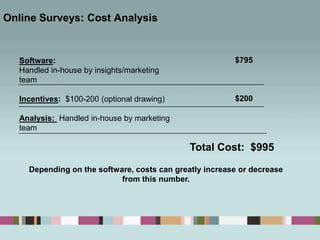
Online Surveys: Cost Analysis$795$200Software:Handled in-house by insights/marketing teamIncentives:  $100-200 (optional drawing)Analysis:  Handled in-house by marketing team  Total Cost:  $995Depending on the software, costs can greatly increase or decrease from this number.
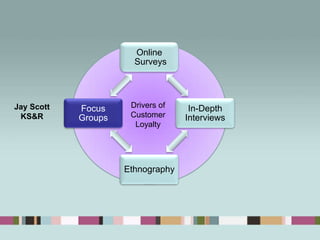
Drivers of Customer LoyaltyJay ScottKS&R
Which focus group is the best way to meet our objectives?VirtualTraditionalIn-person
Teleconferencing
Bulletin Board Focus Groups (BBFGs)How do Traditional Focus Groups work?Recruit participants to central location (usually recruit 12-14 for 8-10 to show)
Prepare discussion guide
Respondents come to facility at appointed time
Moderator conducts group; prompts and probes
Observers are typically behind a one-way mirror to watch the discussion “live”
Discussion typically lasts 1 ½ to 2 hoursDrawbacksHigh incentives required to get desired participation (at least $100 per person for business professionals)

TMCA Conference 2010

  • 2.
    You’re a smallTransportation Logistics company: Business is growing at a rate of 5%, but you have a churn rate of 10%
  • 3.
    Theindustry has a low entry barrier
  • 4.
    Switchingcosts are low
  • 5.
    Customershave multiple options available to them
  • 6.
    Goalis to build customer loyalty
  • 7.
    Youhave a budget of $5,000You have been tasked to:Reduce Attrition by 8%Improve SOW by 10%Questions you might ask yourself: How do I establish the right “Loyalty Drivers” for my customers?
  • 8.
    Which researchmethodology should I use?
  • 9.
    How doI get all this done with a budget of only $5,000?Lesson learned from my Dad….He never missed an opportunity to teach me practical life lessons related to the chores at hand. One of them was "Use the right tool to get the job done right." Cordless ScrewdriverFlathead ScrewdriverPhillips ScrewdriverJeweler's ScrewdriverBuilt for speed and efficiencyMore screws, so don’t have to be extremelytightFewer screws have to be extremelytight and well placedBuilt for detail & qualityMy dad’s advice can also be applied to market research. To get the right results, you need to use the right research tool for the job.
  • 10.
    Many types ofresearch…just like screwdrivers, but which one is right for the job?Drivers of Customer Loyalty
  • 11.
    Dusty Rodgers SouthwestAirlines CargoDrivers of Customer Loyalty
  • 12.
    A 1% increasein customer loyalty is the equivalent of a 10% cost reduction “The Twelve Laws of Loyalty" by Jill Griffin
  • 13.
    Why Online Surveys?Onlinesurveys are fast becoming a popular method for collecting dataA large amount of data can be accumulated in a short amount of time Data can be received, analyzed, summarized real time - enhancing business decisions quicklyRelatively fast, easy and inexpensive
  • 14.
    Online Surveys: EfficientReal Time SummaryQuick reference to determine statusQuick reference to determine how many responders have completed / partially completed the surveyYou can easily organize your surveys
  • 15.
    Online Surveys: IntuitiveDesignEasy to insert your logoEasy to add an introductionEasy to insert new questions
  • 16.
    Online Surveys: Typesof QuestionsEasy to add skip logic
  • 17.
    Online Surveys: RobustReportingReal time reporting.Quick crosstabs, charts, frequency reporting and moreClick of a button to graph resultsData is organized and easy to read
  • 18.
    Online Surveys: Benefits/ DrawbacksDrawbacks BenefitsRelatively Inexpensive
  • 19.
  • 20.
  • 21.
  • 22.
  • 23.
    Suitability for tabulationand statistical analysis
  • 24.
    Higher incidence ratethan any other methodsMay not fully answer your research questionsTechnical skills and time required to develop and analyze questionnairesMay deter visitors from your websiteRepresentative sample might not be the target populationTechnical problems
  • 25.
    Online Surveys: ManyWeb-Based OptionsZoomerang: www.zoomerang.comSurvey Monkey: www.surveymonkey.comVovici: www.vovici.comPoll Pro: www.pollprol.comZtelligence: www.ztelligence.comSurveyTracker: www.surveytracker.comQuestion Pro: www.questionpro.comOr…outsourcing is always an option, but not for $5000.
  • 26.
    Online Surveys: BestPracticesDefine your specific research goalsDesign the questionnaire with relevant and appropriate questionsPretest questionnaires and procedure to identify problems prior to the survey launchEstablish a sampling frame and recruit proper subjectsProvide confidentiality and data security information to your responders
  • 27.
    Online Surveys: CostAnalysis$795$200Software:Handled in-house by insights/marketing teamIncentives: $100-200 (optional drawing)Analysis: Handled in-house by marketing team  Total Cost: $995Depending on the software, costs can greatly increase or decrease from this number.
  • 28.
    Drivers of CustomerLoyaltyJay ScottKS&R
  • 29.
    Which focus groupis the best way to meet our objectives?VirtualTraditionalIn-person
  • 30.
  • 31.
    Bulletin Board FocusGroups (BBFGs)How do Traditional Focus Groups work?Recruit participants to central location (usually recruit 12-14 for 8-10 to show)
  • 32.
  • 33.
    Respondents come tofacility at appointed time
  • 34.
    Moderator conducts group;prompts and probes
  • 35.
    Observers are typicallybehind a one-way mirror to watch the discussion “live”
  • 36.
    Discussion typically lasts1 ½ to 2 hoursDrawbacksHigh incentives required to get desired participation (at least $100 per person for business professionals)

Editor's Notes

  • #7 To secure customer loyalty:Understand what performance criteria results in customer satisfactionUtilize ongoing, web-based surveys to collect dataAnalyze the responses – good and bad - to create a customer retention strategy
  • #30 The picture you walk away with is a self-reported, incomplete vision.Sometimes customers tell you how they WISH they were, or what they want you to believe about them/ their worldSometimes interviewers hear things based on their frame of reference
  • #31 The ‘neat’ daughterThe clutter (baby toys, exercise ball, computer, art supplies)‘Entertaining’ to them may mean something different than it does to you (family gathering, community meeting)Watching activities in action (birthday parties, arts and crafts)
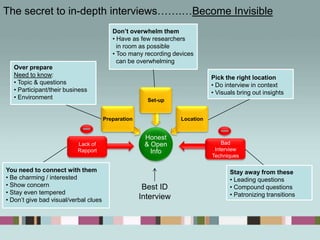
  • #33 Design the study to include more than one visit to each subjectIt takes time to build rapport and allow the subject to feel “unobserved” and act like themselvesMultiple visits allows you to check anomaliesConsider two multi-hour visits per subjectCreate a list of observation objectives before you goKeep your objectives open ended so that you too will be open minded about what you seeFor example: How she prepares her meal vs. Did she use the microwaveMemorize the list in order to be able to be “in the moment” and yet still be observingPractice before you goDevelop a short list of observation objectives for your office or homePractice observing and taking notes while observing your family or colleaguesThink in “verbatim”Write down everything the subject does as if you are capturing their physical “quote”What might not seem important in the moment, could be very important during analysisNever “go native”It is always tempting to help a subject who is struggling with a task related to your product or service since you know it so well but don’t do it.If asked a direct question such as “how do you clean out this filter?” respond with “hmm. How would you normally do it if I weren’t here?”If necessary, once all observational visits are done, demonstrate the easier way to do something with your productDon’t get too chattyUnless you have instructed the subject to “speak out loud everything that is going through your mind as you do this,” try not to start conversation during the observationOnce you establish rapport and explain that you want the subject to ‘do as she normally does,’ remain as quiet as possible – as if you aren’t thereRemain out of the field of visionIn order to blend in it is best if the subject can’t see you when they are performing their routine – try to sit behind her, to the side but back a few feet, etcKeep yourself from “stepping in for a closer look” unless explicitly invited
  • #34 Additional Notes/ Tips on EthnographyStay long enough for those observed not to feel “on stage” (potentially doing things differently)Map the space being observedWatch for “work-arounds”Watch for visual cues of those observed for signs of frustration, nervousness, etc – and capture what motivated that reactionWatch for interruptions, disruptions, bottlenecksAlternative: Each observer pick one role and watch the person filling it through a complete routine—documenting what products they touch or what steps they go throughAlternative: Divide the steps in the customers’ process among the observers to watch in detail (e.g. tool prep, procedure, follow-up)Alternative: Each observer chooses one process / process part and maps the workflow of each role related to it