

20 Product Prioritization
techniques
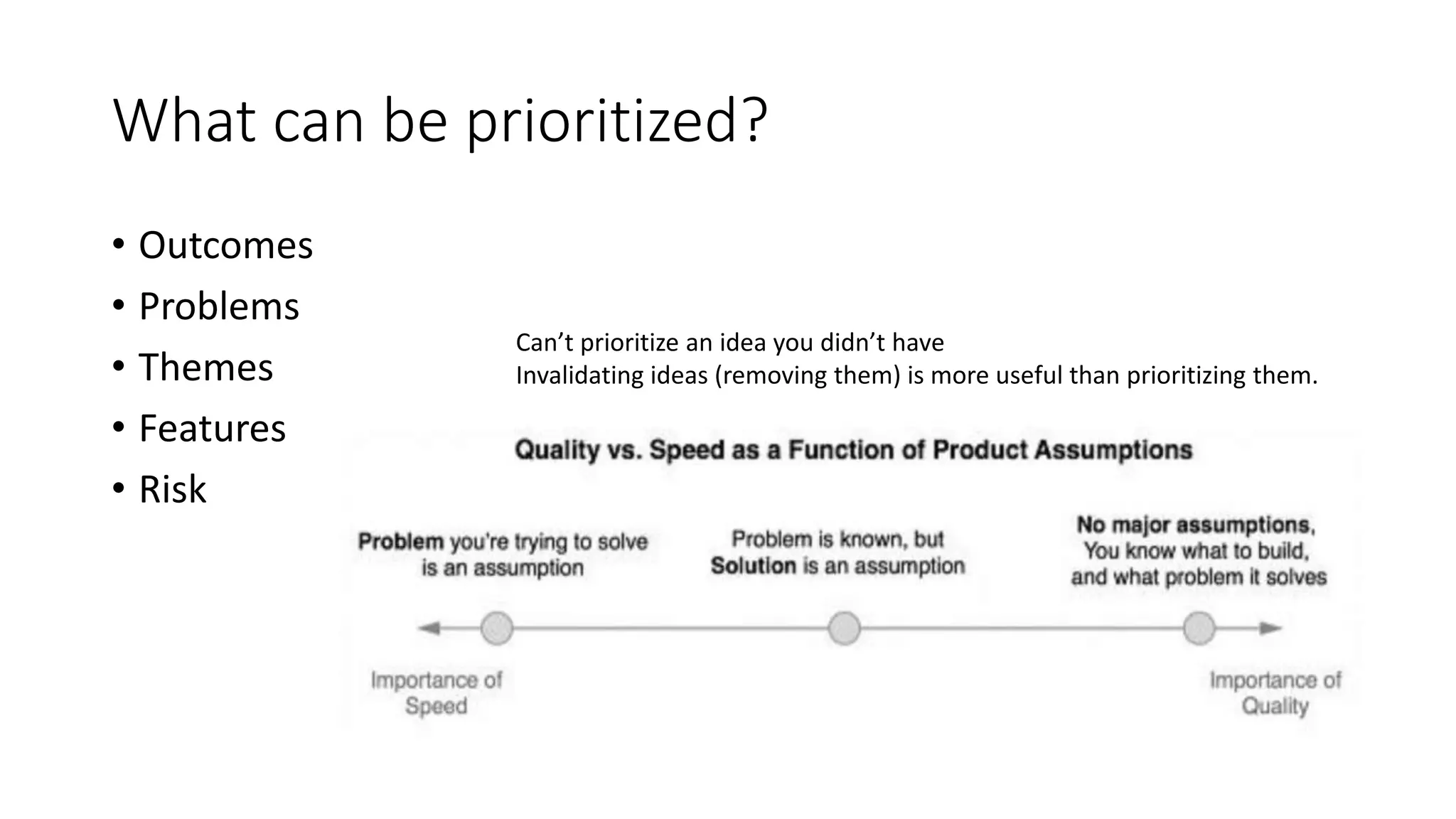
What can be prioritized?
• Outcomes
• Problems
• Themes
• Features
• Risk
Can’t prioritize an idea you didn’t have
Invalidating ideas (removing them) is more useful than prioritizing them.
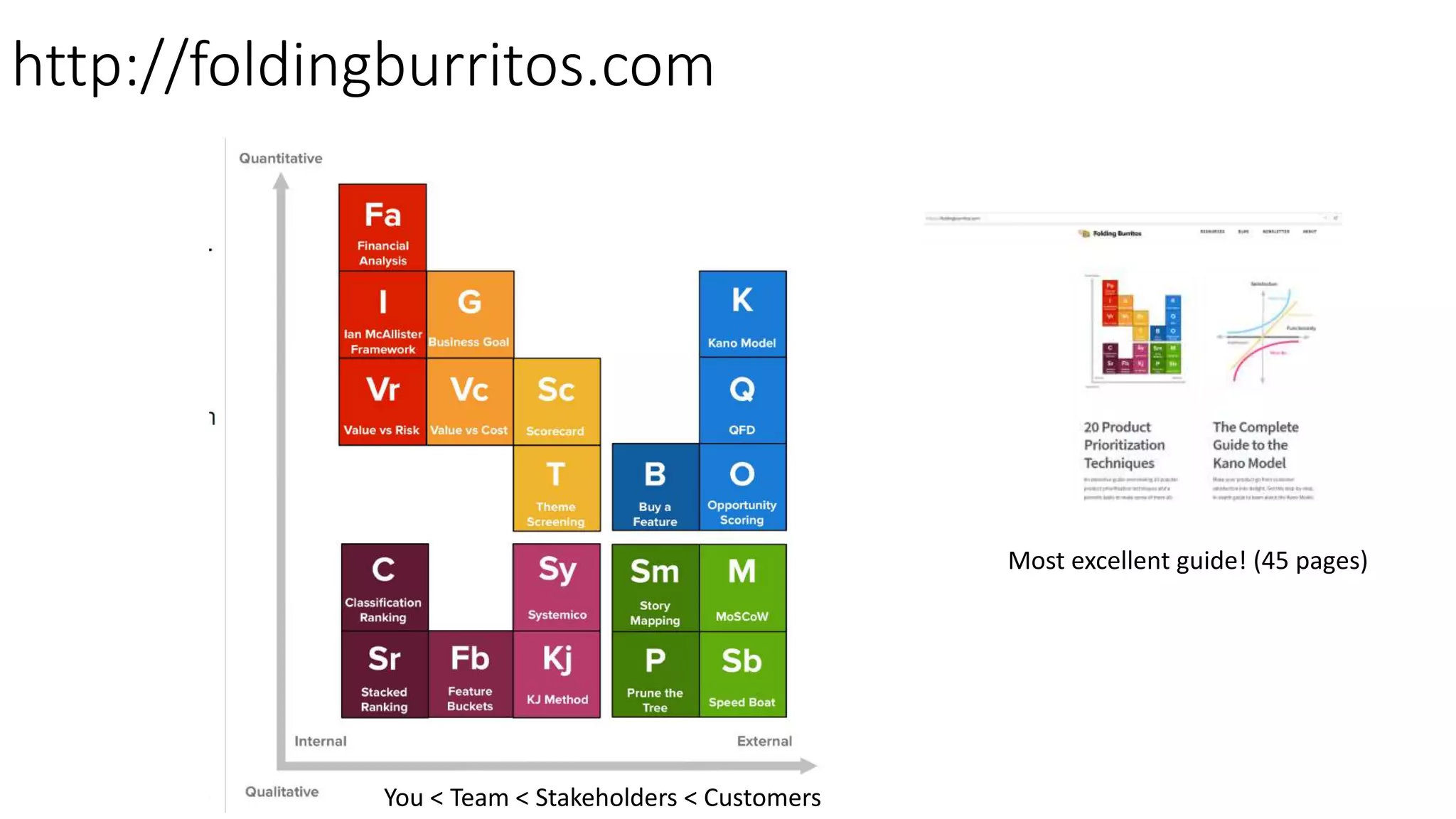
http://foldingburritos.com
Most excellent guide! (45 pages)
You < Team < Stakeholders < Customers
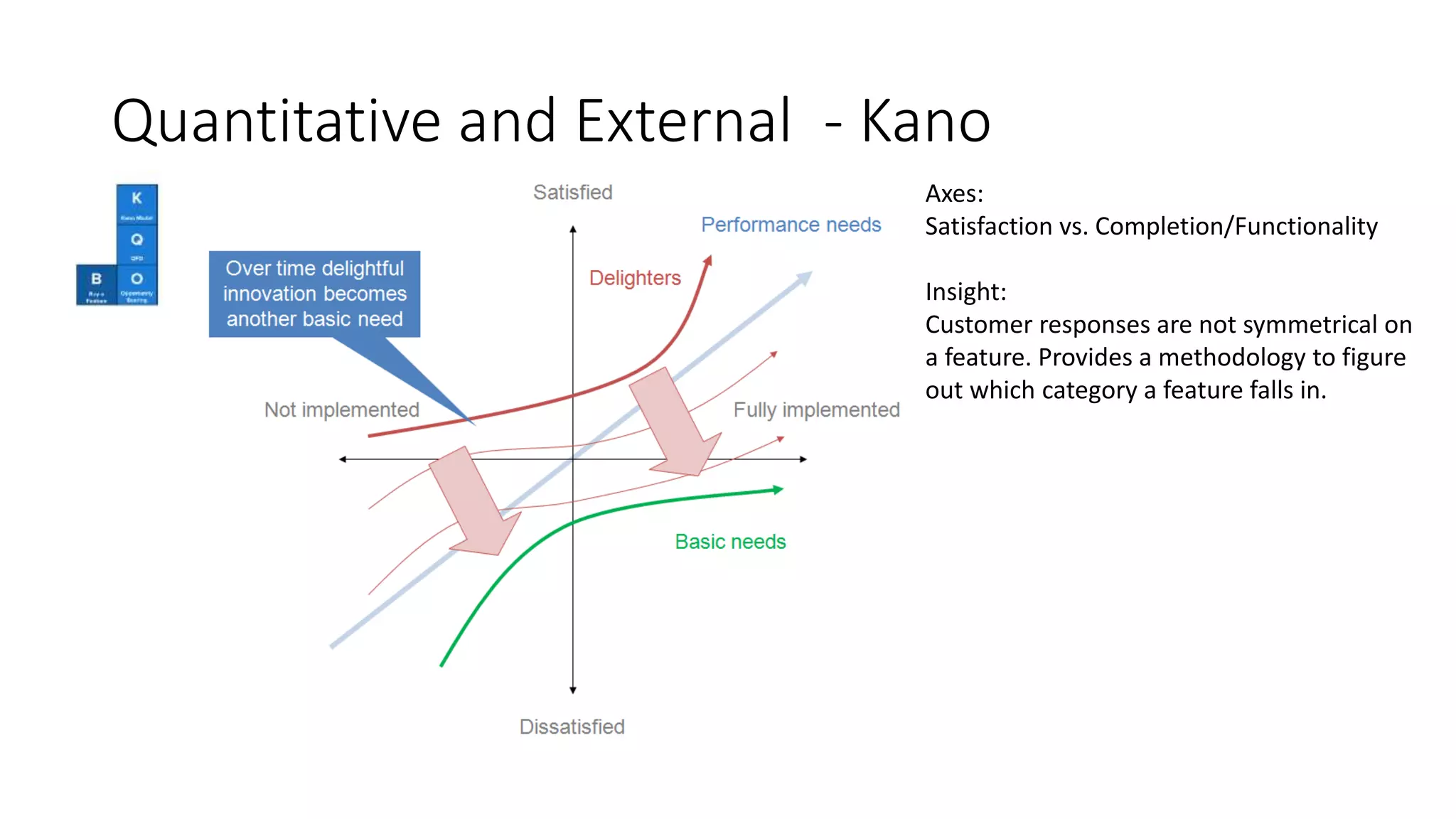
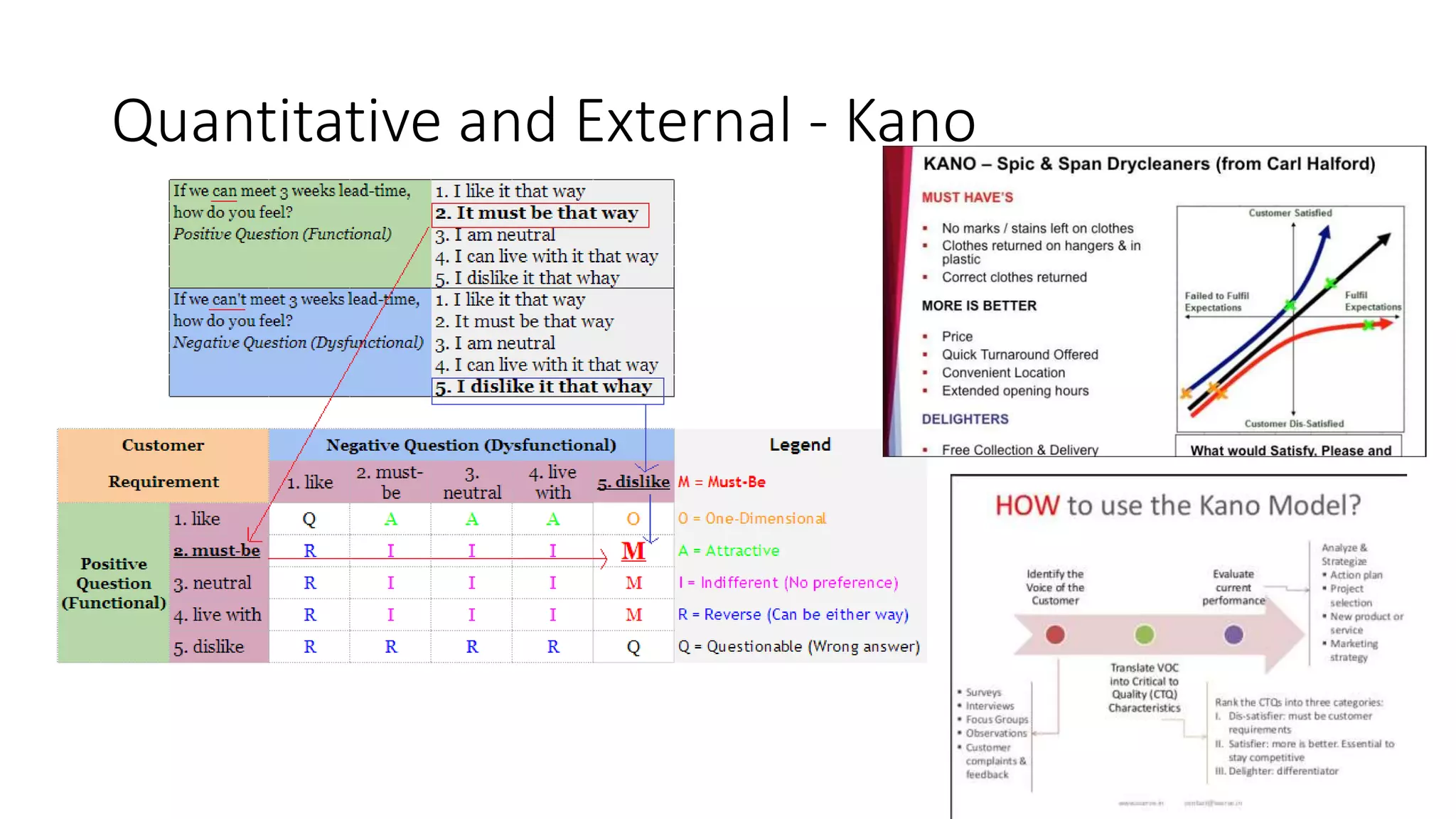
Quantitative and External - Kano
Axes:
Satisfaction vs. Completion/Functionality
Insight:
Customer responses are not symmetrical on
a feature. Provides a methodology to figure
out which category a feature falls in.
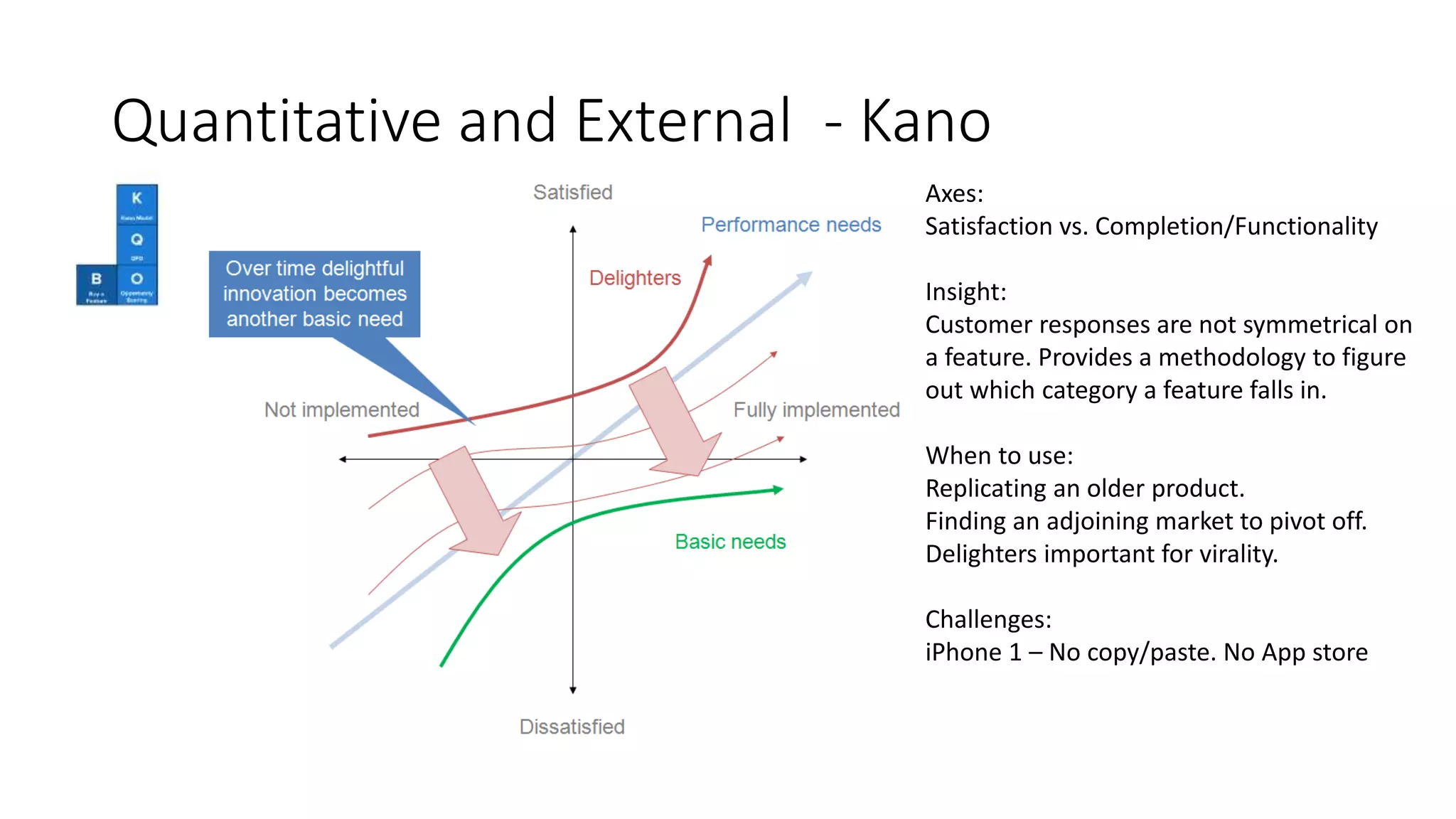
Quantitative and External - Kano
Axes:
Satisfaction vs. Completion/Functionality
Insight:
Customer responses are not symmetrical on
a feature. Provides a methodology to figure
out which category a feature falls in.
When to use:
Replicating an older product.
Finding an adjoining market to pivot off.
Delighters important for virality.
Challenges:
iPhone 1 – No copy/paste. No App store
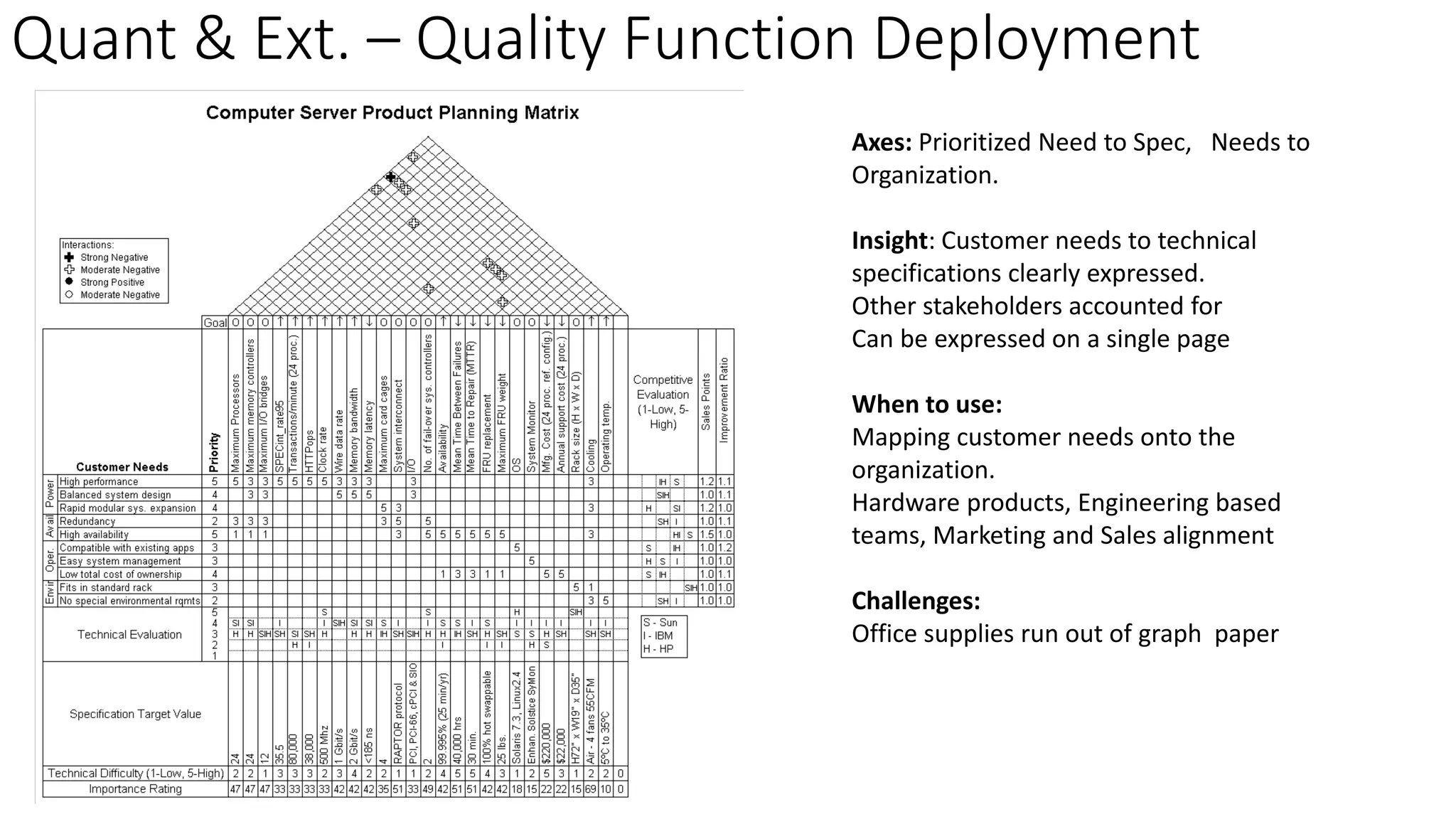
Quant & Ext. – Quality Function Deployment
Axes: Prioritized Need to Spec, Needs to
Organization.
Insight: Customer needs to technical
specifications clearly expressed.
Other stakeholders accounted for
Can be expressed on a single page
When to use:
Mapping customer needs onto the
organization.
Hardware products, Engineering based
teams, Marketing and Sales alignment
Challenges:
Office supplies run out of graph paper
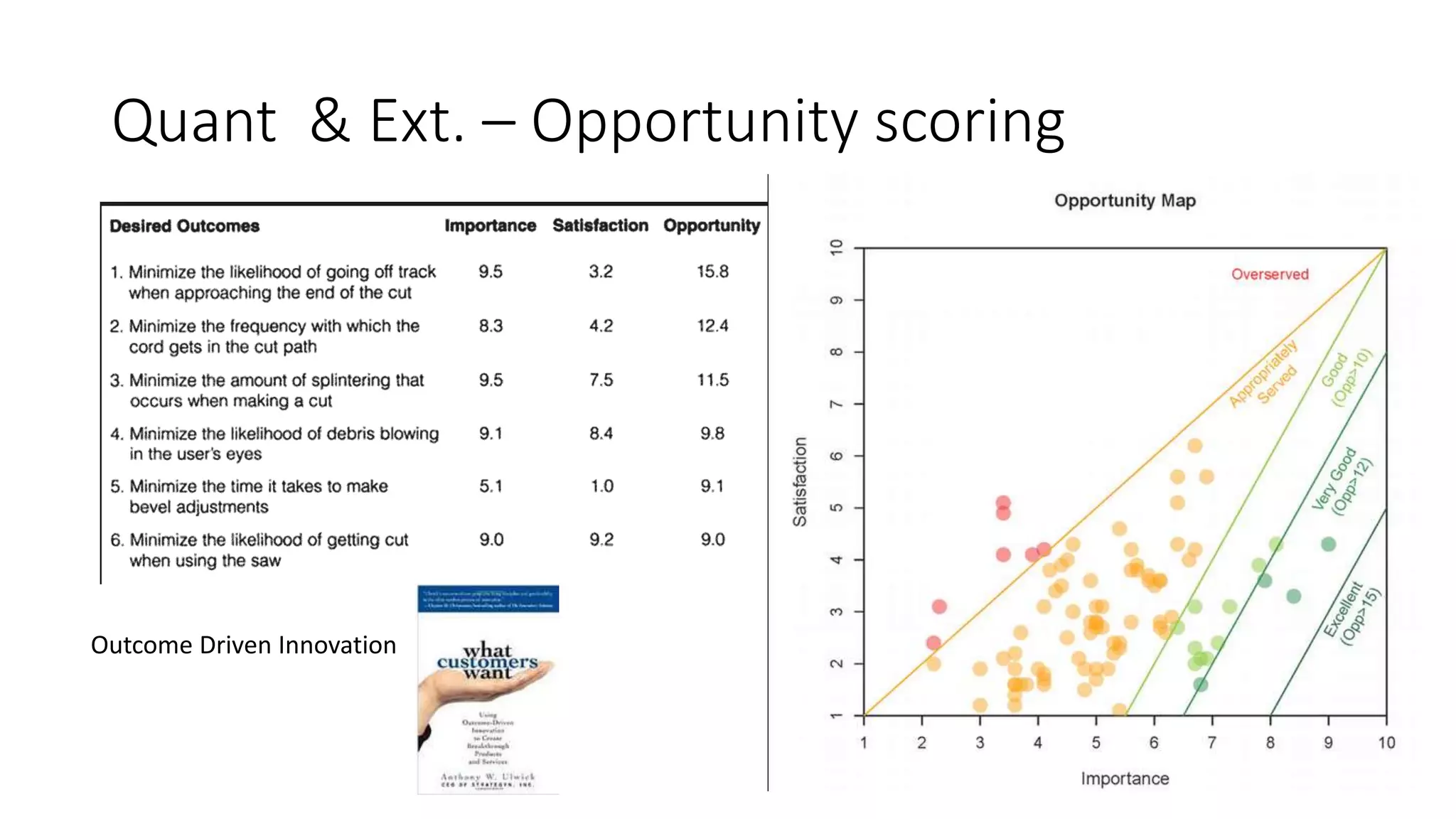
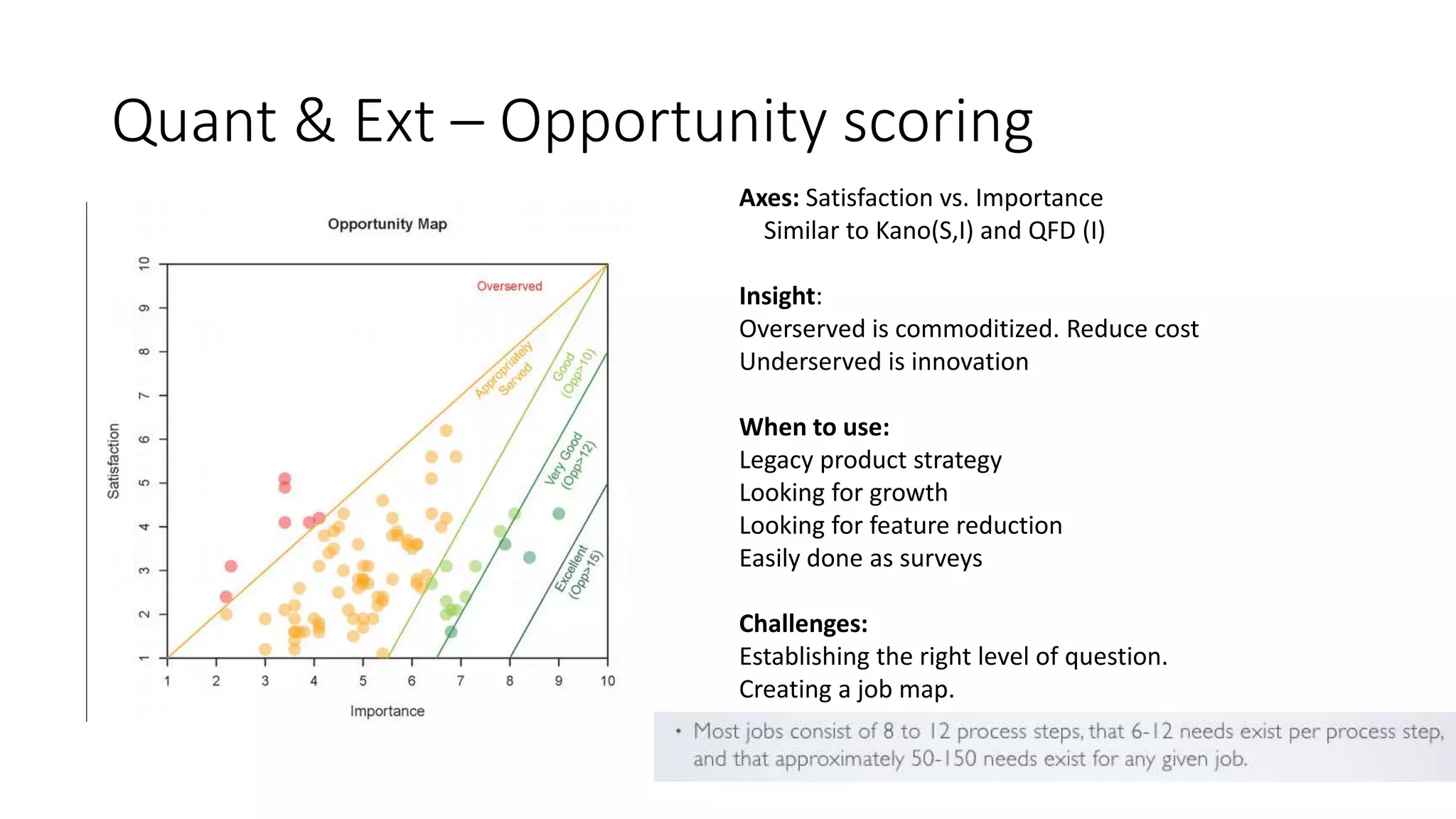
Quant & Ext. – Opportunity scoring
Outcome Driven Innovation
Quant & Ext – Opportunity scoring
Axes: Satisfaction vs. Importance
Similar to Kano(S,I) and QFD (I)
Insight:
Overserved is commoditized. Reduce cost
Underserved is innovation
When to use:
Legacy product strategy
Looking for growth
Looking for feature reduction
Easily done as surveys
Challenges:
Establishing the right level of question.
Creating a job map.
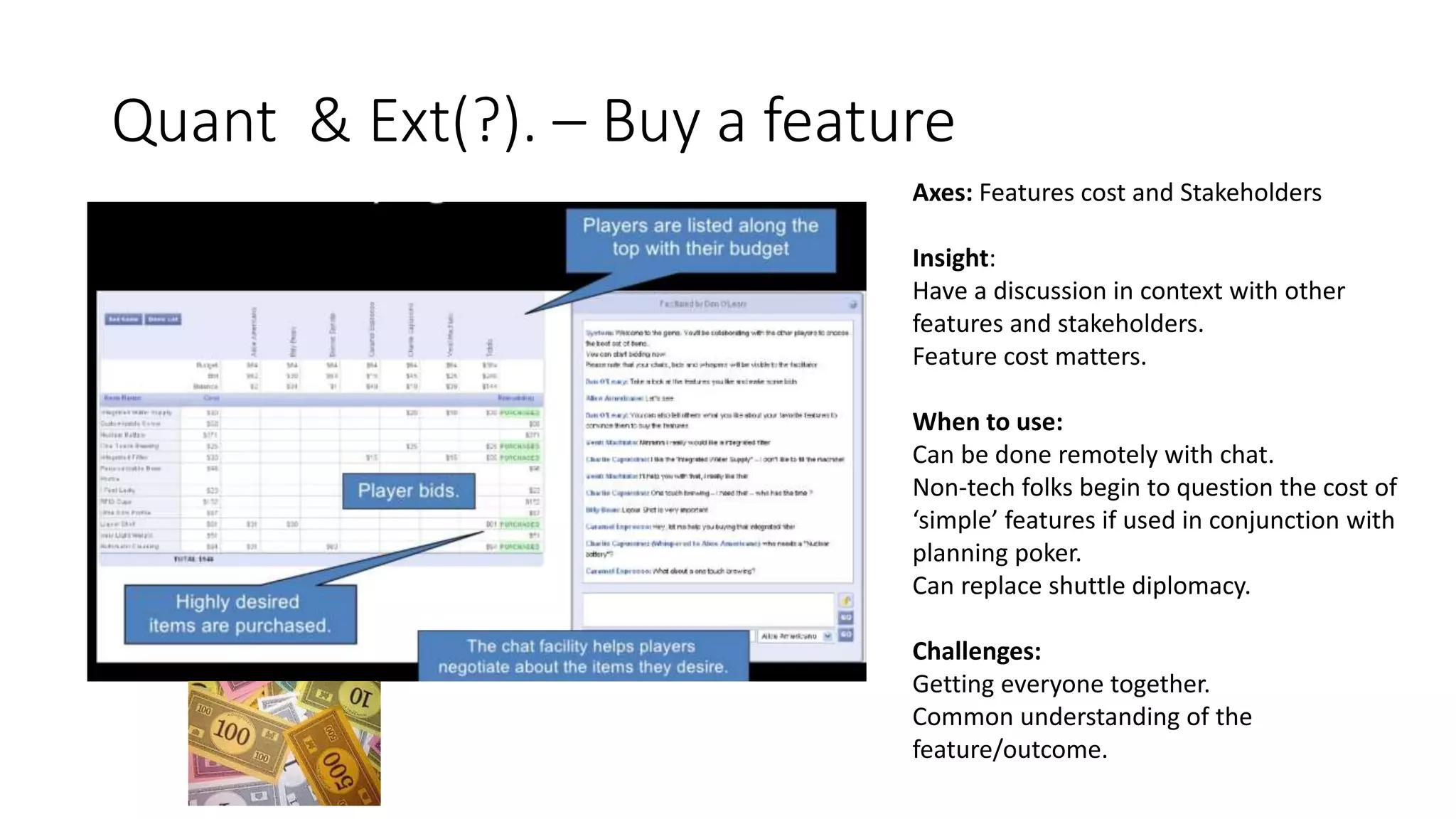
Quant & Ext(?). – Buy a feature
Axes: Features cost and Stakeholders
Insight:
Have a discussion in context with other
features and stakeholders.
Feature cost matters.
When to use:
Can be done remotely with chat.
Non-tech folks begin to question the cost of
‘simple’ features if used in conjunction with
planning poker.
Can replace shuttle diplomacy.
Challenges:
Getting everyone together.
Common understanding of the
feature/outcome.
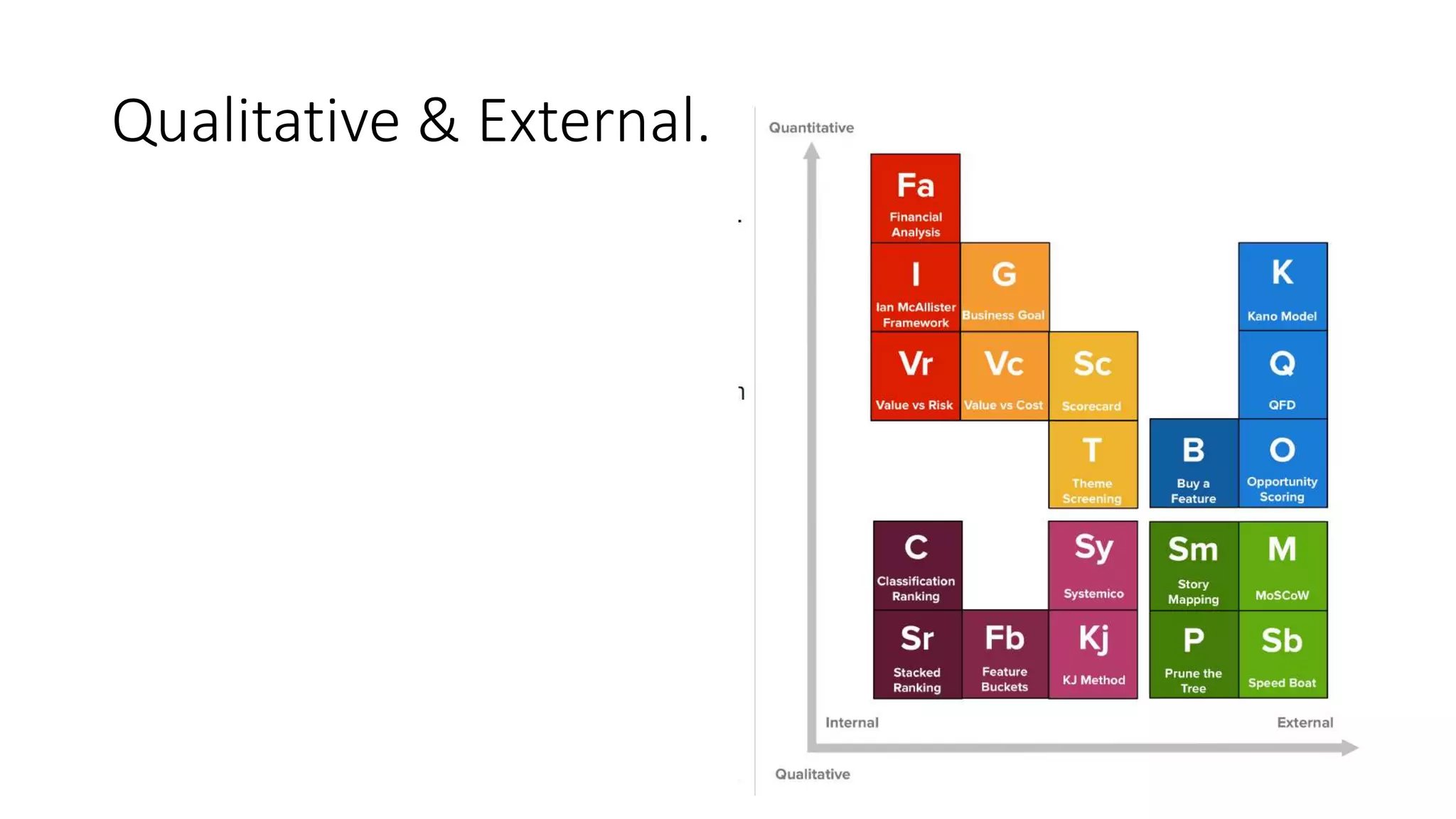
Qualitative & External.
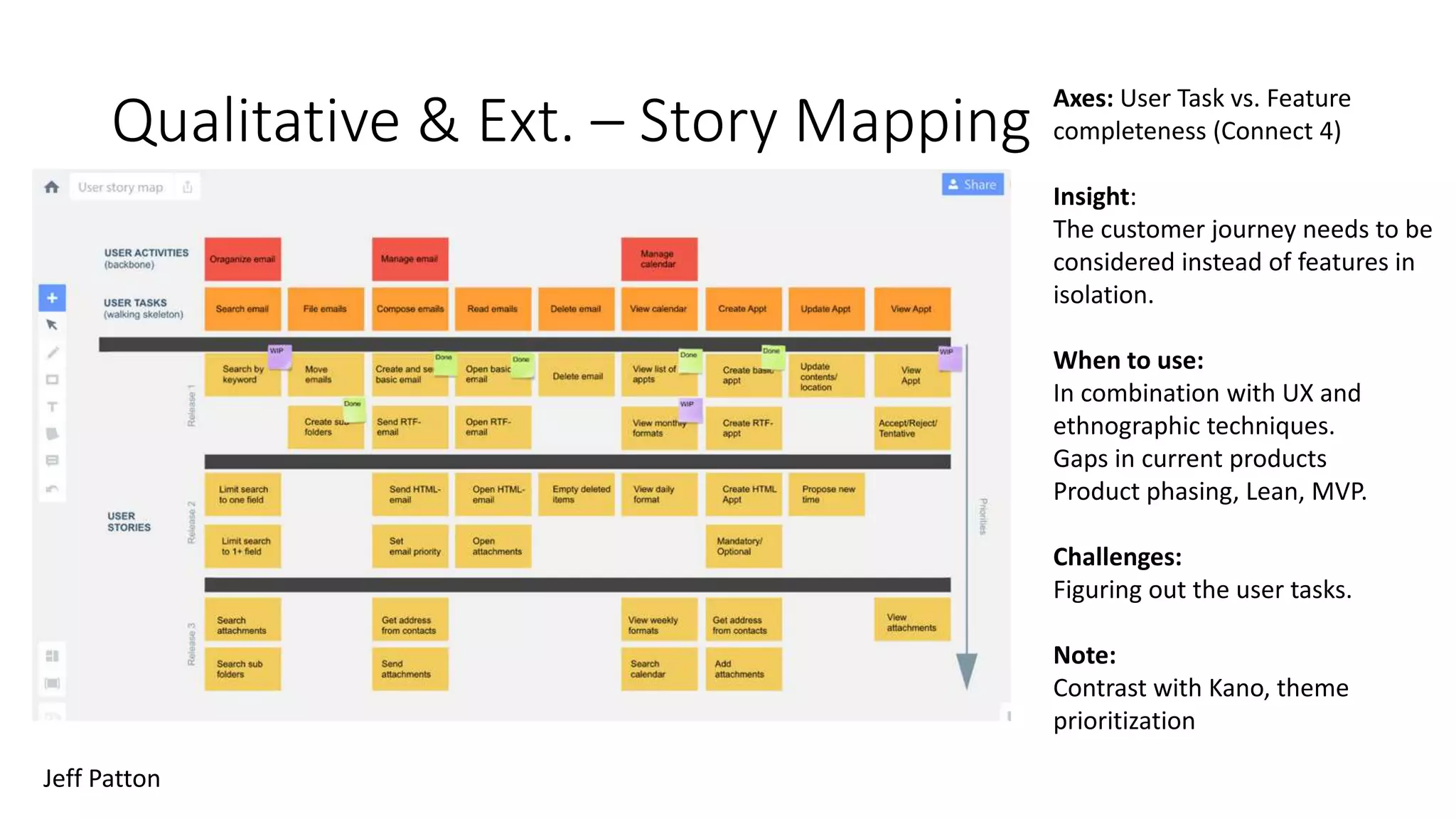
Qualitative & Ext. – Story Mapping
Axes: User Task vs. Feature
completeness (Connect 4)
Insight:
The customer journey needs to be
considered instead of features in
isolation.
When to use:
In combination with UX and
ethnographic techniques.
Gaps in current products
Product phasing, Lean, MVP.
Challenges:
Figuring out the user tasks.
Note:
Contrast with Kano, theme
prioritization
Jeff Patton
Qualitative & Ext. - MoSCoW
• Must Have
• Should Have
• Could Have
• Won’t Have
Qualitative & Ext. - MoSCoW
• Must Have
• Should Have
• Could Have
• Won’t Have
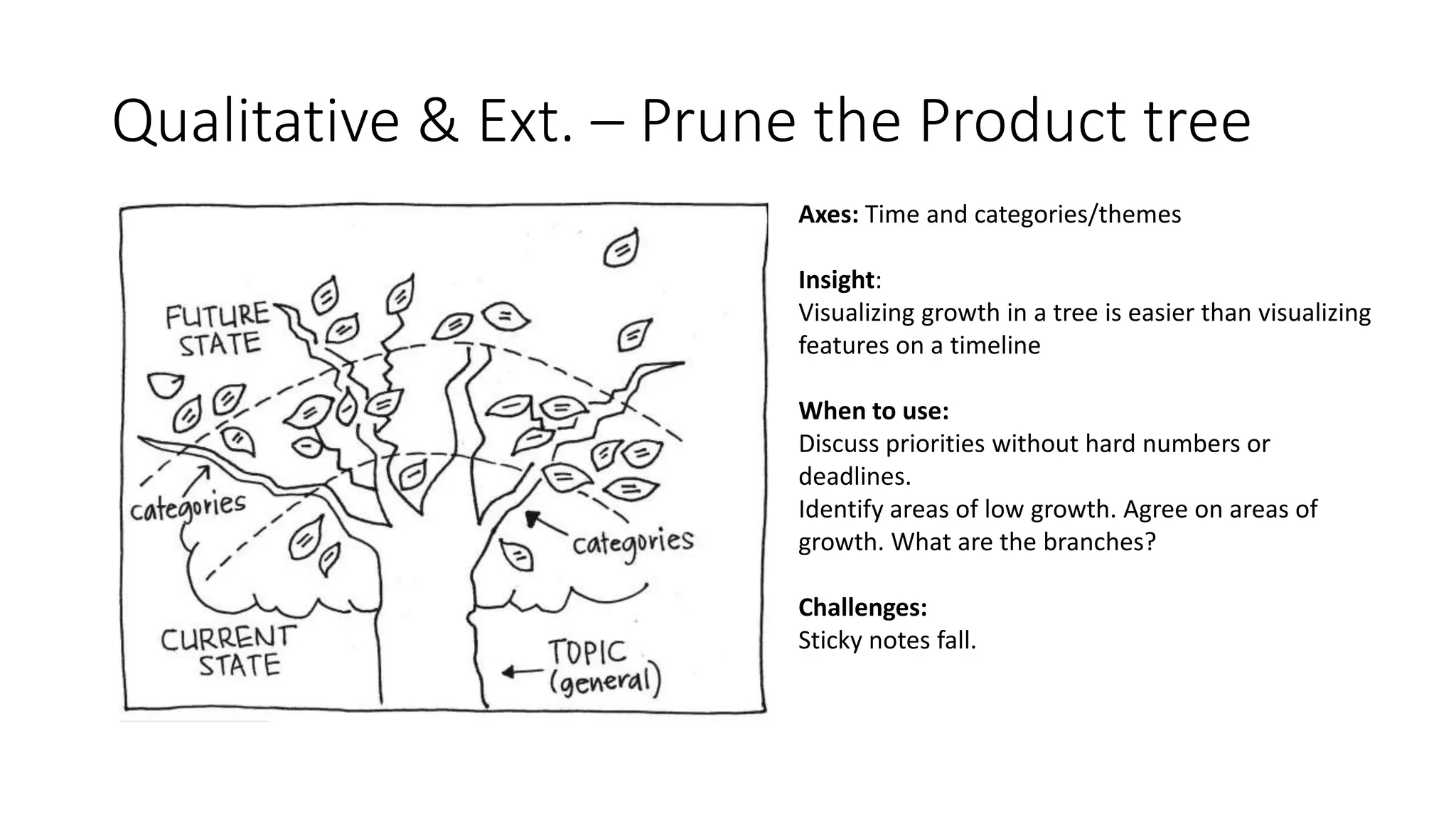
Qualitative & Ext. – Prune the Product tree
Axes: Time and categories/themes
Insight:
Visualizing growth in a tree is easier than visualizing
features on a timeline
When to use:
Discuss priorities without hard numbers or
deadlines.
Identify areas of low growth. Agree on areas of
growth. What are the branches?
Challenges:
Sticky notes fall.
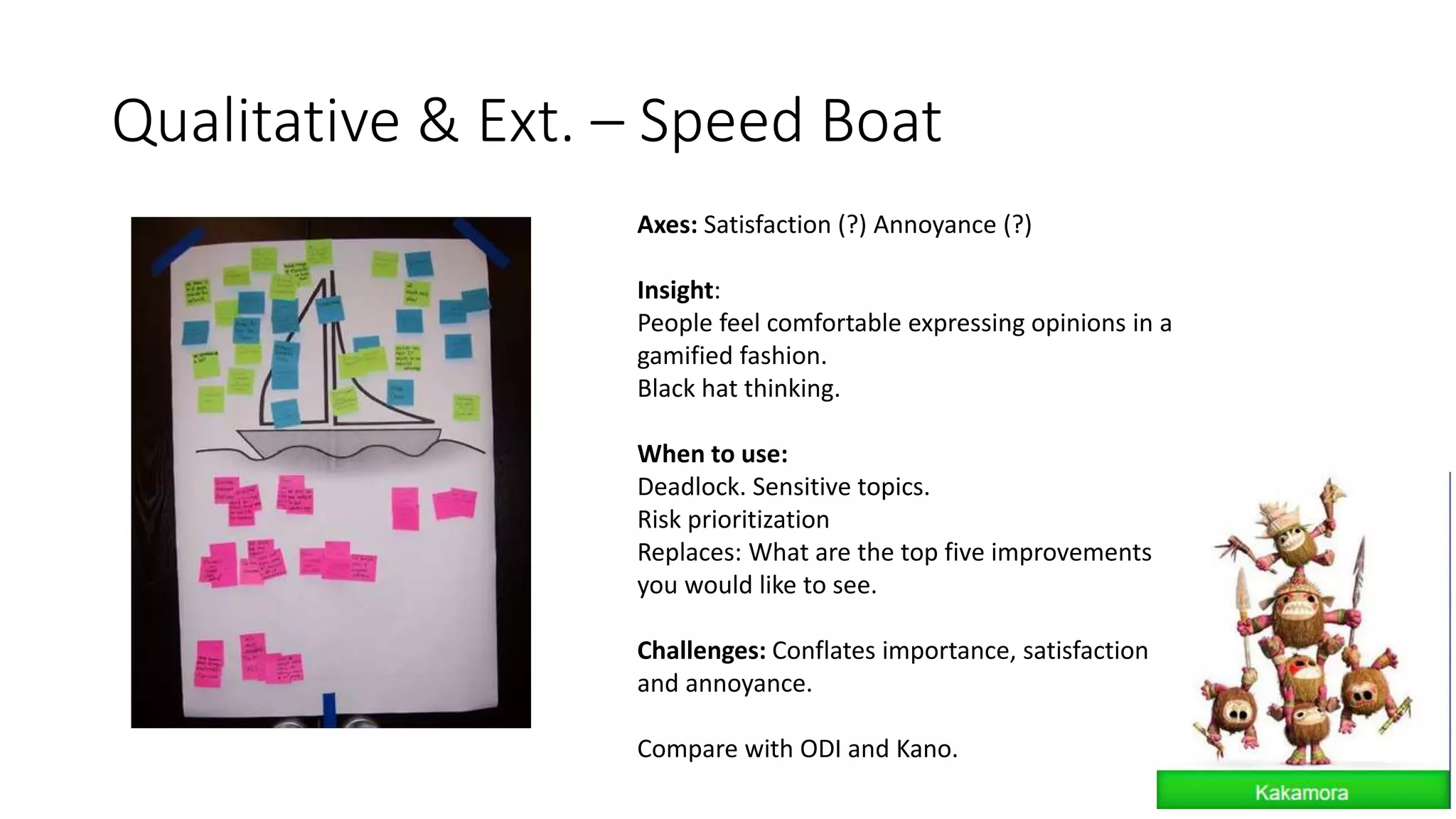
Qualitative & Ext. – Speed Boat
Axes: Satisfaction (?) Annoyance (?)
Insight:
People feel comfortable expressing opinions in a
gamified fashion.
Black hat thinking.
When to use:
Deadlock. Sensitive topics.
Risk prioritization
Replaces: What are the top five improvements
you would like to see.
Challenges: Conflates importance, satisfaction
and annoyance.
Compare with ODI and Kano.
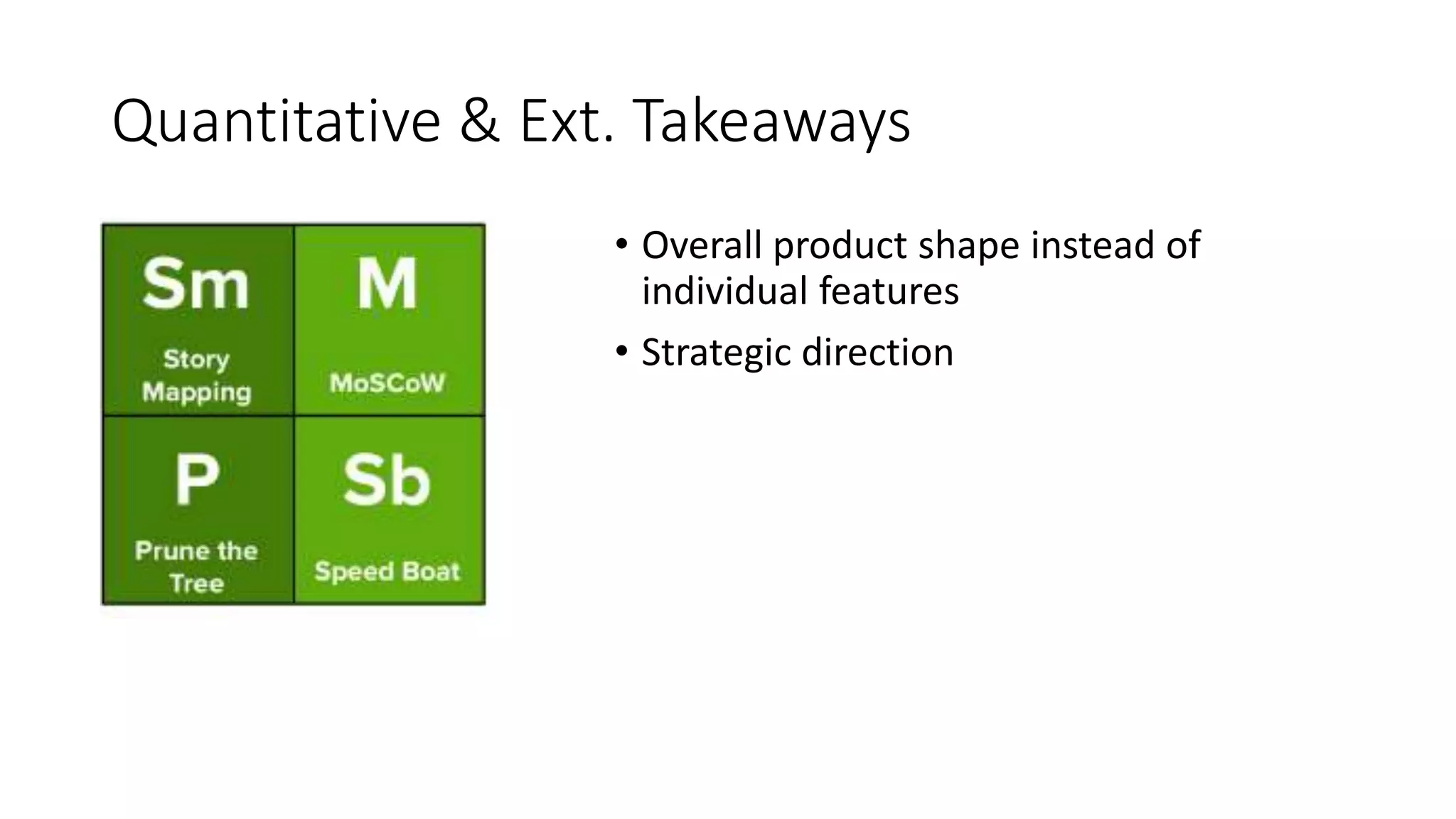
Quantitative & Ext. Takeaways
• Overall product shape instead of
individual features
• Strategic direction
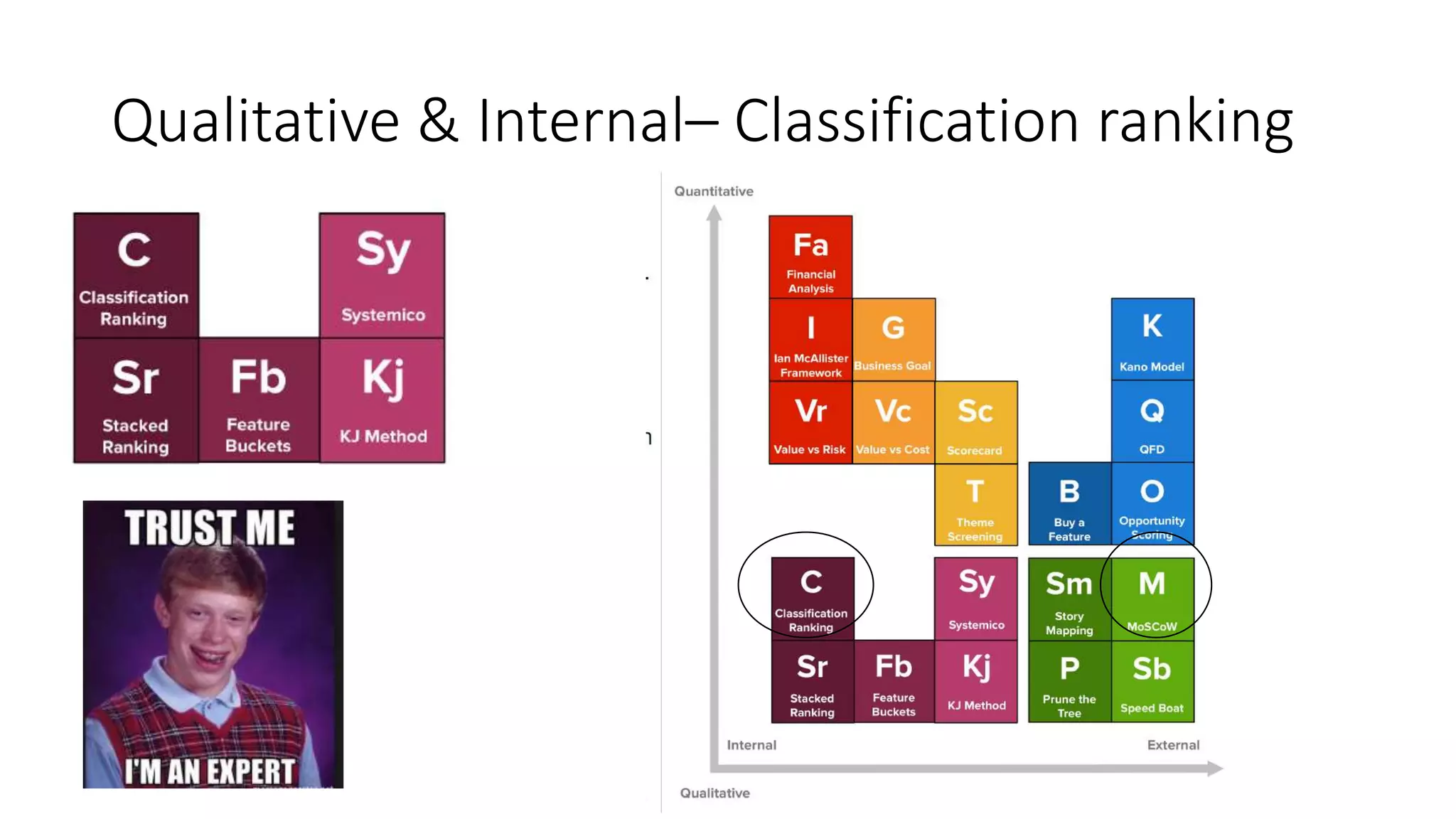
Qualitative & Internal– Classification ranking
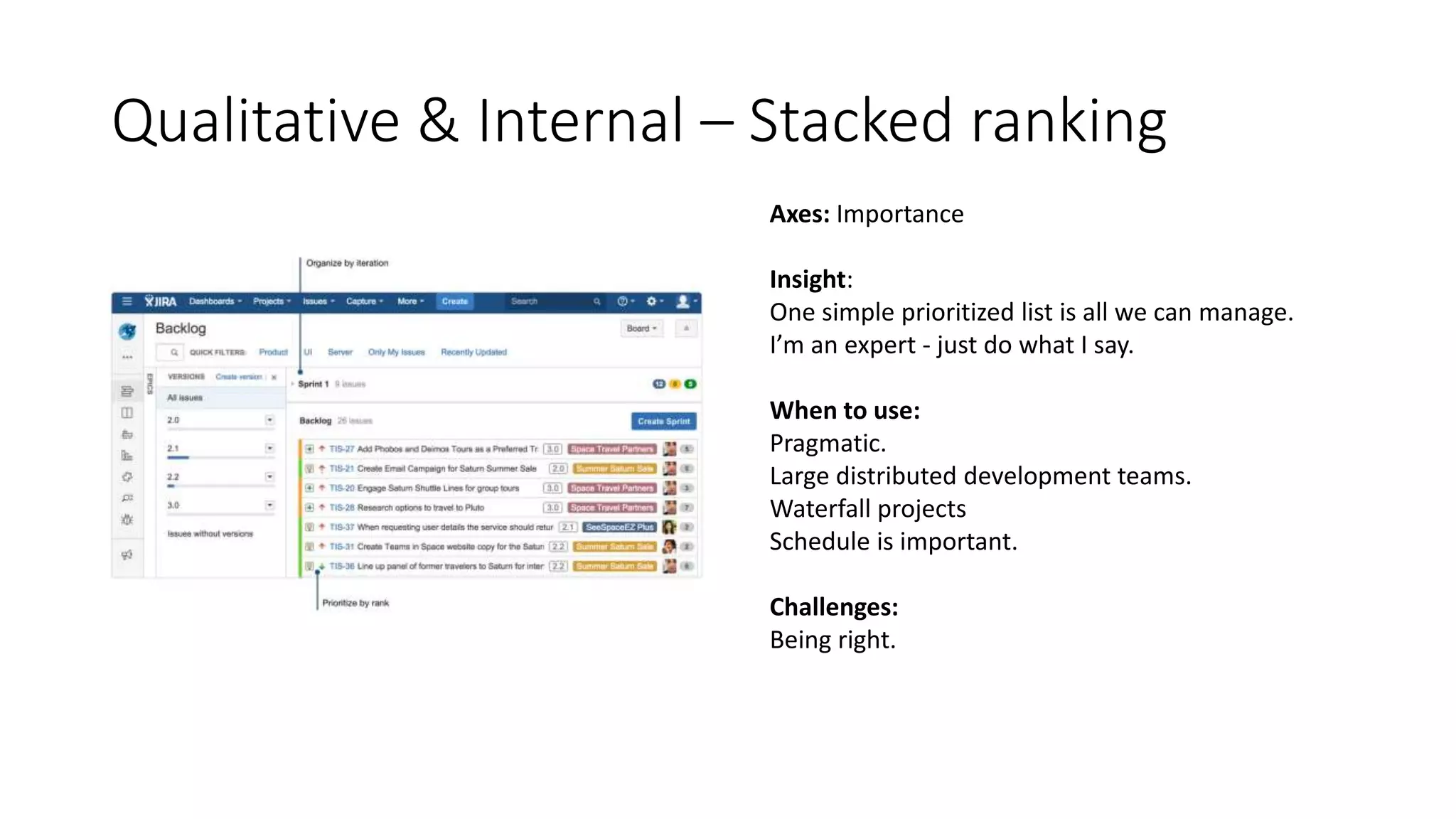
Qualitative & Internal – Stacked ranking
Axes: Importance
Insight:
One simple prioritized list is all we can manage.
I’m an expert - just do what I say.
When to use:
Pragmatic.
Large distributed development teams.
Waterfall projects
Schedule is important.
Challenges:
Being right.
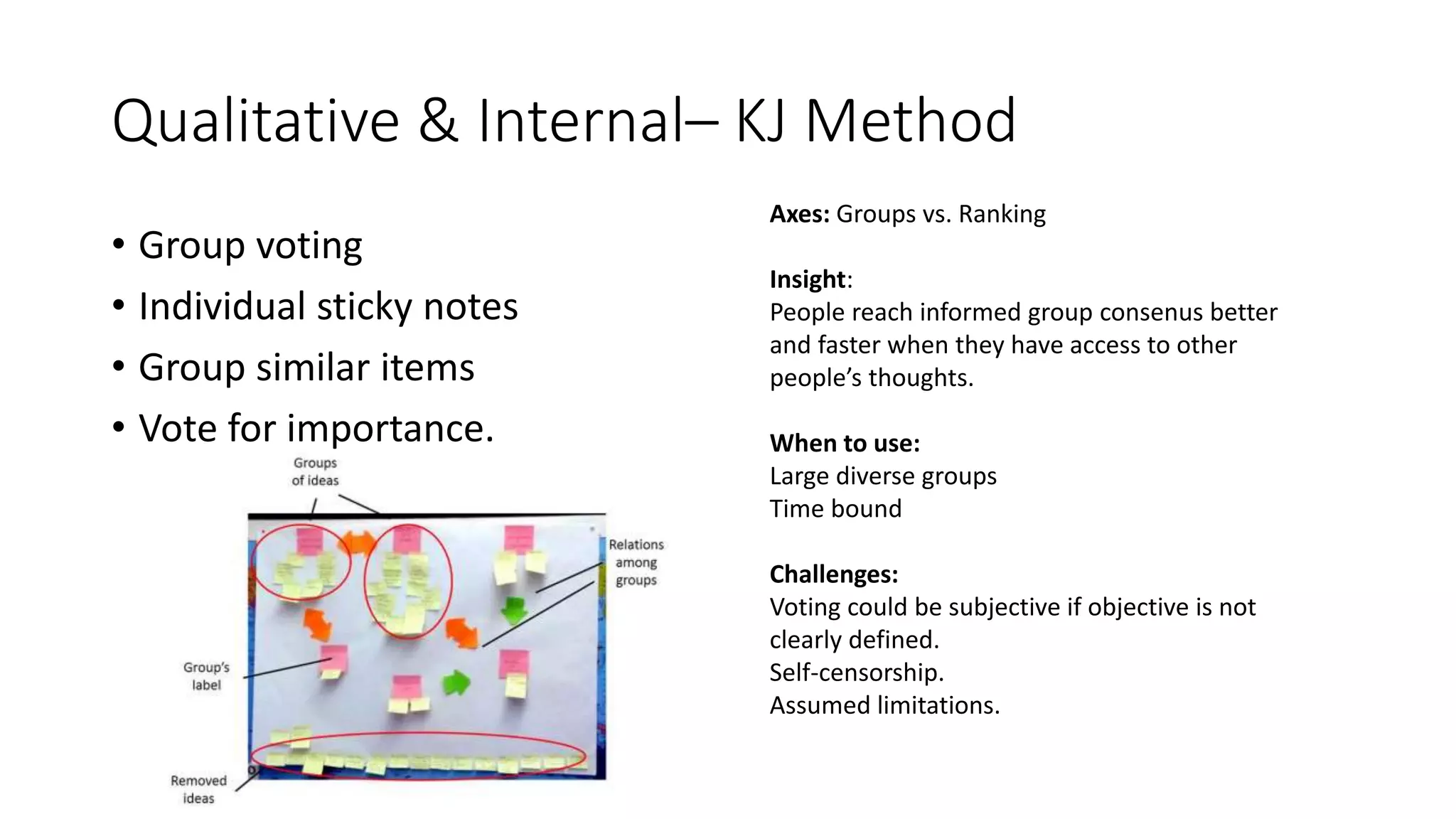
Qualitative & Internal– KJ Method
• Group voting
• Individual sticky notes
• Group similar items
• Vote for importance.
Axes: Groups vs. Ranking
Insight:
People reach informed group consenus better
and faster when they have access to other
people’s thoughts.
When to use:
Large diverse groups
Time bound
Challenges:
Voting could be subjective if objective is not
clearly defined.
Self-censorship.
Assumed limitations.
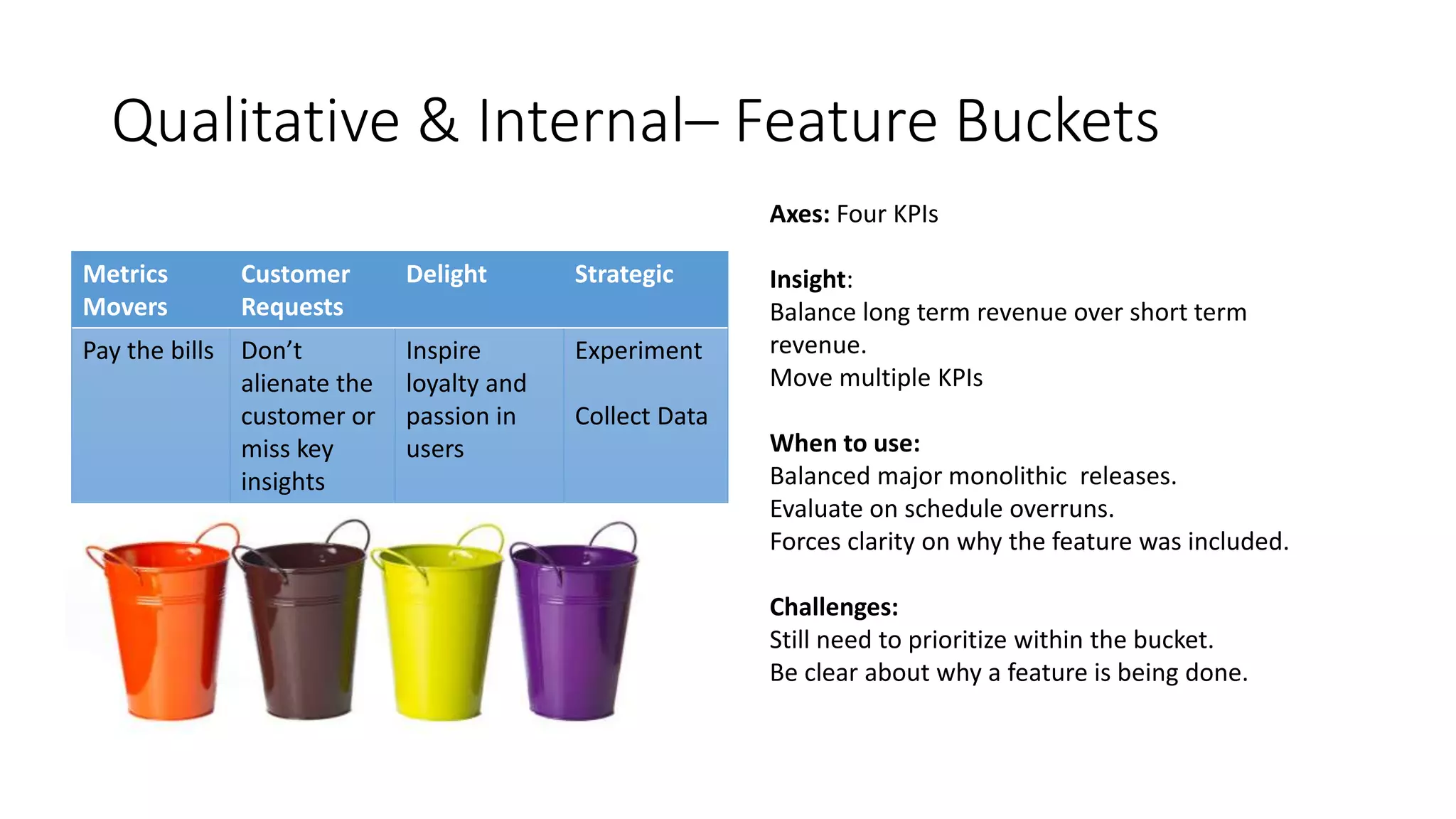
Qualitative & Internal– Feature Buckets
Metrics
Movers
Customer
Requests
Delight Strategic
Pay the bills Don’t
alienate the
customer or
miss key
insights
Inspire
loyalty and
passion in
users
Experiment
Collect Data
Axes: Four KPIs
Insight:
Balance long term revenue over short term
revenue.
Move multiple KPIs
When to use:
Balanced major monolithic releases.
Evaluate on schedule overruns.
Forces clarity on why the feature was included.
Challenges:
Still need to prioritize within the bucket.
Be clear about why a feature is being done.
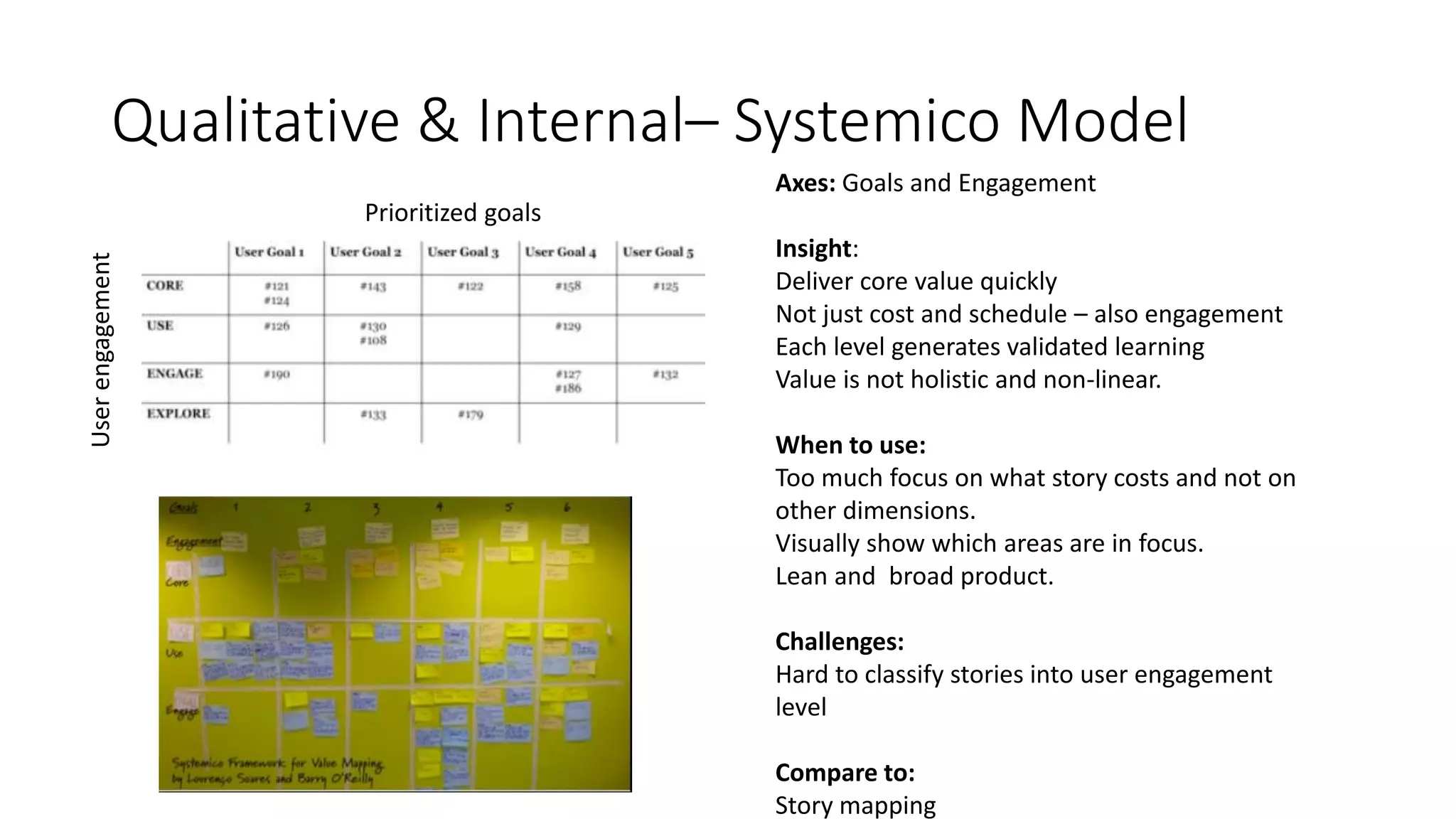
Qualitative & Internal– Systemico Model
Prioritized goals
Userengagement
Axes: Goals and Engagement
Insight:
Deliver core value quickly
Not just cost and schedule – also engagement
Each level generates validated learning
Value is not holistic and non-linear.
When to use:
Too much focus on what story costs and not on
other dimensions.
Visually show which areas are in focus.
Lean and broad product.
Challenges:
Hard to classify stories into user engagement
level
Compare to:
Story mapping
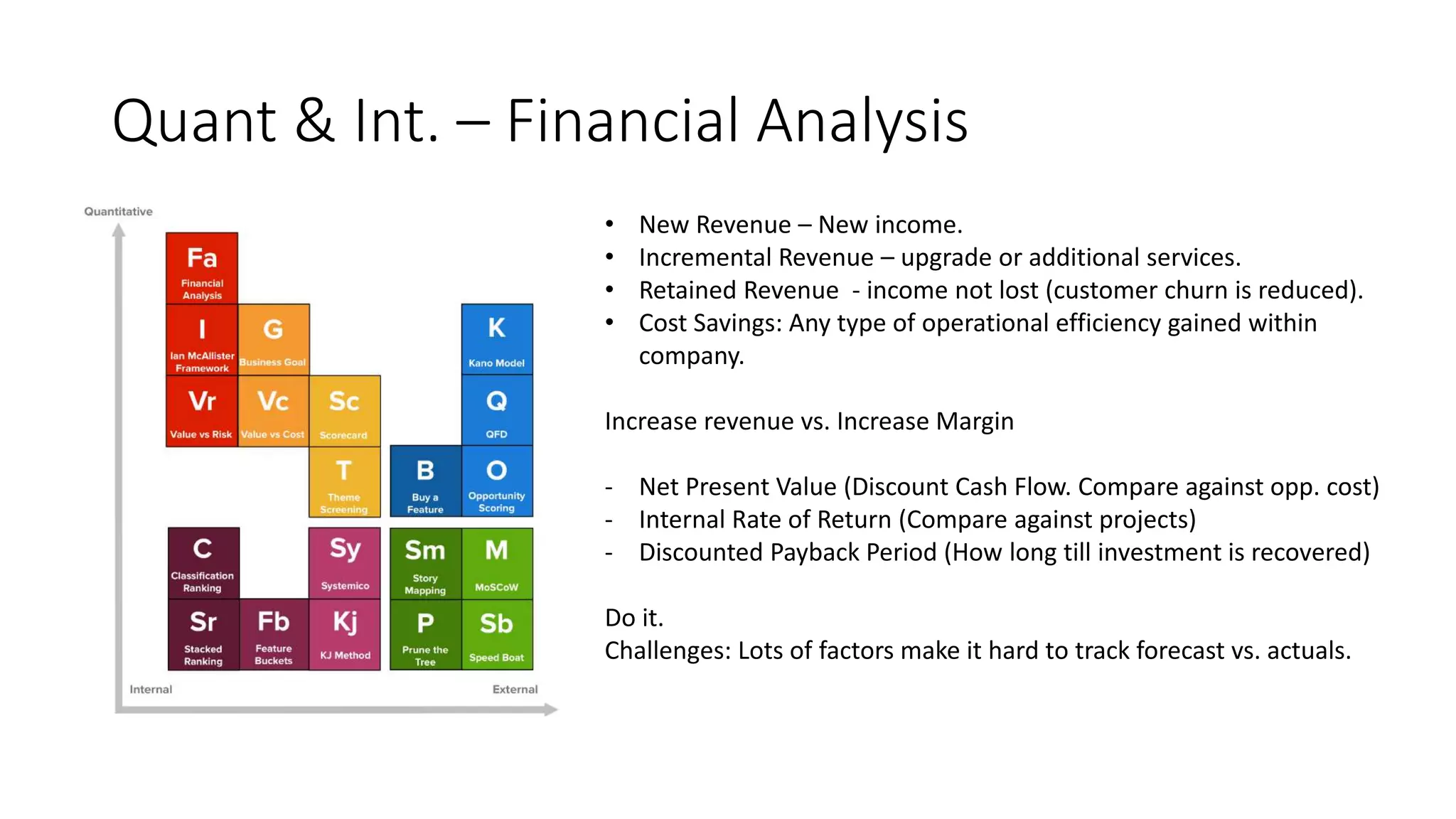
Quant & Int. – Financial Analysis
• New Revenue – New income.
• Incremental Revenue – upgrade or additional services.
• Retained Revenue - income not lost (customer churn is reduced).
• Cost Savings: Any type of operational efficiency gained within
company.
Increase revenue vs. Increase Margin
- Net Present Value (Discount Cash Flow. Compare against opp. cost)
- Internal Rate of Return (Compare against projects)
- Discounted Payback Period (How long till investment is recovered)
Do it.
Challenges: Lots of factors make it hard to track forecast vs. actuals.
Quant & Int. – Ian McAllister’s framework
• Director @ AirBnB
• Prioritize themes (KPIs – AAAR,
revenue, visits/user, etc.) first. Then
projects within.
• Sequence and resource your
themes
• Generate ideas. BIGGER ideas.
smaller projects (first 20% delivers
80% impact)
• Estimate impact, Estimate cost
• Prioritize within each theme
Axes: Theme/KPI and Project
Insight:
Resources allocated to themes explicitly
Resolves prioritization conflicts between apples
and oranges (500ms latency, 5K new users)
Forces modelling of impact. Hones product
sense.
When to use:
The KPIs are not clear or prioritized.
Too many disparate competing features and
projects (Portfolio prioritization)
Continuous resource contentions.
Challenges: These are strategy guidelines.
Quant & Int. – Impact on business goal
• Acquisition: users come to the site
product;
• Activation: users enjoy 1st visit,
signup;
• Retention: users come back
multiple times;
• Revenue: users’ activity leads to
revenue for the product;
• Referral: users like product enough
to recommend to others.
Axes: KPI and Feature
Insight:
Figure out which KPI to improve. Then validate
the improvement.
When to use:
Lean Startup
Challenges:
Strategy guideline.
Cycle time can be long if traditional large
company.
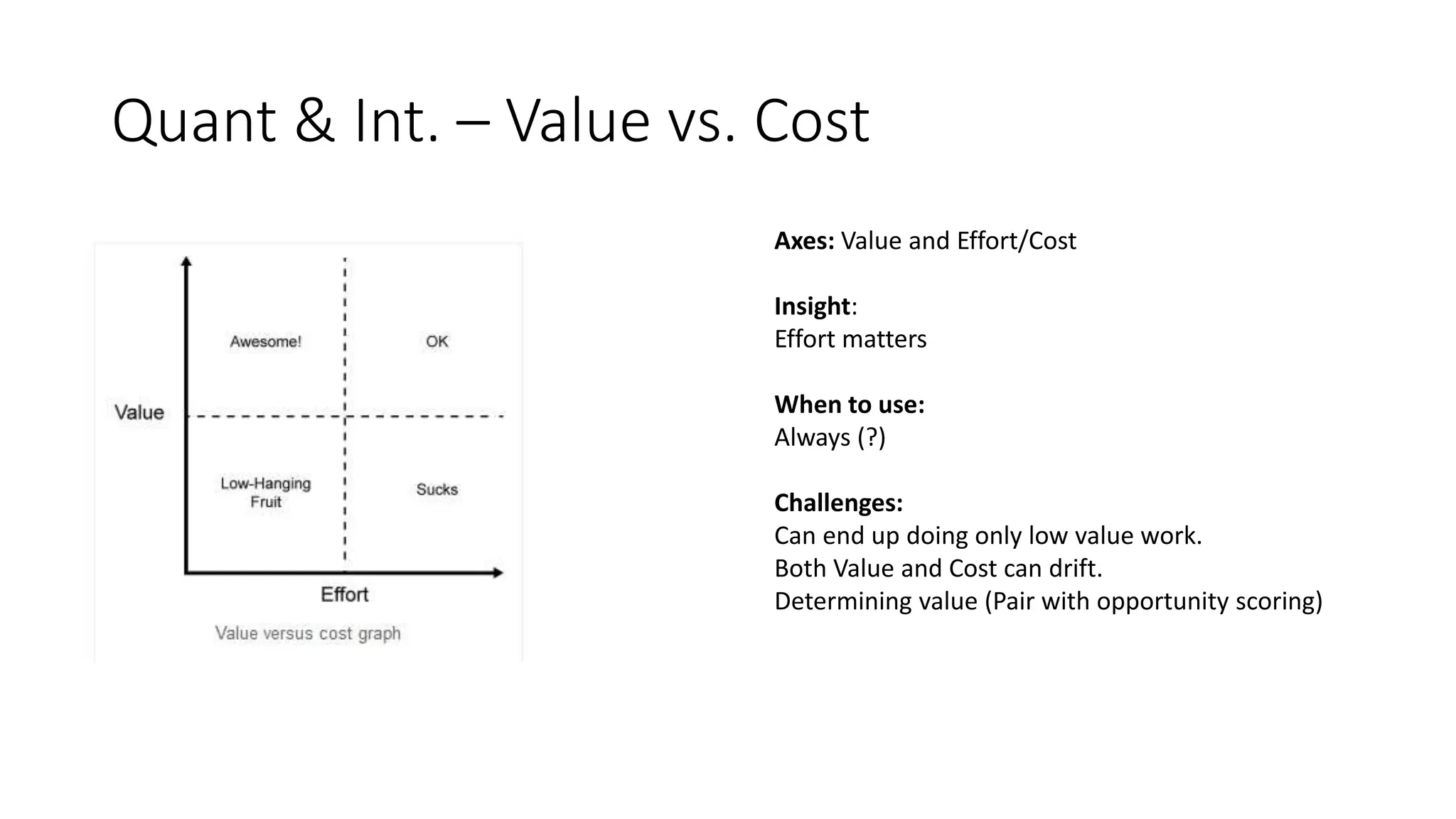
Quant & Int. – Value vs. Cost
Axes: Value and Effort/Cost
Insight:
Effort matters
When to use:
Always (?)
Challenges:
Can end up doing only low value work.
Both Value and Cost can drift.
Determining value (Pair with opportunity scoring)
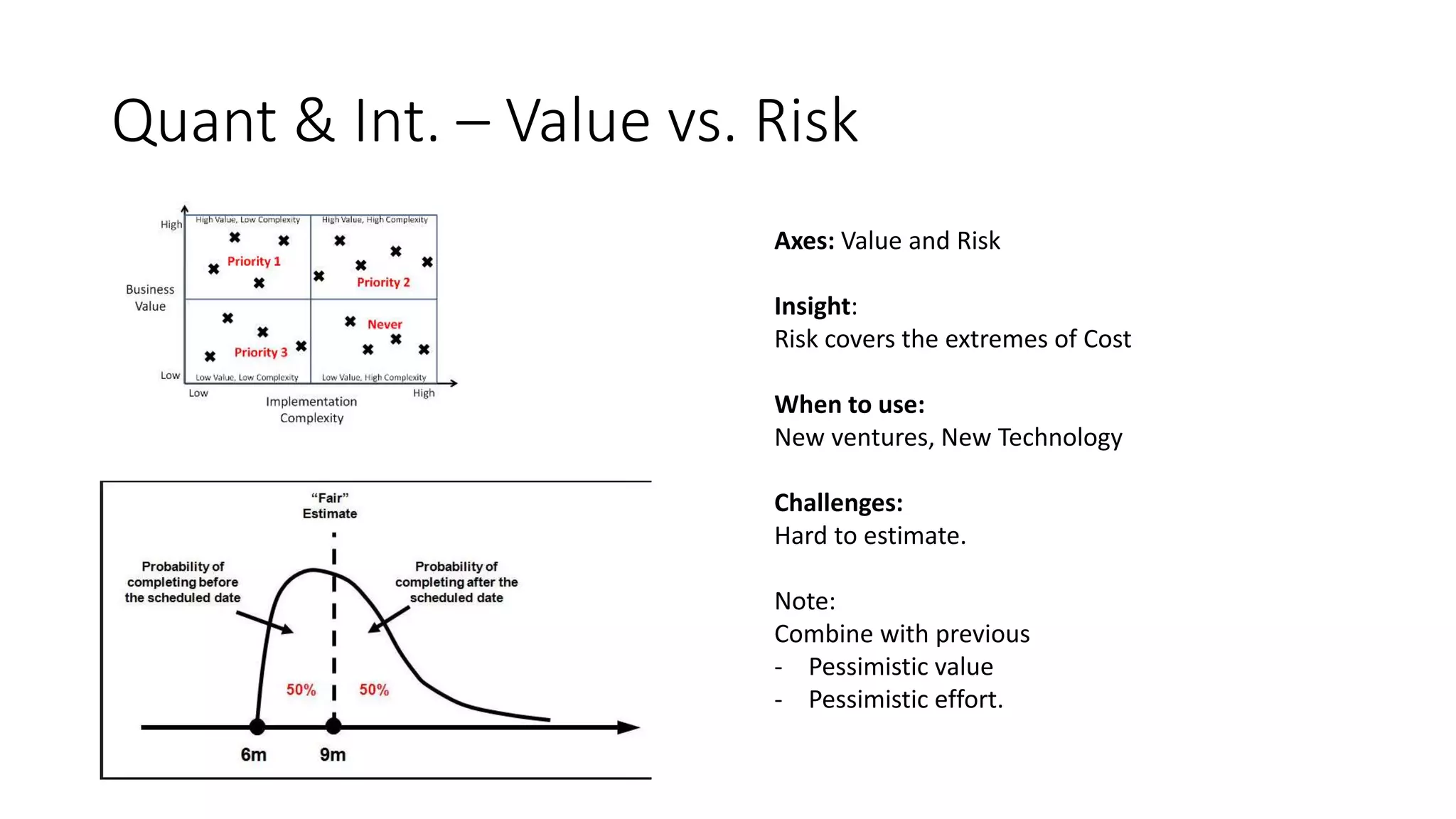
Quant & Int. – Value vs. Risk
Axes: Value and Risk
Insight:
Risk covers the extremes of Cost
When to use:
New ventures, New Technology
Challenges:
Hard to estimate.
Note:
Combine with previous
- Pessimistic value
- Pessimistic effort.
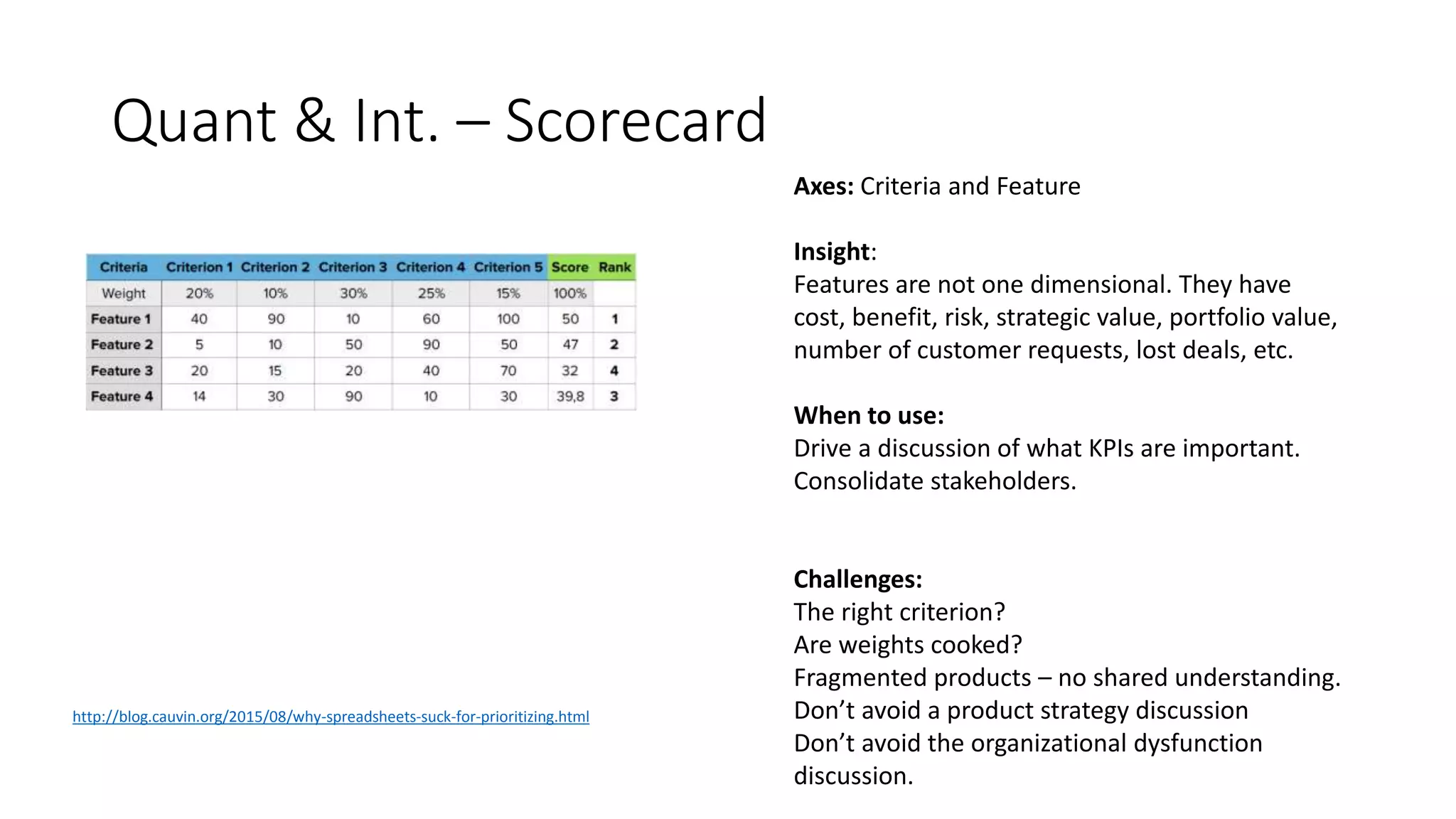
Quant & Int. – Scorecard
Axes: Criteria and Feature
Insight:
Features are not one dimensional. They have
cost, benefit, risk, strategic value, portfolio value,
number of customer requests, lost deals, etc.
When to use:
Drive a discussion of what KPIs are important.
Consolidate stakeholders.
Challenges:
The right criterion?
Are weights cooked?
Fragmented products – no shared understanding.
Don’t avoid a product strategy discussion
Don’t avoid the organizational dysfunction
discussion.
http://blog.cauvin.org/2015/08/why-spreadsheets-suck-for-prioritizing.html
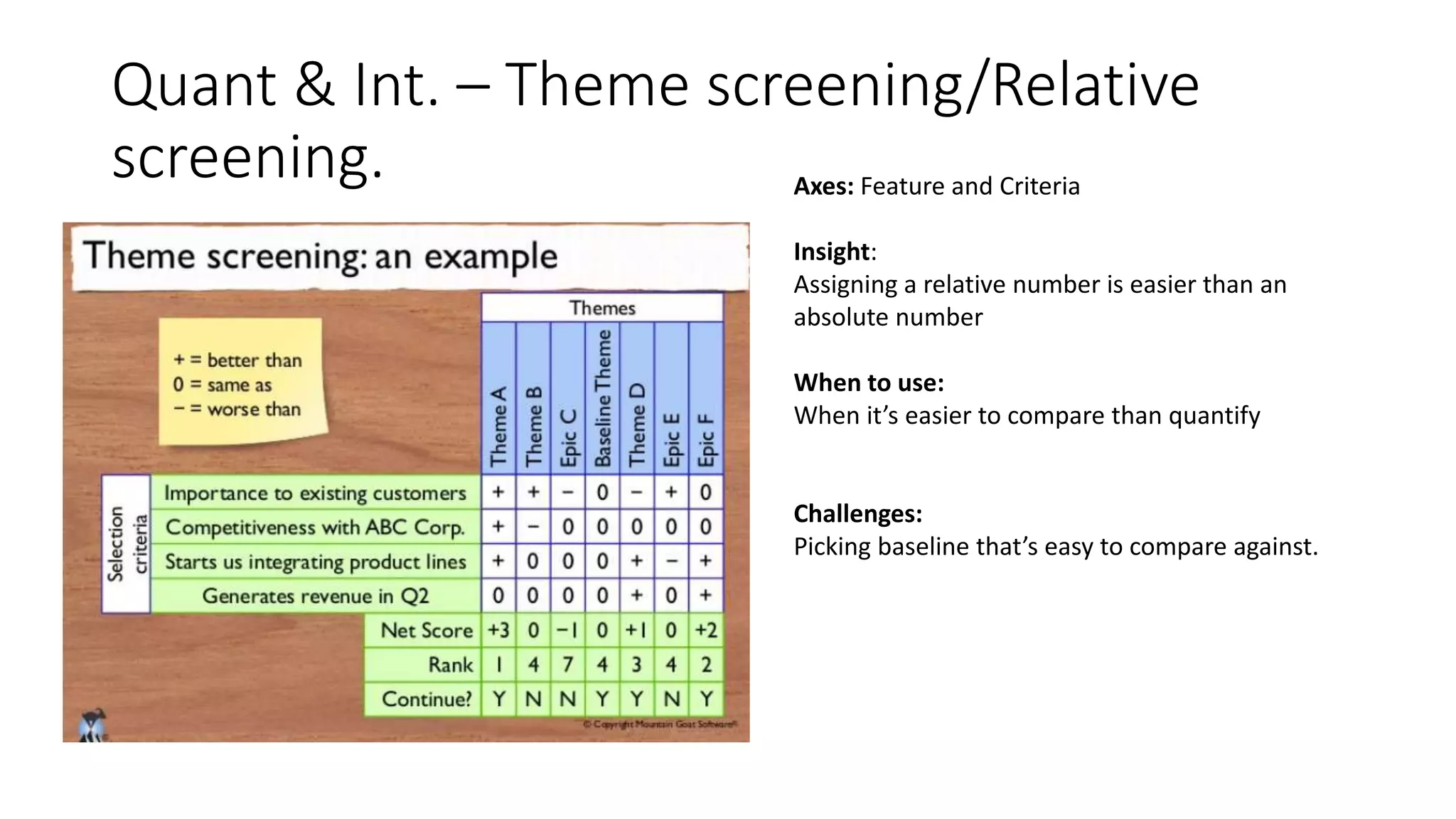
Quant & Int. – Theme screening/Relative
screening. Axes: Feature and Criteria
Insight:
Assigning a relative number is easier than an
absolute number
When to use:
When it’s easier to compare than quantify
Challenges:
Picking baseline that’s easy to compare against.
Takeaways
• External > Internal. (Get out of the building)
• Drive alignment – Identify the KPI/Strategy. Revenue is king.
• Split into themes, buckets if you cannot prioritize across them.
• Think holisitically – the customer journey and overall product shape.
• Align features with organizational capability
• Figure out what prioritization is being discussed (outcomes, problems,
themes, features, risk)
• Customer responses are non symmetrical.
• Find overserved and underserved areas
• Use a relative baseline if absolute rankings are not possible

20 product prioritization techniques for Product Managers. Presented at Boston ProductCamp June 2017

  • 1.
  • 2.
    What can beprioritized? • Outcomes • Problems • Themes • Features • Risk Can’t prioritize an idea you didn’t have Invalidating ideas (removing them) is more useful than prioritizing them.
  • 3.
    http://foldingburritos.com Most excellent guide!(45 pages) You < Team < Stakeholders < Customers
  • 4.
    Quantitative and External- Kano Axes: Satisfaction vs. Completion/Functionality Insight: Customer responses are not symmetrical on a feature. Provides a methodology to figure out which category a feature falls in.
  • 5.
  • 6.
    Quantitative and External- Kano Axes: Satisfaction vs. Completion/Functionality Insight: Customer responses are not symmetrical on a feature. Provides a methodology to figure out which category a feature falls in. When to use: Replicating an older product. Finding an adjoining market to pivot off. Delighters important for virality. Challenges: iPhone 1 – No copy/paste. No App store
  • 7.
    Quant & Ext.– Quality Function Deployment Axes: Prioritized Need to Spec, Needs to Organization. Insight: Customer needs to technical specifications clearly expressed. Other stakeholders accounted for Can be expressed on a single page When to use: Mapping customer needs onto the organization. Hardware products, Engineering based teams, Marketing and Sales alignment Challenges: Office supplies run out of graph paper
  • 8.
    Quant & Ext.– Opportunity scoring Outcome Driven Innovation
  • 9.
    Quant & Ext– Opportunity scoring Axes: Satisfaction vs. Importance Similar to Kano(S,I) and QFD (I) Insight: Overserved is commoditized. Reduce cost Underserved is innovation When to use: Legacy product strategy Looking for growth Looking for feature reduction Easily done as surveys Challenges: Establishing the right level of question. Creating a job map.
  • 10.
    Quant & Ext(?).– Buy a feature Axes: Features cost and Stakeholders Insight: Have a discussion in context with other features and stakeholders. Feature cost matters. When to use: Can be done remotely with chat. Non-tech folks begin to question the cost of ‘simple’ features if used in conjunction with planning poker. Can replace shuttle diplomacy. Challenges: Getting everyone together. Common understanding of the feature/outcome.
  • 11.
  • 12.
    Qualitative & Ext.– Story Mapping Axes: User Task vs. Feature completeness (Connect 4) Insight: The customer journey needs to be considered instead of features in isolation. When to use: In combination with UX and ethnographic techniques. Gaps in current products Product phasing, Lean, MVP. Challenges: Figuring out the user tasks. Note: Contrast with Kano, theme prioritization Jeff Patton
  • 13.
    Qualitative & Ext.- MoSCoW • Must Have • Should Have • Could Have • Won’t Have
  • 14.
    Qualitative & Ext.- MoSCoW • Must Have • Should Have • Could Have • Won’t Have
  • 15.
    Qualitative & Ext.– Prune the Product tree Axes: Time and categories/themes Insight: Visualizing growth in a tree is easier than visualizing features on a timeline When to use: Discuss priorities without hard numbers or deadlines. Identify areas of low growth. Agree on areas of growth. What are the branches? Challenges: Sticky notes fall.
  • 16.
    Qualitative & Ext.– Speed Boat Axes: Satisfaction (?) Annoyance (?) Insight: People feel comfortable expressing opinions in a gamified fashion. Black hat thinking. When to use: Deadlock. Sensitive topics. Risk prioritization Replaces: What are the top five improvements you would like to see. Challenges: Conflates importance, satisfaction and annoyance. Compare with ODI and Kano.
  • 17.
    Quantitative & Ext.Takeaways • Overall product shape instead of individual features • Strategic direction
  • 18.
    Qualitative & Internal–Classification ranking
  • 19.
    Qualitative & Internal– Stacked ranking Axes: Importance Insight: One simple prioritized list is all we can manage. I’m an expert - just do what I say. When to use: Pragmatic. Large distributed development teams. Waterfall projects Schedule is important. Challenges: Being right.
  • 20.
    Qualitative & Internal–KJ Method • Group voting • Individual sticky notes • Group similar items • Vote for importance. Axes: Groups vs. Ranking Insight: People reach informed group consenus better and faster when they have access to other people’s thoughts. When to use: Large diverse groups Time bound Challenges: Voting could be subjective if objective is not clearly defined. Self-censorship. Assumed limitations.
  • 21.
    Qualitative & Internal–Feature Buckets Metrics Movers Customer Requests Delight Strategic Pay the bills Don’t alienate the customer or miss key insights Inspire loyalty and passion in users Experiment Collect Data Axes: Four KPIs Insight: Balance long term revenue over short term revenue. Move multiple KPIs When to use: Balanced major monolithic releases. Evaluate on schedule overruns. Forces clarity on why the feature was included. Challenges: Still need to prioritize within the bucket. Be clear about why a feature is being done.
  • 22.
    Qualitative & Internal–Systemico Model Prioritized goals Userengagement Axes: Goals and Engagement Insight: Deliver core value quickly Not just cost and schedule – also engagement Each level generates validated learning Value is not holistic and non-linear. When to use: Too much focus on what story costs and not on other dimensions. Visually show which areas are in focus. Lean and broad product. Challenges: Hard to classify stories into user engagement level Compare to: Story mapping
  • 23.
    Quant & Int.– Financial Analysis • New Revenue – New income. • Incremental Revenue – upgrade or additional services. • Retained Revenue - income not lost (customer churn is reduced). • Cost Savings: Any type of operational efficiency gained within company. Increase revenue vs. Increase Margin - Net Present Value (Discount Cash Flow. Compare against opp. cost) - Internal Rate of Return (Compare against projects) - Discounted Payback Period (How long till investment is recovered) Do it. Challenges: Lots of factors make it hard to track forecast vs. actuals.
  • 24.
    Quant & Int.– Ian McAllister’s framework • Director @ AirBnB • Prioritize themes (KPIs – AAAR, revenue, visits/user, etc.) first. Then projects within. • Sequence and resource your themes • Generate ideas. BIGGER ideas. smaller projects (first 20% delivers 80% impact) • Estimate impact, Estimate cost • Prioritize within each theme Axes: Theme/KPI and Project Insight: Resources allocated to themes explicitly Resolves prioritization conflicts between apples and oranges (500ms latency, 5K new users) Forces modelling of impact. Hones product sense. When to use: The KPIs are not clear or prioritized. Too many disparate competing features and projects (Portfolio prioritization) Continuous resource contentions. Challenges: These are strategy guidelines.
  • 25.
    Quant & Int.– Impact on business goal • Acquisition: users come to the site product; • Activation: users enjoy 1st visit, signup; • Retention: users come back multiple times; • Revenue: users’ activity leads to revenue for the product; • Referral: users like product enough to recommend to others. Axes: KPI and Feature Insight: Figure out which KPI to improve. Then validate the improvement. When to use: Lean Startup Challenges: Strategy guideline. Cycle time can be long if traditional large company.
  • 26.
    Quant & Int.– Value vs. Cost Axes: Value and Effort/Cost Insight: Effort matters When to use: Always (?) Challenges: Can end up doing only low value work. Both Value and Cost can drift. Determining value (Pair with opportunity scoring)
  • 27.
    Quant & Int.– Value vs. Risk Axes: Value and Risk Insight: Risk covers the extremes of Cost When to use: New ventures, New Technology Challenges: Hard to estimate. Note: Combine with previous - Pessimistic value - Pessimistic effort.
  • 28.
    Quant & Int.– Scorecard Axes: Criteria and Feature Insight: Features are not one dimensional. They have cost, benefit, risk, strategic value, portfolio value, number of customer requests, lost deals, etc. When to use: Drive a discussion of what KPIs are important. Consolidate stakeholders. Challenges: The right criterion? Are weights cooked? Fragmented products – no shared understanding. Don’t avoid a product strategy discussion Don’t avoid the organizational dysfunction discussion. http://blog.cauvin.org/2015/08/why-spreadsheets-suck-for-prioritizing.html
  • 29.
    Quant & Int.– Theme screening/Relative screening. Axes: Feature and Criteria Insight: Assigning a relative number is easier than an absolute number When to use: When it’s easier to compare than quantify Challenges: Picking baseline that’s easy to compare against.
  • 30.
    Takeaways • External >Internal. (Get out of the building) • Drive alignment – Identify the KPI/Strategy. Revenue is king. • Split into themes, buckets if you cannot prioritize across them. • Think holisitically – the customer journey and overall product shape. • Align features with organizational capability • Figure out what prioritization is being discussed (outcomes, problems, themes, features, risk) • Customer responses are non symmetrical. • Find overserved and underserved areas • Use a relative baseline if absolute rankings are not possible

Editor's Notes

  • #2 Second time presenting at PC. The first time was earlier today Slides will be available. There are links throughout for further study. Ask how many people follow – gut feel ranking, ROI type calculations, Value vs. Cost
  • #3 450 features – don’t prioritize- chuck it out
  • #5 Common theme is to have two axes
  • #7 Common theme is to have two axes Customer experience is average of the features
  • #8 Affinitize needs
  • #14 Russian hackers
  • #15 Russian hackers