RAJAN SINGH
SIDDHARTHA RAO
SANKET KAMATH
GAURAV SHINDE
Transport Layer Security (TLS)
1.3
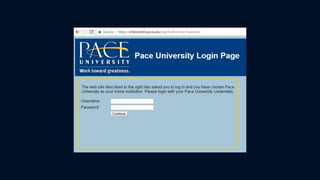
• Authentication
• Confidentiality
• Integrity
Solution: -
• Secure Connection
• SSL Protocol
• Different Versions
Agenda:
• What is SSL?
• Evolution from SSL to TLS
• TLS in a nutshell
• TLS 1.2 vs 1.3
• Handshake
• Resumption
• Forward secrecy
• 2 caveats in TLS 1.3
What is SSL?
https://vimeo.com/135666049
What is SSL ?
➢Secure Socket Layer is a method to secure and
encrypt sensitive information.
➢ HTTPS
➢ SSL v1.0, V2.0, V3.0
Vulnerabilities
• BEAST - 2011
• POODLE - 2014
Impact
• By exploiting this vulnerability, an attacker can gain access to things
like passwords and cookies, enabling him to access a user’s private
account data on a website.
Evolution from SSL to TLS
• Browsers and websites need to turn off SSLv3 and use more modern
security protocols as soon as possible, in order to avoid
compromising users’ private information.
TLS in a Nutshell
• Developed by IETF in 1999
• Revised to TLS v1.1 in 2006
• Again, revised Tls v1.2 in 2008
• SSL v3.0 served as a basis for TLS 1.0 and closely related to SSL 3.0, and is
sometimes referred to as "SSL 3.1"
• Algorithms used:
• Key Exchange: ECDHE-RSA, PSK etc
• Cipher: AES CBC
• Hashing: HMAC - MD5, SHA1
TLS in a Nutshell
• 3 properties offered by TLS connection:
• Private connection due to symmetric key encryption
• Authentication due to public key encryption
• Ensures integrity due to message integrity check
TLS in a Nutshell
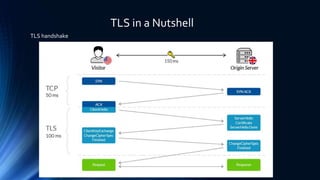
TLS handshake
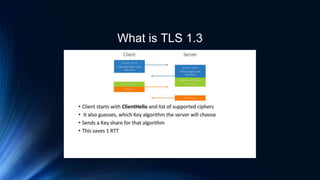
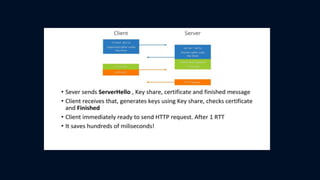
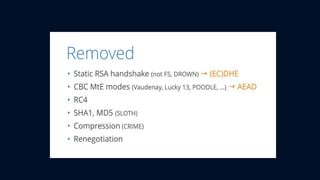
What is TLS 1.3
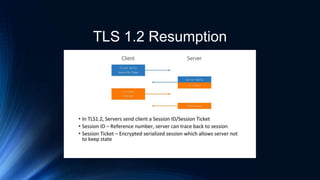
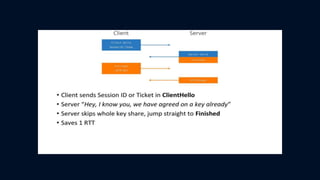
TLS 1.2 Resumption
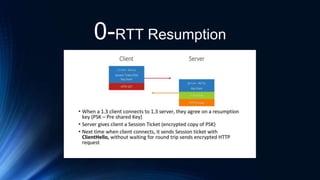
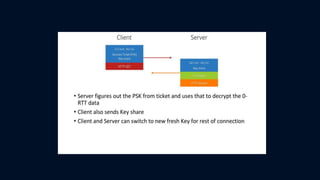
0-RTT Resumption
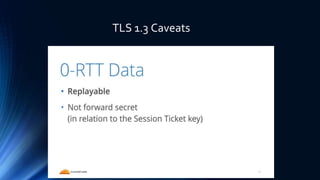
TLS 1.3 Caveats
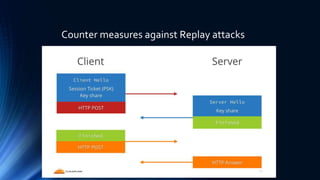
Counter measures against Replay attacks
Thank you!

TLS v1.3

  • 1.
    RAJAN SINGH SIDDHARTHA RAO SANKETKAMATH GAURAV SHINDE Transport Layer Security (TLS) 1.3
  • 3.
  • 4.
    Solution: - • SecureConnection • SSL Protocol • Different Versions
  • 5.
    Agenda: • What isSSL? • Evolution from SSL to TLS • TLS in a nutshell • TLS 1.2 vs 1.3 • Handshake • Resumption • Forward secrecy • 2 caveats in TLS 1.3
  • 6.
  • 7.
    What is SSL? ➢Secure Socket Layer is a method to secure and encrypt sensitive information. ➢ HTTPS ➢ SSL v1.0, V2.0, V3.0
  • 8.
    Vulnerabilities • BEAST -2011 • POODLE - 2014 Impact • By exploiting this vulnerability, an attacker can gain access to things like passwords and cookies, enabling him to access a user’s private account data on a website.
  • 9.
    Evolution from SSLto TLS • Browsers and websites need to turn off SSLv3 and use more modern security protocols as soon as possible, in order to avoid compromising users’ private information.
  • 10.
    TLS in aNutshell • Developed by IETF in 1999 • Revised to TLS v1.1 in 2006 • Again, revised Tls v1.2 in 2008 • SSL v3.0 served as a basis for TLS 1.0 and closely related to SSL 3.0, and is sometimes referred to as "SSL 3.1" • Algorithms used: • Key Exchange: ECDHE-RSA, PSK etc • Cipher: AES CBC • Hashing: HMAC - MD5, SHA1
  • 11.
    TLS in aNutshell • 3 properties offered by TLS connection: • Private connection due to symmetric key encryption • Authentication due to public key encryption • Ensures integrity due to message integrity check
  • 12.
    TLS in aNutshell TLS handshake
  • 13.
  • 15.
  • 17.
  • 20.
  • 21.
  • 22.